Showing posts with label fracking. Show all posts

Friday, October 25, 2019

How Fracking Drives The Proliferation of Plastics & Ocean Pollution, Acidification

A drilling rig operates in Erie in 2015.
Fracking operation in Colorado and a seal pup partially strangled by plastics.

   Humans produce roughly our own weight in plastics each year. How much actually ends up in the oceans is still a matter of debate but scientists in one study have estimated between 4.8 and 12.7  million metric tonnes (in 2010 alone).   Three- fourths of the plastic waste on Earth comes from uncollected litter,  the  leaked from assorted dump sites over the years.  Most of the drastic increase between 1950  and 2015  has been documented in the Journal  Science Advances, i.e.

https://www.researchgate.net/publication/318567844_Production_use_and_fate_of_all_plastics_ever_made

We're now much more aware of how the fracking process is powering a dangerous plastics bonanza,  with the plastics and fracking industries working hand-in-hand to prop up their respective pollution models.   Basically, the fracking industry requires a new source  for yearly demand to sop up its excess gas.  This is to justify more drilling while the plastics industry needs a new source of  low -cost ethane, a fracking byproduct used to manufacture plastics.  As I showed in a previous post, much of this  plastic refuse ends up in our oceans threatening sea life as well as humans - both  ingesting vastly more micro-plastics than ever before.

Apart from that micro-plastics impact, bear in mind  the role of the industrial plants that convert natural gas into petrochemicals emit massive amounts of air and climate pollutants - including carbon dioxide (CO2).  When rising levels of the gas are absorbed in the oceans it exacerbates ocean acidification, i.e. based on the chemical reaction:  CO2  +  H2O ->   H2CO 3

Where H2CO3 is carbonic acid.

How was this produced?  Well, the rapid expansion of fracking created a natural gas glut that drove actual gas prices to the lowest levels in decades.  The plastics industry then rode to the rescue of the gas frackers.  According to Plastics News: "Fracking represents a once -in -a generation opportunity for the plastics industry".   At the same time, a renewed push for plastics manufacturing provides the frackers with a polluting partner to absorb the ever increasing quantity of fracked gas (e.g. methane, much of which is already allowed to be burned off in situ, thanks to altered regulations by the Trumpites.)

It's no surprise then that Wall Street's greedy investors are lining up to build new factories that transform fracking byproducts into plastics. They see more profits pouring in - to pad their bottom lines- but are blind to the toxins pumped out to defile the environment and ruin public health. So now, not only is fracking polluting our air, soil and water, it's also directly affecting the oceans - which harbor the greatest oxygen source on the planet in the form of plankton.

Let's also process  - from the industry's own projections  -   that the global plastics industry is expected to increase production by 40 percent over the next decade.  This is driven by dropping prices for fracking byproducts as well as massively scaled -up production.   This is given that most of the  industry manufactures packaging materials that are immediately discarded.

For perspective, each human on average (globally) disposes of 110 pounds of plastic annually. Process that! It's the weight of a small frame woman.  Much of this ends up in the oceans where it strangles the resident sea life (like sea lions) or ends up accumulating in their stomachs causing them to die of starvation.

Since 1950, the  plastics industry - which had its major shout out in the 1967 film 'The Graduate' ("One word for you, Ben: Plastics!") -   has produced 18.3 trillion pounds of plastics, of which only about 9 percent has been recycled.   That translates into 16 trillion pounds tossed into landfills of which a significant proportion  (30 %) ends up in the oceans.

Less  well known:  Plastic products are inherently toxic and can become a vehicle for other pollutants. Many plastics contain hazardous chemicals and thousands of different additives, which can leach out as the plastic ages.  Such additives can comprise up to half of the object's  weight and be extremely toxic - including endocrine disrupters which affect hormone function.

Once created,  plastics can last for hundreds to thousands of years and the toxic remains of plastics pose serious challenges.   Meanwhile, the microplastics are ubiquitous, finding their way into the food we eat, soil and air we breath. Even indoor air can have high concentrations of microplastics from household products and synthetic textiles. 

We are basically awash in plastics, microplastics even as the fracking industry is making the situation much worse.

Let us also dispel (for the last time)  the cockeyed notion that natural gas is a "clean" fuel source. While it might be "clean" relative to the tar sands oil from the Keystone pipeline, it's not in any way clean standing on its own.  It is another fossil fuel - cheap but still dirty  -  and if you doubt it ask the homeowners who have frack wells near their homes in the Colorado suburbs.  See, for example, this item which greeted us in today's news paper:
Image may contain: possible text that says 'OIL AND GAS STUDY RAISES CONCERN state-funded study of emissions from oil and gas development found the chemicals, including benzene and pose risks to human health. While the study did not measure actual health effects for people who live close to oil and gas operations, it used modeling to predict how pol- lutants would move the air. Researchers found that people who lived far 2,000 feet away from a well pad could face health effects including headaches, dizziness and respiratory problems.'

The conclusion is self-evident: Rather than investing in fossil fuels and their ancillary chemical industry we need to invest more in renewable energy, including solar, geothermal, wind.

Friday, September 20, 2019

Why The Frackers' Language "Overhaul" Is Doomed To Fail

A drilling rig operates in Erie in 2015.
Top: Fracking well despoiling water and emitting volatile organic chemicals in a Colo. town. Bottom: Students get ready for global climate strike

Today, as the global  climate strike revs up, it is well to consider the not insignificant role of fracking.  True, fracked shale oil is still a minor part of fossil fuel consumption but it has an outsized impact on the environment and public health. We've known this since the excellent two-part documentary ("Gasland")  by Josh Fox.  See e.g.

http://brane-space.blogspot.com/2013/07/gasland-ii-fracking-is-worse-than-you.html

Less well known is that fracking - apart from wasting precious ground water reserves and contaminating the environment with fine particulates e.g.
has been a bottomless money pit for investors.  This is  given it takes more energy to generate a quantity of fracked shale oil than the extracted amount delivers.  Thus, the June article in The Wall Street Journal's Business and Finance Section (' Frackers Scrounge For Cash As Wall Street Shuts Spigot'', p. B1, June 7) didn't really astonish or surprise me.. Especially on reading:

"The companies behind the U.S. fracking boom are turning to asset sales, drilling partnerships and other alternative financing to supplement their cash flow. These forms of funding often come with higher interest rates or other downsides  - such as giving outside investors a hefty share of future oil and gas profits."

And further (p. B2):

"Producers have been forced to get creative about financing because Wall Street began shutting off the cash spigot  last year after frackers routinely failed to turn a profit over the last decade."

Worse, only a tenth of large shale companies saw a positive cash flow in the first quarter of 2019.   This according to a Rystad  Energy analysis of 40  drillers.  To sustain  or increase their production these companies had to keep drilling new wells, as opposed to seeing greater production from each existing well .

The piece also noted some companies had become so desperate for cash to jump start new wells that they turned to junk bonds.  The central question emerged:  Why have the frackers - who seemed to be all over the place -- failed to turn a profit over a decade? 

I explained this in earlier posts in terms of the lower energy returned on energy invested (EROEI) say compared with the light  crude oil of the past, non-shale based. I also pointed out the difference in EROEI translated into some bad economics given the lower energy content of shale oil (kerogen) meant the frackers would always be in "catch up" mode so struggling in an energy (and hence economic)  hole.  A less efficient energy source means you have to extract more of it, and at ever higher costs given the innate diminishing returns. (According to the Federal Reserve Bank of Dallas in a report issued as recently as May 31::"The average breakeven price of oil has fallen 4 percent (or $2 per barrel) over the past year, to $50 per barrel, according to the latest Dallas Fed Energy Survey." )

The entire issue of sinking oil shale fortunes pivots on the breakeven price: that amount which the recovered oil needs to earn to have made its extraction worthwhile  If that per barrel amount tends to be below what the market offers, a loss occurs and over years the losses pile up. In many cases, as seen in recent years there is the added factor of an oil glut from over production.  In this case one has an excess supply and so oil prices tend to plummet creating a bigger financial hole for an already marginal operation.

The issue first surfaced some six years ago in Richard Heinberg's book, Snake Oil: How Fracking's False Promise Imperils Our Future', ( p.115).   Therein we learned from a report by a London -based brokerage firm,  Tullett Prebon:

 "Our calculated EROEIs both for 1990 (40:1) and for 2010 (17:1) are reasonably close to the numbers cited for those years by Andrew Lees. For 2020, our projected EROEI of 11.5 to 1 is not as catastrophic as 5: 1 but would nevertheless mean that the share of GDP absorbed by energy costs would have escalated to 9.6% from about 6.7% today. Our projections further suggest energy costs would absorb as much as 15% of GDP (at an EROEI of 7.7 to 1)  by 2030."

Now we flash forward to a WSJ Business & Finance piece from Sept. 10  (p. B1):  'Fracking Lingo Gets An Overhaul' where we learn that:   "Frackers are changing how they talk and how they drill to show they can live within their means."   The problem is that  changing the language doesn't really address the core problem: The low EROEI of shale oil which makes it a fundamentally inefficient mode of oil extraction and use.  But what language overhauls are we talking about?  Some examples from the piece:

1) "Where once top shale executives promised to 'ramp up/ production, these days they are more likely to assure investors they can deliver 'free cash flow'."


According to the article this is "the trendiest term in the industry right now".  It has become synonymous with the promise "not to spend beyond their income and to then generate profits which can be returned to investors."

So, in other words, the execs are promising to lowball the costs of their fracking operations because they can't deliver the fracked oil at the price needed for investors to make a buck.. So the interpretation seems to be forget "production growth" and instead look to "discipline" - meaning the frackers will cut more corners to try to ensure costs of extracting the stuff are within bounds.  But this is impossible if the shale oil itself is of such low grade in terms of EROEI.  After all (ibid.)

"Many of  the companies have yet to show they can deliver consistent returns or live within their means as oil prices hover below $60 a barrel"

Again, WHY is this? Well, it's because it costs MORE to extract a barrel of shale oil than $60 a barrel. So  at that price it's a breakeven world and  below that price it's a LOSS.  If companies have YET to show they can live within their means then they never will unless oil prices spike much much higher.  The EROEI of shale is simply too low compared to light sweet crude to support its consistent profitable production.  Hence, no surprise that "shale stocks have hit historic lows with many companies all but cut off from capital markets and many filing for bankruptcy protection."

In other words, the classic losing operation, or "batting on a losing wicket" in Bajan parlance

2) The frackers promised investors they would "downspace" the wells , i.e. move them more closely. In this case, the frackers claimed "they could boost production by placing wells in closer proximity".  

However, .they  found "doing so meant the wells produced less as they draw down the same resources".  

 Quick to parse the lingo, the industry called it the "Parent-child well problem"   but I call it the "not enough shale energy to go around" problem."  Obviously if two wells are placed closer together and the extracted oil from the combo is less than expected it means there wasn't enough there to supply 2 wells to begin with.   Or to put it another way: the energy returned from the two wells is still too low to make a profit because the oil extraction process itself is too inefficient to support the cost. Because the shale itself (kerogen) is too unprofitable.

Supporting this thesis is the revelation (ibid.) that:  "as financing dries up many companies are retreating to the sweetest spots in the best basins and shutting down drilling elsewhere."  Again, why is that being done?  It's because the frackers - with so little capital to work with on account of the oil price being too low, e..g.  to make it profitable -  have to go to the most productive basins to even break even.  Hell, and "even stalwart fields where the shale boom began, including North Dakota's Bakken, are declining in popularity with drillers."  Why?   Because it takes more energy and effort to snag the few barrels left than the barrels are worth!  The amount of energy processing for kerogen, given its cost, is simply too much for the quality of energy resulting.

  As  Richard Heinberg explains (op. cit.,  p. 110):

"Kerogen is not oil. It is better thought of as an oil precursor that was insufficiently cooked by geologic processes. If we want to turn it into oil, we have to finish the process nature started: that involves heating the kerogen to a high temperature for a long time. And that in turn takes energy- lots of it, whether supplied by hydroelectricity, nuclear power plants, natural gas, or the kerogen itself. "

Oil shale fracking is a symptom of diminishing quality supplies of oil, that of high EROEI (energy returned on energy invested) not oil abundance. Anyone with half a brain would know that, which is why Heinberg  refers to it as "snake oil". It simply can't deliver the energy solution promised and in fact its continued use will result in ever lower quotas of useful energy- at ever higher cost.

While we're on the topic of fossil fuel production and global climate issues, let's bear in mind the Dems are not all pure as driven snow in regard to fossil fuel impacts, campaign cash flows etc.. (At least they seem to be better  in comparison to the climate change denying Reeps.)  On Wednesday, the 103-member New Democrat Coalition saw its Pac BP, ExxonMobil and the Edison Electric Institute all max out on donations to this year –then  outline a series of incremental and “pro-market” steps to curb carbon emissions.

 A suite of legislation unveiled on Wednesday would do many great things, like investing in clean energy research and development via ARPA-E and limiting emissions of methane, a potent greenhouse gas. It is not, however, a plan for fulfilling the challenge laid out by the IPCC, leaving the door open to define coal as a potential source of “clean energy” in pursuit of a “technology-neutral, market-oriented standard for electric energy generation” and providing a financial incentive for fossil fuel companies to capture carbon dioxide and funnel it back into pumping out more fossil fuels.

Sadly. Greta Thunberg’s right. And establishment Democrats pushing doomed strategies and policies are denying climate reality nearly as much as Republicans.

Those who want to access all 340 pages of the 'Climate Deception Dossiers' can go here:

www.ucsusa.org/decadesofdeception

See also:


And:

https://www.youtube.com/watch?v=uGlDSFrLX4A


And:


And:

Thursday, June 13, 2019

Why Are The Frackers Losing Money And Resorting To Junk Bonds To Stay Viable?

A drilling rig operates in Erie in 2015.

The news in The Wall Street Journal's Business and Finance Section (' Frackers Scrounge For Cash As Wall Street Shuts Spigot'', p. B1, June 7) didn't really amaze me in the least. Especially as we read:

"The companies behind the U.S. fracking boom are turning to asset sales, drilling partnerships and other alternative financing to supplement their cash flow. These forms of funding often come with higher interest rates or other downsides  - such as giving outside investors a hefty share of future oil and gas profits."

And further (p. B2):

"Producers have been forced to get creative about financing because Wall Street began shutting off the cash spigot  last year after frackers routinely failed to turn a profit over the last decade."

Worse, only a tenth -  10 percent - of large shale companies saw a positive cash flow in the first quarter of 2019.   This according to a Rystad Energy analysis of 40  drillers.  And to sustain  or increase their production these companies are having to drill new wells, as opposed to seeing greater production from each existing well .  The piece also noted some companies have become so desperate for cash to jump start new wells that they are starting to turn to junk bonds.  Well, talk about batting on a losing wicket.  But the central question here is why have the frackers - who seem to be all over the place -- failed to turn a profit over a decade?   I've explained this in earlier posts in terms of the lower energy returned on energy invested (EROEI) say compared with the light  crude oil of the past, non-shale based.

I also pointed out the difference in EROEI translated into some bad economics given the lower energy content of shale oil (kerogen) meant the frackers would always be in an energy (and hence economic)  hole.  A less efficient energy source means you have to extract more of it, and at ever higher costs given the innate diminishing returns.  It means, basically, endless reinvestment to support the losing operations.  This isn't relativity or rocket science.

The issue first surfaced some six years ago in Richard Heinberg's book, Snake Oil: How Fracking's False Promise Imperils Our Future', ( p.115).   Therein we learned from a report by a London -based brokerage firm,  Tullett Prebon:


 "Our calculated EROEIs both for 1990 (40:1) and for 2010 (17:1) are reasonably close to the numbers cited for those years by Andrew Lees. For 2020, our projected EROEI of 11.5 to 1 is not as catastrophic as 5: 1 but would nevertheless mean that the share of GDP absorbed by energy costs would have escalated to 9.6% from about 6.7% today. Our projections further suggest energy costs would absorb as much as 15% of GDP (at an EROEI of 7.7 to 1)  by 2030."


The report goes on to conclude that the dismal diminishing energy returns means that the economy we "have known for more than two centuries" will "cease to become viable at some point". Cease to become viable?  Uh, yeah!  To use a human analogy, think of a gluttonous guy of 300 lbs, suddenly dropped on to 'Survivor Island' and forced to eat rice, a few crabs and coconuts for the rest of his life as opposed to just 39 days. Think he'd have the energy to do anything?  Think he'd survive? Guess again. His body - starving of protein  (the equivalent of high EROEI energy)-  would begin to consume itself.    That is effectively what our energy-gluttonous society is now doing but in the process headed toward distinct 'malnutrition"'  given the energy content of what it ingests gets lower and lower.  Think of that 300 lb. human gobbling more and more empty calories.

As Heinberg observes, while it may cost less to extract a cubic foot of natural gas or a gallon of oil shale today, it will cost much more in just five years and even more in ten - such that one would have to spend as much or more to get the energy as the benefit it delivers. Heinberg summons a point that most of the snake oil salesman humping fracking won't tell you, that it costs energy to get energy. And if you are a nation that resorts to employing 15 to 1 EROEI energy to extract  5 to 1 EROEI  oil shale energy.....well, can we say 'stupid'?

As Heinberg puts it (p. 116):

"No evidence suggests that the technology of fracking has actually raised the EROEI for natural gas production. It temporarily lowered prices but only by glutting the market."

Heinberg's book is essentially a tour-de-force exposing the false promise of fracking - whether for oil or natural gas-  with hard statistics and basic energy principles. He also shatters the myth  of "100 years of cheap  natural gas" as  effectively as he does the trope of cheaper and cheaper shale oil.   He observes, for example(p. 110), that "a study of the EROEI for electrical heating of methane hydrate deposits between 1000 and 1500 meters deep yielded ratios from 2:1 up to 5:1, depending on the source of the electricity"

The entire issue of sinking oil shale fortunes pivots on the breakeven price: that amount which the recovered oil needs to earn to have made its extraction worthwhile  If that per barrel amount tends to be below what the market offers, a loss occurs and over years the losses pile up. In many cases, as seen in recent years there is the added factor of an oil glut from over production.  In this case one has an excess supply and so oil prices tend to plummet. According to the Federal Reserve Bank of Dallas:

"The average breakeven price of oil has fallen 4 percent (or $2 per barrel) over the past year, to $50 per barrel, according to the latest Dallas Fed Energy Survey."

 This report was dated May 21st  and since then oil prices have climbed owing to the recurring Middle East instability and especially U.S. saber rattling at Iran.  Nonetheless,, given the frackers have repeatedly found themselves in such gluts, their losses have been magnified even over their inability to achieve  breakeven (in normal times).

Unmentioned until now is that whenever one has increased production which expands the existing supply beyond the current demand, a deflationary force is interjected, What this does,i.e.  in tamping down the cost at which oil can be sold, is create more problems for lower efficiency oil sources like fracking - whether in the Permian or Appalachian basins.   (There is also variability among operators;   according to the Dallas Fed survey, with the breakeven prices ranging from $23 to $70 a barrel.  This merely informs us that different operators will have differing methods of extraction, and some may be more efficient, Also, some areas may be more bountiful then others and that needs to be factored in.)

None of this detracts from the point that shale oil is a lower EROEI source and hence much more work must be done to extract it and process it (i.e.g from kerogen) and hence this inefficiency must appear in the lowered GDP over a future track, as reported by Tullet Prebon, e,g,  "Our projections further suggest energy costs would absorb as much as 15% of GDP (at an EROEI of 7.7 to 1)  by 2030."

Energy costs absorbing as much as 15% of GDP by 2030? What does this mean? It means our present energy-intensive civilization with its HDTVs,  Ipads, Smart phones, F35 bombers, Dreamliner and MAX jets,  ICBMS, drones and SUVs will need to go into ever  more debt to function at the same level. That is, to produce the same energy intensive devices, products, gadgets, toys etc.  much greater manufacturing and processing costs will have to be born.  That almost certainly implies much higher levels of debt, namely for the U.S. frackers who will be unable to contend with light crude oil producers (say like the Saudis)- who enjoy far lower breakeven prices (e.g. $23- 24 per barrel).  They mostly enjoy these lower breakeven prices because that oil has a significantly (2x, 3x) higher EROEI.

The much higher processing costs for shale oil also contribute to its producers never having made profits over the past 10 years, and always seeking loans or going through the junk bond route in desperation.   Why? Look no further than the fact (from FactSet) that 40 of the largest oil and gas frackers  since 2009 have collectively spent more than $200b  more than they took in from operations.  This is an ancillary aspect to the lower EROEI and efficiency of the source.   Again, Heinberg succinctly describes the basis of the problem which one never reads about in the mainstream media:

"Kerogen is not oil. It is better thought of as an oil precursor that was insufficiently cooked by geologic processes. If we want to turn it into oil, we have to finish the process nature started: that involves heating the kerogen to a high temperature for a long time. And that in turn takes energy- lots of it, whether supplied by hydroelectricity, nuclear power plants, natural gas, or the kerogen itself. Therefore the EROEI in processing oil shale is bound to be pitifully low. According to the best study to date, by Cutler Cleveland and Peter O'Connor, the EROEI for oil shale production would be about 2:1. That tells us that oil from kerogen will be far more expensive than regular crude oil."

This is something to keep in mind as one reads more and more media accounts of how the frackers are going into debt, and basically getting nowhere fast in extracting their product and selling it beyond the breakeven threshold.  The problem for them now is getting the money to support their continued operations since "investor appetite for buying shale companies' corporate bonds has dwindled"  - leaving the companies "no choice other than to explore the junk bond markets"   There they may find the loans, but with up to 13 percent interest imposed on each one.

This isn't even just a losing wicket, but a veritable sinkhole.


Monday, October 1, 2018

Colorado Proposition 112 Will Be A Brutal 'Wake Up' Call For State's Oil Shale Frackers!

Shale oil fracking in Colorado has presented enormous dangers for inhabitants of our state and nothing clarified the need to increase distances between oil and gas wells and neighborhoods more than the home explosion in Firestone nearly 18 months ago that killed two men. The incident was blamed on a leaky flowline from a nearby well that hadn’t been capped properly.   
Now, what many portray as an existential battle for the "soul" of the state is nearing resolution as the November midterm elections approach. This concerns Proposition 112 - known during  the petition process as "Initiative 97", which adherents insist will bring long sought sanity to neighborhoods throughout the state.
 If it works as planned it will bolster the health and safety of tens of thousands of state residents living above or on the edge of Colorado's increasingly fossil-fuel industrialized landscape. The statewide ballot measure would dramatically increase the distance ("offsets")  from homes as well as waterways for new oil and gas wells.   However, standing opposed are a coterie of oil and gas allies who use insane PR ploys to try to terrify state residents into compliance with their frack happy images for the future. For example, they claim it will cost "147,000 jobs"  and "deprive cities and towns of millions of dollars in tax revenues".  

The truth? The loss of 147,000 jobs is wildly overblown. According to the University of Colorado's Leeds School of Business'  Economic Outlook, there were roughly 26,100 jobs in natural resources and mining in 2018.  That number of workers could easily be integrated into the state's burgeoning marijuana industry.  (In fact, the number includes not only oil and gas workers but also coal and metals mining. There were actually only 11,5000 jobs for oil and gas operations.)

Oh, another complaint is that Prop. 112 will  "rob thousands of mineral rights owners of access to their underground property" (Clarification: Some guy named 'Bubba' in the early days of development of a community bought up tracts A, B and C in a current development.  You now happen to live on tract A.  But Colorado law states that while you own the surface area, e.g. lawn etc., Bubba is the owner of anything found underneath, including any minerals, oil or gas. And so, he can extract those goodies anytime he desires.

These are the opposing narratives Colorado voters will have to resolve on November 6th. 
The real nexus of the clash, of course, is between the yen for the shale drillers to go on reaping their climate -destroying treasure and the state's ongoing population boom .     Given these colliding forces - increased population vs, increased drilling. - it was inevitable something would have to give. 
The graphic shown above basically encapsulates the issues as one beholds the far flung oil drilling active wells.  So given all the new people  (estimated half million since 2008) that have moved to the state, bought new homes - many very expensive - it was expected they'd not find proximate drilling activity conducive to their property values. (And many only learned of the activity after they moved in.)  
So there is an existential collision: On the one hand the people having moved to the state in search of quality of life, versus the intensifying hunt by fossil fuel companies for the resources  (natural gas and shale oil) that power modern life. The central question at the heart of the collision: Economy or citizen health? is quickly becoming a high stakes battle - especially in the governor's race.   That pits pro-fracker GOP candidate Walker Stapleton against Jared Polis, who advocates for sensible offsets and more local control of drilling activity.  
For perspective, the state currently requires oil and gas wells to be located at least 500 feet from buildings and 350 feet from recreation areas like playgrounds. The  Prop. 112 ballot initiative would increase those setbacks to nearly half a mile. Effectively, this would ban drilling  on 85 percent of the state's nonfederal public land, according to an analysis by state regulators.
All this has been used by the fracking industry to fan hysteria, while not informing people there are already nearly 50,000 wells in the state and also that the passage of 112 would not affect offsets of the existing wells.  
In terms of economic effect, the REMI Partnership - a nonprofit research group projects that if the measure passes it will reduce state and local revenue by $201 million to $258 million in the first year. It will also result in the loss of 33,500 to 43,000 jobs.  As I already showed above such job loss exaggerations are absurd given oil and gas fracking accounts for barely 1 percent of all Colorado jobs.
One thing for certain: Colorado voters will have to keep their bullshit detector caps on tight as November 6th approaches!

Wednesday, March 29, 2017

Trump: The 'Hannibal Lecter' Of Climate With His Coal E.O.

Image result for Trump. psychotic images
"Ah, for some nice roast planet, pickled Dems and ....fahvah beans!"

Let us admit right now that about the worst fuel that can be used on this planet is coal. As Bill Nye ('the Science Guy') explained last night on 'The Last Word', it is the stuff of ancient plants that existed millions of years ago. And not just in any era, but a very high CO2 era. Hence, burning coal releases the long sequestered CO2 within it, tipping our planet further toward the runaway greenhouse effect.

Let's also understand that coal mining jobs are decreasing and this is as a result of primarily automation. Coal companies have already cut mining jobs by nearly  two thirds since 1985 - because of factors like automation, as well as the fact that fracking produces a bigger 'bang for the fuel' buck for energy companies.  But don't tell Donald Trump that. Each day it seems this turkey occupying the highest office in the land knows less and less about less and less.

If not why would this odious gasbag issue yet another "executive order" this time to increase coal production, mesmerized by the "clean coal" oxymoron. Which makes about as much sense as "benign VX nerve agent" ... or "President Trump". 

But let's not mince words here, Trump launched an all-out assault on Barack Obama’s climate change legacy on Tuesday with a sweeping executive order that undermines the U.S. commitment to the Paris agreement. The worst aspect? This travesty took place at a ceremony at the Environmental Protection Agency in Washington, where BLOTUS FECES signed an order to trigger a review of the clean power plan, Obama’s flagship policy.

No surprise this move was swiftly condemned by environmentalists and climate scientists as a “dangerous” and “embarrassing” attempt to turn back the clock that would do little to revive the U.S. coal industry while threatening cooperation with major polluters such as China and India. In a speech noted for its stupidity and ignorance before he signed the order, Trump promised “a new era in American energy and production and job creation”.

He actually said: “The action I’m taking today will eliminate federal overreach, restore economic freedom and allow our workers and companies to thrive and compete on a level playing field for the first time in a long time. I’m not just talking eight years.”

Trump promised the measures would be “bringing back our jobs, bringing back our dreams and making America wealthy again”.

Don't believe it, not now or ever! Those jobs aren't coming back no matter what this glorified baboon says. The entire energy dynamic no longer supports coal miners. And no amount of Trump wishing it so or tweeting like a drunken canary will make it so. Even if this buffoon thinks of himself as a canary in a clean coal mine.

Adding insult to felonious injury Trump also pledged a future of “clean coal”, and dismissed “the so-called clean power plan” as “a crushing attack on American industry”. The executive order also lifted a moratorium on the sale of new coal leases on federal land, removes “job killing restrictions” on energy production, and returns power to state level. Of course, with no federal oversight most energy generating states will just go hog wild and try to expand fracking, for example, wherever they can. I expect now that Colorado will probably open fracking wells in or near Rocky Mountain National Park.

All of this amount to a recipe for ensuring this planet is uninhabitable for a future generation, say by 2100. Because if the equivalent of 400,000 Hiroshima scale bombs are now being unleashed every year in the atmosphere -  comparable to the watts per square meter excess CO2 input from man-made global warming, then Trump's E.O will ensure it hits 500,000 bombs per year equivalent within 8 years.

While the fictional "Hannibal the Cannibal" butchered and ate 36 odd humans over his vile career (usually served with a fine Chianti and fava beans), the EPA estimates that 3,600 more will die each year if Trump's new climate insanity gets implemented.

And yes this nation's wealthy days, at least for the general population, are over. I've gone over the reasons until blue in the face in numerous posts but basically it's because the energy efficiency of our current fuels - that determined by EROEI or energy returned on energy invested- is much less than previously. If you want to talk of a "Peak oil" era we can.

At the heart of these considerations is the concept of net energy (cf. Weisz, in Physics Today, July, 2004, p. 51). Weisz posed this in terms of a concise equation:


Q (net) = Q (PR) – [Q (op)  + E/T]

In effect, for break-even oil one would find Q(net) = 0

For the last 700 billion barrels:    Q(net) = negative quantity =  - Q

Since the rate of energy production (Q (PR) must be debited by the energy consumed for its operation Q(op), and the energy E invested during its “lifetime” T. Thus its Q(PR) will be small in relation to the bracketed quantity.  In a similar vein, Richard Heinberg has used the quantity EROEI or ‘Energy returned on energy invested’ which for oil reached a high of 30 (ratio) in the 70s and is still the highest of all energy sources at around 22.   Thus, the problem in a nutshell is not “running out of oil’ per se but running out of CHEAP oil.

Right now, to fix ideas, we are very nearly at this Q(net) = 0 level with shale oil - which is why once its price falls to much lower than $50 /bl. it makes little economic sense to take it out of the ground. Compared to light sweet crude it is effectively garbage fuel. Bottom line, we need not run out of the stuff before the world economy runs into problems of untold, unspeakable proportions!

Alas, fracking shale oil - drilling into shale rock to get kerogen, or alternatively, natural gas, is in fact evidence of grabbing BREAK EVEN oil NOT high EROEI oil!  It is a sign of defeat and desperation.  not success - just like deep sea drilling for oil.

As Richard Heinberg explains (p. 110) it in his book: 'Snake Oil - How Fracking's False Promise Imperils Our Future':

"No evidence suggests that the technology of fracking has actually raised the EROEI for natural gas production. It temporarily lowered prices but only by glutting the market."


Get that? Adding it to the total world pool of higher quality oil merely "glutted the market". This is also what's dragging your 401k down right now, though yeah, you will catch kind of a break at the pump. Let's also grasp that this crap oil isn't even used here in the U.S. it's shipped off to places like China - where it fouls their skies and creates health havoc along with the CO2 and SO2 from factories and autos.

Given all of this which transpired yesterday, as Austan Goolsbee pointed out to Lawrence O'Donnell last night, what planet is Trump living on? How can he take a sledge hammer to Obama's climate legacy on the one hand and then expect to find comity and work with Dems on the other? Only a nut, a fruitcake who's 52 cards short of a full deck would fail to process the inherent cognitive dissonance.

Thus we have the latest evidence 'the Donald'  belongs in a face mask like Hannibal Lecter. Especially after Trump declared  some babble the past two days about "working with Democrats" including on infrastructure.   No Dem I know in his right mind would want to work with this orange-haired psycho ape, first because he can't even parse the most basic aspects of legislation and how to pass it. And second, well, because everything he touches turns to shit. Look at his foolish health plan and his claim to repeal Obamacare. If anything the win with health care will embolden Dems to further opposition of this maniac, which is the correct political call.

Sadly too many of his numb nut supporters bought into his con, just like the delusional coal miners did yesterday at his dog and pony show.

After Trump's latest load of fake bravado and posturing,  Michael Bloomberg, the former mayor of New York, offered the best take:

“No matter what any elected official says, rescinding commonsense climate change regulations and popular public health protections will not revive the coal industry or put thousands of miners back to work. Market forces, including consumer preferences and technological advancement, are the primary reason for the surge in cleaner forms of energy. In fact, even without the clean power plan, we are likely to hit its emissions targets ahead of schedule – because consumers, cities and businesses will continue leading on public health and climate change even when Washington won’t.”

He is correct up to a point. Unfortunately, the CO2 already accumulated in the atmosphere over the past 100 years will continue wreaking its havoc as the rising CO2 concentrations disclose.  The best we can do now  is at least try to ensure the planet is 50 percent livable -while making plans to adapt to what we can in the other 50 percent.

See also:

http://www.salon.com/2017/03/29/donald-trumps-grotesque-new-grand-bargain-did-he-learn-nothing-from-the-obama-years/

Monday, September 12, 2016

Failure Of Colorado Anti-Fracking Initiatives Puts State's Water At Greater Peril


By now, most Coloradans would have become aware that two anti-fracking initiatives, designated Initiative 75 and Initiative 78,, failed to secure the requisite number of petition signatures to appear on state ballots November 8th. To refresh memories, 75 sought to give local governments the authority to limit or ban oil and gas development. 78 sought mandatory 2,500-foot setbacks between new oil and gas development and schools, playgrounds and hospitals, In each case, 98, 492 valid signatures were required. A total of 107, 232 were turned in for 75, but only 79, 634 were estimated verified. A total of 107, 232 were turned in for 78, but only 77, 109 were estimated verified.

The failure of both measures to make the ballot came after months of a costly and contentious grassroots campaign. Arrayed against the anti-frackers were well-funded, Koch brothers backed  industry groups which poured money into an opposing “decline to sign” effort. Also, anti-fracking activists say they faced harassment from opponents while trying to gather their petition signatures.

The  corporate-controlled Colorado Oil and Gas Commission said in a statement that “Coloradans have sent a clear message that they don’t want to resolve these complex issues at the ballot box." The truer take is that Coloradan voices were snuffed out, and the petition process scuttled by a determined propaganda and intimidation campaign sponsored by the Kochs and their state lackeys, allies. This is especially tragic given that the outcome means an ever greater assault on state water resources.

As noted in previous posts it's been confirmed for two years now that the gas and oil frackers are not only ruining our precious water supply here in the mountain West but depleting it as well.  According to a report published in the UK Guardian, "America's oil and gas rush is depleting water supplies in the driest and most drought-prone areas of the country, from Texas to California,".

This is extremely bad news given how our water resources are already depleted from drought as well as ever increasing demand from the half-dozen states that draw water from the Colorado River.  Of the nearly 50,000 oil and gas wells drilled since 2011 nearly two thirds have been in areas where water is scarce and 55% in drought-ravaged areas. But in addition to fracking depleting the water supply (one well requires from 3-5 million gallons of water) the process also entails injection of fracking chemicals,  two thirds of which are carcinogenic.

 Although some well paid PR hacks claim fracking effluent found in water is “safe” – most of us don’t buy it. According to Matt Lepore, head of the “Colorado Oil and Gas Conservation Commission” (basically a PR cover for the oil industry):


"The whole point is that it is safe, that the harm to the environment has been minimized.”

 He was referring to the industry’s latest cleanup method of using mixing machinery and microbes on the affected soil.  But as a May, 2014, Denver Post study observes: “It is not proven”.

 In other words we have only the industry-front organization’s  words to go by. But given they are mainly devoted to the articulation and dissemination of PR,  can we trust them?  I think not.

 The Post expose found that 716,982 gallons of the petroleum chemicals spilled during the past decade have stayed in the ground after the initial cleanup. This has contaminated soil, sometimes spreading into groundwater- based on a Denver Post analysis of COGOC data. Incredibly, their maestro had the never to say the cleanup method was “safe” despite the Post finding the stuff is invading the soil, groundwater.  According to the Post (ibid.):


“There’s about one gallon of toxic liquid penetrating soil every eight minutes.”
In addition, the Post notes: “drillers churn up 135 to 500 tons of dirt with every new well, some of it soaked with hydrocarbons and laced with potentially toxic minerals and salts.”

 Lost on the fossil fuel energy obsessives is a very simple truth: While there are energy alternatives to oil and gas, there is no alternative to water. Water, for every human, fulfills a basic survival need and there's nothing that exists in its place to serve the same purposes including hydration to prevent kidney failure, and also taking in enough to ensure proper bodily function - without also becoming ill by consuming it.

Having said that, it must also be acknowledged that if we demand adequate, unsullied water we may well have to notch down our energy consumption dramatically. You can think of it as a zero sum resource game.  As a first guide one can cite The Physicist's Desk Reference (Table C, p. 187, Energy Generation by Type) for which the most energy-intensive uses (aggressive consumption or category I) for all forms of solar, geothermal and wind are projected to total only 7 exajoules by next year. This compares to 23 EJ for oil, 16 for coal, 9 for natural gas and 5 for nuclear. Thus, ALL the usual "green" alternatives" are projected to barely add up to what nuclear will deliver on its own.

Also factored in we have H.T. Odum's solar "eMergy" (eMbodied energy) which measures all of the energy (adjusted for quality) that goes into the production of a product. Odum's calculations show that the only forms of alternative energy that can survive the exhaustion (or total replacement)  of fossil fuels are : human muscle application, burning biomass (wood, animal dung, or peat), hydroelectric, geothermal in volcanic areas, and some wind electrical generation. Nuclear power could be viable if one could overcome the shortage of fuel. No other alternatives (e.g., solar voltaic) produce a large enough net sej to be sustainable.

This means that at least in one respect the frackers may be correct.  That is, citizens may well find it preferable to sacrifice their soil, air and water quality in order to ensure they get the energy to run their cars, a-c units, Ipads, HDTVs, lawn mowers, smart phones and refrigerators.  Some may believe in their heart of hearts they can have both clean water and sufficient energy for their toys, but they are deluded - detached from energy reality.

The failure of the Colorado ballot initiatives to limit fracking may well speed the day of reckoning, when - as I warned two years ago- (Nov. 29 , 2014 post)  we will have to use recycled toilet or waste water. Already some locales (e.g. Aurora) are using  partially -treated waste water through river banks.  If fracking contaminates or diminishes most of our main water sources in the next decade or so this could become the norm, and "toilet to tap" will become part of our parlance.

See also:

http://smirkingchimp.com/thread/robert-c-koehler/68971/the-future-cries-out-water-is-life

Tuesday, May 24, 2016

John Denver's 'Rocky Mountain High' En Route To A Nightmare


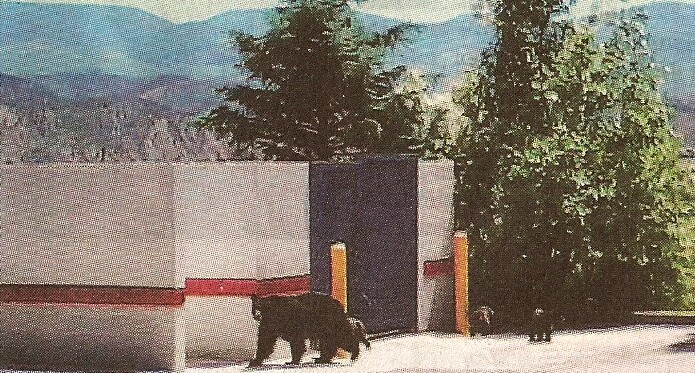
Cougars (top) and bears (below) are increasingly moving into more developed areas of Colorado because of the loss of habitat due to human encroachment.


Who can forget the end of the seventh verse of John Denver's terrific hit, 'Rocky Mountain High':

Why they try to tear the mountains down to bring in a couple more...
More people, more scars upon the land....


Well, we now know those words, written (and sung) more than 30 years ago, presaged what is happening to Colorado now. This was revealed in a Denver Post article four days ago, dealing with the increased takeover of once pristine or public lands for other uses, including fracking and private development.

"The more people" aspect was revealed three days ago in a front page article tracing the genesis of Colorado's Front Range housing crunch. To put it in numerical terms: 102, 000 poured into the state last year but only 25,000 new homes were built to accommodate them,  While in urban areas like Denver this is creating a pressure, high density crunch, in others it's causing gentrification. In the latter, long time residents complain about not even being able to see the mountains any longer because "newcomers have put up new, $1.25 million homes blocking the view".  The same old timers complain that these new arrivals "in BMWs" have incepted many new restaurants, but "most are unaffordable".

According to The Post's analysis:

"Urban sprawl, commerce and drilling claim the equivalent of a football field every 2 1/2/ minutes- roughly a Los Angeles sized open area every year."

The effect is to rapidly fragment the available land which isn't a good thing for humans or wildlife.. According to David Theobald, a Colorado State University conservation biologist quoted in the article:

"If we want to have wildlife populations be able to move across the land, the most widely recommended strategy is connectivity of landscapes. If we are increasingly fragmented that does not bode well."

What he means by that is Coloradans are then much more likely to encounter wildlife in their backyards that don't belong there, including: mountain lions (which have a nasty tendency to eat any pets left out), bear - black and brown, and coyotes.  Thus, the more open space is consumed - by either sprawl, development or fracking, the less habitat available to wildlife and the more probable encounters with humans - which usually don't redound to the benefit of the critters.

Fracking operations "tearing mountains down"  on W. Slope

Looking in more detail, the study found that "the main driver was energy development (i.e. oil and natural gas fracking) which drove 32.7 percent of the transformation in Colorado."

This energy development now includes no less than 55,000 active wells and 40,000 inactive . Next is urban sprawl which expansion has caused 22.3 percent of the change in land use in Colorado. Meanwhile, transportation activities are responsible for 4.1 percent of change.

  Apart from the human factor, climate change and nature are taking  a separate toll: As reported by the Post in a follow-up piece (May 21, p  13A), "the mountain pine beetle has chewed up 3.4 million acres of Colorado forest land - according to the state forest service." The origin of the beetle in Colorado forests is tied directly to climate change- global warming and interested readers can find details here:

http://www.nytimes.com/2008/11/18/science/18trees.html?pagewanted=all

Moving forward, it appears at the rate more people are entering and settling in our state - not all of whom have any affinity for the preservation of its natural beauty - it may not be long before John Denver's nightmare version of his song manifests.

Thursday, March 31, 2016

Hillary Blows A Gasket In SUNY Confrontation With Environmental Activist

WATCH: Clinton goes off on Greenpeace activist: "I am so sick" of you bringing up my fossil fuel money
Hillary loses it when confronted by a Greenpeace activist about money received from fossil fuel lobbyists, CEOs and the like.

It isn't often anyone can rip the façade of smiley from the "front runner's" face, but one Greenpeace environmental activist did today. She confronted HRC on the State University Of New York campus in Purchase, NY about getting moola from the fossil fuelers. As one salon.com description put it, the smile instantly mutated to a scowl (snarl?)  as Hill laid into the impudent girl who had the temerity to ask: "Will you act on your word to reject fossil fuel money in the future in your campaign?”

Well, as Bajans might joke "Who tol' she to say dat?" Hillary let loose, blasting her: "
"I do not — I have money from people who work for fossil fuel companies!"
Adding:

"I am so sick of the Sanders campaign lying about me,”

As she pointed her finger at the shocked Millennial activist, who merely ventured to ascertain whether Hill was in or out of the frackers' pockets, the cameras flashed - catching her with facial defenses down.

Of course, the bit about Sanders's' campaign lying is  misdirection. While the activist asked if Clinton would  reject fossil fuel money overall (and recall as Secretary of State she actively promoted global fracking), Hillary's response implied she'd not received any, period. But Greenpeace has detailed her many connections, e.g.  so she's not totally honest.  What Hillary deftly did is make a misleading distinction between the fossil fuel companies-corporations and the individuals tied to them. But the point is, you're still taking money from them - whether it's a person, or a company. And also, if money is taken from a lobbyist for an industry, that is effectively taking money from the industry since lobbyists represent the face of industries, i.e. in dispensing campaign largesse.

Had her campaign received money directly from fossil fuel companies it would have violated election law, but under the Citizens United ruling, campaigns CAN get the money from individuals and super PACS.

 Mother Jones revealed in a July expose , that "nearly all of the lobbyists bundling contributions to Clinton's campaign have come from the fossil fuel industry."

Environmental news website Grist has also shown how Clinton rakes in money from fossil fuel interests. The outlet notes that her campaign does not receive money directly from fossil fuel companies; rather, she “is getting a lot of money from fossil fuel executives and lobbyists acting as bundlers (fundraisers who collect donations) who represent fossil fuel companies.”


One is left to wonder, if all the gung-ho gender -backers for Hillary - prepared to blind themselves to her flaws just to "put the first woman in the White House" -   will be as ecstatic when fracking drill sites open up in their middle class neighborhoods and their kids suffer from asthma as well as skin rashes and nosebleeds. Will they blame Hill for rewarding the fossil fuelers for their largesse,  or just chirp: "You go girl!"

We will see!