Showing posts with label Munich Re. Show all posts

Tuesday, March 26, 2019

Intensifying Climate Disruption & Ocean Anomalies - Will Big Business Soon Come To The Table?

No photo description available.

Even as the "Green New Deal" continues to be hotly debated - with conservatives (at CPAC) yelping the "Greens" plan to take their burgers away - ominous new falling temperature records signal we may be even closer to the runaway greenhouse.  To fix ideas, this would mean an unstoppable climate forcing dynamic from which neither Earth - nor its human inhabitants - would ever return. We are talking about a process leading to another Venus.  The question that often comes up - especially in the financial media - is whether big business is planning to do much of anything about it. So far the only businesses  we know that are taking climate change totally serious - think of actions not just words - are the re-insurance companies like Munich Re.

The graphic above - from The Wall Street Journal- basically tells the whole tale, at least in terms of the temperature anomalies now recorded,  especially relative to the 1951-1980 average. To the right we can also see the annual and smoothed global surface temperature anomalies compared.   As the article reports:

"The past five years have been the hottest in modern records, federal scientists said....Last year was the fourth warmest year since 1890, according to the report by the National Aeronautics and Space Administration and the National Oceanic and Atmospheric Administration, which track annual climate trends."

Even more ominous (ibid.):

"The report comes after a year of extreme storms, floods and fires across the country, NASA scientists link such extreme weather to rising temperatures, saying that the warming extends fire seasons and fuels bigger storms".

And in terms of the global reach of these effects:

"During 2018 the average temperature across global land and ocean surfaces was 1.42 (0.79 C) above the 20th century average, according to NOAA's report. It noted record high temperatures across much of Europe and the Mediterranean, the Middle East and New Zealand and surrounding oceans - and across Asia, the Atlantic Ocean and the western Pacific Ocean."

In  terms of the latter perilous thresholds are also being reached, again from warmer temperatures. According to  Laure Resplandy , a geoscientist at Princeton University who led the startling study published  in the journal Nature:

"If you look at the IPCC 1.5C, there are big challenges ahead to keep those targets, and our study suggests it's even harder because we close the window for those lower pathways. A warmer ocean will hold less oxygen, and that has implications for marine ecosystems.  There is also sea level, if you warm the ocean more you will have more thermal expansion and therefore more sea level rise."

The critical element is the fact that as waters get warmer they release more carbon dioxide and oxygen into the air.  As Dr. Resplandy made clear:

"When the ocean warms, the amount of these gases that the ocean is able to hold goes down,"  

Adding:

"So what we measured was the amount lost by the oceans, and then we can calculate how much warming we need to explain that change in gases."

The additional IPCC findings help resolve a long-running puzzle about the rate of ocean warming before 2007. when more reliable measurements from devices called “Argo floats” were put to use worldwide. Before that, differing types of temperature records — and an overall lack of them — contributed to uncertainty  about how quickly the oceans were heating up.

The higher-than-expected amount of heat in the oceans means more heat is being retained within Earth’s climate system each year, rather than escaping into space. In essence, more heat in the oceans signals that global warming is more advanced than scientists thought.

As Dr. Resplandy explains:

"We thought that we got away with not a lot of warming in both the ocean and the atmosphere for the amount of CO2 that we emitted.  But we were wrong. The planet warmed more than we thought. It was hidden from us just because we didn’t sample it right. But it was there. It was in the ocean already".
Given ocean temperatures are rising more rapidly than previously calculated, that  leaves nations even less time to dramatically cut the world’s emissions of carbon dioxide. That is, assuming there is any hope in limiting global warming to the ambitious goal of 1.5 degrees Celsius (2.7 degrees Fahrenheit) above pre-industrial levels by the end of this century.  Many newer results show this is overly optimistic and neglecting other factors in play, e.g.


Climate report understates threat

Excerpt:

"So far, average temperatures have risen by one degree Celsius. Adding 50 percent more warming to reach 1.5 degrees won’t simply increase impacts by the same percentage—bad as that would be. Instead, it risks setting up feedbacks that could fall like dangerous dominos, fundamentally destabilizing the planet. This is analyzed in a recent study showing that the window to prevent runaway climate change and a “hot house” super-heated planet is closing much faster than previously understood."
In the midst of all these more recent climate developments it shouldn't be surprising that we learned some of the nation's top oil executives have issued a clarion call that companies "need to actively address climate change and technology concerns that are scaring investors away."  Denver Post, Business,  'Oil Chiefs Issue Climate Call', March 12, p. B3). Still, raising a call or having a conference, is not the same as actual action, given (ibid.):
"Shell is the only giant Western oil and gas company that has agreed to set goals to reduce emissions from the end use of its products."
True, we seem to be a long way from the Climate Deception Dossiers, e.g. 
But alas, we have a long long way to go and there may not be sufficient time to stop the climate change tide even with a Green New Deal.   For example, WSJ columnist Greg Ip has exposed the dichotomy of many businesses which profess concern about climate change, but then "fight solutions that hit their bottom line". ('Climate Change Alarms Business, To An Extent', January 17, p A2).  

The negative takeaways? Many businesses still have to be dragged kicking and screaming to become changelings. Also, "the limited efforts by the federal government under previous administrations are being dismantled by Trump's administration".  Which tells me more businesses - like coal, already on its way out - need to stand up to the Dotard.


 The positive takeaway?  "Many other businesses have concluded some sort of tax or cap and trade system is necessary".  The question remaining is whether global business finally coming to the table now will make an appreciable difference to the fate of our world - the only planet we know is habitable.  At least for humans.

Stay tuned!

Thursday, April 26, 2018

Miami's Residents Now Factor Climate Change Into Housing Costs


It's been known for some time, at least 35 years, that South Florida will be 'ground zero' when the rising seas from climate change begin to have their most serious impact. Indeed, the image produced giving a U.S. Geological survey map - with projected inundations by 2035, was actually published first in a Science Encyclopedia from 1981.

More recently, it's come to the attention of those who live in Miami or Miami -Dade (the greater metro area) that some areas flood during heavy rainfall and even on sunny days - when high tides known as "king tides" can swell the sea.

In fact, a 2016 study in the journal Ocean and Coastal Management found that the frequency of flooding increased significantly in Miami Beach between 2003 and 2016, with rain-induced events jumping 33 percent and tide-induced events soaring more than 400 percent.

How are tide-induced events generated and how are they connected to climate change? An examination of the diagram below can help which serves to illustrate tidal effects at Barbados:

No photo description available.
It is not too difficult to see that the Moon would exert a pull, say  with force F1,   on the near point -  call it A on the Earth. By the same token, point B on the opposite side from A would be pulled  (say  with force F2) )nearer to the Moon than the water above it, thereby inducing a high tide at point B as well. In other words, two separate pulls, with F1 > F2,  resulting in two high tides at locations A  and B.  In this context one can appreciate the concept of differential gravitational pull.

Now, a "king tide" is the common term given to high ("spring") tides which occur when the Moon is at its closest position ("perigee") relative to the Earth.  The difference in distance works out to about 50,000 km or 30,000 miles.  That difference is enough to  generate a significant differential gravitational tidal pull at high tide - when the alignment is as shown.

In a normal situation such tides wouldn't constitute a flooding threat other than when the configuration occurs during a storm, e.g. hurricane. But to have it occur even on sunny days shows some other factor at work - and that other factor is incipient rising seas from climate change.  In effect, the sea level rise - even though it may only be measured in inches - is ample to flood the streets of Miami on sunny days if there is also a king tide on those days. 

That may still sound somewhat sketchy except now we have evidence from Miami property values that the rising seas from climate change  is factoring into realty assessments. Research published last Friday in the journal Environmental Research Letters  and reported in the WSJ (April 21-22, p. A3) shows that "single family homes in Miami Dade County are rising in value more slowly near sea level than at higher elevations."


Why is this? Well, it's entering into buyer considerations of possible "more frequent minor flooding in the short term and the challenge of reselling properties that  decades from now could be submerged. (Again, refer to the projected U.S. Geological survey map).''  The map of the Miami area showing effect of elevation on rate of price appreciation is shown below:


Where the more contrast colored purple section refers to greater effect on rate of appreciation.  The incredible conclusion of Harvard real estat4e professor (and author of the paper) Jesse Keenan, is that ordinary home owners are already factoring future sea level rise into their calculations.

 Reinforcing Keenan's work, the WSJ (ibid.) cites another new paper from researchers at the University of Colorado-Boulder and Pennsylvania State University. This paper "shows the trend in Miami is playing out across the country, with homes vulnerable to rising sea levels now selling at a 7 percent discount compared to similar but less expensive properties.".  In addition the paper "shows that the size of coastal discount has grown over time".  The same thing appears to be happening in Barbados, especially as hotels, beach houses now start to discount their rates after obvious sea level increase has eroded their once extensive beach fronts.

In the case of Miami it's an obvious testing ground for the vulnerability of housing markets to sea level rise- climate change because its elevation "is as little as 1 foot above sea level".

The WSJ cites one particular Miami native (Joel Fabelo) whose previous waterfront home "increasingly flooded in the final five days they lived there" - and "a half a dozen times each year when tides were especially high, water rose over the sea wall leaving mullets swimming on the lawn."

Are Miami's home owners loopy?  Are they too susceptible to global warming "blurtations"? Nope, they have their heads screwed on straight and they know what they know - and what they see with their own eyes. Moreover, like  nearly all the reinsurance companies (e.g.  Munich Re) they have climate change factored into their tables, costs, plans.  They better, because they will be ground zero as the planet's sea level continues its inexorable rise owing to melting ice caps, and the Greenland ice sheet.

Tuesday, September 19, 2017

Cat 5 Hurricane Maria Mauls Dominica and Guadeloupe As Climate Simpletons Remain Out In Force

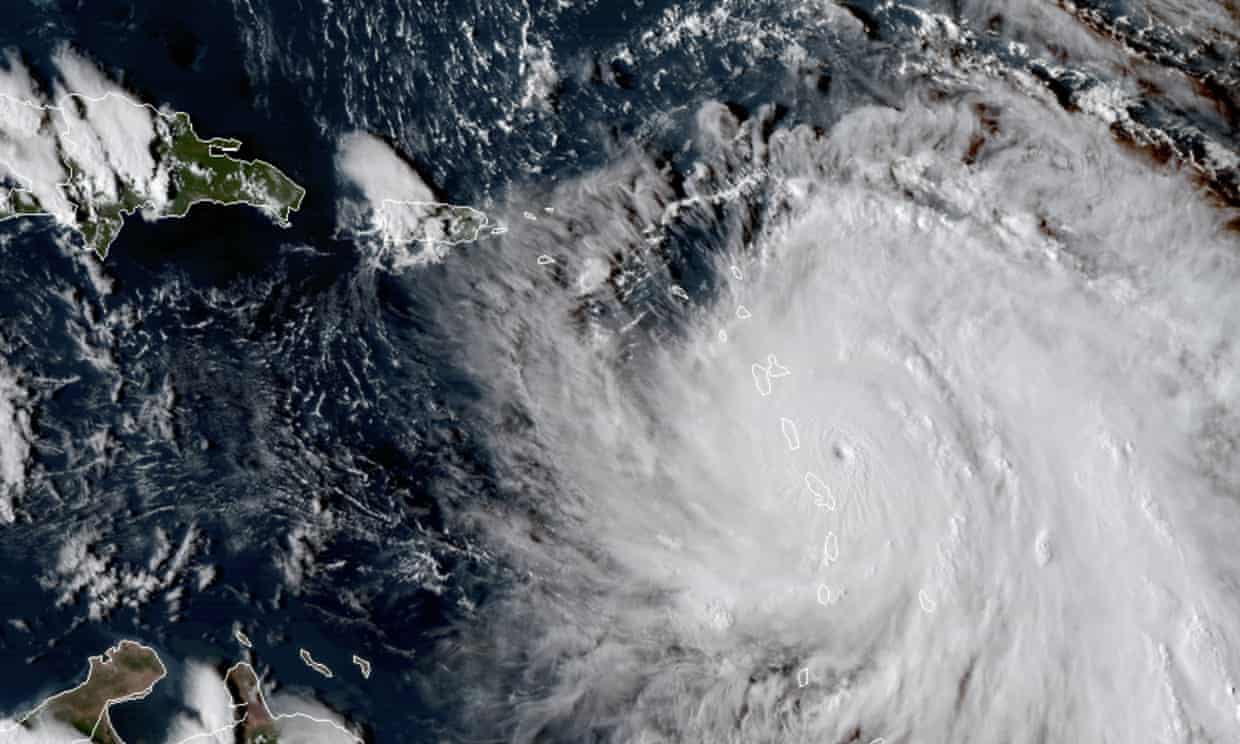
The eye of Hurricane Maria as it nears Dominica.
Category 5 Hurricane Maria which is seen here over the Caribbean island of Dominica 

Let's see now: Harvey, Irma, Katia, Jose, and now Maria and Lee. Not names at a party but monster storms (or potential - "Lee") acting as "atmospheric daisy cutters" and  "nature's weapons of mass destruction" (according to a recent essay in TIME) set to mow down whole islands, towns and states.

One  would have thought that in the wake of the onslaughts of major hurricanes Harvey and Irma the climate denier simpletons would put a sock in it. But that just isn't happening, even after a new category 5 hurricane has demolished Dominica and is heading for the Leeward Island chain.   What is there about basic thermal physics that these climate deniers don't grasp? Well, for starters,  that these "atmospheric daisy cutters"  are actually vast heat transfer systems - removing giga-joules of excess heat from the tropics and conveying them to more northerly, cooler latitudes.

If in fact there was no connection to climate change- global warming these immense  heat conveyors wouldn't be necessary to redistribute heat as often as we've seen.. Where is this heat? Well, in the atmosphere but especially  in the now greatly warming oceans - near the equator. Thus, it is no coincidence that most major Atlantic hurricanes spin off the Cape Verde islands near the African coast. (Where yet another storm, Lee, is now brewing).

According to the oceanographic climate science site below :

http://www.oceanscientists.org/index.php/topics/ocean-warming


 Since 1955, over 90% of the excess heat trapped by greenhouse gases has been stored in the oceans.  Doing the math this is more than enough energy to power dozens of major hurricanes, e.g. Hugo, Allen, Harvey, Andrew, Irma and now Cat 5 Maria.

But the climate simpletons insist there is no connection, For example, meteorologist Ryan Maue writing in yesterday's WSJ ('Climate Change Hype Doesn't Help', p. A19).:

"In the aggregate, the global warming signal may just now be emerging out of our noisy observational records and we may not know certainly for several decades."

In fact, the warming signal is already well defined and observed, - in the collapsing Antarctic ice shelves - some larger than the state of Connecticut, in the melting of glaciers across the planet, and in the increased intensity of the recent spate of hurricanes - including Maria. According to SciCheck, a division of FactCheck.org:

"The most recent analysis of what’s known about the effect of climate change on hurricane activity comes from the June 28 draft of the U.S. Global Change Research Program’s Climate Science Special Report.  One of that report’s key findings said that human activities have “contributed to the observed increase in hurricane activity” in the North Atlantic Ocean since the 1970s. The Gulf of Mexico, where Harvey formed, is part of the North Atlantic Ocean.

The draft report echoes the findings of the U.N.’s Intergovernmental Panel on Climate Change’s 2013 assessment report, which found that scientists are “virtually certain” (99 percent to 100 percent confident) that there has been an “increase in the frequency and intensity of the strongest tropical cyclones since the 1970s” in the North Atlantic Ocean." 


Indeed, extreme weather events  ("1,000 -year"  floods, storms) derived from climate change have killed more than twice as many people in the U.S. as terror attacks in the past 16 years - including the carnage on September 11, 2001.   In fact, the slow rolling disaster of ever intensifying climate change can be thought of as a mode of natural terror which we dismiss or diminish at our peril.

The Pentagon, in fact, has adopted a 'Net Zero' initiative to make its U.S. bases water and energy independent.  Supporting the national defense position, nearly all the reinsurance companies (like Munich Re),  have climate change factored into their tables, costs, plans.  The climate simpletons -who always think they know more than the experts- need to ask themselves why the reinsurance companies are now amongst the strongest advocates for proactive response to global warming. Well, if they'd read the recent WSJ article ('Reinsurers On Hook For Damages', Sept. 11, p. B9) they'd know why. Reinsurance is the 'backstop' for regular insurance  - providing capital when insurance companies are themselves tapped out. Companies like Munich Re are among the most energetic now to get whole communities to take climate change seriously and cease farting around and making excuses. They also want vulnerable communities to think twice before allowing construction on areas susceptible to storm surge or other threats -  many connected to climate change.

But the simpletons refuse to listen.  The real scam, then, isn't Limbaugh's claim that the media and advertisers, companies are "making money" off of hurricane hype - but that ignorant buffoons like Limbaugh are making tons of money by brainwashing their legions over the radio.  WHO do you think will be most severely impacted if another cat 5 hurricane strikes Florida?  Well, it won't be Rush Limbaugh but the sorry people who bought his hogswill and didn't evacuate because "it's all hype to get you to buy more water.' As wifey put it last night: "God, they're almost as bad as those televangelists - like Jim and Tammy Baker."  Well, maybe not quite, but close in terms of inducing gullibility.

What we DO know is the planet is currently  subject to a radiative heating effect equivalent to 2.5 x 10 7  TJ injected each year into the atmosphere or roughly 400,000 Hiroshima size A-bombs.   This in turn conforms to the observed  addition of 2 ppm  per year  in CO2 concentrations and an associated heating increase per year of  2 W/ m2.   

Result?  The temperature of the planet is currently out of balance by  0.6  W/ m2.    and this is almsot entirely due to the concentration of atmospheric CO2 increasing as a result of incessant fossil fuel use.   Now the key part, the heat imbalance is especially extreme between the tropics and northerly latitudes. If then hurricanes represent heat transfer systems - to shift excess heat away from the equator - then it makes sense we'd see more of them so long as conditions (e.g. much warmer ocean temperatures) merit this transfer.  This is basic thermal physics, but of course most climate deniers - or buffoons like Rush Limbaugh - haven't even taken a basic high school physics course

To get down to cases,  a large portion of  Hurricane Harvey's energy was fueled by very warm Gulf temperatures which rose to between 2.7 F and 7.2 F above average. Because of these high Gulf surface temperatures the original Tropic Storm Harvey progressed to a Cat 4 hurricane in barely 48 hours.  How did the Gulf acquire such war temperatures? Well, from the absorption of excess heat in the atmosphere.  As I noted earlier,  over 90% of the excess heat trapped by greenhouse gases has been stored in the oceans.

Meteorologist Maue appears to try to make a much bigger case that the massive destruction wrought ty these storms like Maria derives from over building in areas susceptible to storm surges.  This is obviously part of the equation, but that alone doesn't account for the ferocity of the storms - such as Maria now lashing Guadeloupe after demolishing Dominica. Are those island states over built too? Not really. They are simply more vulnerable because their infrastructure is unable to withstand the force of a storm with the power of an E4 or E5 tornado lasting for hours.

When one dives beneath the superficial stuff, one sees that the over building in susceptible areas- whether on islands or mainland U.S. states - emerges from another problem: too high a density of people, as a result of over population. What? Well, consider that since I went through Hurricane Cleo in Miami in late August of '64 the global population has doubled - from about 3.5 b to 7.3 b. The population of the U.S. has also doubled from 160 million to over 320 million. Doesn't anyone think or surmise that all those extra people might need places to live: homes, condos, apartment buildings?
The point here is that the over building meme is more or less a red herring designed to distract from the link of monster hurricanes to climate change.

This leads us back to the question of why weatherman Maue would seek to distract or not fully buy into the global warming link, as currently manifest.   A possible explanation appears in the Jan.-Feb. 2011 Issue of The Columbia Journalism Review featuring a piece entitled ‘Hot Air: Why Don’t TV Weathermen Believe in Climate Change?’

In the article by Charles Homans, assorted reasons were put forward as to why many TV weathermen (especially ensconced in the Weather Channel) as well as a significant number of member of the American Meteorological Society (AMS) don’t buy climate change. Among them:

1- Given their familiarity with the defects in their own extended predictions, meteorologists looking at long range climate questions (such as global warming effects) are predisposed to “see a system doomed to terminal unpredictability”.

2- Most skeptic meteorologists (like Bob Breck an AMS-certified chief meteorologist at New Orleans WVUE) didn’t properly recognize the limits of their own scientific training – and hence the implausibility of their pronouncing on climate science.

3- Because of (2) the skeptic meteorologists tend to see their own “informed intuition” as the source of some kind of ersatz scientific authority – particularly if the skeptics are also excellent communicators, or fancy themselves so.

Some of the paradoxical statistics that were cited in the article, based on surveys carried out by Emory University Journalism lecturer Kris Wilson, included:

- 29% agreed with Weather Channel mogul John Coleman’s take that global warming was “the greatest scam in history”.

-Only 24% believed that humans were responsible for most of the change over the past half century.

- 50% were certain this wasn’t true and that humans weren’t responsible.

-Only 17% of the opinionated TV weathermen “received a graduate degree, a prerequisite for an academic researcher in any scientific field”.

Similar trends appear to correlate to Australian and European meteorologists but not quite to the same extent as for Americans. In any case, one would not expect to find much in the way of insight or illumination on global warming and its predictions from this lot.

Meteorology, after all, is distinct from climatology -  but I doubt few of the simpletons grasp that. As I have repeatedly suggested, they need to go to:

www.realclimate.org


Where the meteorologists are on firmer ground pertains to the "cones of probability" they assign to storm tracks, again generally misunderstood by the likes of Limbaugh and his followers.  When they ask: "How come we can we put men on the Moon and send craft to Mars but can't even track a hurricane?" they mix apples and oranges.  Getting space craft to their destinations is a matter of using the deterministic laws of physics - from Newtonian gravitation and the special equations of celestial  mechanics. Those laws enable incredible precision once one uses them correctly (including inserting the right units). With hurricanes,  prediction isn't the same because they aren't deterministic systems like space craft.  They aren't subject to Newtonian laws of motion but rather subject to the much more complex stochastic parameters of fluid dynamics.

But again, we shouldn't be surprised so many fail to make the distinction, especially if they've never taken a high school physics course. But this is why - while they are entitled to their opinions - they're not entitled to their own facts.  To quote from Realclimate.org:

"Climate science is one of those fields where anyone, regardless of their lack of expertise or understanding, feels qualified to comment on new papers and ongoing controversies. This can be frustrating for scientists like ourselves who see agenda-driven ‘commentary’ on the Internet and in the opinion columns of newspapers crowding out careful analysis."

I suspect this sense of false expertise on climate is related to the eponymous Dunning-Kruger Effect .  This is a cognitive bias whereby people who are incompetent at something are unable to recognize their own incompetence. And not only do they fail to recognize their incompetence, they’re also likely to feel confident that they actually are competent.  The climate denier brigade, and especially those like Rush Limbaugh and Ann Coulter, must be numbered among this sorry lot.

Saturday, September 2, 2017

Climate Obfuscator Roger Pielke Jr. Strikes Again With Misleading WSJ Piece

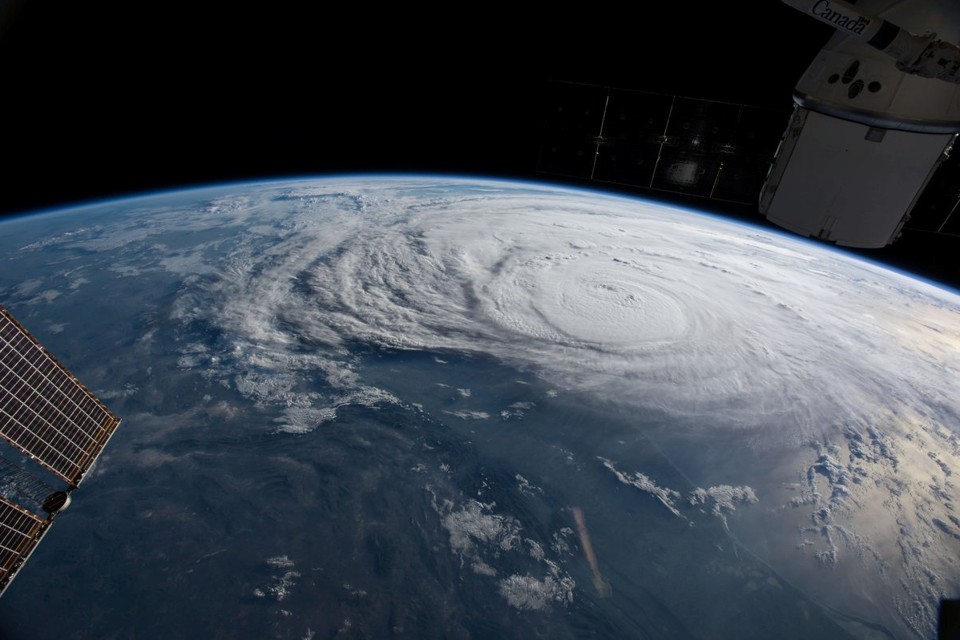
Hurricane Harvey looms off the coast of Texas, as seen from aboard the International Space Station.
Hurricane Harvey - merely an "overdue big One"?  So claims Roger Pielke Jr.

"Renowned Climate obfuscator" Roger Pielke Jr. (in the words of the science check website Skeptic Science), is at it again with his latest piece appearing in the WSJ :'The Hurricane Lull Couldn't Last', (Sept. 1, p. A15).  In it he merely used a probability argument to account for a hurricane like Harvey being "overdue" similar to one that I have myself applied to asteroid collisions, i.e..

http://brane-space.blogspot.com/2016/10/asteroids-celestial-swords-of-damocles.html

Or, transferred to Pielke Jr.'s case (ibid.):

"Because the world has experienced a remarkable period of good fortune when it comes to catastrophes, we are due".

In other words Harvey's arrival was a statistical probability "after a remarkable 12 years without being hit by a hurricane of category 3 strength or stronger."

Pielke Jr. also dismissed more frequent  flood disasters in the U.S.,  e.g.

"Neither has there been an increase in floods, droughts and tornadoes...."

Despite the fact SAME WSJ  noted this morning (p. A14):

"The U.S. has seen 20 storms causing a billion dollars or more in damage since 2010, not including Harvey, compared with nine billion-dollar floods in the full decade of the 1980s."

Earlier (Aug. 30, p. A1) noting that "seven major storms have hit just since 2016 including October's Hurricane Matthew and February's California flooding."

So the Pielke Jr. take that major climate-related disasters are "getting less"  in the U.S. is already exposed as blatant bollocks. These sort of shallow arguments I will go on to explode citing several sources vastly more authoritative than this fake climate guy. Pielke Jr. goes on to babble:

"For many years, those seeking to justify carbon restrictions argued that hurricanes had become more common and intense. That hasn't happened. Scientific assessments, including those of the Intergovernmental Panel On Climate Change and the U.S. government's latest National Climate Assessment, indicate no long term increases in the frequency or intensity of hurricanes in the U.S.."

The actual facts are somewhat more complicated than Pielke Jr. portrays.  According to SciCheck, a division of FactCheck.org:

"The most recent analysis of what’s known about the effect of climate change on hurricane activity comes from the June 28 draft of the U.S. Global Change Research Program’s Climate Science Special Report.  One of that report’s key findings said that human activities have “contributed to the observed increase in hurricane activity” in the North Atlantic Ocean since the 1970s. The Gulf of Mexico, where Harvey formed, is part of the North Atlantic Ocean.

The draft report echoes the findings of the U.N.’s Intergovernmental Panel on Climate Change’s 2013 assessment report, which found that scientists are “virtually certain” (99 percent to 100 percent confident) that there has been an “increase in the frequency and intensity of the strongest tropical cyclones since the 1970s” in the North Atlantic Ocean."

Adding:

"there is some uncertainty: The projections don’t yet align with the observed data on hurricanes because the data are “not of a high enough quality” to detect human contribution to the trend, the report says."

This is not at all surprising given that assessing human contributions to such a trend is effectively a stochastic analysis, not like one in celestial mechanics.  To nail the links down more securely we need more precise data on carbon depositions - as well as from other greenhouse gases such as methane. The sheer volume of such sources alone is staggering, encompassing the natural (e.g. melting permafrost in the Arctic) as well as the directly man-made (e.g. CO2 released from oil shale fracking operations).

What we DO know lies more in the way of ancillary thermal physics effects: for example, the planet is currently  subject to a radiative heating effect equivalent to 2.5 x 10 7  TJ injected each year into the atmosphere or roughly 400,000 Hiroshima size A-bombs.   This in turn conforms to the observed  addition of 2 ppm  per year  in CO2 concentrations and an associated heating increase per year of  2 W/ m2.    Result?  The temperature of the planet is currently out of balance by 0.6W/ m2  and this is almost entirely due to the annual rate of CO2 concentrations increasing. This is not due to any natural phenomenon but to human injection of carbon and other greenhouse gases into the planet's climate system.  

In other words, humans have - by fossil fuel activity -engendered a world with pronounced greenhouse dynamics.  The overall effect of such a greenhouse dynamic is warmer air which can hold more moisture. In addition, the warmer atmosphere causes evaporation to happen more rapidly. However, that alone doesn't explain the full role of the greenhouse effect on Hurricane Harvey.  Another consequence of greenhouse warming is that the oceans are absorbing CO2 and also becoming warmer- which in turn raises sea surface temperatures.

In effect, a large portion of Harvey's energy was fueled by very warm Gulf temperatures which rose to between 2.7 F and 7.2 F above average. Because of these high Gulf surface temperatures the original Tropic Storm Harvey progressed to a Cat 4 hurricane in barely 48 hours.

Climate scientist Michael Mann writing in the Guardian UK, invoked the well known  Clausius-Clapeyron equation  to ascertain that for every 0.5 C increase in warming there corresponds a  roughly 3% increase in average atmospheric moisture content.  For a climate 1 to 1.5C warmer than several decades ago this translates to an enhanced atmospheric moisture content of up to 9 percent. For Harvey, specifically, the sea surface temperatures were 0.5 - 1.0 C higher than current-day average temperatures, translating to 3- 5 % higher moisture content.   That in turn created the potential for the much greater rainfall in tandem with the effect of two subtropical highs which kept the storm in position an overly long time.  But again, this should not be confused with the intensity of the storm per se - tied to global warming - which was estimated yesterday at 1.2 inches of precipitation per hour for Houston.

Rice University climate scientist Jim Blackburn confirmed this connection and asserted that, in tandem with the destruction of nearby wetlands, the destruction wrought by Harvey was almost predicable - and "what all serious climate scientists have warned about". What about Roger Pielke Jr.? It appears he isn't a serious climate scientist at all but a climate science obfuscator along the lines of Willie Soon, e.g.

But Pielke Jr's antics precede him and have been pointed in details by Skeptic Science, one of the most useful resources - along with the site www.realclimate.org for exposing fake science and fake science news, as well as distorting, obfuscating op-eds like Roger Pielke Jr's.  

Pielke Jr. didn't come to more national prominence until cited by Nate Silver at his Five Thirty Eight blog, e.g.

wherein I noted "Pielke Jr. is no more a real climate scientist than I'm the pope."

I further cited one reviewer's take on Pielke Jr's book  The Climate Fix: What Scientists and Politicians Won't Tell You About Global Warming:

Pielke Jr. is really astonishing in the way he almost completely denies the urgent need to mitigate climate change by greatly lowering global carbon emissions. He does it in a very slick way by masquerading as someone with real and different solutions, when in reality all he proposes is that society do next to nothing about burning fossil fuels.
He basically brushes aside climate change as if it were a trivial concern." 

Skeptic Science picks up on Nate Silver's Pielke attributions and notes, for example:

"Nate Silver has launched a new FiveThirtyEight blog with the intent of applying his data-driven approach to a wide variety of subjects.  The problem is that Nate Silver is himself only one man, so FiveThirtyEight has hired a variety of contributors to write about the subjects that are outside his expertise and comfort zone.  For the topic of climate change, Silver decided to hire the renowned obfuscator Roger Pielke, Jr.

This was immediately disappointing for those familiar with Pielke's work, because FiveThirtyEight is a statistics site, and frankly Pielke is not good at statistics.  Instead, Pielke is known for taking a selective view of the peer-reviewed scientific literature in order to downplay the connection between human-caused global warming and extreme weather.  Predictably, Pielke's first two posts at FiveThirtyEight did exactly that, and included a litany of errors:
  • The headline and main point of his post are wrong.
  • He misrepresents his own research.
  • The references he provides don't say what he claims and don't support his argument.
  • Research he neglects contradicts his conclusions.
  • He doesn't include all available data.
  • He incorrectly claims that weather-related disasters aren't becoming more frequent.
  • He fails to account for the costs of improved technology and the damages they prevent.
  • He considers only land-falling hurricanes whose damages are highly variable.
  • His conclusions are contradicted by the increased intensity of North Atlantic hurricanes, and global warming's contribution to their storm surges and flooding"
In other words, Nate Silver blew it in terms of his information source for climate change.   Other Pielke Jr.  hijinks include:

Pielke's first FiveThirtyEight post begins by plotting global disaster economic losses, from data provided by reinsurance company Munich Re.  Except for some reason Pielke only plots the data from 1990 to 2013, when Munich Re provides data beginning in 1980.

Munich Re disaster losses

 Most damning in terms of Pielke Jr's WSJ piece:

"The Center for Research on the Epidemiology of Disasters also has natural disaster cost estimates ranging back to the year 1900.  And ironically, when Munich Re published its report, Pielke criticized them for only including data since 1980, saying,
"Thirty years is not an appropriate length of time for a climate analysis, much less finding causal factors like climate change"
Yet Pielke has dismissed climate change as a causal factor using data from just 1990. As it turns out, the positive trend in global disaster losses in the Munich Re data is almost 30 percent larger for 1980–2013 than it is for 1990–2013.  What's more, the trend in disaster losses for 1980–2013 is statistically significant at the 99 percent confidence level, whereas the trend for the 1990–2013 window cherry picked by Pielke is not statistically significant."

SO much for Roger Pielke Jr's. dishonest representations that natural disasters have not become more common and intense.   As Skeptic Science goes on to point out:

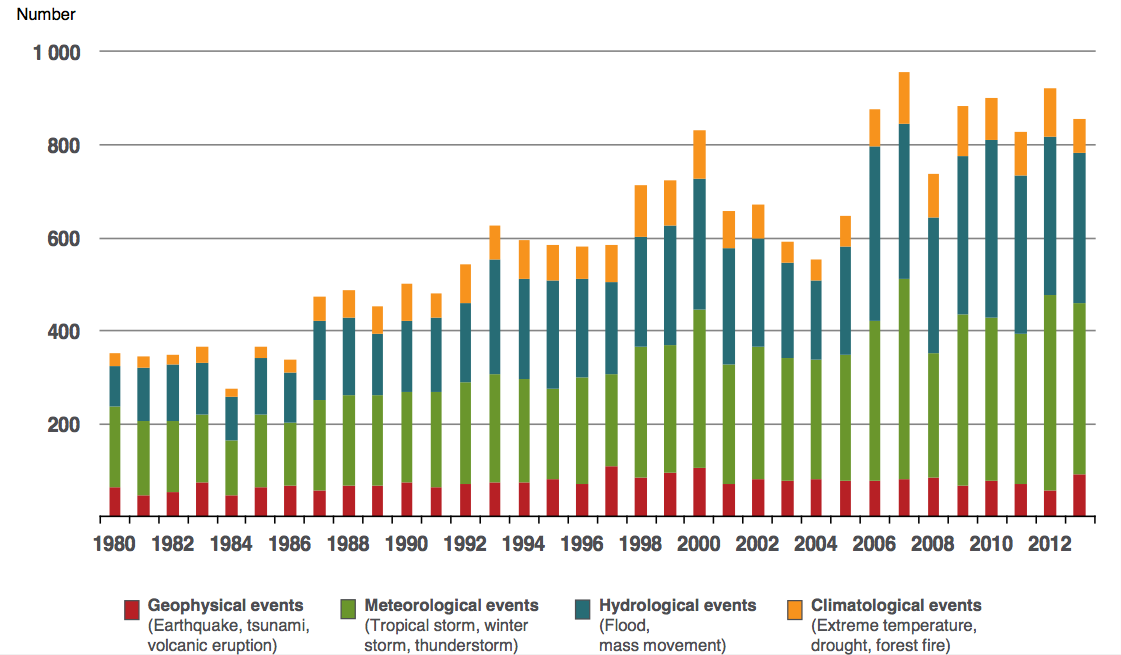
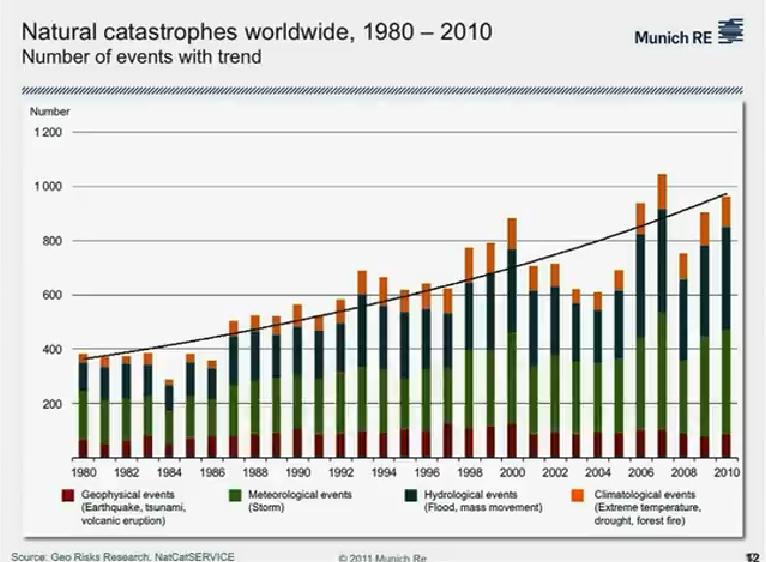
"To determine if weather disasters are becoming more frequent, you don't look at economic loss data.  Munich Re also provides data about the number of annual disasters, and the frequency of these events is indeed rising.  Pielke claims,
"When you read that the cost of disasters is increasing, it’s tempting to think that it must be because more storms are happening. They’re not."
They are unequivocally increasing as illustrated in the figures above and below.
Munich Re Disaster Frequency


Munich Re disagrees with Pielke on the answer to this third question, concluding following a study of "Severe Weather in North America" that (emphasis added),
"Among many other risk insights the study now provides new evidence for the emerging impact of climate change. For thunderstorm-related losses the analysis reveals increasing volatility and a significant long-term upward trend in the normalized figures over the last 40 years. These figures have been adjusted to account for factors such as increasing values, population growth and inflation ... In all likelihood, we have to regard this finding as an initial climate-change footprint in our US loss data from the last four decades."

Does Pielke Jr. deserve to have his work published? Of course!  But mainly in The National Enquirer and perhaps some graphic comics.

See also:

http://www.smirkingchimp.com/thread/amy-goodman-and-denis-moynihan/74892/hell-hath-no-fury-like-mother-earth-scorned

Excerpt:

"Writer and activist Naomi Klein has long made the connection between disasters and economic opportunism. A key ingredient, she says, is a compliant media. “You turn on any coverage, and you hear that word over and over again, but what you don’t hear, or you hear very, very rarely, is an explanation for why the word ‘unprecedented,’ ‘record-breaking’ — why these words have become meteorological cliches,” she said on “Democracy Now!.” “We hear them all the time, because we’re breaking heat records year after year. We’re seeing record-breaking wildfires, record-breaking droughts, record-breaking storms, because the baseline is higher.”

Klein continued: “Nobody is saying that climate change caused this storm. What we’re talking about are what are the superchargers of this storm, the accelerants that took what would have been a disaster, in any situation, and turned it into this human catastrophe.”

That is a central tenet of climate science: You can’t attribute any given weather event to climate change, but human-induced climate change is making extreme weather events stronger and more frequent, more costly, more deadly. While the people in Texas and Louisiana suffer the final days of rain and begin recovery, over 1,200 people have been killed by massive floods in Bangladesh, India and Nepal. The planet is drowning in denial. Climate change is real, and needs to be addressed."

Monday, June 22, 2015

Separating REAL Threats To Human Existence From Specious Ones: The Case Of WR 104

Image result for wr 104
The object WR 104. Why are so many more concerned about it than global warming?


An interesting question directed at me, and received at ALL Experts barely a week ago, concerned how to "defend" against a monster gamma ray burst from the object WR 104. Evidently, this possible event (supernova)  has been on a number of questioners' minds for at least seven years now. It reflects again the inability of the human species to distinguish distant, improbable threats (and events) from much more dangerous proximate ones that concern us in the here and now.

Of course, in the fantasy world of pie-eyed optimists no one would fret about any cosmic threat - or even the Earth getting a little warmer (in their minds). We should all just enjoy the lives we have and simply dismiss all such concerns, understanding that compared to the brutish, short lives of past humans we are living the 'life of Riley'.

Alas, the sober realist, and especially those of more serious scientific bent, can't be so blase.

Anyway, getting back to the question, I had to inform the person that those in the know (astronomers and astrophysicists)  ascribe a large uncertainty to powerful gamma rays bursts from WR 104 . In fact, most of the popular accounts that insist it's "coming" really mean any time from today to 500,000 years from now. That's how much uncertainty is attached to the potential event.

 For my odds, it is likely much later, and global warming is much more likely to take humans out than gamma rays from WR 104.  (Note the most recent data indicate that the mean global temperature rise by 2100 to be 4C-6c - in runaway greenhouse territory).  The worst effect of a gamma ray burst (GRB) from WR 104 would be violently eradicating up to 50 percent of the ozone layer, leading to much higher levels of UVB radiation being absorbed and a major uptick in skin cancers, as well as cataracts.

As for "defending" ourselves I  informed the questioner that I saw no technological way to do it. In fact the only moderate way to do it is passive: i.e.  to ensure we aren't enlarging the ozone hole over the Antarctic given any WR 104 GRB is estimated to take out 50 percent of the ozone layer.

Thankfully the cessation of use of CFCs (chloroflourocarbons) via the 1987 Montreal Protocol has caused human input of CFCs to stop - which were eroding the ozone layer. The bad news is that erosion is still going on because of the long length of time (up to 1,000 years) that CFCs remain in the atmosphere.  Still, recent research suggests that it is feasible all ozone hole erosion can be halted by 2070.

I then reiterated that it is much more important  we concern ourselves with the vastly more immediate threat for human extinction:  the runaway greenhouse effect. Are we talking about  a "little warmer Earth" to make us sweat a bit more and feel uncomfortable? No, we're talking about extinction level events and heat - with all existing human technological prowess reduced to useless dross, especially power grids.

We're talking of fires blazing across two thirds of the planet from dawn to dusk and temperatures topping 120F, or close to what New Delhi experienced for over a week earlier this month. Only this time going on for months. We're talking of little respite even at nightfall with temperatures still in the 100F -110F range. We're talking of millions dying, unable to get relief from the unbearable heat - or  even  to garner enough water because the electricity use will face such demand that even the pumps to bring up water into pipes will cease working.

Thus the Pope was absolutely correct in his encyclical when he warned:

"Climate change is a global problem with grave implications: environmental, social, economic, political and for the distribution of goods. It represents one of the principal challenges facing humanity in our day. Its worst impact will probably be felt by developing countries in coming decades."

The problem is that the onset of the runaway greenhouse may be as close as two decades.

However, the effects of unmitigated climate change are experienced in the here and now, and have drawn alarm in serious quarters. For example, both insurance and re-insurance companies (like Munich Re) are already factoring in major extreme weather events - such as the flooding in TX and drought in CA - as climate change related and computing current and future costs of premiums on this basis - as well as potential future payouts.

Meanwhile, few ordinary citizens are aware that on April 24 this year the 'Defense, National Security And Climate Change Symposium' was held in Washington, D.C.  At the Symposium Brigadier General Stephen Cheney stepped up to the podium to discuss 'Conflict and Climate Change'. Cheney, like some other speakers- zeroed in on climate-driven migration, asserting:

"We know for a fact that climate change is already driving internal and cross border migration"

Referencing here, for example, that in Bangladesh - the 'ground zero' of global warming- rising sea levels could displace 15 million by 2050. Oxford University's Norman Myers has projected there could be as many as 200 million climate refugees by mid-century.

Cheney's presentation tagged a number of conflict climate triggers, including the desertification in the borderlands between Chad and Nigeria which "has caused a lot of migration". He also indicated that the terror organization Boko Haram "is simply taking advantage of that".

Other aspects of Cheney's talk cited beefing up military infrastructure at home and abroad to be resistant to harsher climate. The army, in fact, has adopted a 'Net Zero' initiative to make its U.S. bases water and energy independent.

Less well known is the Dept. of Homeland Security's Climate Action Plan. In effect since 2013, the Plan acknowledges that it may be necessary to prepare U.S. border for "frequent, short term, disaster driven migration".  The Plan anticipates legal and illegal movements across the U.S. border because of "severe drought and tropical storms".

More unsavory, the presence of over 100 military weapons vendors at the 9th annual 'Border Security Expo' in Phoenix in April - all slavering at the potential to make war on climate refugees - which would spell profitable business opportunities.

Climate change - global warming, never mind the seemingly small increments (which delude too many into complacency), is the most serious threat humans face. Can humans still be happy with their situations and not be overtaken by constant misery? Of course! But it would be stupid to single-mindedly pursue a perpetual "happy"   while being oblivious to the calamity unfolding around us- to the extent of emulating the proverbial ostrich with head buried in the sand.
 

Saturday, December 3, 2011

Is Global Warming Science A "Religion"?


One would have thought by now that even with one of the prime skeptics (Richard Muller) coming over to the side of scientific consensus, the climate change deniers and naysayers would give it a rest. But no, this is not their wont. They are driven by the belief that economics trumps all other concerns and hence even if the Earth burns and millions perish, Wall Street's fortunes and prerogatives must prevail.

Their tactics also know no bounds, including of disrepute. And so we have recent outbursts such as Daniel B. Botkin (WSJ, 'Absolute Certainty is Not Scientific', Dec. 2) and earlier WSJ nabob Brett Stephens claiming global warming science is a "religion" ('The Great Global Warming Fizzle').

In Botkin's case, he makes the spurious claim that those of us who support the theory of anthropogenice global warming are also insisting the basis is one of "absolute certainty". Of course, if one issues tenets of absolute certainty, then what one has is dogma, not science. We know this. But what appears to bother Botkin is the massive consensus that supports anthropogenic driven climate change. He appears clueless that this is based on more than 15,000 papers published in peer-reviewed climate journals. He therefore errs in conflating the hardness and scope of the consensus with "absolute certainty".

This shows that Botkin, like many others (maybe even Stephens) doesn't grasp the nature of the scientific support. Not grasping it, they then assert some kind of absoluteness of "belief" or "dogma". Years ago, this was skewered by Daniel Schrag, Harvard professor of geochemistry and director of the Laboratory for Geochemical Oceanography. Schrag correctly noted that the Intergovernmental Panel on Climate Change (IPCC) is by nature a conservative organization. The breadth that gives its findings weight – 3,000 scientists, reviewers, and government officials were involved in drafting the reports – meant that consensus had to be reached across broad points of view, including those from countries whose economies are based on oil production.

Meanwhile, in the reactionary financial press and its sundry op-ed pages, the IPCC is depicted as a bunch of wild-eyed radicals seeking to bring the global economy down deliberately. Not so! What they have observed is:

a) For the thousands of years the CO2 concentration was 280 ppm or less, fairly uniform cycles of rain and droughts applied and these were limited to specific regions.

b) Once the industrial revolution began and the CO2 concentrations shot up, these cycles began to get disrupted.

c) Today, at a level of 390 ppm, we are seeing massive prolonged droughts in many places - such as Texas and Mexico (where over 1.7 million cattle have died from starvation or thirst in the past year) and the potential for massive further climatic disruptions, including intense flooding and drought - the extremes predicted by the AGW models.

d) We know that the CO2 concentrations are increasing at 2 ppm/yr and that each such increment translates in an additional 2 watts per sq. meter of heat trapped - which must be added to the solar insolation (1330 w/m^2)

e) We suspect the tipping point to the "runaway greenhouse effect" is at 450 ppm or close to it, which means if nothing is done and at the present rate of carbon deposition, we will reach that critical threshold in merely 30 years. Or by 2041.

Granted, all of these are projections, but nearly all climate scientists concur with these basics. This doesn't mean all aspects are settled, only the geographical uniformity. Talking about rising average temperature is almost misleading because the effects will vary in different parts of the world. Common all over, however, will be the increase in violent storms and extreme weather events, such as droughts and floods, as the atmosphere seeks to redistribute the new energy – in the form of heat – that it is absorbing.

Other major global shifts, such as changes to ocean currents, are less likely but possible. Should they occur, they could also have far-reaching effects. If the warm water current that flows across the North Atlantic were to slow or shift south, for example, temperatures in Europe, which typically experiences warmer temperatures than its northerly latitude would indicate, could plunge. (This was the scenario depicted in 'The Day After Tomorrow' although it is one of the least likely).

The point is that climate scientists don't claim to have any absolute certainty across the broad spectrum of details, but only in the major points listed earlier. Hence, it is egregious for naysayers like Botkin to make an issue out of "absolute certainty" when only the major points are agreed on. Are these enough to warrant carbon taxes or other means to limit the increase of CO2?

Yes, I believe so, and advance it in an analogous fashion to Dick Cheney's "1 % doctrine" on terrorism. Thus, for Cheney, if there was even a 1% chance of a massive terrorist strike then that was sufficient to command all or most national defense resources to prevent it. In like manner, if there is only a 1 percent chance of Earth ending up in a runaway greenhouse effect, with all that portends (including the death of billions) then all resources we have must be mounted to prevent it. In other words, all the money in the world will not help us by one iota if humans will not be able to adapt to a runaway greenhouse planet with daily temperatures near 150F in most places, except the Arctic and Antarctic.

In Brett Stephens case, he argues:

"Expect Mayan cosmology to take a hit to its reputation when the world doesn't end on Dec. 21, 2012. Expect likewise when global warming turns out to be neither catastrophic nor irreveersible come 2017."

But comparing the Mayan end times babble to global warming theory is irresponsible in itself. It also shows the author to be incapable of discriminating between patent pseudo-scientific barf and a true scientific theory for which we actually have abundant data, i.e.

http://brane-space.blogspot.com/2011/06/latest-climate-news-not-sanguine.html

wherein I noted that the projected anthropogenic CO2 emission rate of 35 gigatons per year is 135 times greater than the 0.26 gigatons per year emission rate for volcanoes, plumes etc. This ratio of 135:1 (anthropogenic to volcanic CO2) is what defines the anthropogenic multiplier index.

Then there was the matter of carbon isotope ratios:

http://brane-space.blogspot.com/2010/12/carbon-isotope-ratios-and-climate.html

and the graph shown, of radiocarbon (C14) excess over C12 over a roughly 2,000 yr. period. Quoting the late solar physicist John Eddy on the nature of that graph:

"The sharp upward spike at the modern end of the curve, representing a marked drop in relative radiocarbon, is generally attributed to anthropogenic causes—the mark of increased population and the Industrial Age. "

But one wonders if Stephens is even able to read, far less interpret correctly, such graphs. Very few are, and especially very few nattering WSJ nabobs who likely have never taken a college general physics course in their lives. But hey, that makes it easier for them to flap their gums (or keyboards) about "religions" when they don't know dick or diddly squat.

This is demonstrated by the fact that the guy doesn't appreciate that AGW (anthropogenic global warming) theory has followed the traditional path of all good science in successive approximations to its original thesis or model. You have data, and accessory information which leads to some initial result which tests a particular hypothesis- call it 'x'. You then acquire better data (perhaps because of refined instruments, techniques ) and are led to a modified (improved) result such that: x (n+1) = x + P(x) where x(n +1) denotes an improvement via iteration, with P(x) the process (acting on x) that allows it.

Integrated into the process is the matter of falsifiability! Thus, at each stage, tests to falsiafy said hypothesis must be conducted before proceeding to the next iteration. Religions - by contrast- simply impose their truth ab initio by fiat or decree. There is no attempt whatever to incorporate any approximation. Or to even acknowledge that 'truth' can't be accessed all at once. Rather, one must set rational truth aside and succumb to ‘faith”.

Meanwhile, early versions of the IPCC model actually predicted the Arctic would first experience global change in melting ice caps, permafrost, and it did. It predicted the warmest years of the decade would correlate to CO2 concentrations > 366 ppm, and they did. (Nine of the past 11 years were the warmest on record, all displayed CO2 concentrations at > 367 ppm).

As for the Mayan malarkey, Stephens isn't even remotely aware that its purveyors never delivered one single test for falsifying it, say to predict a specific consequence (on Dec. 21, 2012) of the Milky Way's "dark rift" being aligned with the Sun (which occurs about once every 100 million years)

As for Stephens' 2017 insinuation, no serious climate scientist I know has predicted anything 'irreversible" by that year, or a specific catastrophe. Hence, he is guilty of invoking straw men. What we do know, and can be pretty sure of, is that this is 6 more years, which means the CO2 concentrations will increase another 12 ppm to 402 ppm - assuming the same rates of fossil fuel consumption, and that means a further 12 watts/m^2 of heat trapped. This will likely translate into much more melting of Arctic and Antarctic ice sheets. Will this spell "catastrophe"? We don't know, and neither does Stephens know that it won't!

Stephens last bit of bloviated garbage would be the funniest it it weren't so pathetic:

"Religions are sustained in the long run by the consolations of their teachings and the charisma of their leaders. With global warming, we have a religion whose leaders are prone to spasms of anger and whose followers are beginning to twitch with boredom. Perhaps that's another way religions die".

But again, since AGW is not a religion, the comparison is both daft and inappropriate. I also don't know where Stephens gets this "followers" bullshit. Global warming theory is not based on popular beliefs , but on accepting the theory based on passing the tests for its own falsification.

It is quite obvious to me that Stephens doesn't even grasp that being a follower of a religion can't be the same as a "follower" of AGW, since AGW's "followers" by definition are predicated on their understanding of the new data and tests, not "beliefs" or emotional persuasion. Will AGW theory "die"? Not bloody likely so long as the data and tests for falsifiability keep on coming through, and being passed.

And not so long as climatic disasters keep occurring from year to year, including increasinly long heat waves such as we saw this past summer, e.g. in Texas, Oklahoma. Moreover, evidently unknown to bloviators like Botkin and Stephens, even as some deluded business interests oppose any climate change legislation in Washington, many companies with the most to lose from global warming (e.g re-insurers like Munich Re and Swiss Re), are treating it as a reality - as reflected in their much higher insurance costs. One executive, David Friedberg, of a company that insures farmers against climate disasters, has noted that "What seems like minor deviations in rain and heat to the average person, are millions in crop damage to soybean farmers in Indiana, North Dakota and Texas".

But maybe Brett is cheered on daily by his own WSJ followers and their fervid economic beliefs, so tends to generalize overmuch. Or maybe, to quote David Friedberg, he's just "an average person" who doesn't feel climate impacts directly, so regards anything seen or heard as "religious hype".


Given such delimiting parameters on his intelligence, insight and experience, we may one day expect Brett to start his own anti-global warming religion. Just be sure, Brett, you have some good excuses ready for your followers when the day time temperatures become so high in New York City that it's unaffordable for good ol' Rupert M. to keep the a/c running in those WSJ offices!