Showing posts with label Roger Pielke Jr. Show all posts

Wednesday, September 6, 2017

New Research Paper Shows Climate Models May Be MORE Accurate Than Reported

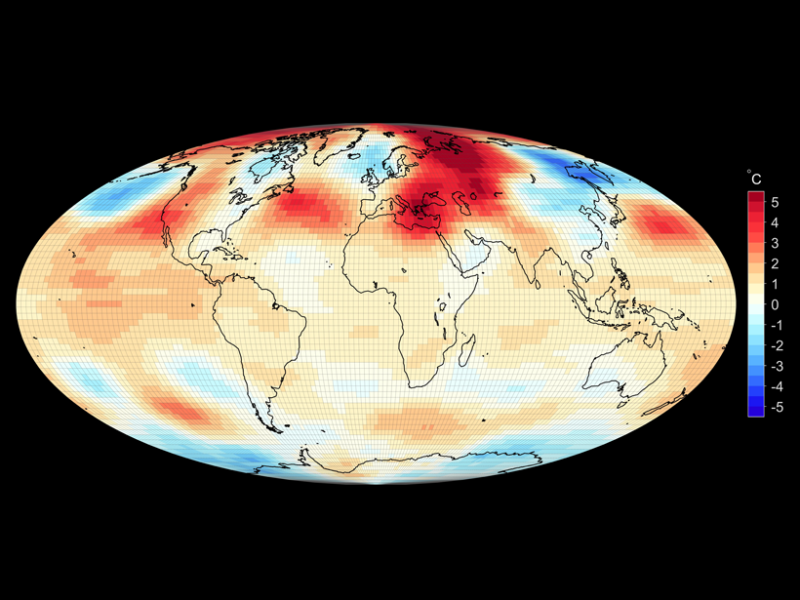
Temperature anomalies (deviations from the 1981–2010 monthly mean in degrees Celsius) estimated from advanced microwave sounding unit data for February 2016
Temperature anomalies (deviations from the 1981–2010 monthly mean in degrees Celsius) estimated from advanced microwave sounding unit data for February 2016. Estimates of their spatially averaged magnitude, using sum-of-squares-based average-deviation measures, such as the root-mean-square or standard deviation, would erratically overestimate their true spatially averaged magnitude. (Data are from the National Space Science and Technology Center, University of Alabama in Huntsville.)


Even as Category 5 Hurricane Irma churns toward South Florida (on its present track) there is renewed interest in the level of accuracy of climate change related forecasts. This is especially in terms of whether the intensity and frequency of major storms is increasing. I already dealt with a number of these issues in my Sept. 2nd post to do with climate troll Roger Pielke Jr.'s obfuscations. This post concerns advances in the statistics determining predictive accuracy for climate models, and how a new investigation discloses they may be more accurate than originally reported.

The new research, published by Cort J. Willmott, Scott M. Robeson and Kenji Matsuura shows that in fact our climate models may well have been more - not less -accurate than expected.  (Eos: Earth & Space Science News, September, p. 13).

As the authors note, all sciences use models to predict physical phenomena but the predictions are only as good as the models on which they are based. For example, in my paper Limitations of Empirical-Statistical Methods of Solar Flare Prognostication’ appearing on pp. 276-284 of the 'Solar Terrestrial Predictions Proceedings- Meudon'  e.g.
No automatic alt text available.

I noted the limits of prognostication for given  (magnetic, optical, radio) observational thresholds in respect of forecasting geo-effective solar flares. These are the flares that can interfere with communications on Earth as well as aircraft navigation controls. The problem is that the models in question were mainly hybrid, combining a lot of statistics with physical aspects, for example accounting for release of magnetic free energy in specific flares using:

/   t  {òv  B2/2m  dV} = 1/m  òv div[(v  X B) X B] dV 

 -   òv  {han | Jms |2 }dV       


The limits of climate models are also dependent on statistics - mainly the statistical assessment of errors in model prediction and estimation.   See, for example:

http://www.ipcc.ch

for recent IPCC reports that present commonly used estimates of average error to evaluate the accuracies of global climate model simulations.   There is also another recently developed model evaluation metrics package to be found at:

http://bit.ly/PCMDI-metrics

which similarly assesses, visualizes and compares model errors. In many ways, this is reminiscent of many of the papers appearing in the aforementioned Solar-Terrestrial Predictions volume, except the latter was focused on solar flares, CMEs and auroral substorms.  Another similarity is the climate package evaluated measures for the average differences between observed and predicted values for the root mean square errors (RMSEs, e.g.  s[x], s[y] ).

Willmott et al's contribution as noted in their paper is:

"We contend, however, that average error measures based on sums of squares, including the RMSE, erratically overestimate average model error. Here we make the case that using an absolute value–based average-error measure rather than a sum-of-squares-based error measure substantially improves the assessment of model performance."

They go on to note (ibid.):

"Our analyses of sum-of-squares-based average-error measures reveal that most models are more accurate than these measures suggest [Willmott and Matsuura, 2005; Willmott et al., 2009]. We find that the use of alternative average-error measures based on sums of the absolute values of the errors (e.g., the mean absolute error, or MAE) circumvents such error overestimation.

At first glance, the distinction between average-error measures based on squared versus absolute values may appear to be an arcane statistical issue. However, the erratic overestimation inherent within sum-of-squares-based measures of average model estimation error can have important and long-lasting influences on a wide array of decisions and policies. For example, policy makers and scientists who accept the RMSEs and related measures recently reported by the IPCC [Flato et al., 2013] are likely to be underestimating the accuracy of climate models. If they assessed error magnitude–based measures, they could place more confidence in model estimates as a basis for their decisions."

Willmott et al's  discovery of the acceptance of RSMEs is for sure a momentous find, and suggests a drastic need for re-assessment of climate model accuracy.  As they further explained above, this is not merely an "arcane" or esoteric statistical  issue:

Hence, their recommendation needs to be taken seriously by climate modelers, to wit:

"Our recommendation is to evaluate the magnitude (i.e., the absolute value) of each difference between corresponding model-derived and credibly observed values. The sum of these difference magnitudes is then divided by the number of difference magnitudes. The resulting measure is the MAE.  In effect, MAE quantifies the average magnitude of the errors in a set of predictions without considering their sign. Similarly, the average variability around a parameter (e.g., the mean) or a function is the sum of the magnitudes of the deviations divided by the number of deviations. This measure is commonly referred to as the mean absolute deviation (MAD)."

The authors most noteworthy conclusion is:


"Although the lower limit of RMSE is MAE, which occurs when all of the errors have the same magnitude, the upper limit of RMSE is a function of both MAE and the sample size (√n × MAE) and is reached when all of the error is contained in a single data value [Willmott and Matsuura, 2005].

An important lesson is that RMSE has no consistent relationship with the average of the error magnitudes, other than having a lower limit of MAE."


Adding:

"we concur with J. S. Armstrong, who after assessing a number of forecast evaluation metrics warned practitioners, “Do not use Root Mean Square Error” [Armstrong, 2001]. Only in rare cases, when the underlying distribution of errors is known or can be reliably assumed, is there some basis for interpreting and comparing RMSE values.

More broadly, comparable critiques can also be leveled at sum-of-squares-based measures of variability, including the standard deviation (s) and standard error [Willmott et al., 2009]. Their roles should be limited to probabilistic assessments, such as estimating the sample standard deviation as a parameter in a Gaussian distribution."

 
Given the propensity of the climate change denier (and obfuscator) brigade to impugn any climate modeling and the integrity of the models themselves, it is important these more refined error assessment and evaluation procedures be circulated and used.

In many ways the authors' advice in respect of climate model error assessment reminded me of my own advice to flare modelers using a multiple regression format. (say relating geo-effective flare frequency to sunspot area, A,  and magnetic class, C). That is, I advised that the optimum forecast accuracy was best approximated by use of the coefficient of multiple determination - or the percentage of total sample variation accounted for by regression on the independent variables (e.g. A,C).  I also strongly advised the use of Poisson statistics to ascertain the significance of solar events, including coronal mass ejections. 
 

Saturday, September 2, 2017

Climate Obfuscator Roger Pielke Jr. Strikes Again With Misleading WSJ Piece

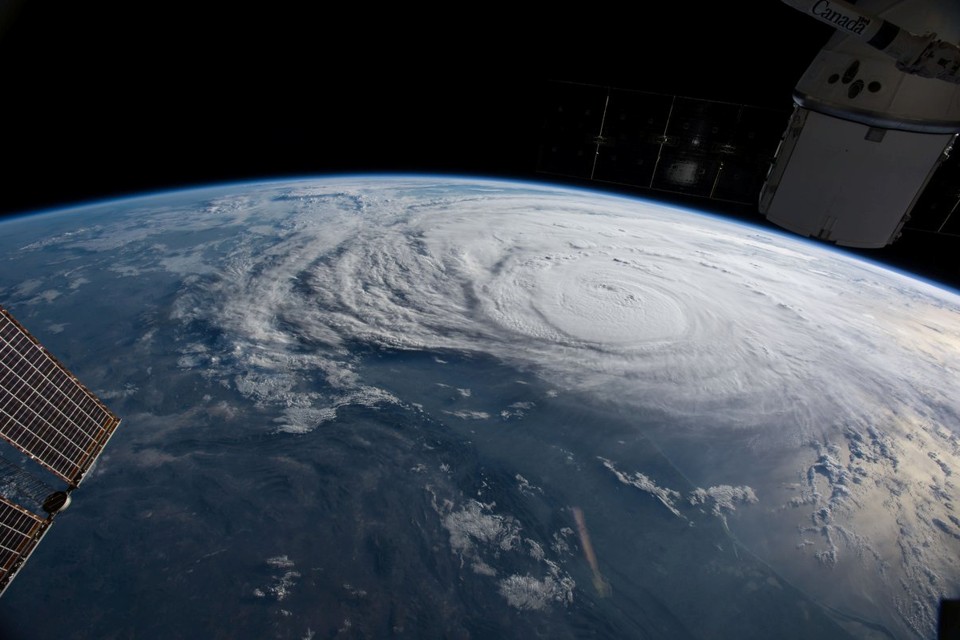
Hurricane Harvey looms off the coast of Texas, as seen from aboard the International Space Station.
Hurricane Harvey - merely an "overdue big One"?  So claims Roger Pielke Jr.

"Renowned Climate obfuscator" Roger Pielke Jr. (in the words of the science check website Skeptic Science), is at it again with his latest piece appearing in the WSJ :'The Hurricane Lull Couldn't Last', (Sept. 1, p. A15).  In it he merely used a probability argument to account for a hurricane like Harvey being "overdue" similar to one that I have myself applied to asteroid collisions, i.e..

http://brane-space.blogspot.com/2016/10/asteroids-celestial-swords-of-damocles.html

Or, transferred to Pielke Jr.'s case (ibid.):

"Because the world has experienced a remarkable period of good fortune when it comes to catastrophes, we are due".

In other words Harvey's arrival was a statistical probability "after a remarkable 12 years without being hit by a hurricane of category 3 strength or stronger."

Pielke Jr. also dismissed more frequent  flood disasters in the U.S.,  e.g.

"Neither has there been an increase in floods, droughts and tornadoes...."

Despite the fact SAME WSJ  noted this morning (p. A14):

"The U.S. has seen 20 storms causing a billion dollars or more in damage since 2010, not including Harvey, compared with nine billion-dollar floods in the full decade of the 1980s."

Earlier (Aug. 30, p. A1) noting that "seven major storms have hit just since 2016 including October's Hurricane Matthew and February's California flooding."

So the Pielke Jr. take that major climate-related disasters are "getting less"  in the U.S. is already exposed as blatant bollocks. These sort of shallow arguments I will go on to explode citing several sources vastly more authoritative than this fake climate guy. Pielke Jr. goes on to babble:

"For many years, those seeking to justify carbon restrictions argued that hurricanes had become more common and intense. That hasn't happened. Scientific assessments, including those of the Intergovernmental Panel On Climate Change and the U.S. government's latest National Climate Assessment, indicate no long term increases in the frequency or intensity of hurricanes in the U.S.."

The actual facts are somewhat more complicated than Pielke Jr. portrays.  According to SciCheck, a division of FactCheck.org:

"The most recent analysis of what’s known about the effect of climate change on hurricane activity comes from the June 28 draft of the U.S. Global Change Research Program’s Climate Science Special Report.  One of that report’s key findings said that human activities have “contributed to the observed increase in hurricane activity” in the North Atlantic Ocean since the 1970s. The Gulf of Mexico, where Harvey formed, is part of the North Atlantic Ocean.

The draft report echoes the findings of the U.N.’s Intergovernmental Panel on Climate Change’s 2013 assessment report, which found that scientists are “virtually certain” (99 percent to 100 percent confident) that there has been an “increase in the frequency and intensity of the strongest tropical cyclones since the 1970s” in the North Atlantic Ocean."

Adding:

"there is some uncertainty: The projections don’t yet align with the observed data on hurricanes because the data are “not of a high enough quality” to detect human contribution to the trend, the report says."

This is not at all surprising given that assessing human contributions to such a trend is effectively a stochastic analysis, not like one in celestial mechanics.  To nail the links down more securely we need more precise data on carbon depositions - as well as from other greenhouse gases such as methane. The sheer volume of such sources alone is staggering, encompassing the natural (e.g. melting permafrost in the Arctic) as well as the directly man-made (e.g. CO2 released from oil shale fracking operations).

What we DO know lies more in the way of ancillary thermal physics effects: for example, the planet is currently  subject to a radiative heating effect equivalent to 2.5 x 10 7  TJ injected each year into the atmosphere or roughly 400,000 Hiroshima size A-bombs.   This in turn conforms to the observed  addition of 2 ppm  per year  in CO2 concentrations and an associated heating increase per year of  2 W/ m2.    Result?  The temperature of the planet is currently out of balance by 0.6W/ m2  and this is almost entirely due to the annual rate of CO2 concentrations increasing. This is not due to any natural phenomenon but to human injection of carbon and other greenhouse gases into the planet's climate system.  

In other words, humans have - by fossil fuel activity -engendered a world with pronounced greenhouse dynamics.  The overall effect of such a greenhouse dynamic is warmer air which can hold more moisture. In addition, the warmer atmosphere causes evaporation to happen more rapidly. However, that alone doesn't explain the full role of the greenhouse effect on Hurricane Harvey.  Another consequence of greenhouse warming is that the oceans are absorbing CO2 and also becoming warmer- which in turn raises sea surface temperatures.

In effect, a large portion of Harvey's energy was fueled by very warm Gulf temperatures which rose to between 2.7 F and 7.2 F above average. Because of these high Gulf surface temperatures the original Tropic Storm Harvey progressed to a Cat 4 hurricane in barely 48 hours.

Climate scientist Michael Mann writing in the Guardian UK, invoked the well known  Clausius-Clapeyron equation  to ascertain that for every 0.5 C increase in warming there corresponds a  roughly 3% increase in average atmospheric moisture content.  For a climate 1 to 1.5C warmer than several decades ago this translates to an enhanced atmospheric moisture content of up to 9 percent. For Harvey, specifically, the sea surface temperatures were 0.5 - 1.0 C higher than current-day average temperatures, translating to 3- 5 % higher moisture content.   That in turn created the potential for the much greater rainfall in tandem with the effect of two subtropical highs which kept the storm in position an overly long time.  But again, this should not be confused with the intensity of the storm per se - tied to global warming - which was estimated yesterday at 1.2 inches of precipitation per hour for Houston.

Rice University climate scientist Jim Blackburn confirmed this connection and asserted that, in tandem with the destruction of nearby wetlands, the destruction wrought by Harvey was almost predicable - and "what all serious climate scientists have warned about". What about Roger Pielke Jr.? It appears he isn't a serious climate scientist at all but a climate science obfuscator along the lines of Willie Soon, e.g.

But Pielke Jr's antics precede him and have been pointed in details by Skeptic Science, one of the most useful resources - along with the site www.realclimate.org for exposing fake science and fake science news, as well as distorting, obfuscating op-eds like Roger Pielke Jr's.  

Pielke Jr. didn't come to more national prominence until cited by Nate Silver at his Five Thirty Eight blog, e.g.

wherein I noted "Pielke Jr. is no more a real climate scientist than I'm the pope."

I further cited one reviewer's take on Pielke Jr's book  The Climate Fix: What Scientists and Politicians Won't Tell You About Global Warming:

Pielke Jr. is really astonishing in the way he almost completely denies the urgent need to mitigate climate change by greatly lowering global carbon emissions. He does it in a very slick way by masquerading as someone with real and different solutions, when in reality all he proposes is that society do next to nothing about burning fossil fuels.
He basically brushes aside climate change as if it were a trivial concern." 

Skeptic Science picks up on Nate Silver's Pielke attributions and notes, for example:

"Nate Silver has launched a new FiveThirtyEight blog with the intent of applying his data-driven approach to a wide variety of subjects.  The problem is that Nate Silver is himself only one man, so FiveThirtyEight has hired a variety of contributors to write about the subjects that are outside his expertise and comfort zone.  For the topic of climate change, Silver decided to hire the renowned obfuscator Roger Pielke, Jr.

This was immediately disappointing for those familiar with Pielke's work, because FiveThirtyEight is a statistics site, and frankly Pielke is not good at statistics.  Instead, Pielke is known for taking a selective view of the peer-reviewed scientific literature in order to downplay the connection between human-caused global warming and extreme weather.  Predictably, Pielke's first two posts at FiveThirtyEight did exactly that, and included a litany of errors:
  • The headline and main point of his post are wrong.
  • He misrepresents his own research.
  • The references he provides don't say what he claims and don't support his argument.
  • Research he neglects contradicts his conclusions.
  • He doesn't include all available data.
  • He incorrectly claims that weather-related disasters aren't becoming more frequent.
  • He fails to account for the costs of improved technology and the damages they prevent.
  • He considers only land-falling hurricanes whose damages are highly variable.
  • His conclusions are contradicted by the increased intensity of North Atlantic hurricanes, and global warming's contribution to their storm surges and flooding"
In other words, Nate Silver blew it in terms of his information source for climate change.   Other Pielke Jr.  hijinks include:

Pielke's first FiveThirtyEight post begins by plotting global disaster economic losses, from data provided by reinsurance company Munich Re.  Except for some reason Pielke only plots the data from 1990 to 2013, when Munich Re provides data beginning in 1980.

Munich Re disaster losses

 Most damning in terms of Pielke Jr's WSJ piece:

"The Center for Research on the Epidemiology of Disasters also has natural disaster cost estimates ranging back to the year 1900.  And ironically, when Munich Re published its report, Pielke criticized them for only including data since 1980, saying,
"Thirty years is not an appropriate length of time for a climate analysis, much less finding causal factors like climate change"
Yet Pielke has dismissed climate change as a causal factor using data from just 1990. As it turns out, the positive trend in global disaster losses in the Munich Re data is almost 30 percent larger for 1980–2013 than it is for 1990–2013.  What's more, the trend in disaster losses for 1980–2013 is statistically significant at the 99 percent confidence level, whereas the trend for the 1990–2013 window cherry picked by Pielke is not statistically significant."

SO much for Roger Pielke Jr's. dishonest representations that natural disasters have not become more common and intense.   As Skeptic Science goes on to point out:

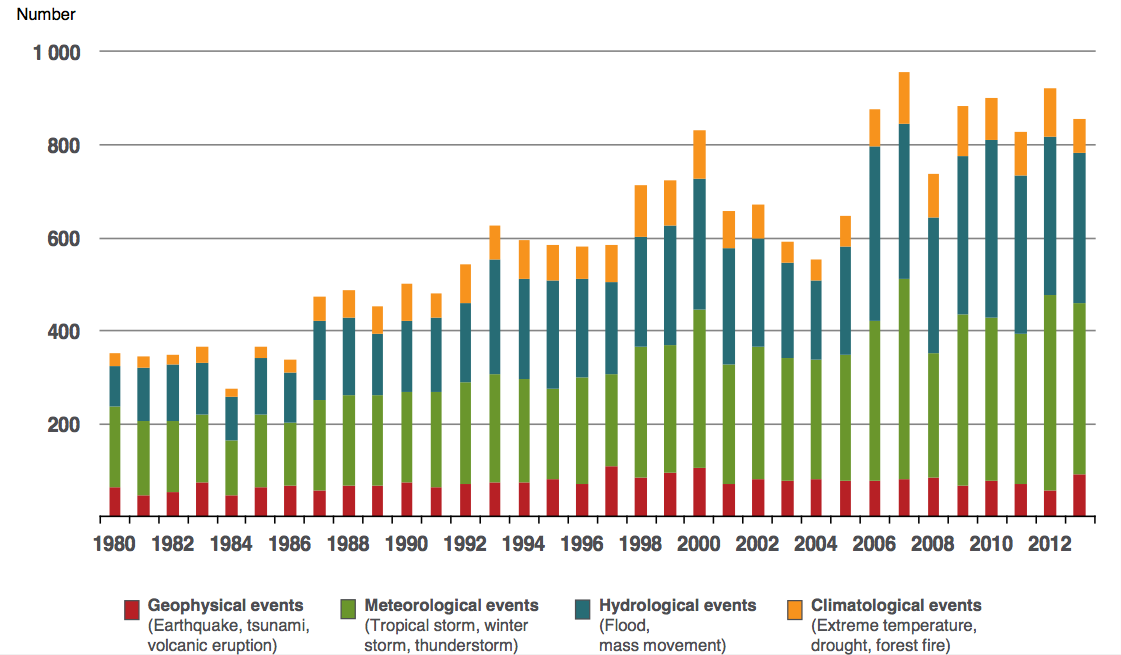
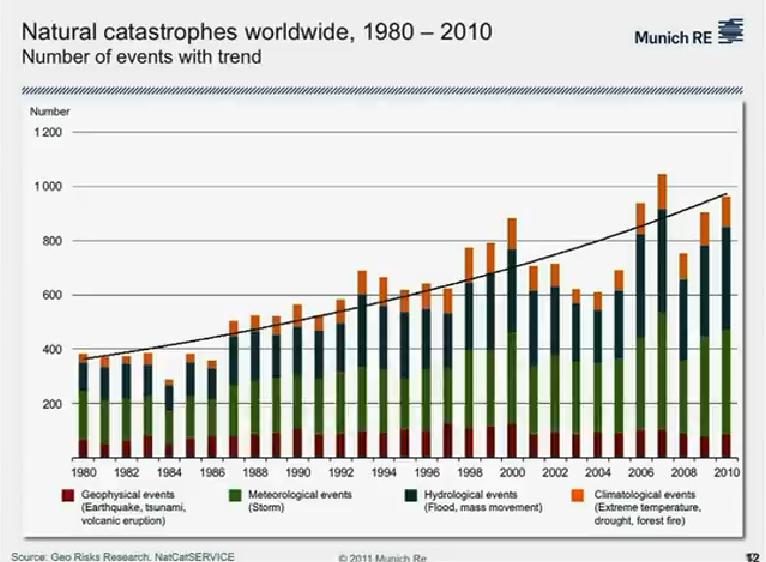
"To determine if weather disasters are becoming more frequent, you don't look at economic loss data.  Munich Re also provides data about the number of annual disasters, and the frequency of these events is indeed rising.  Pielke claims,
"When you read that the cost of disasters is increasing, it’s tempting to think that it must be because more storms are happening. They’re not."
They are unequivocally increasing as illustrated in the figures above and below.
Munich Re Disaster Frequency


Munich Re disagrees with Pielke on the answer to this third question, concluding following a study of "Severe Weather in North America" that (emphasis added),
"Among many other risk insights the study now provides new evidence for the emerging impact of climate change. For thunderstorm-related losses the analysis reveals increasing volatility and a significant long-term upward trend in the normalized figures over the last 40 years. These figures have been adjusted to account for factors such as increasing values, population growth and inflation ... In all likelihood, we have to regard this finding as an initial climate-change footprint in our US loss data from the last four decades."

Does Pielke Jr. deserve to have his work published? Of course!  But mainly in The National Enquirer and perhaps some graphic comics.

See also:

http://www.smirkingchimp.com/thread/amy-goodman-and-denis-moynihan/74892/hell-hath-no-fury-like-mother-earth-scorned

Excerpt:

"Writer and activist Naomi Klein has long made the connection between disasters and economic opportunism. A key ingredient, she says, is a compliant media. “You turn on any coverage, and you hear that word over and over again, but what you don’t hear, or you hear very, very rarely, is an explanation for why the word ‘unprecedented,’ ‘record-breaking’ — why these words have become meteorological cliches,” she said on “Democracy Now!.” “We hear them all the time, because we’re breaking heat records year after year. We’re seeing record-breaking wildfires, record-breaking droughts, record-breaking storms, because the baseline is higher.”

Klein continued: “Nobody is saying that climate change caused this storm. What we’re talking about are what are the superchargers of this storm, the accelerants that took what would have been a disaster, in any situation, and turned it into this human catastrophe.”

That is a central tenet of climate science: You can’t attribute any given weather event to climate change, but human-induced climate change is making extreme weather events stronger and more frequent, more costly, more deadly. While the people in Texas and Louisiana suffer the final days of rain and begin recovery, over 1,200 people have been killed by massive floods in Bangladesh, India and Nepal. The planet is drowning in denial. Climate change is real, and needs to be addressed."

Sunday, July 5, 2015

Do We Need A Google "Truth Algorithm" For Web Searches?

Back in March, Google announced a new search algorithm that would display websites and news stories based on their factual content at the top of the list and the factually-deficient results at the bottom.  This is radically different from current practice where Google puts the top read results at the top and less read to the rear. But is this the way it should be, given people may be reading too much bollocks and not enough factual, scientific material?

Should creation science websites or climate denier sites be at the top of searches because  most people read them, or at the bottom because they are not factual? If the former is acceptable, then really all we have is a popularity contest. Is that valid for those seeking genuine information as opposed to PR and nonsense?

Interestingly, when Google first announced this new search program, there was instant blowback and outrage from FOX News (which consistently ranks low in accuracy at Politifact.org and Factcheck.org.) Why would FOX be howling its head off? Maybe, just maybe because their honchos know most of what they put out there is gibberish and distortions. From O'Reilly to Hannity and Fox n' Friends, none of it can be trusted.

FOX wasn't the only bunch screaming. Others included: climate change deniers, Vaxers (those against childhood vaccinations), and birthers.  Again, why are they howling like stuck pigs if they are offering valid information? There'd be no reason for such outbursts.

Sadly, Google has no plans to start using the program but it's interesting to consider the uproar if they did given all the liars, PR-mongers, disinformationists and others would have to come out of the woodwork. They'd not sit still or remain quiet given it might jeopardize their interests.

But think of the benefits!

For example, employers could fact check job candidates' resumes and LinkedIn pages, identifying bogus credentials including inflated education credentials that might eliminate many job seekers on the basis of fudged resumes.

Even more importantly, kids and others interested in advancing their educations on the subject of climate change, evolution and American history wouldn't be driven first to nonsense sites such as those of Roger Pielke Jr., Ken Ham and the history revisionist Larry Schweikart, see e.g.

http://brane-space.blogspot.com/2014/08/48-liberal-lies-how-about-50-tea-party.html

Imagine how much more efficient educational web searches would become if all the detritus could be instantly ranked at the bottom instead of the most relevant and factual material - forcing truth seekers to plow through page after page, even after refining searches.

But it seems this is what we will have to settle for until Google implements its truth algorithm. That means facts and truth will not come easily but only after diligent work. Of course, in this quest reading can also do wonders, because it upends the popularity ranking systems prevalent for existing web search engines.

Point of fact, babble such as put forward by the likes of  Larry Schweikart, Ken Ham or Roger Pielke Jr. wouldn't stand a chance at being seen as credible if people read more diligently from the pool of books shown to be factual or scientific. Books such as Darwin's Origin of Species, and James Loewen's tour de force ('Lies My Teacher Told Me') exposing the bogus American history taught our kids- but more importantly also disclosing the actual history omitted!

Moral of the story: read first, or at least read to check any web searches you pull up - don't just accept the first ones as the factual ones.

Saturday, April 19, 2014

"Liberal Fascism" is an Oxymoron. It Doesn't Exist Except in Right Wing Brains!


The term "liberal fascism" has become increasingly fashionable to bandy about but mostly in right wing circles because this enclave of under-educated folk don't know the difference between any of the historical political-economic systems, whether fascism, socialism, or Neoliberal capitalism. Hence, it's no surprise the term would be misused.

What prompted the Right to inject the boogeymen of liberal fascism into the ongoing cultural wars? Well, a sequence of incidents. First you had the way most of us in the liberal spectrum came down like a ton of bricks on Nate Silver for hiring climate denier Roger Pielke Jr on his Fivethirtyeight blog. Then there has been the massive criticism of the Right - as in the 'Hobby Lobby' case, trying to exploit the specious "religious liberty" theme to justify aborting the contraceptive sections of Obamacare. Finally, there was the Brandeis University announcement that it would rescind an honorary degree it planned to award to Ayaan Hirsi, a best selling author and critic of Islamo-fascism.

Brandeis’ decision to cave has been described (even in liberal quarters like salon.com)  as arising from pressure by the left-wing/Islamofascist militants and thus canceling Hirsi Ali’s honor has been castigated by champions of freedom around the world..

Here, we need to back up and explain that there is no such thing as a "left wing Islamo-fascism"  no matter what the militants call themselves. This would have about as much "left wing" bona fides as Hitler's National Socialist Party would have socialist bona fides. (Leading to the continued confusion that remains today between genuine socialism - which is wholly left wing - and Hitler's Right wing version). IF "left" is synonymous with Liberal, then no kind of fascism can be permitted. Fascism is a creature of the Right, not the Left, and has been since the days of Hitler and Mussolini.

 
It is instructive here to consult Douglas Rushkoff's  Chapter Four ('Individually Wrapped').  in  his  book, Life Inc. - How Corporations Conquered the World and How We Can Take It Back.   He
 
observes (p. 109):

"American corporatists saw in fascism a counterbalance to FDR's strong-handed tactics and aggressive social welfare programs.....Henry Luce, a co-founder of TIME magazine, put Mussolini on the cover five times and traveled the country arguing that corporations - not government - were really in charge of America.  Luce convinced many business people that fascism might be corporatism's best hope for organizing and influencing people."


One is led to question why  American corporatists would want to invoke fascism to offset FDR's pro-government programs. There are several reasons, all of them tied to the historically accepted characteristics of fascism and germane to Rushkoff's point, as well as mine, i.e. that liberalism and fascism are counterpoised:

Corporate Power is Protected -- The industrial and business aristocracy of a fascist nation are often the ones putting government leaders into power, creating a mutually beneficial business/government relationship and a power elite.  This automatically sets domestic non-military and social insurance programs in opposition, and at risk - from the nascent pro-corporate economic structure.


Labor Power is Suppressed -- Because the organizing power of labor is the only real remaining counterbalance to a fascist government, labor unions are either eliminated entirely or are severely suppressed. We have seen this happen progressively in this country as unions have all but vanished from the landscape and are mightily resisted where they might find new places to begin.


Supremacy of the Military -- Even when there are widespread domestic problems, the military is given a disproportionate amount of government funding, and the domestic agenda is neglected. Soldiers and military service are glamorized.  This is deliberate in all fascist nations-systems, given their opposition to providing domestic social insurance for the masses. Thus, if the military spending can be made large enough it can deplete the tax commons to the extent that inadequate money is available to support social -domestic needs.

Obsession with National Security -- Fear is used as a motivational tool by the government over the masses and special attention is focused on those who complain about inadequate domestic resources, say because they are at the mercy of increased military spending and inciting wars by which to validate such spending.  If then a "boogeyman" can be created and sustained it can also be used to mute the demand for addressing domestic needs.  Create a system of color -coded alerts or 'warnings' then you keep most people in tow, and also the critics at bay.

The 1983 American Heritage Dictionary defined fascism as:

"A system of government that exercises a dictatorship of the extreme right, typically through the merging of state and business leadership, together with belligerent nationalism."

The U.S.-based  dictionary definition has gotten somewhat squishier since then, as all the larger dictionary companies have been bought up by multinational corporations (e.g. Bertelsmann AG, NEWSCorp etc.), who would be more invested in obscuring key definitions to align with their corporatist bias.

Benito Mussolini, however, was quite straightforward about all this. In a 1923 pamphlet titled "The Doctrine of Fascism" he wrote,

"If classical liberalism spells individualism, Fascism spells government."

But not a government of, by, and for (We)  The People - instead, it would be a government of, by, and for the most powerful corporate interests in the nation. In 1938, Mussolini brought his vision of fascism into full reality when he dissolved Parliament and replaced it with the "Camera dei Fasci e delle Corporazioni" - the Chamber of the Fascist Corporations. Corporations were still privately owned, but now instead of having to sneak their money to folks like John Boehner and useful idiots like the Tea Partyers, they were openly in charge of the government.

The above preliminaries are useful in parsing salon.com writer Alex Pareene's take:

 All of these seemingly unconnected incidents can be understood with one simple word: fascism. Liberal fascism. “Fascism” as a term has been abused by leftists over the decades, but it is a definable and concrete thing. Essentially, fascism is when a bunch of people criticize something they disapprove of or are offended by, and ask that the thing or person that offends them not be rewarded in some fashion."

But as we've seen,  fascism is a lot more complex than merely a "bunch of people criticizing something they disapprove of or are offended by, and asking that the thing or person that offends them not be rewarded in some fashion." 

This is what I would call the "elementary school version" of fascism.  Comprehensible to those at the fourth grade level - i.e. grasped easily in the personal antagonism 'he said-she said' domain, but unfitting for an adult of even moderate intelligence to really grasp what fascism is about.

As for "liberal fascism" it can only make sense in the cartoon context Pareene describes, but not in the formal definitional sense.

If you're at a cocktail party and engage in a political debate (not advised), don't interject "liberal fascism" unless you want to be thought of as an over-sized, ill-informed 4th grader!
    

Sunday, April 13, 2014

Again: Why An Ideology Is Needed If One Seriously Blogs

Readers who arrive at this blog (Brane Space) know after a few scans of my posts that I come from a definite political and economic view point and ideology which includes:
 
-Anti -Neoliberal
 
- Anti-War (unless domestic security is really threatened)
 
- Anti- Bush Tax Cuts or ANY Tax cuts (and Pro-Higher Taxes for Most Americans to pay for the needs and benefits most of us take for granted. Oliver Wendell Holmes: "Taxes are the price we pay for a civilized society")
 
- Pro-environment (No, not a 'tree hugger' but if you don't accept global warming, you're an idiot.)
 
Anti- American Exceptionalism (I don't buy exceptionalism for any nation!)
 
Anti-NSA mass surveillance (In favor of getting rid of all the NSA prying programs, PRISM,  MUSCULAR, XKeyscore, etc.)
 
Pro-Transparent Government and Pro-Whistleblower ("When the government knows more about you than vice versa you have tyranny. When the reverse is true, you have freedom")
 
Pro-Socialism - to more evenly distribute the wealth of this nation from the hands of the few - like the Kochs.
 
If people don't like this POV they generally will not stop by this blog but go to one more in line with their own political, economic predilections.
 
Lastly, my ideology as summarized above isn't based merely on "opinion" but was honed from decades of individual research over broad areas. Thus, my POV represents in many ways the distillation of that accumulated knowledge  with critical thinking applied. I sincerely believe every citizen has the right to offer opinions, but those invested with scientific, historical and economic insight are to be valued more especially if critical thinking is also applied. Thus, not all ideology is created equally and having an ideology just for the sake of such is a fool's errand.
 
 
As I noted in a previous post, to do with why Obama failed to become transformative:


It is ideology that gives one’s world and perceptions context and color. If you lack an ideology, as an old logic teacher once put it to me, then you will find yourself cast adrift and swayed by any and every meme, blabber or blowhard that might try to influence you

 
This is germane now as we’ve recently beheld a spate of mainstream bloggers  (Ezra Klein, Nate Silver and Jonathan Chait) who have lost their vision – indeed assuming they ever had one – bringing back what media critic and New York University professor Jay Rosen has famously called “the view from nowhere,”.  As described in a recent piece on the three hotshots in salon.com, Rosen refers to:

a bid for trust that advertises the viewlessness of the news producer.”


In other words,  no central point of view, no singular perspective in evidence. All POVs are equally correct in the world of nebulous, Neoliberal political mumbo –jumbo.   Rosen does grant that this inclination to be “objective” is not always bad. Indeed, journalism is impossible if its practitioners don’t acknowledge the existence of at least some kind of baseline objective reality. However, as the author of the salon.com piece observes:

 
But the view from nowhere is more often a self-flattering and ass-covering gimmick, one that is intended to protect the journalist from receiving criticism for partiality but often leaves the reader less informed as a result.”

 In this case, we behold the Neoliberal stock- in -trade which treats “two sides of an issue” in the same manner as objective reporting – when there’s really no relation. Two sides of an issue is balderdash. There are not “two sides” to whether the Holocaust occurred. It did, full stop. Period. There are not two sides either to whether climate change is real and human-generated. The evidence is overwhelming and only knuckle draggers and flat Earthers disagree. The effort to present two sides of an issue when the issue has already been settled in reality is therefore to run from objective reality not to embrace it.

But because the political pool has become so contaminated by Right wing nonsense and spin, too many mainstreamers (and bloggers – like Nate Silver) are chicken shit to accept the objective findings- say for global warming – which discloses the Left is more totally accurate in tune with the findings  than the flat Earth Right. Thus, they fear PARTIALITY or informed ideology when it is in fact aligned with reality!

Of course, FOX News also has an ideology, but it is largely uninformed and distorted. Recall that I also noted (in my earlier link above) that:

Of course, one always checks his ideology against reality, this is important!

Alas, the FOX-ites seldom if ever do this! This is why they are so wrong on climate change and why they actually had to get Neil deGrasse Tyson to try to explain it to them ("Fox and Friends") – with meager success.

The problem with bloggers like Nate Silver, as I pointed out, is that when they hire climate nebulizers like Roger Pielke Jr. on the new version of FiveThirtyEight they are essentially disclosing how little objective knowledge or insight they themselves have into the existing science.  They need to hire a right wing propaganda meister to help them out.  As the salon.com report observes: “ the Pielke Jr. experience brings to mind Mark Twain’s famous quote that there are “lies, damned lies and statistics.” The view from nowhere is no less problematic when it’s festooned with numbers”..

 Indeed, which is why it is so sad that a guy supposedly well versed in numbers and excellent in political statistics, could fail so badly in terms of processing climate science data.  Again, I attribute most of this to not having been exposed adequately to the science but also being too ready to adopt the useless “view from nowhere” -  which is of little use to his blog readers.

 
Then there is Ezra Klein, one of the many journalists who built a successful career by coming out of the blogosphere and tweaking old media for its faux-objective habits. But, incredibly,  who then began telling people that his much-anticipated new website’s goal would be to “explain the news” to readers. Are you kidding me? Explain the news? What? You have that little regard for your readers?  I don’t presume to “explain the news” to readers here on Brane Space. I see my blog more as the final, ultimate “bull shit filter” – after readers have already been inundated with tons of faux news and Neoliberal PR, whether about the economy, the Ukraine, health news, science or some facet of our bought out political system. Thus, given the POV and ideology noted at the top of this post, I can more easily discern the bullshit being endlessly fed to the public by the Neoliberal media and share it with others.

 
Klein’s blog Vox, actually had an inaugural post  that pronounced that its “end goal” wasn’t “telling you what just happened, or how we feel about what just happened,” but rather to “make sure you understand what just happened.” Suddenly Klein, the guy who cut his teeth at the liberal American Prospect, was telling readers he could make them “understand what just happened” without “telling you … how we feel about what just happened.”

 
In other words, Klein,  like his "viewless" compatriot Silver, had descended to the level of a useless Neoliberal parrot and nabob.  Jeezus Peace! Don’t we have enough of these characters? We don’t need more parrots but we do need many more serious Blogger BS filters since there’s so much bullshit manufactured in this country per second (as comic George Carlin once noted) that I’d have to write 45 blogs a day to cover it all. And I don’t have that much time. (Carlin also observed, in one of his skits, that bullshit is this country’s largest product and most consumed around the world.)

 
But why be surprised  at Klein, who dropped his liberal ideology as soon as his  mainstream star began to rise and the Neoliberal Beltway Bozos began taking him seriously as the “Voice”. The twerp actually disavowed liberalism, telling the New Republic’s Alec MacGillis:


 I don’t really think of myself as a liberal. That’s not the project I’m part of, which is to let the facts take me where they do.”

So, okay, if any ensemble of facts points to a conclusion that a liberal would accept than you’d dismiss them?  In fact, Klein here reveals himself as just another Neoliberal gasbag like so many others, at politico, or wherever the Neolib hacks reside on the blogosphere.

But I gathered as much about Klein when the guy appeared on Rachel Maddow’s show some time ago, in a segment to do with Obama's proposed Chained CPI.  After Maddow’s usual long –winded intro, Klein appeared with his toothless smile, explaining the Repukes were merely "hyping" it and Obama "wouldn't really do it". This despite that anyone who could read and had a newspaper subscription knew better. And this is the cat that wants to “make sure” we understand what’s going on? He’s joking for sure!


Incredibly, Klein’s lead-off big piece for Vox was a story about “how politics makes us stupid” that focused on yet more research showing that smart, highly informed people were in fact often more rather than less likely to let their fundamental values and beliefs change the way they interpreted new information. By choosing to get things started with a piece about the inescapable nature of subjectivity, Klein seemed to be making a subtle recognition that no one can “explain the news” without having their own biases color their explanation.  In other words, the twerp ended up reinforcing my point that ideology operates as one’s fundamental compass to make sense of the world  (again, so long as it jibes with reality!). The problem is that little Ezra wants you to believe that HIS bias trumps yours in explaining the news.

On the other hand, here on Brane Space, I merely present a kernel of discrete (political, or economic or scientific) material  per day, with most of the BS removed, and you can decide for yourself if that is acceptable, or you want to filter out even more.  I don’t presume to tell the reader that this and only this is what I expect you to leave with.


Lastly, Jonathan Chait’s “view from nowhere” shtick has been exposed in the salon.com piece by Elias Isquith which noted:

Chait’s argument is a bit complicated and, going by defenses he’s mounted both on his blog and on Twitter, not intended to be read as an analysis of race in modern America but rather the way political partisans talk about race in modern America. This strikes me as an extremely played-out and uninteresting topic to write a long essay in one of America’s most-respected magazines about — which may explain why the headline and the subhead of the piece imply it’s about America and race, not Fox News and MSNBC — but maybe people who are less immersed in the daily political squabbling of the Obama presidency than I will find it to be of interest. (Slate’s Jamelle Bouie has written a definitive takedown of the piece here, and the response from Salon’s Joan Walsh is well worth reading, too.)
Again, as Isquith points out, “nearly everything wrong with the article can be explained by Chait’s curious and unfortunate habit of presenting himself as the only reasonable man in the room. Or, to put it differently, his implication that he’s best able to judge competing claims of racial demagoguery because he holds the view from nowhere.”

In this his shtick is curiously like Klein’s and Silver’s.   If a person then is terrified of partiality or ideology,  and if it makes his or her skin crawl, then he is obviously best served by frequenting  Silver’s 538blog, Klein’s Vox and Chait’s. They can sleep easy and doubtless the toneless language (almost imaged from a cyborg) will help assuage all cares. 

If, on the other hand, people can handle a definite ideology and viewpoint (again, predicated on research, information that is often hidden by the mainstream media)  in viewing national or world events, as well as some harsh lingo from time to time (no mincing of words in the never-ending goal to expose Neoliberal bullshit) you’ve come to the right place here – on Brane Space.

One thing you may be certain of: Brane Space will not mutate into another 'VOX'!

See also:
http://smirkingchimp.com/thread/norman-solomon/55346/why-we-need-media-critics-who-are-fiercely-independent