Showing posts with label Entropy. Show all posts

Tuesday, March 31, 2020

Looking At Entropy and The 2nd Law Of Thermodynamics

Two general statements applicable to heat engines-cyclical machines, provide a basis for the Second Law of Thermodynamics: 1)  The Kelvin-Planck statement, and 2) the Clausius Statement. Hence, it is worthwhile to first examine each in turn:

I) The Kelvin -Planck statement:

It is impossible to construct a heat engine, operating in a cycle, which produces no other effect than absorption of thermal energy from a hot reservoir and the performance of an equal amount of work.

Does a refrigerator not qualify? NO! Because it is simply a heat pump (cf. Fig. 1) operating in reverse. Thus in this case the engine absorbs heat Qc from the low temperature or cold reservoir and expels heat Qh to the hot reservoir. In other words, it can be depicted by Fig. 1 with the thermodynamic arrows reversed


Then, the work done is: - W = Qc - Qh or, Qh = Qc + W (e.g. heat given up to hot reservoir equals the heat absorbed from the cold reservoir).


II): The Clausius statement:

It is impossible to construct a cyclical machine that produces no other effect than to transfer heat continuously from one body to another at higher temperature.

*Entropy:

Given the Kelvin-Planck and Clausius statements regarding the 2nd law of thermodynamics, it is evident that since a perfectly 100% efficient cannot be constructed, then inefficient engines will reign and that means waste heat given off or manifesting as increased disorder. This disorder,  which refers to cohesion of states in matter is what we call entropy, often denoted by the symbol S.

All isolated systems then tend to a state of disorder and entropy is a measure of that disorder. A general result (from a field of physics known as statistical mechanics) which can be stated is:

“The entropy of the universe tends to increase in all natural processes.”

In thermodynamics at this level, however, what most concerns us is the change in entropy of a system.  A general principle to do with this can be stated:

The change in entropy DS of a system depends only on the properties of the initial and final equilibrium states.”

Example

In the case of an engine performing a Carnot cycle  (Fig. 2)running between hot and cold temperatures Th  and Tc

One finds:

DS =  Q h/Th   -  Q c / Tc  

And since we showed previously for the Carnot cycle:

Q h/Th   =   Q c / Tc  

Then:  DS =  0

One can generalize to state that for any reversible cycle:


dQ r /T  = 0

Which implies that the entropy of the universe remains constant in any reversible process.

 Quasi-static reversible process (Ideal Gas):

Of more practical application is the quasi-static reversible process, say applied to an ideal gas. In this case, we consider an ideal gas which goes from an initial state of temperature and volume (Ti, Vi)   to a final state (Tf, Vf).    

By the first law of thermodynamics:

dQ = dU + dW = dU + p dV

For an ideal gas:

dU = n C v,m dT and P = nRT/V

So that:

dQ = n C v,m dT +  nRT (dV/V)

To integrate the preceding, we need to divide through by T:

Þ  dQ/ T = n C v,m dT/T +  nR (dV/V)

And this is to be integrated between limits corresponding to the initial (i) and final (f) states. Thus the change in entropy, DS :

DS = òf i   dQ/ T = n C v,m   òf i   dT/T +  nR  òf i  (dV/V)


DS =   n C v,m    ln (Tf/Ti)  + nR ln (Vf/Vi


Change in Entropy for Reversible Process:

In the case of a real, irreversible thermodynamic process, consider:-

a)The case of heat conduction and the one way loss of heat (Q) from a hot reservoir (at temp. Th ) to a cold sink (at temp. Tc). Then at the cold sink  heat increases by Q  / Tc  while at the hot source, heat decreases by Q / Th  . The change in entropy is then:


DS =  Q  / Tc  - Q /Th    or, since Tc  < Th  :

 D S >  0

b) Free expansion:

We consider a treatment of a system equivalent to an isothermal, reversible expansion such that W = 0, Q = 0 and DU =  0, we have:

DS = òf i   dQ/ T = 1/T òf i   dQ


Here: dQ = W(i® f) = nRT  ò Vf Vi  (dV/V) = nRT ln (Vf/Vi

Note:

In the preceding case, the process must be performed very slowly to approximate an adiabatic free expansion.

Thought Challenge:

Technically speaking, the 2nd law of thermodynamics applies only to closed systems. Solar radiation injects on average 1360 watts per square meter onto the Earth's surface, or 1360 J each second per sq. meter.

Given this fact, and that plants absorb a good deal of this for the process of photosynthesis, show why the creationist argument that "evolution violates the 2nd law of thermodynamics" doesn't hold up. (Hint: NO quantitative work is needed!)

Wednesday, December 26, 2018

Solutions To Statistical Mechanics Problems (1)

1) Quantify the magnetic energy for the system at time t(o) compared to time t(o) + t, if the magnetic energy of one spin magnet can be written:

M = - m B cos Θ 

where m  is the magnetic moment (-eL/2m, L = 1) and assume Θ = +/- π, and B = 0.1T. 


Solution:

For the elementary spin magnets in the system, the orientation of the up spins is such that  Θ =  90 deg, so   cos Θ  =  1.  Given the orientation we may use for the elementary spin magnetic moment:  m s z  =   L  (given the spin is aligned with z-axis)

where:     u B = 9.27 x 10⁻²⁴ J/T  is the Bohr magneton

Then the magnetic energy difference for the spin states at   t(o) compared with  t(o) + t, can be written:

D M =  12 m s z B cos Θ    =   {12  ( 9.27 x 10⁻²⁴ J/T)  (0.1T)}  =  1.1  x 10 -23 J

2)  Say that S = log (g) determines the entropy for a  simple statistical mechanical system, where g denotes the number of accessible states. Then estimate S for the 2D ice crystal model - including any errors that might enter.

Solution:

In the Ising model case applied to the ice crystals, the energy is the sum of interaction of all adjacent squares. The contribution  of each pair of neighbors depends only on their colors. Since the total number of white squares is fixed, it is proportional to the total length of the contours separating white from blue.    Thus:

Energy = 2 × Length of contours

The key to successful solution here is to note that white squares save energy by clumping, but low energy does not automatically imply high probability (i.e. associated with the highest entropy state).  Then, as an approximation, we take the clumped contours (if readers have performed the contour-drawing exercise) to be higher order (analogous to the spin ups in the ferromagnetic system) and non-clumped "singletons" to be lower order,analogous to spin downs.

From the contour sketch there are 4 clumped states, and 5 non-clumped or singleton (lower order) states. Thus, there are 5 accessible (higher entropy) states for the system.

Then:

S =  log (g)  =  log (5)  = 1.6

Approximately. (Remember, 'log' here refers to base e log, not base 10!)

Obviously, errors could enter if the contours (yielding clumped, non-clumped crystals)   are incorrectly drawn.


Tuesday, December 18, 2018

Statistical Mechanics Revisited (1)

Statistical mechanics (also statistical physics),  is that branch of physics  (according to Britannica.com) that combines the principles and procedures of statistics with the laws of both classical and quantum mechanics, particularly with respect to the field of thermodynamics.  This definition is useful for our purposes but also leaves out a lot, namely that what we have is a detailed probability theory (as mathematics oriented to physical states and spaces) applied to the behavior of microscopic particles.


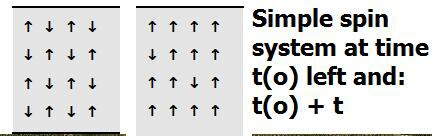
The "Ising model" is central to many problems and systems in statistical mechanics.  It first came to the fore in the study of ferromagnetic systems. It was found that the use of such simplified models paved the way for greater understanding via modeling of more complex systems.  Let's now look at an elementary, statistical mechanical spin system.  A fairly  mundane example is a two-dimensional Ising model for ferromagnetic matter. It contains magnetic domains for which the individual spin magnets can be subject to sudden reversals. For a simple example, think of the 2D model of 4 x 4 elementary spin magnets as shown below:
Related image
 
Here the Ising model system, by virtue of undergoing spontaneous magnetization  discloses an evolution to a higher degree of order  (from state S(1) to state S(2)) at the later time t(0) + t, where t could be in billions of years or nanoseconds.

The degree of order, as well as information, is determined from what is called "the spin excess", or the net spin difference (up minus down or vice versa). The larger this number, the greater the degree of order, and the lower the entropy of the system. Obviously, since 0 denotes an extremely low number, we can deduce large entropy.

Consider the system S(2) in more detail, noting the right side orientations of the elementary spin magnets. Here we get: 14 spin ups - 2 spin downs = 12 spin ups, or in other words the spin excess = 12. This system, S(2), has much higher degree of order (less entropy) than the system S(1). (We should add here that higher entropy - as in S(1) - corresponds to the most probable state, defined by the minimal spin excess of zero.)


Accessing such simple systems allows us to infer fundamental measures applicable to the systems, for example the "magnetic moment" of a state, as well as the "degeneracy function". Consider an N= 2 model system with either 2 ups (two up arrows) or 2 downs. 

Then, if  m  denotes the magnetic permeability we can have:

M = + m   or M = -2 m

where the first is the magnetic moment for two spin- up particles, and the second for two spins down. One can also, of course, have the mixed state inclusive of one spin up plus one spin down, then:

M = O m or O

Meantime, the degeneracy function computes the number of states having the same value of m (individual spins) or M such that:

g(N,m) = N!/ (½N + m)! (½N - m)! [Mav]


where [Mav] denotes the average value of the total magnetic moment summed over all states (e.g. with ms)

The power of the Ising model, however, doesn't end with ferromagnetic systems. We can also use it to examine ice crystal configurations as has been shown in a recent paper by Andrei Okounkov (Bulletin of the American Mathematical Society, Vol. 53, No. 2, p. 187).  In this paper the author presents us with the 2D ice crystal Ising model shown below:
No automatic alt text available.

Each white square denotes an ice crystal and the blue areas represent separating media. Certain model stipulations apply as given in the paper: 1) the total number of white squares is fixed, just as the total number of elementary magnets in the earlier system; 2) all squares along the boundary are deemed blue in order to prevent crystals sticking to the sides of the container, and 3) It must be possible to assign probabilities to the configuration in the same way we might assign "order" or entropy to the ferromagnetic system.

The most basic probability for any such system is "thermal equilibrium". Thus, at some temperature T if the system attains thermal equilibrium then the probability of any particular configuration decays exponentially with the energy of C, which is analogous to E 
 m  B in the ferromagnetic case. The probability of any particular configuration dependent on T is then:

Prob (C) = 1/ Z(T) [exp (-Energy (C)/ kT)

Where k is Boltzmann's constant, 1.38 x 10 -23  J /K.

One will also make use of the  "partition function":

Z(T) =  
å C   exp (- Energy (C)/ kT)

which as Okounkov notes, really functions as a "normalization factor"  given that it "makes the probabilities sum to 1".  In this Ising ice crystal model, then, the energy is "the sum of interactions of all adjacent squares." Since the total number of squares is fixed (see stipulation (1))  then the energy must be proportional to the total length of the contours separating white from blue.

To identify the contours is easy. If the energetic reader will run off  a copy of  the image of the 2D rectangle, then take a black magic marker and trace around each ice crystal region as it appears, he will have generated the contours. The normalization for energy is then (op. cit.):


Energy = 2 x Length of contours

As in the case of the ferromagnetic system entropy competes with order (energy).  In the Ising ice crystal energy is saved via clumping. If we designate an "order parameter" such that  
b = (kT)-1  then in the ice crystal case the larger   b   the stronger tendency for order. Interestingly, as Okounkov notes there is a critical temperature  Tc  > 0 above which entropy wins, it is:

b  =  0.5 ln ( 
Ö 2    + 1)  

Below Tc  and for ice crystal concentrations above a certain threshold a crystal will form as the size of the container goes to infinity.

Problems:

1) Quantify the magnetic energy for the system at time t(o) compared to time t(o) + t, if the magnetic energy of one spin magnet can be written:

M = - m B cos Θ

where  is the magnetic moment (-eL/2m, L = 1) and assume Θ = +/- π, and B = 0.1T. 

2)  Say that S = log (g) determines the entropy for a  simple statistical mechanical system, where g denotes the number of accessible states. Then estimate S for the 2D ice crystal model - including any errors that might enter.


Thursday, December 29, 2016

Earth "Over Shoot Day" By 2030 - What Will We DO To Avoid It?


Graph showing absolute 'two planet' overshoot by 2030. This assumes 'business as usual' which will be the case certainly in "Trump world".

As we approach a new year it is useful to think about the planet's limited resources, our stewardship of them and the potential for overshoot. Even moderate UN scenarios suggest that if current population and consumption trends continue, then by the 2030s we will need the equivalent of two Earths to support us. Of course, we only have one, and that is now badly polluted, including with coral reefs dying throughout the world's oceans,

.
Too many of our citizens fail to appreciate that every energy conversion process has as an accompaniment entropy, or disorder. In most cases this appears as waste heat, as well as pollutants. For example, a car engine produces carbon monoxide as well as carbon dioxide and waste heat generated via the internal combustion engine.  The 2nd law of thermodynamics or entropy law  states that the expelled gas constituents cannot ever be combined again to produce the original fuel. In other words, resource consumption here is a one way process. Resource extraction, such as oil shale fracking also has many adverse effects on the terrestrial environment, apart from the CO2 released when the stuff is burned (e.g. as kerogen)

Turning resources into waste faster than waste can be converted into resources puts us in global ecological overshoot, depleting the very resources on which human life and biodiversity depend.
Every year Global Footprint Network raises awareness about global ecological overshoot with our Earth Overshoot Day campaign. Earth Overshoot Day is the day on the calendar when humanity has used up the resources that it takes the planet the full year to regenerate. Just like the hands of the  'doomsday clock'  approaching 'midnight' for nuclear cataclysm, Earth Overshoot Day  has moved earlier and earlier each year across metaphorical calendar months. By way of comparison, it has already shifted from early October in 2000 to August n 2015 and will arrive by early July next year - but many predict by early May under a Trump administration's excesses. This is nothing to cheer about but instead something to fear because it shows our time is running out..

The inevitable result will be dying coral reefs,  collapsing fisheries, faster melting polar caps and glaciers, diminishing forest cover, depletion of fresh water systems, and increasing ocean acidification as well as sea level rise.  Overshoot also contributes to resource conflicts and wars, mass migrations, famine, disease and other human tragedies—and tends to have a disproportionate impact on the poor, who cannot buy their way out of the problem by getting resources from somewhere else.

When famed science and science fiction writer Isaac Asimov arrived in Barbados in February, 1976, the entire island was in an uproar The reason was eager anticipation of his public lecture at the venerable Queen's Park Theater.


Isaac Asimov makes a crucial point concerning overpopulation at his Queen's Park Lecture in Barbados, in February, 1976.

Asimov's general theme was 'The Moon and What It means To Us' but - as usual- his lecture did veer off into other important areas, especially the increase in human population, and its dire effects on the welfare of everyone.

A metaphor that Asimov used to make his point then has since become known as "the bathroom metaphor" and it works to get people to understand the debilitating, disastrous effects of too many people, and particularly overshoot of limited available resources.. As Asimov noted, if two people live in an apartment, and it comes with two bathrooms, they have a comfortable life. Either one can use the bathroom anytime he or she wants, and can remain in there as long as they desire, even reading while doing business.

One can say, that for the purpose of "Bathroom freedom" - 2 is the carrying capacity for a two -person apartment. Now, let there be twenty people occupying the same apartment, and what happens? Bathroom freedom evaporates. Visits now must be regulated by the clock, and no one may stay in for too long. Indeed, a timetable likely has to be set up for each person's bathroom use. (Don't laugh too hard at the improbability of this example, since we now know of numerous cases where immigrants have been found crammed into such conditions - but usually in a house)

The point is, that the liberating use of the bathroom which applied for two persons, no longer applies with twenty, and probably evaporated by the time there were five or six occupants of the apartment. By the latter numbers, say at two or three times the normal occupancy - one attains "overshoot" for the apartment. In a similar way overpopulation of a finite planet with limited resources and space  degrades the quality of living, and cheapens it for all.

Is Asimov's example a tad too extreme or is there a real world, historical example to support it? In fact, there is, and it can be traced to Easter Island. The Easter Islanders went from a maximum 20,000-odd population ca. 1600 AD to barely 1,000 when the first Europeans landed in 1720. (Massive civil war broke out ~ 1680) The newcomers had found that the natives had descended into war and cannibalism. In the case of the E. Islanders, they expended all their wood, forest stores – and were reduced to living in caves by the time the Europeans arrived.

What happened? The Islanders grew too comfortable with their existing resources, and began to consume them at a rate beyond their replacement leading to overshoot. This had a critical impact because of the fact: a) Easter Island was so remote - closest other island is Pitcairn, 1240 miles west, and b) the trees that formed the base of the resource supply were limited in extent.

Because of the trees, the Islanders could build adequate shelters, plus construct boats able to navigate many miles offshore to catch large dolphin (fish, not mammals) and eat heartily. But they became too sated too soon. Their ability to provide a bounty of food early drove their birth numbers higher. From a base population of ~ 3500, they grew to 5500, then 7800, then 10,000, then 15,000. In all likelihood they were already on the verge of overshoot by 5500.

As their numbers increased on the tiny island, the demand for lumber did as well. Massive deforestation was now the rule, as they cut down trees to try to keep pace with the exploding population. Before long, new seedlings planted could not reach the maturity needed to build the sturdy fishing boats to go miles offshore and catch dolphin. The populace was now reduced to scavenge for small mollusks near the tidal basin, and to hunt whatever birds there were (the birds were hunted to extinction).

As people, then animals, soon descended to eating the seeds of the trees, collapse set in. By the time the Europeans arrived there were no more wood shelters, and the people had retreated into caves and had been eating each other for decades. Such are the horrific fruits of overshoot, when people become desperate.

Like Easter Island before its overshoot, the Earth has provided humans all that's  needed to live and thrive. But also like Easter Island and its then inhabitants, we are approaching the critical limits beyond which it will be impossible to survive - far less thrive. So what will it take for humanity to live within the means of one planet? Individuals and institutions worldwide must begin to recognize ecological limits. We must begin to make ecological limits central to our decision-making and use human ingenuity to find new ways to live, within the Earth’s bounds.

This means investing in technology and infrastructure that will allow us to operate in a resource-constrained world. It means taking individual action, and creating the public demand for businesses and policy makers to participate.

Using tools like the Ecological Footprint to manage our ecological assets is essential for humanity’s survival and success. Knowing how much nature we have, how much we use, and who uses what is the first step, and will allow us to track our progress as we work toward our goal of sustainable, one-planet living.

Regrettably, such objectives will now be vastly harder to achieve under a Trump administration which has appointed a horde of climate deniers who don't give a damn about planetary stewardship. Further, they deny global warming reality in favor of a business model that is totally unsustainable in a world beset by the runaway greenhouse effect.

See also:

http://www.smirkingchimp.com/thread/gaius-publius/70443/north-pole-50-degrees-warmer-than-normal-in-december


Sunday, August 28, 2016

Looking At Simple 2D Ising Models

The "Ising model" first came to the fore in the study of ferromagnetic systems. It was found that the use of such simplified models paved the way for greater understanding via modeling of more complex systems.  A fairly  mundane example is a two-dimensional Ising model for ferromagnetic matter. It contains magnetic domains for which the individual spin magnets can be subject to sudden reversals. For a simple example, think of the 2D model of 4 x 4 elementary spin magnets as shown below:

No photo description available.

 Here the Ising model system, by virtue of undergoing spontaneous magnetization (say from a state S(1) with spin excess 0 to state S(2) with spin excess 12 , discloses an evolution to a higher degree of order at the later time t(0) + t, where t could be in billions of years or nanoseconds.

The elementary magnets may exist temporarily in the state S(1) as shown  (i.e. each arrow denotes the net spin of the atom based on the sum of electron orientations within it). We then may want to find the degree of order applicable to the system, say at time t(o) and do the appropriate counting of "spin ups" and spin downs" as shown in the left side of the model.  We find on doing so (which the reader can verify) that we get 8 spin ups - 8 spin downs = 0 net spin, or in other words the system is at equilibrium.

Consider then the same system but at a later time (t(0) + t) , for which we behold the right side orientations of the elementary spin magnets. Here we get: 14 spin ups - 2 spin downs = 12 spin ups, or in other words the spin excess = 12. This system, call it S(2), has much higher degree of order (less entropy) than the system S(1). (We should add here that higher entropy - as in S(1) - corresponds to the most probable state, defined by the minimal spin excess of zero

The degree of order, as well as information, for the simple spin system shown is determined from what is called "the spin excess", or the net spin difference (up minus down or vice versa). The larger this number, the greater the degree of order, and the lower the entropy of the system. Obviously, since 0 denotes an extremely low number, we can deduce large entropy.

Accessing such simple systems allows us to infer fundamental measures applicable to the systems, for example the "magnetic moment" of a state, as well as the "degeneracy function". Consider an N= 2 model system with either 2 ups (two up arrows) or 2 downs. Then, if m denotes the magnetic permeability we can have:

M = +2m or M = -2m

where the first is the magnetic moment for two spins up particles, and the second for two spins down. One can also, of course, have the mixed state inclusive of one spin up plus one spin down, then:

M = O m or O

Meantime, the degeneracy function computes the number of states having the same value of m (individual spins) or M such that:

g(N,m) = N!/ (½N + m)! (½N - m)! [Mav]


where [Mav] denotes the average value of the total magnetic moment summed over all states (e.g. with ms)

The power of the Ising model, however, doesn't end with ferromagnetic systems. We can also use it to examine ice crystal configurations as has been shown in a recent paper by Andrei Okounkov (Bulletin of the American Mathematical Society, Vol. 53, No. 2, p. 187).  In this paper the author presents us with the 2D ice crystal Ising model shown below:
No photo description available.
Each white square denotes an ice crystal and the blue areas represent separating media. Certain model stipulations apply as given in the paper: 1) the total number of white squares is fixed, just as the total number of elementary magnets in the earlier system; 2) all squares along the boundary are deemed blue in order to prevent crystals sticking to the sides of the container, and 3) It must be possible to assign probabilities to the configuration in the same way we might assign "order" or entropy to the ferromagnetic system.

The most basic probability for any such system is "thermal equilibrium". Thus, at some temperature T if the system attains thermal equilibrium then the probability of any particular configuration decays exponentially with the energy of C, which is analogous to E  = m m  B in the ferromagnetic case. The probability of any particular configuration dependent on T is then:


Prob (C) = 1/ Z(T) [exp (-Energy (C)/ kT)

Where k is Boltzmann's constant, 1.38 x 10 -23  J/K.

One will also make use of the  "partition function":

Z(T) =  å C   exp (- Energy (C)/ kT)

which as Okounkov notes, really functions as a "normalization factor"  given that it "makes the probabilities sum to 1".  In this Ising ice crystal model, then, the energy is "the sum of interactions of all adjacent squares." Since the total number of squares is fixed (see stipulation (1))  then the energy must be proportional to the total length of the contours separating white from blue.

To identify the contours is easy. If the energetic reader will run off  a copy of  the image of the 2D rectangle, then take a black magic marker and trace around each ice crystal region as it appears, he will have generated the contours. The normalization for energy is then (op. cit.):

Energy = 2 x Length of contours

As in the case of the ferromagnetic system entropy competes with order (energy).  In the Ising ice crystal energy is saved via clumping. If we designate an "order parameter" such that  b = (kT)-1  then in the ice crystal case the larger b   the stronger tendency for order. Interestingly, as Okounkov notes there is a critical temperature  Tc  > 0 above which entropy wins, it is:

b =  0.5 ln (Ö2    + 1) 

Below Tc  and for ice crystal concentrations above a certain threshold a crystal will form as the size of the container goes to infinity.

From this brief foray iwe can see that  the Ising model shows the great generality of physics, in being applicable to vastly dissimilar physical entities.