Showing posts with label cosmology. Show all posts

Monday, October 1, 2018

Selected Questions- Answers From All Experts Astronomy Forum (Becoming An Astronomer)


Question:  I am 16 in high school and interested in an astronomy career. Can you answer the following for me?

A) How much does the average astronomer make and what are the health benefits, opportunities for overtime etc.?
B). What are the chances for promotion in the field, i.e. to become boss astronomer?
C) What courses do I need to take, including in college?
D) What is the typical work day like?

Answers:

First, no one I know goes into astronomy for pay, health benefits, paid overtime or the like. You can probably find better options in a corporation! If benefits and remuneration are one's primary concern, it's probably better to re-think his or her choice of career. The average astronomer's salary, by the way, depends on many factors, not least is the institution with which one is affiliated, and the seniority of position.  But most base pay for the starting astronomer (associate professor, say) is in the range of $55,000 - 75,000 per annum.

 'Promotion' is a loaded term, because it implies that those in senior positions will soon retire - to make way for younger staff. This doesn't always happen, or at least as quickly as the younger staff want it in a field like astronomy.   For many, it may be necessary, therefore  - to work only in 'adjunct' or part time positions with few or no benefits. People understand this when they go into the field. (Especially as government funding for many astronomy projects has gone way down in the past 6 yrs. or so)

 The main promotion criterion is how many papers one has had published, and the quality of research. The key indicator in that regard - if one is university based - is getting tenure. Tenure may be conferred based on quantity and quality of research papers produced, but alternatively - in terms of academic works, books published.

Regarding necessary skills, of course, a great deal of mathematical and observational skills are needed, and computer skills certainly are indispensable - mainly since so much numerical modeling is done these days in astronomy departments. Perhaps above all, one needs an abiding curiosity in nature and the larger universe.

Re: education and skills needed - these are usually formidable.  In high school for example take all the math and physics courses available. 'Astronomy' is actually quite a large area to try to explain at one time because it includes a number of large sub-areas:

 astrometry - the study of star positions and how these change over time with celestial coordinates

 celestial mechanics - the prediction of the future positions of the planets, Moon

 stellar astrophysics - the study of the physics of the stars, and their evolution, changing properties

 solar physics - the study of the Sun, its physics and properties, as well as terrestrial effects

galactic dynamics  - the study of the dynamics and physics of the galaxies and galactic clusters

cosmology-  the study of the large scale motions and expansion of the universe including the derivation of its past properties from currently observed phenomena.

 Each one of these would probably take several large books to even survey, far less 'explain'. What this shows is that like many other scientific disciplines, astronomy has grown and developed beyond simple description or being one simple science. When people become astronomers today, in fact, they have to specialize in one area, say solar physics - they can't just do 'astronomy' - it's too much!

 The core courses needed for a specialist astronomy (B.Sc.) degree include:

Math:  Calculus, Advanced Calculus, Linear Algebra, Differential equations, Complex Analysis, Numerical Analysis.

 Physics: General Calculus-based Physics (with labs); Electricity & Magnetism, Thermodynamics,  Classical Mechanics, Quantum Mechanics, Statistical Mechanics, Optics, Plasma Physics.

 Astronomy: Geodesy & Astrometry (coordinate systems, fundamental star positions and determinations); Celestial Mechanics (application of classical mechanics to celestial motions), Stellar
 
Astrophysics, cosmology, radio astronomy, Stellar evolution, Binary stars, astronomical observing and measuring.

 
The "typical working day"   depends on which type of astronomer you mean, which specialty field. To make it simple - let's assume the person is in a university- where most research astronomers are.

 The typical day probably then begins with giving a class, say in astrophysics, then holding at least one hour for office time - to allow students to come in and ask questions.

 Then there may be a need to prepare a lab - and if not, one can make use of the campus library to get caught up on the research - and also - look to preparing one or more papers in one's field. In general, research astronomers are allocated more time for this (as opposed to teaching) because it is expected they will publish more.

 Lots of time may also be spent going over data - say obtained from a telescope or other facility. It may also be necessary to go to the Observatory and re-do photographic plates, or spectra if it is thought better resolution is needed. (Better optical results to determine what is going on with the objects under study.)
 
If one is. senior academic, then supervising research students will also be part of the day's duties.


Wednesday, March 14, 2018

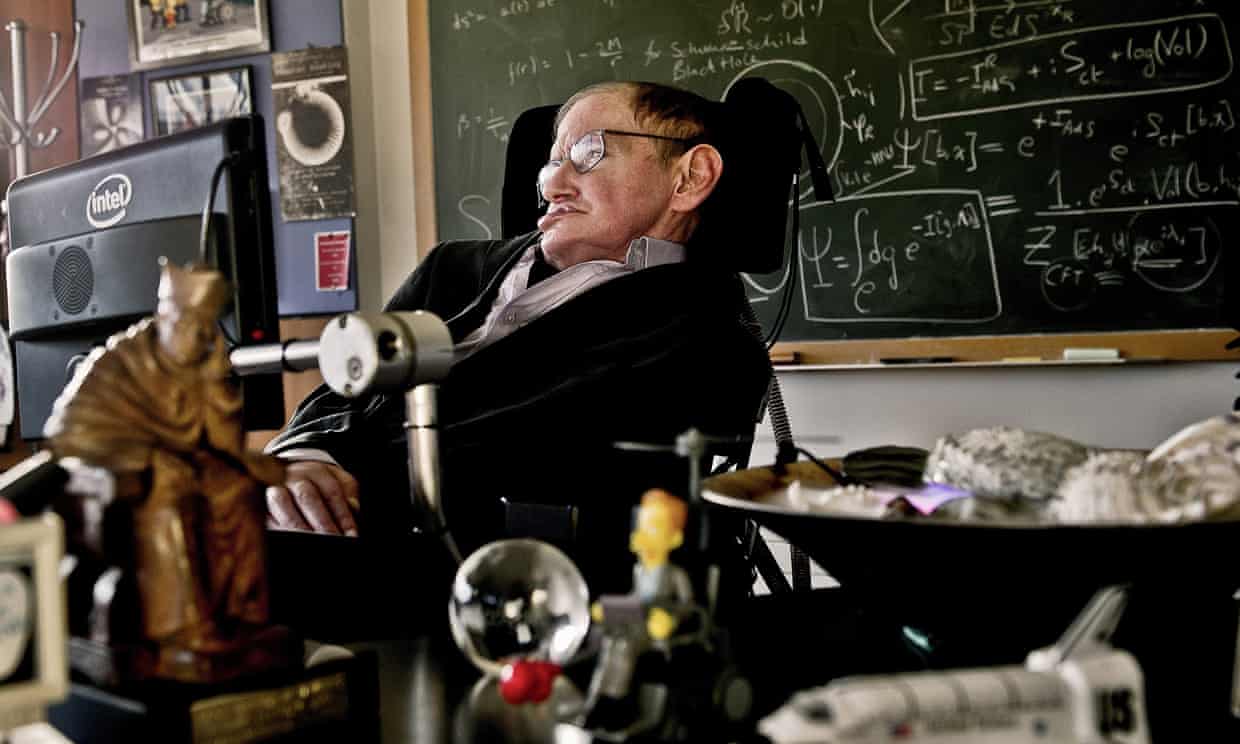
In Memoriam: Stephen Hawking

Professor Hawking’s insights shaped modern cosmology and inspired global audiences in the millions.
Perhaps the greatest cosmologist ever - Stephen Hawking - died  at 76.

Stephen Hawking, one of the the brightest stars in the firmament of science, whose insights into modern cosmology inspired millions, has died aged 76.  Hawking's family released a statement in the early hours of Wednesday morning confirming his death at his home in Cambridge.


Hawking’s children, Lucy, Robert and Tim said in a statement: “We are deeply saddened that our beloved father passed away today.He was a great scientist and an extraordinary man whose work and legacy will live on for many years. His courage and persistence with his brilliance and humor inspired people across the world."
Adding:
He once said: ‘It would not be much of a universe if it wasn’t home to the people you love.’ We will miss him for ever.”
Well all of us will miss him, especially those of us who have written books that promoted his ideas, such as the 'boundary free cosmos" as well as imaginary time.  Indeed, anyone who'e been involved in astronomy at any level - even if they haven't read his ground breaking book, 'A Brief History of Time.   This was the work, not some abstract theoretical paper, that rocketed him to fame.  
Published for the first time in 1988, the title made the Guinness Book of Records after it stayed on the London Sunday Times bestsellers list for an unprecedented 237 weeks. It sold 10 million copies and was translated into 40 different languages. 

In 1974 Hawking drew on quantum theory to declare that stellar black holes - i.e. collapsed from large mass stars- were not the only type. There should also be "mini" or quantum scale  holes capable of emitting heat and eventually popping out of existence. For normal black holes, the process is not a fast one,  taking longer than the age of the universe for a black hole to terminate.. But near the ends of their lives, mini-black holes release heat at a spectacular rate, eventually exploding with the energy of a million one-megaton hydrogen bombs. Miniature black holes dot the universe, Hawking said, each as heavy as a billion tonnes, but no larger than a proton.
His proposal that black holes radiate heat stirred up one of the most passionate debates in modern cosmology. Hawking argued that if a black hole could evaporate into a bath of radiation, all the information that fell inside over its lifetime would be lost forever. It contradicted one of the most basic laws of quantum mechanics, and plenty of physicists disagreed.

More recently, Prof. Hawking achieved even more popular renown in the Oscar-nominated movie,  The Theory of Everything, in which Brit Eddie Redmayne played the lead role and won Best Actor Oscar. Hawking also appeared on The Simpsons and played poker with Einstein and Newton on Star Trek: The Next Generation. He  also delivered  memorable put-downs of  the insufferable geekazoid,  Sheldon Cooper, on The Big Bang Theory.
While it is true that Prof. Hawking never won a Nobel Prize, that should not diminish the respect and gratitude those of us who've worked in space science, astronomy or cosmology have for him. In that regard, I leave readers with the following links to previous posts I've written to do with Stephen's various forays:

 See also this interesting Hawking lecture on 'how to escape from a black hole':
We will surely miss your wit and intellect, Professor Hawking!

See also:

Wednesday, July 16, 2014

Why Does Every Manjack Think He's a Cosmology Expert?


It continues to mystify me how so many  - who likely have never even taken a basic astronomy course in their lives - believe they are qualified to write about cosmology or the universe at large, including cosmic expansion. . In the most recent example,   Lawrence Edward Bodkin, Sr. (Intertel Integra, April, pp. 10-11),   propounds a curious conjecture concerning the basis of the spectroscopic red shift as it applies to the expanding universe. While he basically gets the Doppler principle of spectral shifts correct, i.e.  “a shift to the red means an object is receding from us, a shift to the blue means it is approaching”, he falls down in a number of other areas.

First, it is incorrect to refer to “galaxies” in the context of red shifts and indeed in terms of cosmic expansion. The reason is that the recessional velocities observed  which conform  to the Hubble law, e.g.

 
V = Hd

 
Where H is the Hubble constant, and d is the distance, only apply to galaxy clusters (the exception being quasars or quasi –stellar objects).  Thus, no independent or unbound galaxies occur from which reliable redshifts z can be obtained, all are found to be members of aggregates that are themselves gravitationally bound. (The exceptions to this constitute galaxies that have been ejected from their respective groups.) Within each such cluster the galaxy members can undergo blue shifts or red shifts, depending on the reference point from which the observation is made. But it is critical to grasp that these individual galaxy spectral shifts within clusters have no bearing on cosmic expansion.


As an example, our Local Group features at least 35 distinct member galaxies which the interested reader can find listed in Table 2.1 of the excellent monograph, The Galaxies of the Local Group, by Sidney van den Bergh.  The members include: The Milky Way, M31 (Andromeda galaxy), and the Large and Small Magellanic clouds.


When one peruses the individual data for the individual members of the Local Group, one finds for example, a radial velocity for the Triangulum galaxy of (V(r) = -181 km/ sec) cf. Table 5.1, which denotes a blue shift indicating velocity of approach, born out by the negative sign of V(r)> On the other hand, when one consults the data table (6.1)  for the Large Magellanic Cloud, one finds V(r) = +275 km/ sec  indicating a recessional velocity and red shift.

Again, the point is that within a given galaxy cluster a member can have either a blue shift or red shift depending on the vantage point from which observed.  The key concept to bear in mind is that these have no bearing on the Hubble law and do not figure into cosmic expansion.

Second, Mr. Bodkin’s preoccupation with “viewing angle” only has reference to the interior of a galaxy cluster, and again, what angle the observed member galaxy occurs in relation to the point of the one doing the observation. It has no bearing from the cosmological perspective because all “viewing angles” are the same.


Since the expansion is one of space as well as time, there is no preferred reference frame for the expansion, so Earth is only one vantage point by which to arrive at the Hubble law. A fairly good analogy to invoke is that of an inflating balloon with ink dots on its surface. As you inflate the balloon each of the dots moves away from its neighbors, analogous to how galactic clusters move away from each other in the real cosmos. However, as can be seen, NO single dot can be the center of said expansion.


If special viewing angles really existed, this would not be the case and one would find different recessional velocities at differing distances, rendering the Hubble law unusable. In addition, it is conceivable that the odd blue shifts would appear which we do not observe in terms of cosmological observations.

Third, there is no evidence at all the “blue shifted galaxies have constantly depleted in number and become additions to the number of red-shifted galaxies.” From the true cosmological perspective, not a single such “change” has been detected.

 
Fourth, Doppler-determined speeds approaching the speed of light (c = 300,000 km/ sec) need to be treated very carefully. In general, the red shift for the Hubble law, defined as:

z = v /c

is for the non-relativistic case. Thus, if  z = 0.2 then the recessional velocity is: v = 0.2c. n other words the object is moving away at one-fifth the speed of light. If the object’s recessional velocity is nearing the speed of light,  a different expression is needed:

v =   c [(z 2 + 2z) / (z 2 + 2z + 2)]

 
Bodkin Sr. also argues that the perception of special viewing angles has been part of human experience for "billions of years". But the fact is humans haven't even been around that long. The most generic form of anthropoid ape probably only existed from 1.6 million years ago at most - and I warrant they'd not have been concerned with the viewing angles of distant galaxies. Modern scientific man has arguably only existed since Galileo in the 17th century and his primary focus was on Jupiter and its moons, Saturn and sunspots.

It seems to me that those like Mr. Bodkin might better use their time to learn about cosmology - a difficult sub-discipline of astronomy - before they write long tracts about it!


Tuesday, December 24, 2013

Of Mangers and Materialism: What Ross Douthat Doesn't Get

NY Times Neolib-cum-Christianoid mouthpiece Ross Douthat in his latest clarion call ('Ideas from a Manger', Dec. 22,  Sunday Review) bids us to "pause for a moment" on our holiday shopping to "glance at one of the manger scenes". Therein, Douthat informs us, we ought to "see the scene not just as a pious set piece but as a complete world picture- intimate and comprehensive".

What, pray tell, is this complete world picture the manger scene offers? Douthat again:

"It's an entire world view in a compact narrative, a depiction of how human beings relate to the universe and to one another. It's about the vertical link between God and man- the angels, the stars, the creator stooping to enter his creation. It's also about the horizontal relationships in our society, because it locates transcendence in the ordinary, the commonplace, the low."

After presenting this, Douthat bemoans that this view is "increasingly losing market share to what you might call the spiritual world picture-   the divine is active in human affairs, every person is precious in God's sight- but doesn't sweat the details."

He describes this view as:

 "Christian-ish but syncretistic, adaptable, easy going and egalitarian. It doesn't care whether the angel really appeared to Mary- the important thing is that a spiritual version of that visitation can happen to anyone - including you."

This "spiritual syncretism"  would, of course, also comport with the worldview of my sister-in-law, Krimhilde, see e.g.

http://brane-space.blogspot.com/2013/08/continued-conversation-with-krimhilde.html

How would Krimhilde respond to Douthat's take on her, and not being invested in literalist biblical traditions? I quote her from the above link:

"Reading those ancient books or bibles is like a college student groveling around in a nursery and still talking baby talk. Worse, the degraded level of the book writers, especially where they depict this “god” killing humans out of vengeance, is a reflection of their own base nature and desire for vengeance. Their degraded, low vibration souls hate so they write to make their god hate, like them. This bible god is no god of love.

The obsession with the 'good book' is based  on the anxiety to be right…..right, right, right….This impulse and need penetrates and suffuses everything. That’s why they clutch their bibles so closely, as if to worship the book itself
."


Wow! Quite an eye-opener! But Krimhilde is much more correct in her take than Douthat is on his. Indeed, there is no evidence that any of the narrative reported in the New Testament gospels concerning the nativity is "true" or in any way historical.   Exegetical and historical document researchers have, in fact, confirmed that:  present day Nazareth couldn’t be the biblical city referred to say, in the fourth chapter of Luke. 

One way to verify that is to go back and examine the Old Testament, the Talmud and related documents that precede the NT and determine if an extant Nazareth existed. One will find that  “Nazareth” is not mentioned once in the entire Old Testament, nor do any ancient historians or geographers mention it before the beginning of the 4th century.  The Talmud though it names 63 Galilean towns, names Nazareth not one time.  Not once. More telling, though Josephus does cite Japha - a town about a mile from present day Nazareth, he doesn't mention Nazareth. So much for Douthat's manger scene, because if Nazareth didn't exist then we can conclude none of the other aspects did either, including the manger, the guiding star, the Magi and even that Yeshua was born an actual "God-Man", i.e. God incarnated as human. It is all an elaborate myth intended to communicate a spiritual message - but not to be taken literally.

So, here we have an answer for Douthat on why spiritualist folk like Krimhilde aren't inclined to pay too much attention to "details" that only exist in a mythical sense.

But Douthat isn't content to merely take the spiritual people and groups (like Eckanckar) to task. He goes after secularists as well. He bloviates (ibid.):

"The secular picture, meanwhile, seems to have the rigor of the scientific method behind it. But it actually suffers from a deeper intellectual incoherence than either of its rivals because its cosmology does not harmonize at all with its moral picture."

Actually, no "intellectual incoherence" is suffered because cosmology in the specific definition of the term does not entail any moral "picture". Cosmology refers to the study of the large scale universe or cosmos, its dynamics, behavior and composition - including dark matter, dark energy.  Thus, cosmology is a physical discipline that attends to and investigates physical factors of our cosmos. It does not treat morality so that secularists cannot be said to uphold a "cosmology that does not harmonize with its moral picture."

But, this is not to say that secularists embrace NO moral view. Indeed, in an article published in The Barbados Sunday Advocate in 1991, ('Materialism and Moral Values') I took pains to show how and why the philosophy of scientific materialism is compatible with moral values at their most fundamental level without having to interject mythic entities or gods. I noted:

"It isn’t necessary to wave a bible or the ten commandments at a Materialist, nor quote the "golden rule". The true Materialist, by definition, respects his fellow men and reveres all life, since he recognizes (through his philosophy) that they share a planet that may be unique in the cosmos. Thus, the true Materialist treasures and conserves the Earth's finite store of resources, since he comprehends that Earth also has one life to live - and there is no more after the existing resources are consumed.

With these things in mind, the true Materialist does not give his offspring any and every thing that grabs attention. He certainly does not wish to encourage the sort of wanton greed and over-consumption that has brought our world to its present sorry state. The Materialist knows well enough that the planet can ill-afford more such uncaring people.

Embodied within the above examples is a practical ethics, which has been forged out of the Materialist's reason and his priorities. This has one overriding aim: to cherish the Earth and all life upon it. Consequently, the true Materialist disdains all forms of violence, since ultimately these are inimical to the community and to species' survival. Since violent acts undermine a community's cohesion and threaten its very existence, the true Materialist must regard them as irrational. The Materialist is compelled to co-operate with his fellows and promote a common good, not out of fear for the wrath of a deity, but to held insure a thriving, harmonious community with high survival value.


As William Provine notes in his article Evolution and the Foundation of Ethics [1], young people should be encouraged to think rationally and critically concerning ethics, not out of fear of some divine force's wrath, but to protect their own long-term self-interest.

Any persistent observer of human social interaction will note that the vast majority of people are law-abiding and decent folk who naturally practice a common-sense, utilitarian ethics similar to what has been described. For proof, one need only look as far as the upstanding Atheist or agnostic who inhabits every community and who - though he disdains a deity, nevertheless treats his fellows with compassion and respect. No supernatural law or commandment ordains this behavior. Instead it is the conscious and deliberate recognition that the promotion of the welfare of others is directly linked to the one's own welfare.


Unfortunately, what the religionists have done is to take the natural code of ethics most people follow and embellish it with a blizzard of superstitious precepts and injunctions. These are superstitious since, inevitably, they are linked to the supposed dictates of a supernatural "being" who will not hesitate to "punish" those who disobey "him". This includes injunctions to participate in - or attend, primitive rituals which celebrate a de facto cannibalism.

Christians, for their part, profess a ‘God of love’, but never hesitate to invoke fear (of eternal torment) to have their ethics adhered to. Logically, this suggests that the ethics is insupportable without the additional imposition of some type of "divine" retribution. A punitive ethics, then, is at the very core of the Christian religion, as it is many others. Sir Bertrand Russell, in his book Why I Am Not A Christian, precisely identifies ‘religion’s source of terror’ to account for the hold it has on so many.
"

----------

The article received many kudos from letter writers, who said it was the first time they'd ever seen a coherent and logical discourse on a Materialist-based  ethics. Hitherto, they'd never realized that scientific Materialism and ethics could be compatible.

Douthat makes the same error, as when he writes (op. cit.):

"In essence (scientific Materialism) proposes a purely physical and purposeless universe, inhabited by evolutionary accidents whose sense of self is probably illusory. And yet it then continues to insist on moral and political absolutes with all the vigor of a 17th century New England preacher. And the rope bridges flung across this chasm - the scientific sounding logic of utilitarianism, the Darwinish justifications for altruism- tend to waft, gently, into a logical abyss.."

Which is total nonsense.  As any sensible person can see, on reading my articulation of ethical values based on scientific Materialism, though they are practical - and hence might be said to be "utilitarian" - that doesn't disqualify them from being more useful than Christian morality - which is based on what? Something a god did or didn't do in the Bible?   Or more relevant in Douthat's case: What the Catholic Church rules is moral or not based on its "Canon Law"?

To fix ideas, consider the nun excommunicated by the Catholic Church in Arizona 3  years ago for saving a 27 year old mother’s life at the expense of her fetus. Her moral choice was either to let the birth occur and see both mother and infant die, or prevent the birth (because of the mother’s blood pressure complications) and save the mother.

The nun made the utilitarian ethical choice over Catholic dogma. In this case, the greater relative good is always chosen over the lesser one. Hence, by practical Materialist ethics,  two deaths with two life saving efforts represents the lesser good, while one death with one life saving effort represents the greater one.  The error of the Bishop that excommunicated the nun was in upholding an absolute right to life ethic for both when in practical terms (that exercise of practical intelligence again) both could not survive. But this is the very danger of moral absolutism.

So in fact, contrary to Douthat's take, it is not within utilitarian ethics that absolutism resides, but rather in the goofy supernaturalism pushed by Christians.  If one can believe in the supernatural then, one can believe in an absolute standard which overrides practical reason and practical ethics. We call this "skyhook" thinking.

As Daniel Dennett once noted ('Darwin's Dangerous Idea')  - the hyper-religious like Douthat want to build their world and universe on "skyhooks" not cranes. Cranes, after all, have to hoist from the ground up to effect their constructions. They're prosaic, dirty material-mechanical flotsam and jetsam like cells, electric signals and chemicals. But oh those skyhooks! To toss them upwards and hook on to the ethereal, immaterial realm in the hyper yonder beyond the clouds and gross matter!

"BWAAAAAA....We don't want that! We wanna be GRANDIOSE beings! Made of sky and spirit not filthy matter! "


These delusional seekers fail to comprehend that for humanity to be one in harmony - no single subset can elevate itself as "more special" or more worthy" or more "grandiose" than any other. Irrespective of who or what they believe. And while it might be nice or appealing to believe ALL humanity is skyhook-engendered, in practice it never works! Because once the skyhook meme is admitted, one segment yearns to claim its supreme grandiosity and specialness for itself, and exclude the others! Much better to look at basic evolution out of the mire by natural selection, and how we all came to have the same basic DNA in our cells. "Brothers in DNA".

And once we get off our skyhook  addiction and concede a brotherly, material unity in biology and DNA, then the embrace of a practical ethics isn't far away.  In this world, we need more practical ethics or moral provisionalism, and less absolutism.

Douthat would do well to process that before he next bids us to stop and stare at manger scenes. True, to quote Douthat, "though a few intellectuals scan the heavens, they have yet to find their star." But maybe that's because no skyhook-based,  guiding star exists. We have to forge, as Materialists, our own "star"!
---------------------

[1] William Provine, ‘Evolution and the Foundation of Ethics’ (MLB Science, Vol. 3, No. 1, 1988, p. 25)


Monday, February 27, 2012

The Making of a Terminal Bore: Wojciech Langer

The spherical harmonic function for problem (1) which I assigned Langer. He punted on all three cosmological questions that a first year physics student could have solved.


I wasn't remotely aware of the individual named Wojciech Langer until perusing some of the book reviews to do with cosmology on amazon.com. Then I beheld him cropping up like a bad penny each time five stars was awarded in a review for a book challenging the god assumption. The most recent example was Lawrence Krauss' excellent summation of recent cosmology, A Universe Out of Nothing.

In comment after comment going after 5-star reviewers of anti-creationist cosmology books, Langer's irritation - like most would-be godmongers, appeared to be that atheism was infiltrating or being infused into cosmology. Evidently the guy didn't realize or know this has been so for some time!

For example, there was the terrific book, ‘Great Ideas and Theories of Cosmology’ by Jagjit Singh (Dover, 1961).

I reference this book, because Singh’s book was among the first to boldly lay waste the idea of a “creator” being responsible for the cosmos (Chapter XVI, p. 252), and indeed he notes:

"No one… would dream of defending surrealism and cubism by an appeal to the tensor calculus or quantum theory, and it is as illogical to invoke scientific cosmology in support of God.

For the practice of rationalism is an irreversible process. If once one loses the innocence of naïve belief by venturing to stray into rational thought, there can be no honest way of recovering it. When one has cut himself off from God by a first sip of the cup of knowledge, one will not rediscover Him by drinking its dregs, no matter how hard they may be boiled


Even Stephen Hawking revived this tradition in his book, ‘A Brief History of Time’ though many readers may not have carefully parsed his words and only interpreted what they wanted to. For example, he clearly notes on p. 122 - after an audience with the pope, following a scientific conference at the Vatican:

At the end of the conference, the participants were granted an audience with the pope. He told us that it was all right to study the evolution of the universe after the Big Bang, but we should not inquire into the Big Bang itself because that was the moment of creation and therefore the work of God.

I was glad then that he did not know the subject of the talk I had just given at the conference - the possibility that space-time was finite but had no boundary - which means that it had no beginning, no moment of creation.I had no desire to share the fate of Galileo, with whom I have a strong sense of identity”.

A few pages later in the same chapter, emphasizing the consequences of the quantum, boundary free cosmos, Hawking asks: "What need then for a Creator?"

Which is precisely the point! Science and modern scientific theories - bearing predictions which can be verified - make religious or supernaturalist intrusion redundant. They add nada to the quality of predictions, nor do they afford a new variant of suggested observations based on existing ones. In other words, all they offer is some childish security blanket for the timid or mentally un-tough, but not much more.

I used all this as a basis to dismiss all Langer's comments to the effect that this mindset "has no place in a cosmology text". YES, it does!

As for Wojciech Langer - the "industrial chemist"(from his amazon profile) - I suspected he didn't know diddly squat about any cosmology so that all his criticisms were hollow. They merely needed to be exposed, as he did. So I put him to the test by giving him three simple cosmological questions, of which I'd have been satisfied to get even one back correct. They were:

1) The data obtained from balloon-borne microwave telescopes, e.g. Maxima and Boomerang (cf. Physics Today: ‘Balloon Measurements of the Cosmic Microwave Background Strongly Favor Flat Cosmos’, July 2000, p 17)enabled a power spectrum of spatial temperature fluctuations to be assembled (see graphic) using a spherical harmonic function fit.

The multi-humped graph (ibid) plotted mean square temp. fluctuation (in micro-Kelvin on vertical axis) vs. multipole order l on the abscissa. This multipole order also concides with the spherical harmonic order index l.

The temperature differences dT_i appear at angular separations of π/ l and display a non-uniformity on angular scales of about 1 deg. If the first peak occurs at l= 200 and the 2nd peak is asymmetrically spaced relative to it, predict the next 2 minima displayed (i.e. their spherical harmonic order indices) and show working.

2) If the plasma is treated as an ion acoustic plasma what is the most direct (and simplest interpretation) of the “humps” in the function? According to the article (ibid.) the propagation speed of sound in such a plasma would be expected to be v(s) = c/ [3]^ ½

The acoustic properties of the plasma therefore create “standing waves”.

Assuming v(s) to be the “ion sound speed” how would one use it estimate the temperature of the plasma?

3) Consider 3 galaxies: A, B and C, i.e. as represented below:

(0.7c) <--------(B)----(A)-----(C)-------->(0.7c)

An observer in A measures the velocities of B and C and finds they are moving in opposite directions - each with a speed of 0.7c relative to him.
What is the speed of A observed by someone in B? What is the speed of C observed by someone in B?

And what was Langer's reply? (Even after I let him know that calculus wasn't needed for any of the problems).I produce it below:

"No, I am not able and not willing ..-I read POPULAR books (in case you did not managed to verify it), and inability to deal with high level of math (I do practical work not theoretical science) does not disqualify me from reviewing and commenting on them Same relates to majority of reviewers for this and other pop-cosmo books, therefore you show disrespect towards them as well.


But of course, he had no problems showing disrespect to another commentator who also questioned his criticisms on cosmology issues, especially when his profile showed "industrial chemist". His reply to her? Her comment was "stupid". In fact, it was spot -on and she just didn't have the background to expose him for the fake he is, and why his comments - at least to do with cosmology texts, have no merit. If a profuse, relentless critic of cosmology books and reviews can't even solve one simple cosmological problem he definitely doesn't deserve to have his opinions or comments taken with more than a grain of salt!