Showing posts with label Sir Martin Ryle. Show all posts

Wednesday, December 13, 2017

No, Not A Good Idea To Try To Bounce Radio Waves Off A Possible Alien Artifact

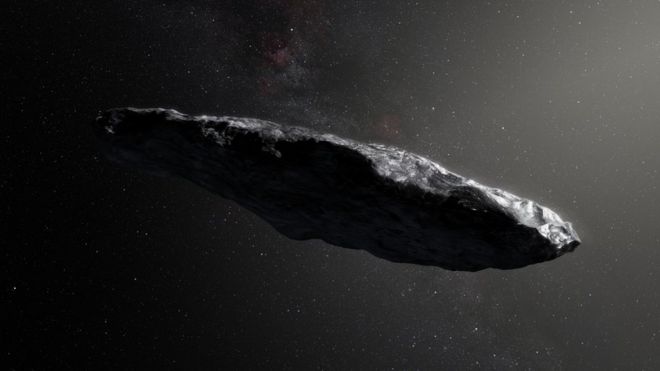
'Oumuamua
Object named Oumuamua now transiting our solar system. IF it is an alien artifact it's not  good idea to bounce radio waves off it.

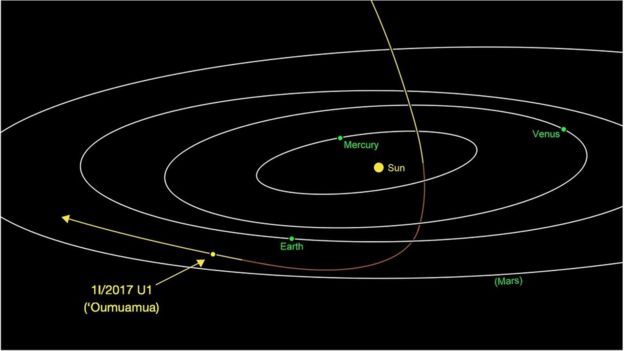
Trajectory of asteroid
The eccentric trajectory of the object, i.e. out of the plane of the solar system, suggests it originated from outside our system - possibly another star.

By now millions of Earthers are aware of an extraterrestrial intruder having entered our solar system. In the shape of a mangled stogey, the thing designated as 1I/ 2017 U1 (aka Oumuaua) was detected as it sped towards the Sun on 19 October.  Its orbital properties suggest it originated around another star, making it the first such body to be spotted in our cosmic neighborhood. More fascinating, its cigar-ish shape marks it as a potential alien artifact.

To wit, Yuri Milner's Breakthrough Listen program released a statement which read: "Researchers working on long-distance space transportation have previously suggested that a cigar or needle shape is the most likely architecture for an interstellar spacecraft, since this would minimize friction and damage from interstellar gas and dust."

In addition, we've learned from measurements that it has a dense structure and is comprised of rock and metal, but with little - if any - water-ice. 

What about observations? Andrew Siemion, director of the Berkeley SETI Research Center, said: "'Oumuamua's presence within our Solar System affords Breakthrough Listen an opportunity to reach unprecedented sensitivities to possible artificial transmitters and demonstrate our ability to track nearby, fast-moving objects."

The first set of observations are to commence today at the Robert C Byrd Green Bank Telescope in West Virginia is due to last for 10 hours.  These radio observations will be made across four different radio frequency bands. If passive "listening" is as far as it goes - no active bouncing of radio waves, i.e. transmissions off its surface -then that ought to be okay. But nothing more.

Stephen Hawking and others have already come out and warned if there is any chance of making ourselves known - revealed- to a much more technologically advanced civilization, we'd be wise not to do so. A nest of bugs happily ensconced in a corner of a home's kitchen won't have a very long life expectancy if the home owner finds them.

In 1978 the British Astronomer Royal, Sir Martin Ryle, pleaded for extreme caution in restricting any and all types of electromagnetic signals and noise emanating from our planet. He warned that it would be foolhardy to be anything but passive listeners given we don't know anything about alien intentions - should they receive a calling card from another world. Of course, Sir Martin likely based his cautions on a paper in the journal Science two years earlier, which showed how an advanced alien civilization could put together a detailed picture of life on Earth, especially of our defense capabilities.

Sir Martin may also have been reminded - as I am now with this object - of Sir Arthur C. Clarke's novel, Rendezvous with Rama - published in 1973. Set in the 2130s, the story involves a cylindrical alien star ship that enters Earth's solar system.  Images obtained from unmanned spacecraft reveal  that Rama is a perfect cylinder, 20 kilometers (12 mi) in diameter and 54 kilometers (34 mi) long, and almost completely featureless, making this humankind's first encounter with an alien spacecraft.

In a 1962 high school research paper, long before Hawking’s or Sir Martin's alien warnings emerged, I showed how any encounter with a truly advanced alien intelligence would likely be disastrous for the human race. While scifi films (e.g. 'Earth vs. The Flying Saucers') often painted the meetings or altercations in cartoonish terms, I reasoned a hostile future encounter was almost inevitable and that our (putatively) lesser civilization would fall to a much more advanced, alien one. It was impossible to avoid, and this may have been the basis of a 1960 Brookings Institution REPORT to that effect. (Which I cited in my paper)

Brookings Institution thinkers feared any contact with highly advanced aliens would trigger social, economic and religious upheaval - and collapse of civilization.  The Brookings Institution's conclusions were largely based on the public reaction to the infamous Orson Wells' radio broadcast of "The War of the Worlds" and the local panic that ensued in 1938.

Let's also not forget that in 1972 - at a conference on potential interstellar contact- physicist Freeman Dyson warned that the first species we are likely to encounter is going to be technologically advanced and also highly aggressive -  more likely to be predators than cosmic pals willing to share their techno secrets.. 

As one Brit astronomer put it to the BBC, this is all likely huff and puff and merely a strange shaped natural object, say asteroid. But if there's even a 1 in a billion chance it's really of alien origin, we'd be best to keep our encounter totally passive.

Saturday, August 1, 2015

Aliens Are Dummies? The WSJ Piece That Many Will Still Believe


As humans have continued over decades to search for extraterrestrial signals, a number of different takes have surfaced as well as proposals, advice. In an article I wrote in 1978, 'We Are Not Alone', I warned that our hitherto emitted radio and TV signals could already have betrayed our position to an alien civilization. I suggested that if humans had any residual smarts at all they would take care to conceal their radio presence in future rather than announce it, because we could not be sure who or what might pick the signals up and what they'd do in response.  I then cited physicist Freeman Dyson, who in a 1972 speech, asserted that the extraterrestrials we're most likely to encounter would be “like a malignant, technological cancer spreading across the galaxy” and we’d "do well not to wish for any meeting."  He predicted that it would be the most aggressive species we'd be most likely to meet, and we'd likely regret it.

I also cited British Astronomer Royal, Sir Martin Ryle, who pleaded for extreme caution in the nature of radio band signals we send, and advocated for restricting any and all types of electro-magnetic signals and noise emanating from our planet. He warned that it would be foolhardy to be anything but passive listeners given we don't know anything about alien intentions .

More recently, this has echoed  in new warnings from Elon Musk and Stephen Hawking, comparing the aliens that are most likely to visit Earth (because of stupidity on our part, i.e. in actively beaming messages) to the first colonizers of the New World - who decimated native populations for resources and territory. Musk, Hawking and others have urged that we do not move to "active SETI" which entails designing radio telescopes to actively transmitting messages as opposed to mere passive reception.

The general tenor of discussion then, has been that the aliens  likely to be contacts will be: a) super -intelligent, far in advance of Earthers' best, and b) highly aggressive.

Never mind. In his WSJ piece (July 25-26, p. C5) Joe Queenan assures gullible readers  (of which there are likely to be many) that "scientists don't want to let on they are searching for signs of average intelligence".

As he facetiously notes:

"The logic is infallible. If aliens were really smart, it stands to reason they would already have contacted us."

Adding, to clarify:

"Really, really smart creatures would want to let us know they were there, if only to show off, the way people who went to Harvard can't order a BLT without letting everyone in the room know they once wrote for the Crimson."

Not really!  And again, though to me his angle was tongue in cheek, it definitely could be literally misconstrued by a hidebound human chauvinist - who would have his belief reinforced that either: a) humans are the only advanced species in the cosmos, or b) any other species would be at the level of "incompetents" compared to us (Queenan uses the analogy of the East Germans before being absorbed by W. Germany)

The reality is that we're more likely to make first hand physical contact with extraterrestrials than radio contact. The logic and basis for this were well laid out in the paper ‘Galactic Civilizations: Population Dynamics and Interstellar Diffusion’ by William Newman and Carl Sagan, in Icarus, Vol. 46, June 1981,

The authors' logic was impeccable and simple. Any civilization worth its salt would at some point enter an Atomic age. Weapons of ultimate annihilation would become widely available as well as potential for nuclear power, possibly fusion. A civilization entering this age would either come out much more advanced and in one piece, or destroy itself. It is the latter category that would most likely limit itself to only radio contact.

The former would be able to parlay their awesome new power into fusion energy, and also interstellar space flight. The latter would open the doors to planetary conquests, given, as the authors noted, interstellar colonization would more likely be accomplished by a technologically aggressive species.  Hawking, for example, compared their arrival on Earth to the arrival of Columbus' expedition to the New World, resulting in the decimation of the Arawaks. Thus, the simple disparity in technology would result in the elimination or the absorption of the less advanced species - without even the veneer of a "war" declaration.

How advanced could such aliens be? Russian astrophysicist I.S. Kardashev, put forward a three-class scheme:[1]

I: Able to harness the equivalent power of the planet Earth
II: Able to harness the power equal to a typical star (10^23 kw)
III: Able to harness the power equal to a typical galaxy (10^33 kw)

Plausibly, an encounter with either Types II or III would amount to Earth hominids elimination or absorption - though it is difficult to see how the latter might work. (Perhaps literally, as food, see e.g.
the Twilight Zone episode 'To Serve Man'). On the other hand, an encounter with a Type I may have more potential for genuine exchange, even if at the analogous level of a human mathematician trying to teach a backward child residue calculus.

What we should not do, is buy into Queenan's theme of meeting or contacting "average" aliens. In terms of actual galactic civilizations, there is no such thing - except perhaps for humans.

[1]Shklovskii, I. and Sagan, C.:1966, Intelligent Life in the Universe, Dell Publishing Co., p. 394.

Thursday, February 19, 2015

SETI Should Avoid Actively Beaming Messages to Possible Aliens

No photo description available.
The alien species we invite to Earth - and which actually reaches us -  may not be warm, fuzzy and benign like "ET".

I said it before in numerous newspaper articles as well as other (academic) papers, that if we humans have any sense at all we will keep our galactic location a secret and not actively attempt to advertise our presence to whatever alien civilizations might be out there (and there are probably thousands in our Milky Way galaxy alone).

For example in one article I did for the Barbados NATION newspaper back in 1978, e.g.
No photo description available.

I cited Sir Martin Ryle's warning that any advanced aliens out there could already have assembled a complete picture of our technological and defense capabilities simply from the electromagnetic waves already dispatched, incidentally, as part of our media broadcasts.

Earlier, in 1972 - at a conference on potential interstellar contact- physicist Freeman Dyson warned that the first species we are likely to encounter is going to be technologically advanced and also highly aggressive - not ready to merely become easy friends- but more likely our worst predators.

More recently, Stephen Hawking has sounded similar warnings comparing the aliens that are most likely to visit Earth (because of stupidity on our part, i.e. in actively beaming messages) to the first colonizers of the New World - who decimated native populations for resources and territory.

All the above bears on some current plans by a group of astronomers (many connected to the SETI project) that we should no longer just sit passively at radio telescopes waiting to hear from "ET" but instead "actively beam messages into the void and invite the closest few thousand worlds to chat or visit." ('Calling the Cosmos', Denver Post, Feb. 15, p. 10A).

TO which I and others (e.g. Stephen Hawking) reply 'bad idea'. Hawking goes so far as to call it 'crazy' (I say it's irrational) and that "instead of sweet and gentle ET we might get the aliens from Independence Day.)

This isn't as far fetched as it seems. Any race able to mount the technological ability for interstellar travel is likely to be aggressive and possibly even conspicuously territorial and warlike. Look no further than the conquering empires on Earth which developed the most advanced tech abilities - say for space travel and going to the Moon, or Mars - they are also the most aggressive. The U.S.- which actually landed men on the Moon, has also engaged in 248 armed conflicts in 153 locations since the end of World War II. It is also responsible for 41 percent of the world's military spending according to a paper in the American Journal of Public health available as a free PDF here.

So there is good preliminary evidence using examples from our own world that high tech and aggression go together. We would be foolish to believe it's any different in the stellar void at large, and believing in fantasy motion pictures as an alien template is as foolish as believing human virgins can give birth or that Lee Harvey Oswald killed JFK. 

Some astronomers like Douglas A. Vakoch - director of interstellar message composition at SETI- don't buy this hesitaton or the arguments for exercising an abundance of caution.  They're convinced that actively "calling out" may be the only to find out if we are alone.  Hence,  we need not fret about too many negative speculations, particularly just "letting sleeping aliens lie". But those of us adhering to the precautionary principle would remind these contact Pollyannas  of the monstrously aggressive sorts that Freeman Dyson once described as a "technological cancer in the galaxy".

Believe me, these characters will find us soon enough, so why press our luck? Haven't we enough to worry about with climate change now on the verge of the runaway greenhouse effect - without adding aggressive, voracious aliens to our troubles?

SO it was good that this dispute broke out last Thursday and Friday in San Jose, CA at a convention of the American Association for the Advancement of Science. We need to get this out in the open and hope to hell that cooler, more rational heads prevail.  Thanks also to Elon Musk (of Space X fame) and Geoff Marcy for starting a petition cautioning against actively sending out such messages since it's impossible to predict whether extraterrestrial life will be benign or hostile.

The idea they oppose is one called "active SETI". While it is true we've been passively , incidentally sending out radio and TV messages for 70 years - these lacked the strength and power that a directly beamed and focused message would possess as part of active SETI.

Vakoch has described this potential  coordinated, sustained million dollar a year effort as "an attempt to join the galactic club". Fair enough, but what if that "club" is only composed of the most territorial and consumptive species in the galaxy - who give no quarter - and might regard planets like ours as fodder for their machines? (They might even argue that given how we're wrecking the planet anyway with fracking we don't deserve to have a say in how or whether it is preserved).

My pessimism is shared by astrophysicist David Brin (also a scifi author) who thinks inviting aliens here is a bad idea. Even if there's a low risk of nasty creatures arriving (see image) the consequences would be horrific if in fact they do. As he puts it:

"I can't bring myself to wager my grandchildren's destiny on unreliable assumptions about benevolent aliens".

Well put, and I agree!

Wednesday, April 4, 2012

Why Would ETs Wish to Communicate with Glorified Apes?


In the sci-fi thriller, The Last Theorem, by Arthur C. Clarke and Frederick Pohl, Mankind's foolish continued obsession with nuclear armaments - including multiple megaton tests in the 50s, and later EMP blasts (to knock out terrorist hives, communications) finally draws the attention of a galactic clean-up crew known as "the One-point-fives" (a description based on their peculiar anatomy). These "terminators" (whose job it is to exterminate useless species that may pose a future threat to others) are then dispatched to Earth by the reigning Overlords called the "Grand Galactics".

Their mission is to wipe out Homo Sapiens and not leave a single solitary strand of DNA left to be replicated. When they arrive, they're about to commence their extermination when they're ordered to give the resident species a single test to ascertain if it's worthy to be allowed to survive. The test in alien signals, entails a proof of Fermat's Last Theorem.

As fate would have it, only one single living human, a mathematician who's already proven Fermat's theorem in 3 pages (thereby besting Andrew Wile' 200+ page magnus opus) is able to deliver the goods. Thus does an otherwise little known Sri Lankan named Ranjit Subramanian earn major kudos for the deliverance of the species. (Who, because one member showed the species' worth, were then allowed to meet via virtual -digital messaging all the other intelligent species inhabiting the Galaxy.)

Yes, it's fiction, but it brings up a key question, as we learn that the SETI (Search for Extra-terrestrial Intelligence) project is "buying more lotto tickets all the time on the chance of scoring the Big one" (See e.g. 'What Happens When We Detect Alien Life?', by Seth Shostak, in Astronomy, May, p. 24).

The question is: WHY would any truly advanced civilization wish to communicate with a species that is barely 1 million years evolved from ape-hood? Indeed, our brains still bear the evolutionary marks of not only the ape, but our reptilian ancestors - the former in the meso-cortex and the latter in the reticular formation. (For a very readable account, see Carl Sagan's: The Dragons of Eden).

Yet, filled with human hubris, no one on the SETI team appears to have even considered this! According to them, we're perfectly eligible to join the Galactic Round Table. I hardly think so! Another assumption is that any such signal sent would be intended for the likes of us. Arguably, the destination would have to be a truly intelligent species, but do we qualify?

Consider simply these documented "accomplishments":

- We've overpopulated the Earth to the point that the existing resources (even if somehow distributed perfectly equally) would not last more than a generation.

- We've recklessly polluted water resources, not only by careless dumping of industrial wastes but by using energy drilling methods which require millions of cubic feet of fresh water for each acre drilled. And aliens on learning this would have to conclude we're morons.

- We've actually taken food crops (e.g. corn) and converted them into fuel (ethanol) despite over a third of a billion starving people on the planet.

- We've done absolutely nothing....not one damned thing...about the gigatons of carbon added each year to the atmosphere, thereby pushing the planet's climate toward a permanent instability in the form of the runaway greenhouse effect.

Note here that if an advanced alien species actually visited, say enticed by early promising radio band communications, any advanced measurements they employed on arrival would quickly show them how we'd driven the Earth to the point of catastrophe as an abode for life. They'd conclude instantly they'd made a whopping error in their estimations of humanity, and we were little better than advanced chimps - from which our DNA differs by less than 1%.

Beyond this, as Sir Martin Ryle first pointed out in the 1970s, advanced alien telemetry and signal recovery would have shown them clearly how warlike and dedicated to destruction we are. (Ryle warned that it would be foolhardy to be anything but passive listeners given we don't know anything about alien intentions.) They'd have perhaps assembled the equipment to detect the dozens of multi-magaton nuclear blasts set off in the 1950s, and concluded - somewhat like the aliens in 'The Last Theorem' - that even if total destruction wasn't warranted, we're a species best left to itself. At least until it grows up.

So, again, why would any truly advanced aliens have any genuine interest in us, other than say as possible laboratory animals subjected to ongoing experiments? (Which would be the basis for being studied by alien craft, assuming such exist and have visited the Earth, or their occupants interacted by taking human specimens. )

Let us note that Carl Sagan( Icarus, Vol. 19, pp. 350-52, 'On the Detectivity of Advanced Galactic Civilizations') observed that:

"civilizations only a thousand years in our technological future become disinterested even in communicating with civilizations as backward as ours."

He goes on to note:

"A society thousands or millions of years more advanced than we are, beneficiaries of an exponentiating technology over all those intervening millennia, will not be engaged in a simple extrapolation of our activities, or be driven by our motives."

This would seem to go without saying, yet if it does, one wonders why those like Seth Shostak would bother tilting at this windmill.

At the same time, in a subsequent paper (The Quarterly Journal of the Royal Astronomical Society, Vol. 24, pp. 113-121, 1983) Sagan and Newman do give us hope that it's unlikely we'll encounter an advanced aggressive alien species such as bruited by Physicist Freeman Dyson in a November, 1972 address to the Institute of Advanced Study in Princeton (p. 268, in 'Whispers From Space', 1976, by John W. MacVey, Paladin Books, UK):

"We are more likely to discover first the species in which technology has got out of control, a technological cancer spreading through the galaxy. We should be suitably alarmed if we discover it and take our precautions. It is just as well to be warned ahead of time."

But according to Sagan and Newman (op. cit.):

"The idea that there will be no new and more compelling challenges for such (technological) civilizations than relentless galactic colonization, represents a serious failure of the imagination."

Despite that bit of good news, the authors do warn that it's very unlikely for an aggressive species to survive what they deem a critical threshold period- generally within two generations of the first atomic explosions. According to the authors (op. cit., p. 120):

"Weapons of mass destruction force upon every emerging society a behavioral discontinuity:if they were not aggresive they probably would not have developed such weapons; if they do not quickly learn how to control that aggression they rapidly self-destruct. Those civilizations devoted to territoriality and aggression do not long survive after the development of apocalyptic weapons.

Long before they are able to make any significant colonization of the Milky Way they are gone from the galactic stage. Civilizations that do not self-destruct are pre-adapted to live with other groups in self-respect."

The question then becomes: Are we a civilization destined to self-destruct or not? If we are, and if alien advanced technological civilizations possess data which confirms this, why on Earth would they want to make any contact with us? Why send a beam in our direction?

Is there evidence we're on such a path to self-destruction? Consider that right now the U.S. and Russia have collectively enough nuclear warheads to destroy everything and everyone on Earth 14 times over. A beginning had been made to eliminate stockpiles of each nation's nuclear weapons - especially in the former Soviet states- but Republican lawmakers have protested like stuck pigs, declaring it "appeasement". (Note: Defense contractors, their lobbyists and assorted Pentagon groupies and whores have also kept assorted Dems plowing taxpayer money into more war-making, useless combat air brigades....and weapons such as building 2,443 F-35s at a cost of 0.3b each!)

Consider the words of Jon Kyl, Republican Senator from Arizona, writing in The Wall Street Journal ('What's At Stake in the Missile- Defense Debate?', April 3, p. A15).

"Would the world be safer and more peaceful if the U.S. had fewer nuclear weapons? Is the current nuclear balance unstable?...The answer to these questions is 'No'.

Yet very low numbers of deployed nuclear weapons, as the president appears to have in mind, could engender instability."

Thus, despite the fact the U.S. has enough nuclear warheads (about 1,280) to kill the world's population eight times over, Kyl demands we make more!

In effect, Kyl as well as his warmongering Gooper confederates (Romney wants to double the Pentagon budget if elected, and we already spend more than the next 25 nations combined) makes my case that we are on a path to self-destruction. This type of territorial and aggressive thinking is exactly what Sagan and Newman have warned against in their paper. (Doubtless the Russians also share it, and that makes it doubly clear the human race isn't ready for any advanced ET contact).

My prediction, grim as it is, is that the Human species will obliterate itself within another generation, if not by nuclear holocaust (say on account of implementing a stupid missile "defense" system near Russian borders, or invading Iran) then by climate catastrophe in the Runaway Greenhouse Effect.

We just have not shown, all the SETI folks beliefs to the contrary, we are worthy to be equals on the galactic stage with those who've displayed that "mutual respect" indicated by Sagan and Newman, including respect for the planet they inhabit.

Despite that, any blog readers that still have hope (we know hope springs eternal in the human breast) can log onto the SETI site at:

http://www.setilive.org/