Showing posts with label Selfies. Show all posts

Friday, December 7, 2018

Glad To Get To Yellowstone BEFORE The Selfie-Instagram Hordes Arrived


Buffalo seen from our car soon after entering Yellowstone in summer of 2000.


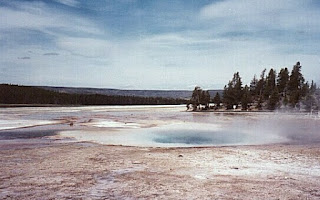
Scene inside Yellowstone - heading to one of the many geysers.
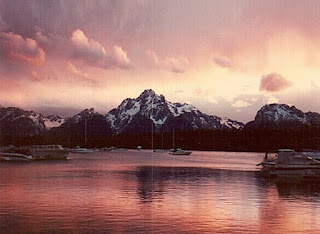
Lake not far from Lodge where we stayed for three days.

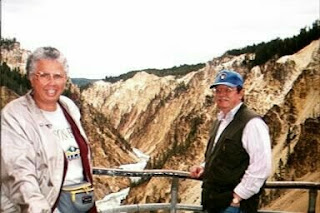
At Fountain Paint Pot in Yellowstone National Park, August, 2000.


Overlooking a raging river in Yellowstone National Park, Aug. 2000

According to a recent detailed report by the UK Guardian,  see,  e.g.
https://www.theguardian.com/environment/2018/nov/20/national-parks-america-overcrowding-crisis-tourism-visitation-solutions

Americans are overwhelming their national parks, literally "loving them to death".   In Yellowstone, the nation's oldest national park, visitation has surged 40 percent since 2008, topping 4 million in 2017.  Fortunately, we (Janice and I) visited the park long before the instagram era, in August, 2000.  This was while it was still largely unspoiled and one didn't deal with traffic jams and clueless boors. (Like the much publicized recent idiot who came to the park to taunt the buffalo).

Anyway, over a period of four months, from  high summer to late autumn last year, the Guardian dispatched writers across the American West to investigate how tourist crowding is playing out at ground level.  The results were not sanguine and showed clearly the time when we visited was likely the optimum.

For example, the Guardian team found:

- Two mile long "bison lines" in Yellowstone

- Fist fights in Glacier - a small Colorado town overrun by million of visitors.

- At Yosemite, park officials warn visitors to expect "two to three hour delays entering Yosemite valley"

-  At Glacier National Park MT, there are regular, tense standoffs in parking lots.

- A new level of moron has invaded Yellowstone, illegally flying drones and tossing rocks and debris into the sensitive geothermal features.

According to one park ranger, tourists to Yellowstone now regularly scramble from their vehicles - even temporarily abandoning them -  in the hope of getting close up photos. (We shot our buffalo - shown in the top pic - from the car while briefly stopping. We did not get out.) According to the same park ranger: Most visitors "just don't know how to behave in a wild place".

Well, maybe because they were also never taught how to behave in a non-wild place.

In the case of Yellowstone, which became the first national park in the world in 1804, original visitor numbers were on the low side. For example, in 1904, a total of 120, 690 people visited the then national parks which included: Mount Rainier, Sequoia and Yosemite.   By just the mid-century the numbers swelled to tens of millions.  Soon national park destinations became synonymous with summer vacations.

Today, the pace of visitation has outstripped resources. Worse, recent research has ascertained our national parks bear the disproportionate brunt of global warming - while years, hell decades-  of wear and tear have seen parks' maintenance left far behind.   Traffic has clearly become one of the most visible consequences of the tourist tsunami, with some locations seeing thousands of cars per day jamming the entry roads. In addition, some parks have seen a 90 percent increase in vehicle accidents.   Again, according to one park ranger at Yellowstone, "We're exceeding the carrying capacity."


The numbers explosion since 2008- 2010 is not surprising and is almost totally attributed to the dawning  of the selfie and instagram era.  People today, often the young and clueless (e.g. millennials), don't believe a destination exists unless it's captured in a selfie and dispatched to followers on instagram or Snapchat. This voyeur yen and personal image capture obsession has driven ever more crowds with their selfie sticks, not only to Yellowstone, but to Rocky Mountain National Park, the Grand Canyon and Yosemite. In some cases, like at Yosemite, distracted tourists have become so mesmerized with the scene and getting their selfies they've misjudged their positions - and fallen to their deaths.  They were so taken by getting the photo they didn't look where they were leaning.

What may have to be done to control the mob factor, especially as the planet gets ever more overpopulated, is to adopt a reservation system for the parks. This is already being seriously considered for Yellowstone, and it should be.  In such a system, just like for a fine hotel, reservations would have to be made long in advance - as well as payment.

Yep, it sounds like a sacrilege, but given the masses invading the national parks and the problems being caused - including overflowing porto-potties, it is inevitable.

As I noted, I am glad we got to visit Yellowstone almost twenty years ago - as well as Rocky Mountain National Park and Estes Park (site of the Stanley  Hotel - where 'The Shining' was centered, and many scenes shot.).

Image result for brane space,  PragueLet's also be aware the tourist selfie crush is inundating most of the fragile and beautiful places of the world - where it seems every manjack armed with selfie stick  wants to get snaps. Europe is especially overrun and in places like Dubrovnik, Croatia (a  'Game of ' Thrones'  site)  they are also considering limiting the influx - which, like in France (Louvre), Italy (Venice), often tasks the available resources.  Not to mention all the trash, garbage left behind.   We also beheld the tourist swarm in Prague when we visited in September, 2015, e.g. by the Astronomical clock:


The constant hordes  of humanity eyeballing and instagraming are forcing many more discriminating travelers to consider less popular cities and sights, such as  Jasper, Alberta  (see me entering the post office below)


which we visited this year,  and  Bratislava, Slovakia,  which we visited in 2015, e.g. me by the Opera House :

Image result for brane space, Bratislava
Yes, travel can be a unique  and even educational experience, but it is now evident too many of the same places are being overrun by tourist crowds which are killing a good thing.  Almost certainly, as the damage from human masses inflicted on precious local infrastructure becomes more pronounced, the numbers will have to be managed or in some cases, like in Venice, severely limited.  Exaggeration? Uh, no.

 In  an article appearing  in  In These Times ('Should Cities Ban Tourists?', August, p. 12, 2015) we're informed that Barcelona's Mayor had insisted the popular Spanish destination needed a "tourist cap" and a "moratorium on new hotel licenses".  This since "tourism is now seen by many as a scourge" and as reported by one resident:

"They have urinated on my balcony. They have set fire to laundry and one even defecated in the building's hallway"


Meanwhile, in the U.S.,  reservations to the national parks like Yellowstone will almost certainly be implemented in the next few years. By way of perspective, when we visited Europe in July and August,  1978 we experienced no similar issues. We easily got into the National Gallery in London  and Greenwich Observatory, same with Windsor Castle, Earl's Court, Westminster Abbey, St. Paul's Cathedral, the Royal Albert Hall for a summer concert as well as the Tower of London with no delays and not being forced onto conveyor belts as they have to do now to rigidly control the time allowed (30 sec), i.e. to see the jewels (WSJ, 'Europe's Culture Storm', May 25, 2015)

What gives is the world is a much more crowded place than it was 40 years ago with nearly twice the number of people and also many more affluent people- namely middle class Chinese - who can now afford to travel at will to wherever they want - from African safaris, to Jungfrau Joch in Switzerland, to Jasper, Alberta. 

 Worse, much of today's tourism is driven by the omnipresent cell phone and the obsession to take selfies of everything on God's green earth.   As comic George Carlin would put it if he was still around: "People, I have to tell ya, this is a very unhealthy habit!"

In the midst of the current  human crush and swarming let us remember it was the French philosopher Jean-Paul Sartre who once pronounced: "Hell is other people".  For many exceptional places in this world, Sartre's maxim is being proven each and every day.

Stay tuned.

See also:

https://www.theguardian.com/environment/2018/dec/05/american-wilderness-trump-energy-threat


Sunday, October 11, 2015

Newsflash! Your Kids ARE Digital Zombies!

Arizona State sorority members
If these kids aren't digital. zombies, then what are they? Certainly not living in the present and attending to the larger world.

Bill Maher, in his last ('New Rules') segment of Real Time Friday night,  merits kudos for calling out all the selfie stooges - including the recent mobs in Philly and NYC trying to capture Pope Francis on their smart phones - looking through their mini screens - instead of taking in the moment directly. (Not to mention the assorted kids with a 1 in a million chance to actually meet and see the Pope facing backwards and doing selfies with him.).

But the ubiquitous selfie is but one symptom of the zombification of the nation, especially its younger generations.  We also behold texting zombies - heads buried in their phones- walking along side walks, crossing busy streets or even driving cars - oblivious to the reality around them. They also display an alarming .similarity to actual zombies in their sidewalk shuffles and guttural, incomprehensible responses when you attempt to make conscious contact, e.g. "Urrrgh", "Unhhh".  Can we then agree if it walks like a zombie, and expresses itself like a zombie it is, for all intents, a zombie?

The WSJ's Alice Gopnik ('No, Your Children Aren't Becoming Digital Zombies', Oct. 10-11, p. C2) doesn't believe so. She cites study after study purporting to show there are no ill effects and all is pretty close to normal. She also revives the old "happened in older generations" Mcguffin, by trying to compare the behavior  we're seeing now with smart phones to the telegraph! Are you kidding me? She seriously quotes a hand wringer from the year 1858 about the telegraph being too "unsifted, superficial and too sudden for the truth".

But of course,  this is a false analogy,  irrespective of what any critic of the time said or wrote. For one thing, the telegraph was not ubiquitous like smart phones are today. You had to actually enter a post office or wireless station to send a message off, and even then there were absolutely NO images...only terse wording. There was no way - given the costs - one could use it to communicate with peers minute by minute or second by second as texters can now. Hell, there was no speed of long distance communication such as allowed and enabled today by the Global Positioning System (GPS).

Hence, Gopnik compares chalk and cheese.

The point she misses in her Pollyanish prose is that there is indeed cause to worry given how the dominance of imagery has weakened communication as well as literacy skills in adults.  I already have noted this in previous posts referencing the findings of Neil Postman in his masterful book, 'The Disappearance of Childhood’.

Postman’s thesis is subtle to grasp because it is two-pronged. He showed how the continued intrusion of visual media via television (and now smart phones, I-phones and the internet)  has stripped childhood of its innocence, even as he showed the same media has effectively rendered adults as children. The effect has been to create “adult-children” and ‘child adults”.

Thus, nearly all current TV fare adults can watch, like 'Survivor', kids can also watch. The visual medium itself - integrated into the use of iPads, TVs and smartphones, makes the reduction of the world to a visual medium the same for all ages. Hence, child adults, and adult children. Taking selfies, as the scenes of Francis also showed, are as much the province of kids as adults. Thus, one beholds a regression of modern day adults to the state of children - again via their over use of electronic media.

Many may be surprised, but in fact the era of true adulthood only seemed to last a short time, certainly in western culture.

In the period following print typography, a new world of symbolic abstraction based on the printed word emerged, and the human adult with it. As this adult became more solidified and print became the basis for separating the adult mind from the child’s – the social construction of “childhood” had to be created. This was to more easily distinguish child activities and media from what adults consumed. Thus, it was expected even as recently as 60 years ago that no child would be paging through Playboy, or for that matter Sartre's Being and Nothingness, and no adult in his or her right mind would be glued to 'Howdy Doody' or 'Superman' on the tube. In either case, there would be cause for serious intervention (in the child reading Sartre case, it would be positive, say the kid  skipping 7-10 years of school to go directly to first year university.)

Postman's point is that before about 300 years ago the “child” as such didn’t exist in the social sphere. The child before about 1650 was treated as a small adult, had to work in the coal mines along with his more mature relations, as well as toil in the fields. There were no child clothes, child games as such or child distinctions.

The arrival of print changed all that because it disclosed the need for the young to be properly trained to assume a role in a world in which lack of print mastery exacted great social costs. The mastery of print required also a certain skill set totally contingent on the ability to process the printed word including: the ability to sit still and focus  for protracted periods, the ability to sequentially process abstract (phonetic) symbols, the ability to master logical –rational thought.

The point missed by those like Gopnik is that the child-adult transition is now nearly impossible because of the ubiquity of electronic media. This indeed, has been proven in research such as by Mark Bauerlein, ('The Dumbest Generation'). showing FB users, for example, have been conditioned to accept a "single-minded attachment or obsession which has contributed to an artificial,  solipsistic view of the world"

Thus, instead of being a channel of information and genuine knowledge consolidation, the monitor screen becomes a mirror for the users’ own limited selves and under-developed psyches. That Facebook would insinuate itself into a life to the extent of excluding so much else in the world is not surprising, and Bauerlein shows how this is done by blocking out all unwanted material on one's FB pages. Most of this material turns out to be dealing with complex issues of news, global conflicts etc - hence the elimination indulges the child yen for a pain-free world minus any negatives.

But Facebook is but one medium. We now know from research (that Gopnik totally ignores)  that legions of kids are already seriously addicted to  online games, and it's gotten so bad in China that the gamers have had to be interred in "boot camps", e.g.

http://brane-space.blogspot.com/2015/09/chinese-get-serious-with-their-net.html


As noted above, for the Chinese, screen addiction of any type is now classified as a clinical disorder and they've taken serious measures to break their young addicts of their screen dependence - whether it's to their smart phone, or laptop via some gaming app. At Daxing Boot Camp in Beijing, one of 400 rehab centers created to treat net addicts, calisthenics, group therapy. some mild ECT and a complete lack of screens. You can bet your bippy if the problem is severe in China this screen addiction is equally severe here in the U.S. all Gopnik's cited studies to the contrary.

Gopnik also neatly sidesteps how digital bullying has now evolved to the number one form, and we won't even go into the increasing prevalence of porn addiction - such that many teens (according to a recent Economist report, Sept. 26th, p. 59)) are having to seek help at sites like "No fap". The report cites a pan-European study from 2010 that found 14 % of 9 to 16 year olds had seen porn in the previous year - and this was prior to the advent of smart phones and iPads which make the stuff easier to access for kids.  Further, March Childline and NSPCC - two charities serving kids - found that one in ten British 12-13 year olds described themselves as "addicted to porn". If these stats are such in the UK you can be certain they are as bad or worse here in the U.S.

Gopnik, at the end of her piece asks:

"So why, despite the research and all those failed prophecies of previous technological doom are people so convinced that this time it's different?"

Well, because it is! In the old days drivers weren't killed at a 20 percent higher rate (reported last year) because of "texting while driving". You had to sit in your home with your trusty Smith Corona and type your messages out. You didn't do it in a car!  In the old days also kids couldn't bully their peers by long distance, sending nasty messages over the smart phone. You had to get up close and personal and settle issues with your fists right then and there. No hiding behind a screen.

And as for porn, it wasn't ubiquitous on some 800 million websites (hell, no internet even existed then) all accessible by smart phones, as The Economist notes. You had to actually get up off your duff and hoof it down to the corner 7-11 and plunk down 50 cents to buy the latest Playboy - and hope the counter clerk didn't ask your age.

So YEAH, it IS different in quality and quantity. A pity those like Gopnik don't see that, but then - working for the WSJ - her job is as much to feed and "grease"  the wheels of consumer frenzy (especially in time for Xmas) as it is to spout specious opinions.

See also:

http://www.salon.com/2015/10/11/turn_off_your_fking_phone_and_talk_to_me_sherry_turkle_on_why_im_not_the_darth_vader_of_social_media/
 

Sunday, October 4, 2015

A Note to Selfie- Takers: Not At Baseball Games!

Arizona State sorority members
These selfie-obsessed sorority babes at a recent AZ Diamondbacks' baseball game merely showed how out of touch they are with the real world. Fortunately, no one was taken out by a line drive.

As most readers of this blog are aware, I detest the whole selfie -taking culture as a narcissistic, navel gazing socio-economic mutation of recent history with our young people (mainly) spending more time staring at themselves than looking beyond and attending to world events.  Even when the selfie-takers do apprehend external events it's often to make them part of their selfies, even catastrophic ones,  e.g.

http://brane-space.blogspot.com/2015/07/memo-to-selfie-takers-not-in-front-of.html

Thereby these image narcissists deform perceptions of the event by interjecting an unwanted, irrelevant, solipsistic aspect.

Perhaps my sister- in-law Krimhilde (an Eckist) best summed it up:

These are the creations and obsessions of the immature human, which remains steeped in narcissism, in self-absorption. No truly advanced or advancing human on the path to a higher spirituality takes a selfie. Our true motivation and mission in this life is instead to embrace selflessness. That means placing one's body in proper relation to one's spirit."

This came to the fore again this past week as a group of sorority girls from Alpha Phi Omega was caught ingratiating themselves in an orgy of selfies at a major league baseball game. On beholding them so involved in a superficial pursuit, devoid of attention to the game (why go to it in the first place?) the first thought that came to mind after their self-(ie) obsessing was the risk being taken in not paying attention. We've already had two incidents this year where one woman was clobbered by a flying bat (who wasn't paying attention to the game) and another knocked out by a foul ball lacing into the stands.

While morons have talked about putting up "protective screening" to shield idiots, the rest of us (baseball lovers) are asking: "Why the fuck aren't you watching the game instead of texting or engaging in random, distracted BS?"

The same question could apply to these sorority women. On that basis it was a welcome  intervention for many of us to hear the sports casters go off on them with the following light-hearted commentary:

Do you have to make faces when you take selfies? That’s the best one of the 300 pictures I’ve taken of myself today!”

ADVERTISEMENT
 “Every girl in the picture is locked onto her phone. Every single one is dialed in. Welcome to parenting in 2015.

"Take a selfie with the hot dog, selfie with the churro, selfie just of the selfie! Here’s my first bite of the churro, here’s my second bite of the churro.”

 “Can we do an intervention? How about if we send Baxter (the Diamondbacks’ mascot) out there and he just collects all the phones. You’re not getting them back till the end of the game.”

It was too hilarious for words, but then the no-nonsense PC police took notice, as in a recent piece in the UK Guardian and pulled up the announcers for their "misogyny" which is the most ridiculous nonsense ever belched out in a serious newspaper. The moralistic author went on to write:

"And so forth. The cringeworthy exchange persisted even after Arizona’s David Peralta led off the bottom of the fourth with a base hit, the horse apparently not dead enough."

Seriously? And further:

"On one hand baseball broadcasts, first on radio and later on TV, have long depended on light-hearted commentary of ballpark scenery to fill the many pockets of downtime during the average game. Yet something about Wednesday’s paternalistic rant felt creepy and excessive beneath its bouncy veneer.

From a fan standpoint, the failure to hang on every pitch of meeting between two also-ran clubs that have been out of playoff contention for weeks is hardly a mortal sin.."

 Which beggars the rational mind, because those detached, self-absorbed young women certainly merited a dressing down for their surreal antics in a setting not conducive  to "pompasetting". (In Bajan parlance.) To their credit, the announcers delivered it with humor. Only a politically correct nag would see it otherwise, but evidently this Guardian writer did (along with the selfie brigade defenders) As for blasé inattention during a game not being a  "mortal sin", maybe not. But to a baseball lover you attend a damned game - irrespective of its portents or implications - to watch it, not text incessantly, yak it up with your neighbor or take selfies of you and your munchies. If you don't really like baseball, and it's too boooooooorrrriug for your hi-techie, high-powered social life and truncated pace, then stick to 'World of Warcraft', re-doing your dorm or Facebook page. Besides, then you won't risk losing your front teeth or getting a busted nose if a foul ball hits you in the face.

Then, after busting the chops of the two sports casters the writer drags even more codswallop onto the page:

 "But even the most seemingly innocuous episodes of everyday sexism reinforce the idea of sports as a boys’ club, an outdated notion that serves no one. Certainly not a traditional sport whose problems attracting younger, more progressively minded fans are as thoroughly documented as the Mitchell Report. The median age of last year’s World Series viewer was 55.6 according to Horizon Media, up from 49.9 only five years ago. That’s an alarming trend for baseball’s power brokers even as revenues and franchise valuations soar."

Yadda, yadda, we've heard it all before. Look, here's the real skinny:  too many in today's world are driven to impatience so really have no time for anything substantive - whether reading a real book - like Sartre's Being and Nothingness, or attending to the thoughtful intricacies of a game they only partly understand and probably never played as youngsters.  To many of us 'old farts', however, that doesn't hold and that's why we still watch venerable sports contests like the Series. (Which I've watched nearly every year since 1957.)

But I believe the underlying issues go even deeper and the problems were first articulated by Neil Postman over 33 years ago in his masterful book, 'The Disappearance of Childhood’.

Postman’s thesis is subtle to grasp because it is two-pronged. He showed how the intrusion of visual media via television (and now smart phones, I-phones and the internet)  has stripped childhood of its innocence, even as he showed the same media has effectively rendered adults as children. The effect has been to create “adult-children” and ‘child adults”. To starkly illustrate his point, he compares – for instance – the favorite TV shows of different age groups, ca. 1980 (p. 131):

“The 1980 Neilsen Report on Television reveals that adults (defined as people over the age of 18) rated the following among their fifteen favorite syndicated programs: Family Feud, The Muppet Show, HeeHaw, M*A*S*H, Dance Fever, Happy Days. These programs were also listed among the top fifteen most favored by those between 12 and 17 years. And they also made the favored list of those between age 2 and 11!”

He concludes from this that the figures support his contention that what in 1980 amused the child also amused the adult. By extension, the selfie an 18 year brat can take, a 4 year old can as well. What happened?

In the era following print typography, a new world of symbolic abstraction based on the printed word emerged, and the human adult with it. As this adult became more solidified and print became the basis for separating the adult mind from the child’s – the social construction of “childhood” had to be created. Thus, before about 300 years ago the “child” as such didn’t exist in the social context. The child before about 1650 was treated as a small adult, had to work in the coal mines along with his more mature relations, as well as toil in the fields. There were no child clothes, child games as such or child distinctions.

The arrival of print changed all that because it disclosed the need for the young to be properly trained to assume a role in a world in which lack of print mastery exacted great social costs. The mastery of print required also a certain skill set totally contingent on the ability to process the printed word including: the ability to sit still and focus  for protracted periods, the ability to sequentially process abstract (phonetic) symbols, the ability to master logical –rational thought.

The mastery of print also separated child from adult in much the same way that current specialist domains, say in modern physics,  separate specialists from those outside the specialty discipline. Take solar physics for instance. The appropriate equation of transfer in a simple, plane-parallel atmosphere would be:


dI = j dx - σ I (Θ) dx = (j - σ I (Θ)) dx


where I (Θ) is the specific intensity. If you do not know the language of solar physics (or basic stellar physics) you will not know what specific intensity is, nor will you be able to produce the "moments of intensity" - say obtained by successive integrations over an element of solid angle - defined as (A/r^2) for a sphere. In other words, you will be like a "child" left out of esoteric knowledge granted to those in the "priesthood" of solar physics. Those who had to come up through years of dedicated training, education and research to be able to perform such tasks.

In other words, you'd be like the child relative to the adult in the new world where print mastery was foremost....and defined the adult.

Before the advent of print there were no children as such because there existed no means for adults to know exclusive information. What the adult knew the child knew, as all knowledge was in the "vernacular". With print this changed, because the introduction of abstract symbols split the access "codes". As adults mastered the printed world, children were excluded...analogous to how novices are excluded from the province of specialist research.

 Print literacy then, similarly demanded a specialized period of “childhood” education and training, apart from adulthood for which literacy had attained a peak. Thus, a child was not expected to master anything like Milton’s ‘Paradise Lost’, Thomas Mallory’s ‘Le Morte d’Arthur’ or Darwin’s ‘Origin of Species’ but the adult was.

The arrival of electronic visual media changed all that by making everything available to everyone but in visual form rather than symbolic. Attendant on this was the need for speed, for shortcuts in presentation, and as Neil Postman puts it, the insatiable demand for novelty. Thus, one eventually ended up in a “Jerry Springer” cartoon world shown on daytime TV airing problems on everything under the sun from a spouse’s sexual fetishes, to violent on- set altercations between races, to once private personal physical issues, to you name it.

And the damnable thing was that with this medium no barriers existed. The child glued to the TV (or now to his Surface or Ipad, could soak everything in as much as the adult. No symbolic barriers existed that had to be surmounted. All one had to know is how to flick the remote on, and change channels! Or to paraphrase Postman, “the six year old and sixty year old could equally access what was shown on TV.”


Seen in this light, the selfie taking sorority sisters can actually be seen as immature, self-absorbed children (at about the  6-year age). I would also warrant they'd be no more likely to sit attentively through a 9-inning baseball game (even at the Major League level) than they would be to read Tolstoy's 'War and Peace' - or even the complete  front sections of The Wall Street Journal or The Financial Times. Their flitting little brains wouldn't be able to handle it! And this isn't being "misogynist" or "sexist" because I daresay none of their male peers - similarly invested in the current social media world- would fare any better! They all have the attention spans of gnats, precisely because of the media in which they incessantly and gratuitously partake.

Heck, it's much easier to become swallowed up by the childish visual divsersions of the selfie which encourages rampant narcissism at every turn. "Look at ME! ME! ME! ME!"

But the worst offal to come from the PC Guardian columnist was this:

"Worse, these patterns embolden misogynists, like the third-rate aggregator who demeaned Wednesday’s offenders as “future world leaders” who got the dressing-down they deserved."

Well again, as noted earlier, the accusation of "misogyny" isn't even relevant because the flit-brained fan boys these girls likely hang out with share the same attention disorders. So, dismissing that complaint, the "third rate aggregator" may have had a point. Which elicits what kind of college majors these young women (or their frat boy friends) are pursuing. If it's public relations, marketing or something on that score - then I'd say 'case closed' and that "aggregator" has got it correct. Because I sure as shit wouldn't want some airhead marketer or PR front person dealing with Putin, or even Bibi Netanyahu!

Lastly, the writer is flat wrong for insisting that we beheld: "grown men mocking young women for enjoying themselves"

No. What I saw and heard were serious humans who have lived through some serious recent  times (including 9/11) expressing horror at the solipsistic vacuum these women inhabit. Thus, they responded they only way they could,  pulling up  these vapid brats (their own profs are probably afraid to)  who probably haven't even taken a single history course that interprets events without spin and PR.

IF these are our future leaders, may the Force help us all!

Wednesday, July 8, 2015

Memo To Selfie Takers: Don't Follow Christina Freundlich's Example!

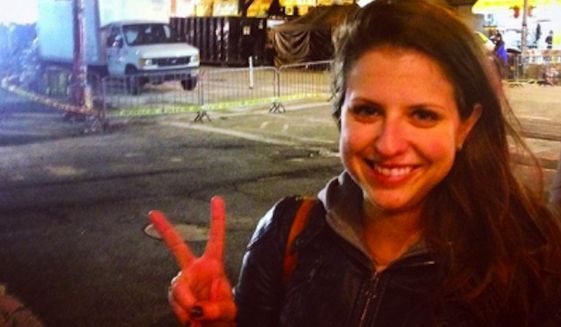
Christina Freundlich, a former communications director for the Iowa Democratic Party who sparked outrage in March after taking a smiling selfie in front of the scene of a deadly New York City fire, has reportedly been hired as a spokeswoman for the Democratic National Committee. (Christina Freundlich via New York Post)
Christina Freundlich flashes the 60s Peace Sign in front of the site of a NYC fire that killed two.
I gave my unvarnished opinion of selfies in a post exactly one year ago when I wrote:
"We need the selfie craze to come to a halt as it's now getting ridiculous. The scene shown this morning (on CBS Early Show) of the Tour-de-France and one rider smacking the smart phone from a selfie -taker said it all. The ignoramus was apparently sticking his neck literally way out into the stream of bike riders to try to snap his mug with the racers in rear view. He couldn't fathom he was creating an obstruction, so having the stupid phone slapped from his hand was a wake up call."
And, of course, we know the stupid "selfie sticks" have now been banned from theme parks like Disney World, and if you've ever been there you'd know why. Let us also recall what Krimhilde, my sister-in-law and Eck spiritualist,  also said about selfies:

"These are the creations and obsessions of the immature human, which remains steeped in narcissism, in self-absorption. No truly advanced or advancing human on the path to a higher spirituality takes a selfie. Our true motivation and mission in this life is instead to embrace selflessness. That means placing one's body in proper relation to one's spirit."
No more graphic illustration of the "immature human selfie taker" was seen this a.m. on 'Morning Joe' when the image of dopey Millennial Christina Freundlich  flashed on the screen with Katy Kay providing the background info that the young woman posted "a controversial selfie at the site of a deadly gas explosion that killed two and injured twenty-five was now a spokeswoman for the DNC."
Seriously? The DNC, or Democratic National Committee.?  Does she not know, or has she never been taught,  basic democratic manners, principles and culture? Foremost among them that a Democrat is a fundamental Humanist who differs from his/her Repuke counterparts by having human sensibilities. We don't worship money changers or call money "speech" - denigrating flesh and blood people. We also look out for vulnerable citizens, help at soup kitchens where possible, and if not at least donate to worthy humanitarian causes. What we emphatically do not do is pose in front of a devastating disaster scene to take a selfie while smiling broadly.  That sends the message of being a closet Repuke, not a Dem!
Freundlich said in March  when this first blew up (and she caught plenty of flak),  that she was “deeply sorry” for the “careless and distasteful” photo she posted on Instagram that showed her flashing a peace sign with the caption, “Scene of the accident.” Just behind her the East Village scene could be seen cordoned off after the inferno.

She should be "deeply sorry" given her crass photo was the epitome of ghoulish, ghastly behavior. The self-inflation via selfie after others perished itself inviting bad karma by insinuating one's image into a death scene. No person of sound judgment would take such a heinous image, and the fact she is supposed to now to be “Southern Regional Press Secretary” for the DNC (according to her Twitter page) calls the DNC's own judgment into question.

According to one Pew Research study, the Millennials are supposed to be the primary selfie takers and aficionados. This may be a sign that they are having a difficult time growing up and becoming more self-aware, or it could be they are too caught up doing what their peers are doing. Whatever the case, including being too addicted to Instagram, they need to attend to the memo that you do not take selfies at disaster scenes. Especially smiling selfies in front of where people lost their lives.

Tuesday, July 8, 2014

Enough Selfies Already!

Arizona State sorority members
Okay, enough is enough! We need the selfie craze to come to a halt as it's now getting ridiculous. The scene shown this morning (on CBS Early Show) of the Tour-de-France and one rider smacking the smart phone from a selfie -taker said it all. The ignoramus was apparently sticking his neck literally way out into the stream of bike riders to try to snap his mug with the racers in rear view. He couldn't fathom he was creating an obstruction, so having the stupid phone slapped from his hand was a wake up call.

Apart from the fact NO males ought to be doing selfies, one wonders how this insane craze got started and why it is sustained.   Well, it turns out Joel Stein has the answer to  how this odious, self-absorbed obsession began ('Selfie Madness', Playboy, July/Aug. p. 38) as he notes:

"These were originally the bailiwick of club girls on MySpace: shot in the bathroom mirror, cleavage showing, head tilted, hand on hair, duck lips out."

He also observes, accurately I believe, that men have no business at all taking selfies. He writes:

"Men are even taking selfies in front of other people, unaware of the shame they should feel. A woman taking a selfie in public is inherently hot. She's telling the whole bar to look at her, signaling her confidence....after centuries of posing for male artists the girls can at last objectify themselves.

For a man, though, I am absolutely convinced taking a selfie is a demonstration of insecurity. We have the luxury of not having to be constantly evaluated on our looks, it's pathetic to care too much."

Indeed, it is. While a woman can be excused, especially if fairly attractive, in imposing herself in assorted real world scenes, males are a blight and an unwelcome intrusion - say like a skunk or rabid rat  suddenly appearing at a picnic. Outside observers don't appreciate it, and neither do those (like the bike racers in England) on whom this foolishness is spontaneously imposed - though truth be told, the females ought to have been keeping low profiles too (in the case of the bike race). So it is safe to say the selfie craze has metastasized to the point of a visual cancer in much of the culture.

Even Obama fell into the selfie trap at Nelson Mandela's funeral, something JFK never would have done in a million years. JFK had a sense of decorum and even if offered this smart phone device, would have likely used it only for basic communications or the odd web surfing - or taking photos of his kids- never of himself.  JFK projected power, and he was confident enough not to have to have a record of himself in every situation. (Of course, the media DID want to photograph him in almost every situation, so much so that JFK often had to go to extremes to reclaim his privacy!)

The "selfie" then embodies all the gratuitous self-infatuation that is poisoning this country - causing it to mutate into a bunch of navel-gazing zomboids with faces pushed into assorted small screens - whether of smart phones or iphones- and intruding into the visual world.  Let us also recall what Krimhilde, my sister-in-law and Eck spiritualist,  said about selfies:

"These are the creations and obsessions of the immature human, which remains steeped in narcissism, in self-absorption. No truly advanced or advancing human on the path to a higher spirituality takes a selfie. Our true motivation and mission in this life is instead to embrace selflessness. That means placing one's body in proper relation to one's spirit."

Indeed, and one of the ways we've seen the extreme manifestation of the selfie craze is in "after sex" selfies, which no one has any business doing for all the reasons I posted in a previous blog post:


http://brane-space.blogspot.com/2014/04/no-you-dont-want-to-do-aftersex-selfies.html

Can we get people to rein in the selfies?  Not too likely until such time that they mature sufficiently to not have to interject themselves into the world every five seconds.

Stein noted that according to a poll in the British newspaper The Telegraph, selfies are "the most popular type of photograph". Which is sad, and shows the extent of solipsistic navel gazing to which we've descended. "I- phones", "Ipads"....the whole tech lingo bespeaks I, I, I. The selfie or "I-photo", simply extends this ego gratification one more dimension.

No wonder today so few have eyes turned toward the larger universe, and outer space. We're all so enmeshed in the "I" we are unable to externalize the EYES to realms beyond ourselves.

Sad.


Saturday, April 19, 2014

No, You Don't Want To Do 'Aftersex' Selfies


You really want your aftersex selfie to have Newt Gingrich's mug photo-shopped onto it then circulated with your gf?

There are so many reasons not to do "aftersex" selfies that it shouldn't be necessary to enumerate them. Start with the smug, solipsist nature of the "selfie" itself which embodies all the gratuitous self-infatuation that is poisoning this country - causing it to mutate into a bunch of navel-gazing zomboids with faces pushed into assorted small screens - whether of smart phones or iphones.  Let us also recall what Krimhilde, my sister-in-law and Eck spiritualist,  said:

"These are the creations and obsessions of the immature human, which remains steeped in narcissism, in self-absorption. No truly advanced or advancing human on the path to a higher spirituality takes a selfie. Our true motivation and mission in this life is instead to embrace selflessness. That means placing one's body in proper relation to one's spirit."

Wonder what she'd think of the 'aftersex' selfie?  It isn't difficult to imagine and the clue is in the last line of her comment.

But perhaps one isn't spiritually inclined. Then there are other reasons not to traverse the route of this benighted form of selfie:

1- Any instagram, any selfie can go onto the larger web, and can also be used in ways never intended by the original senders.  One such is displayed above with the aftersex selfie twisted into a mocking caricature by having photo-shopped the visage of Newt Gingrich into the guy's face. The poor girl friend is then stuck being seen with this GOOPr goober along side her, while the delirious face of the cat who sent the selfie is nowhere to be found.  (Let's also bear in mind a truly malicious person would use programs superior to photo-shop to superimpose the face of a terrorist onto the selfie, instead of Newt's!)

2- The GCHQ, NSA's Brit cousin, can snatch it up - as it does millions of instagrams, via its 'Optic Nerve' program. As the Guardian noted (Feb. 27), having gobbled up and stored millions of such images, including "sexually explicit" ones it's become increasingly difficult to keep them from the prying eyes of staff. While aftersex selfies are usually not explicit, one can picture GCHQ staff having some good yucks at the assorted ones captured that they gawk at before permanent storage. Besides, do you really want your aftersex selfie stored in some spook outfit's system for decades?

3- This ought to go without saying, but sheesh, if you actually have to post an 'after sex' visual maybe you aren't getting enough in the first place.  I mean why would you need the selfie? To remind yourself for the next 'dry' six months of what you haven't been getting regularly?  So then you can stare freely at the captured sex-satisfied smile and engrave it in memory until the next time?  Oh wait, it's not that at all, it's that you want to rub it in to your friends' faces how much you're getting and they're not! Again, a fool's errand! Most perspicacious people will still perceive you have to "prove" you are getting at least what THEY are getting! And they'll still end up believing that because you had to post it then you ain't getting what they are!

4- The aftersex selfie is gauche and uncool. No really cool person, at least  from a 60s perspective, would have to advertise having had sex.  A hippie couple from the 60s would view this manifestation not so much with disdain or judgment, but look at the senders with a mixture of pity and sympathy.  They'd also kind of tie it in with the perspective in (3).

5- Sexual relations, as Buddhist philosopher Alan Watts once pointed out ('Does It Matter?') are still a basic form of human intimacy. This extends not merely to the sex act itself but to the prelude to it (foreplay) and the post-coital phase which ought to include light banter, snuggling, cuddling - but not dispatching "selfies" to the digital world of 2 billion staring, peering, judgmental eyes.

6- The person who would violate the  boundaries of social propriety by taking an after sex selfie (also according to Watts) would be blind to what constitutes the off-scene or the "ob-scene" in human relations and situations, and hence would also be likely to send a selfie of him (or her)- self sitting on the crapper taking a dump.  Since the person lacks the social perceptions to see what ought to remain private in one domain (sexual), they'd likely lack it in another (bodily elimination) for which privacy is also warranted. (Of course, the exact analogy here would be the "post-dump selfie").

These are just some of the reasons the wise and mature person avoids taking aftersex selfies. Of course, the really wise and mature person avoids taking any selfies, period!

Tuesday, February 25, 2014

The Case for the "Ugly Selfie" And Why Meryl Davis Probably Shouldn't Do Selfies

A new indie film that emerged at the Sundance Film Festival last month was entitled "Selfie". It featured 18 teenaged girls who were asked to capture (during a 1-day workshop) the physical imperfections they'd normally try to hide - say if they were taking a selfie to send off to a friend. The images included accentuation of their double chins, freckles, upper arms, and pimples. Cynthia Wade, the film maker, said the point was to start a conversation about cultural beauty standards. and self-esteem.

According to Ms. Wade, quoted in The NY Times (Feb 23, p. 12-ST):

"We spend so much time trying to hide our flaws because the culture has set it up that you have to be ashamed if you're not perfect. I think girls are tired of it. They're suddenly much more willing to embrace the ugly or ironic."

In this context, it is natural for cute or pretty girls to rebel from the image dictators and strike back, often with the deliberately ugly selfie in which the face is contorted, teeth bared, mouth twisted. The effort is to dispel the "pretty girl" image.  This is fully merited given the media is focused on dictating pose and appearance for any one who's already pretty. According to Nancy Etcoff, a cognitive psychologist quoted in the piece:

"Modern day beauty images have maintained a particularly rigid definition: ladylike, small, modest unthreatening and virtually emotionless."

The piece goes on to reinforce this perception, observing:

"It takes little more than a scan of any red carpet to see that idea in action: a sea of toothless smiles, frozen foreheads and hunched shoulders, the uniform that every young woman has learned to mimic. And while this generation may be more tech savvy than any other, that beauty ideal can still be crippling."

Let's be clear this  "beauty ideal" can also be exclusionary, merciless and rife with bigotry.  Who can forget the stunning outcry last year after Nina Davuruli   was named Miss America?   Her victory was met with outcry from racist troglodytes via social media backlash.  Why the rampant hostility? Because Nina didn't meet the unspoken beauty standard. She wasn't white enough, too "foreign -looking", according to her Twiteratti critics.

This is why any girl who seeks to break out of the hobbling beauty standard deserves to be applauded.  Thus, as one quoted expert put it, "One of the things ugly selfies do for girls is to strip the conventional approaches to prettiness."

But what if a white woman, or girl, finds herself with an appearance at the cusp of the standard cultural beauty idiom?   By this I mean that her appearance emerges as ambiguous and can't be immediately defined as "beautiful", say as it might for a Marilyn Monroe, Kate Upton or Pamela Anderson.  Such appears to be the case for Olympic figure skating star Meryl Davis - whose face has been variously described as "non-human" or resembling  a 'N'avi alien" (from Avatar), a Disney cartoon character, and a "Grey alien".   Some of those comments can be seen here:

http://www.topix.com/forum/olympics/winter/T2LA22HVRIU6JP5FS

Also:
http://answers.yahoo.com/question/index?qid=20100222064159AA28fT7

Scarcely able to accept this, I played back some of the figure skating scenes on the DVR, and especially the close ups of Meryl afterward.  It immediately became clear that her facial features diverged from those normally deemed "acceptable" according to the beautyist promoters. Her eyes were very wide apart, for one thing, and her face extremely flat. In some ways, but perhaps only because I'd read some of the comments on Topix.com, she did appear to be like a Disney cartoon character come to life.

What was the problem? Not just in my perceptions, but those of others'. It was that our evolutionary formed vision (and brain)  detected divergences from a symmetry typically associated with both normality and "beauty".  See: http://en.wikipedia.org/wiki/Facial_symmetry  

Excerpt: "Evolutionary theorists in biology and psychology argue that more symmetric faces are preferred because symmetry is a possible honest sign of superior genetic quality and developmental stability"

Was she "ugly" as some of the commenters claimed? No, but she didn't meet the acceptable symmetry standards biological science associates with how most humans perceive beauty either.  Indeed, on examining her images - paused on the DVR- it occurred that making a selfie might not be a good idea, unless sent to personal friends. If done beyond that circle, she would risk creating a "Poe" of a Selfie. In that instant, I appreciated and realized the extent to which I also had become ensnared in the cultural-media  prejudices of what constitutes female beauty. I had also fallen victim to my evolutionary visual prejudices, i.e. in subjectively preferring a more symmetric female face.  I ought to have been able to see Meryl's beauty as singular and unique to her, as opposed to supposing she risked creating a "Poe" of any selfie! 

As we know, the "Poe" emerged from "Poe's law" originally formulated by Nathan Poe in 2005. Poe's take was that in any confrontation with a creationist - or reading his material- one had to be wary because in the absence of a 'smiley' it would be utterly impossible to distinguish a parody of the creationist (or fundie) from the real statement or real person.

Since then, the usage of the term "Poe" has come to be synonymous with almost any parody on the internet. Indeed, it could be extrapolated to include a certain subset of selfies.  This would include selfies of all those females, for example, who are at the cusp of cultural beauty standards, like Meryl Davis. For this subset, then, doing a selfie would risk creating a Selfie Poe.  In line with the definition of Poe, it would be impossible to distinguish a parody of such - say a girl  deliberately creating an "ugly" selfie by artifice, from a girl whose appearance comes over as 'strange', or at least unconventional,  doing one naturally and seeing it confused with the former category. 

This is why one might advise Meryl Davis not to do selfies outside her circle. (Apart from the fact if some of those on Topix.com ever got hold of them, they'd have a field day).

What does it say about our culture that an unconventionally attractive woman like Meryl Davis - at the top of her game in the Sochi Olympics - could be regarded as an "alien" or odd, or even having a deformity ("frontonasal dysplasia" cited at Ask.com)?

It means that our culture has become too superficial, too obsessed with appearance and "good" looks. It means that females especially, have been cajoled to submit to a cruel cycle of self-condemnation and magnifying imperfections. The "ugly selfie" then emerges as a kind of playful slice of authenticity in an age and culture where everyone and everything seems airbrushed to perfection. One psychologist actually said the teen girls were "conducting a visual coup d'état" against the perfectionist standards inherent in beauty imperialism.

Let's hope their coup d'état succeeds!

If not, it means we are a long, long way from being ready to meet and greet actual extraterrestrials. And if there are such, their best strategy remains avoiding planet Earth.