Showing posts with label Asteroid 2012 DA14. Show all posts

Saturday, February 16, 2013

Do People Take Asteroid Strikes Seriously Enough?


Meteor crater in Arizona, nearly 4,000 feet across and 570 ft. deep, formed by the equivalent of a 10 megaton blast.


The question posed in the header is difficult to answer. However, following the cosmic coincidence of yesterday (meteoroid exploding over Siberia, close passing asteroid DA 14), everyone on the Earth with more than air between the ears ought to be taking potential asteroid (or large meteoroid) strikes, very seriously indeed.  (see also: http://www.brane-space.blogspot.com/2013/02/two-cosmic-shots-over-bow-for-earths.html ) Check out also the accompanying image of the Meteor Crater in Arizona (formerly the Barringer Crater) and process its dimensions: 4,000 ft. in diameter (1,200 m) and 570 ft. (170 m) deep.

The crater was was formed by the impact of an iron-nickel meteorite 50 m (165') across, coming in at 28,600 mph, generating an impact energy of 10 megatons. This crater, in other words, would have reduced a city the size of Miramar, FL to rubble. The impact occurred roughly 50,000 years ago. By comparison, the meteoroid that exploded over Russia was about 49 m in diameter, and Russian physicists estimate its explosive release at about 20 Hiroshima bombs of 10 kilotons each, or 200 kilotons - thus, a fifth of a megaton. Small change, in other words.

Meanwhile, a 100- to 130-foot asteroid exploded over Siberia in 1908 and flattened 825 square miles of forest, while the rock that is thought to have wiped out the dinosaurs 66 million years ago was a monster 6 miles  (10 km) across. The difference is the first is classed as a "regionally devastating impact"  (1-100 megatons) while the latter is classed as a mass extinction event (100 - 100,000 megatons). Though smaller in diameter than the one that exploded over the Urals, it was likely traveling at a faster velocity and probably had a higher mass density.

The worst nightmare is the Earth-sterilizing asteroid or planet killer, with explosive equivalent of > 100,000 megatons. This will be from a rock greater than 10km across.  While I did write in an earlier blog I would take an asteroid instead of a central meridian solar CME, that only applied to tiny asteroids like DA 14. NOT to planet killers, since a massive CME and planet killer would have the same outcome: most or all of humanity dead or dying.

Astronomer Paul Chodas, who works in NASA's Near-Earth Object program in Pasadena, Calif., decribed the Russian object as:

"....a tiny asteroid.  It would be very faint and difficult to detect — not impossible, but difficult."

Meanwhile, the actual asteroid DA 14 2012 that made a heart stopping close pass, was three times the size of the Russian object, and coming in at nearly 40,000 mph. Its blast -energy release was more like a 20 megaton blast.

In many ways then, these things are almost like random terror attacks from the sky. So why aren't more people concerned (up to now, for example, only 12 have read the blog from yesterday, compared to 270 who've read the Dec. 1st blog on the Notre Dame Prep sex video. Can a sex video really be more important or interesting than a potential, obliterating asteroid strike? Wait, don't answer that...

But at least according to Rusty Schweickart, who flew on Apollo 9 in 1969, and helped establish the planet-protecting B612 Foundation (quoted in Saturday's Denver Post  referring to Friday's events): "

"After today, a lot of people will be paying attention,"

Well, maybe! If sex or Beyonce don't distract them! Schweickart and his Foundation have been warning NASA for years to put more muscle and money into a heightened asteroid alert. To his credit, he and some former astronauts want to give the world a fighting chance in terms of confronting the specter of an asteroid approach. After all, what good is all our vaunted human intelligence if we meet the same end as the dinosaurs one of these days?

Here's the current skinny: Scientists think there are 500,000 to 1 million "near-Earth" asteroids comparable in size to DA14 or bigger out there. But less than 1 percent have been spotted. Astronomers have catalogued 9,600 of them, of which nearly 1,300 are bigger than 0.6 miles long. That means they are at least of mass extinction level.


Earth's atmosphere gets hit with 100 tons of junk every day, most of it the size of sand and most of it burning up before it reaches the ground, according to NASA. And also, there may be many bolides such as exploded over Siberia, but many will do that over oceans or other areas where few human observers live.

As NASA's Jim Green, director of planetary science, puts it, regarding the Russian event:

"These fireballs happen about once a day or so, but we just don't see them because many of them fall over the ocean or in remote areas. This one was an exception,"

Former Astronaut Schweickart observed:

"The chances of Earth getting hit without warning by one of the big ones are extremely low, so low that it's ridiculous. But the smaller ones are quite different."

This is true, but the probabilities for the monster rocks smacking us ought not be readily dismissed, because one never knows what sort of gravitational perturbations can affect existing orbits. We already know, for example, that an estimated 1,000 asteroids are perturbed from the asteroid belt each year to become Earth-crossers. We call these "Apollo asteroids". We need to keep track of them, because they are the ones that are among the planet killing or mass extinction scales. The smaller ones? Yes, they are nuisances, but we can deal with them if we have some long range planning wherewithal combined with alert observers.

And what are our illustrious politicos doing in the meantime, since the Friday events?  Rep. Lamar Smith, R-Texas, chairman of the House Science, Space and Technology Committee called for a hearing in the coming weeks. In his words:

"Today's events are a stark reminder of the need to invest in space science,"

Yes indeed, but we need a lot more than hearings. We need lots more technically-minded people with eyes on the skies.

Schweickart and others meanwhile, have advised that NASA launch a $250 million-a-year program to survey asteroids and work up a deflection plan. The latter would be most effective for the lesser objects but may also help with the larger ones, of at least mass extinction scale. Ideally Russia (especially after Friday) and the USA should combine their resources and work together for the planet's benefit - as opposed to more opportunistic war -making (to ramp up defense budgets), including endless stupid wars on terror.

WTF use is a war on terror, defending against maybe a 'dirty bomb' that can remove a thousand people, when a major meteroid strike - such as produced the Barringer crater-  would kill millions, say if it landed directly on New York City?  Instead of therefore pumping $200 b a year into wars on terror we ought to be focused on the terror from the skies - which though  admitttedly rare- would have consequences that are irreparable.

Schweickart notes that "NASA now has $20 million" for searching out these terrorists in the skies, and adds. ... "It's peanuts."

Sadly, it may well take a monster meteoroid or small asteroid (like DA 14) crashing into a populated area before NASA and other agencies, politicos wake up. That would then be our cosmic 9/11 and prompt us to get off our asses before the really BIG one arrives. Aka, the planet killer!


Friday, February 15, 2013

TWO Cosmic Shots Over the Bow for Earth's Planetary Sleepers!

In this oblique view, the path of near-Earth asteroid 
2012 DA14 is seen passing close to Earth on Feb. 15, 2013Today, not one but TWO cosmic shots over our planetary bow have been received - well, ok, the 2nd is the asteroid DA 14 2012, scheduled to make a close pass at 2.25 p.m. ET today. (See graphic attached). Will we take note or continue living in a fool's paradise oblivious to the threats of large rocks from space landing on us at any time? One wonders! We are supposedly the species with the large brains and high intelligence, unlike the dinosaurs who were basically taken out 65 million years ago by the KT boundary event.  The dinos at least had an excuse, since their average brain size was about the size of a walnut so they'd never be able to configure rockets or telescopes to provide advance warning systems for asteroids or large meteoroids. (Apart from the fact they lacked the digits to render such machines, even if they had the brain power to conceive them.)

Anyway, the first 'shot over the bow' occurred with the explosion of an 11 ton (~2.2. x 10 4 kg) meteoroid over the Russian Urals barely 12 hours ago by Russian local time. The blast broke windows in 6 cities according to an MSNBC report this morning, and injured 1,000 people, while 3,000 buildings sustained damage mostly from the blast shock wave. See, e.g.

http://www.cnn.com/2013/02/15/world/europe/russia-meteor-shower/index.html

  The incident recalled for many the Tunguska Siberian event in 1908 which knocked down nearly 80 million trees and decimated nearly 820 square miles, about two-thirds the size of Rhode Island.  And this was from an object perhaps ten times the size of the 11 ton meteoroid that just hit the Urals this morning.

Meanwhile, a much larger asteroid, the one identified as DA 14 2012 is making its closest pass barely three hours from now. It packs a mass of 130,000 metric tons (~ 2.9 x 10⁸  kg) and with the explosive release equivalent of a 20 megaton nuclear bomb.  Incredibly, the object was first discovered back in February last year by a DENTIST using a high powered telescope! Why the hell had no national scientific agencies made the discovery? What would have been the case if,  instead of a minor midget asteroid making this close pass, it was a planet killer 6 km across or larger? (As opposed to only 150'  or 45 m  DA 14 2012) Would we be ready to do anything other than piss, moan and pray?

It seems doubtful! This despite evidence that we truly are living in a fool's paradise of false security! As far back as 1979, in an interview given to the BBC, Dr. Basil Boothe warned it was most unwise of humans to bet on their future security from approaching cosmic objects. This would be by assuming that their lone home planet would remain untouched, unaffected and they could sleep in peace. Not so! He estimated at least a 50-50 chance of a strike by a planet killer within 250,000 years. Sadly, this long timeline - misunderstood by the budget cutters- has been taken to mean we can do nada for a quarter million years, as opposed to a strike happening at ANY time between NOW and a quarter million years hence.

Indeed, as recently as 1994 Earthlings also observed transfixed as nearly 21 immense fragments from Comet Shoemaker Levy 9 crashed into Jupiter. Had they instead smashed into our own planet, we might not even be having this discussion.

Meanwhile, Projects Space watch and Spaceguard remain on relative life support, funding wise. The first, based at the University of Arizona, featured generous grant allocations in its early years when it discovered over 1,300 Earth -approaching asteroids by 2002. As the austerity mindedness infected all science research areas, that capability has since wound down a lot, leaving Spacewatch mostly in the hands of amateurs. Not that the latter aren't observationally capable, but we also need professionals to spot these things and then (using the well known equations of celestial mechanics) to obtain the orbital parameters as fast as possible.

Spaceguard extends the detection to focus more on NEOs (near Earth objects) as opposed to singling out near Earth asteroids (NEAs).  Again budget limitations have loomed and imposed  truncated observation time frames and selectivity.

Although there have been many discoveries of near-Earth asteroids  the Spaceguard Project has been criticized for not having an in-depth master plan if our humble planet is directly in the crosshairs of a giant asteroid. It has also been criticized of having false alarms that could lead to dangerous implications.

NASA published an article in April of 2001 to clarify many questions that have come up with this project. The report distinguished the difference between NEOs and NEAs, why the organization selected NEAs with a diameter of at least one kilometer in diameter, why the number of 90 percent was chosen and many other questions that have perplexed the general public.

Neither Space watch or Spaceguard is adequately funded, which means that either an NEO or NEA can escape through the observational 'net' and could wreak havoc, especially if the size and mass approaches that of a planet killer such as exterminated the dinosaurs.

In addition, there is no plan of which anyone is aware  for taking out a planet killer - say 6-10 km across, if one does target Earth. There have been past ruminations about using nuclear weapons to try to split the object into smaller pieces, but that was put aside when the ''architects" decided a number of smaller (1 km ) strikes might not be so good either. But still, a planet killer of 6 km arriving intact is not something to dismiss lightly and our space gurus may well have to opt on the side of losing half of the earthly populace to losing ALL of it, say from a nuclear winter onset as a result of some 10 28 kg of dust and debris in our atmosphere, cutting off sunlight.

We have the brains, supposedly, and given we aren't planning to abandon 'Mother' Earth any time soon, we had better damned well come up with a credible plan to deal with a monster planet killing asteroid if and when one appears and approaches us - whether that be next year, or in ten thousand. It is either that, or we go the way of the dinosaurs, in which case, our vaunted intellect wouldn't have made a dime's worth of difference!

Monday, February 11, 2013

Asteroid Hit or Solar Meridian-Centered CME? I’d Take the Asteroid!


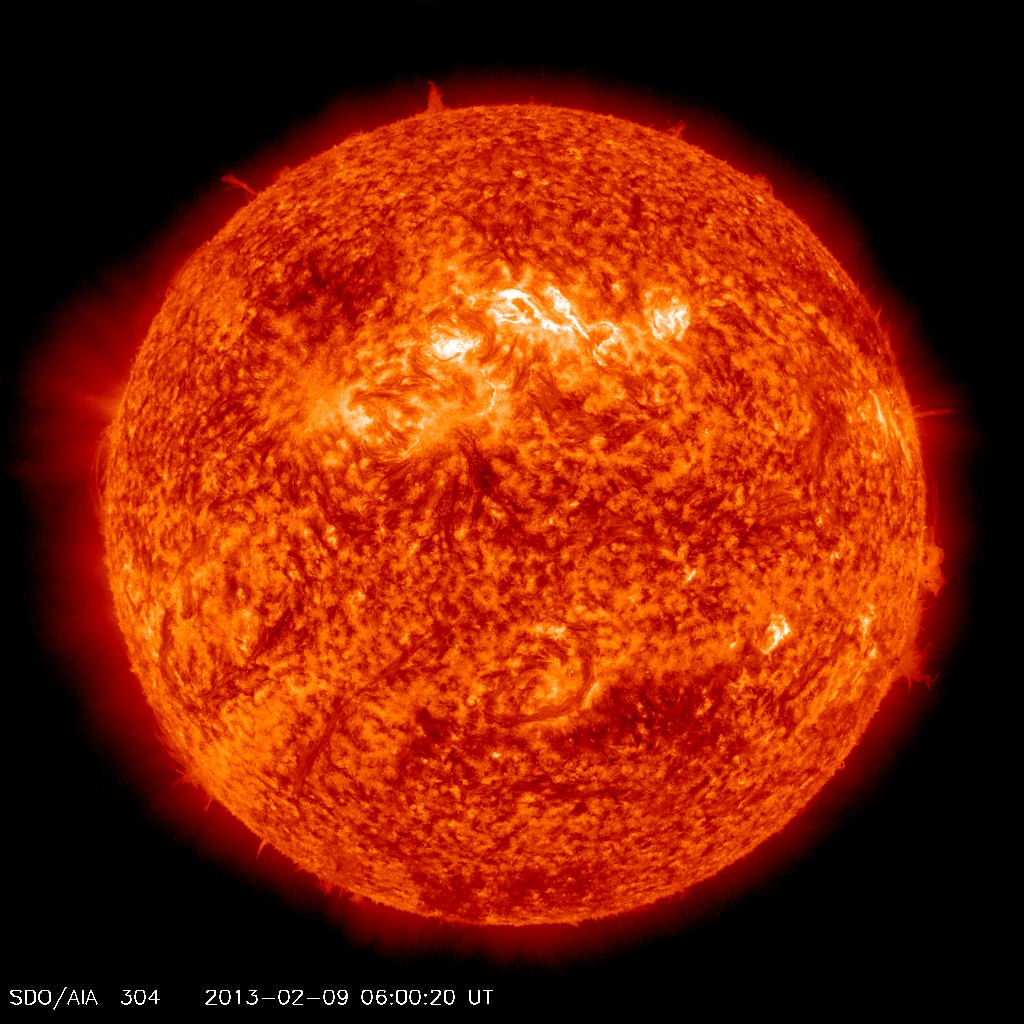
The CME captured by the Solar Dynamics and Heliospheric Observatory (from spaceweather.com)

As the asteroid 2012 DA14 approaches Earth, and is set to pass within 17,000 miles (or less than two Earth diameters) on Friday, at a speed of 17,400 mph, a high probability has also arisen of being struck by a CME (coronal mass ejection) three days earlier. This elicits the question- assuming the worst in each case- of which you’d rather have: a strike by a 15 story wide, 130,000 ton asteroid, or being struck by a CME.

First some background: In the case of the asteroid, NASA reports that this is the closest known approach of an object of this size. (They also add there’s no chance whatever of the thing whacking Earth. Well, assuming it doesn’t get deflected after hitting a geostationary satellite). It was discovered in February 2012 by astronomers at the Observatorio AstronĂ³mico de La Sagra; it passed the Earth on Feb. 16th of that year, missing us by a comfortable 2.6 million km (1.6 million miles). The asteroid has a very Earth-like orbit, talking 366 days to orbit the Sun. Its orbit is slightly more elliptical than ours and tilted by about 11° to ours as well. All that’s about to change though: After the encounter this year, the Earth’s gravity will change the orbit of DA14 quite a bit, reducing the period to about 317 days.

The asteroid, with a mass of possibly 10 9  kg would – if it impacts - be about equal to a 20 megaton thermonuclear weapon blast. It obviously would cause considerable damage if it smacked into a city or an island like Barbados – but those odds are even less than our being struck in the first place. The odds are also 3 in 4 that if it did impact it would be an ocean strike, possibly incepting a 20-40 m tidal wave depending on the location, angle of entry, etc.

The CME, meanwhile, was captured by the Solar and Heliospheric Observatory (see graphic)  as it shot away from the Sun at 800 km/s. The initial prediction is that the bulk of the ejected mass will sail over the Earth’s north pole. However, spaceweather.com warns there is still a chance of a glancing blow. The former likely means high latitude observers on Earth will see brilliant auroras, but will experience no serious disturbance. A glancing blow possibly means one or more power grids knocked out such as occurred in Quebec in 1989 after a giant solar flare.

In a 2010 episode (‘Magnetic Storms’) of the series ‘The Universe’, the initial sequence featured a March, 2013 CME event which also triggered brilliant auroras, as far south as Cuba, but which also within hours delivered a head on blow to Earth, that knocked out the entire power grid of the U.S. and every single transformer. Such possibilities were discussed in an earlier blog, e.g. http://www.brane-space.blogspot.com/2012/06/cme-that-you-dont-want-to-see.html


The result of the CME hit depicted then was no power across the U.S. No water, since water in your taps requires electricity to pump it, and no fuel either or gasoline, since gas stations also require electricity to effect pumping. For what awaits us, get another gander at those images after superstorm Sandy Struck NY and NJ in November. Long lines, squabbles over position in lines, fights, and even supermarkets going out of business. In other words, no food either! Such a CME would also knock out GPS satellites, and that would wreak even more havoc. Computer networks everywhere would go down, and without electricity anyway – computers would become museum pieces.

The episode projected some 10-15 million dead since the power wouldn’t be able to come back for years, given all the infrastructure would need to be rebuilt, including transformers, power stations, etc. Imagine then a nation with no power to speak of, hundreds of millions without food, limited canned stores – if they have that, no water, and no way to access critical emergency networks or services. The most vulnerable, as in the case of Sandy, would be the elderly, and sick.


The episode went on to further conjecture of an even worse scenario:  a CME striking at exactly the time when the Earth’s magnetic poles are reversing. With such a reverse there’d be days or weeks with no magnetic field to protect us from the full brunt of high energy solar particles so the entire planet would be affected with up to 2-3 billion dead as a result of all the power knockouts, the starvation to follow, the mayhem. The ‘End of the World’? Technically no, but many would think it was.

So, on that basis, and given my druthers, I’d always pick the hit from an asteroid like 2012 DA14 rather than a full smackdown from a CME.

Let’s hope neither of them transpires!