Showing posts with label aurora. Show all posts

Tuesday, October 4, 2016

The Aurora - The Linchpin Of Space Physics

With today commencing the recognition of World Space Week (Oct 4- 10) I plan to post space-related blogs each day on different space-related topics.


In Alaska in March, 2005, I took the above photograph of an auroral display just outside Chena Hot Springs, Alaska. I was glad my wife was with me to behold the sight (her first time) since it later evolved to an exciting electronic scene with bursts of red and green interacting and changing positions.  An even more impressive image is shown below:


While the aurora is a fantastic sight, few may realize that it also has served as a spring board to detailed studies of near Earth plasma - treated as magnetic storms. But mote on this in a bit.

How are these magnificent displays caused?

One can visualize the Earth as a giant spherical magnet, with magnetic field lines extending from its north to south magnetic poles, e.g.

No photo description available.
These magnetic field lines have the property that any charged particles (+protons, - electron or ions) that approach from the Sun, will spiral along them.

The Earth itself is "bathed" in the solar wind, a stream of high speed charged particles that flows into space, originating from the Sun's corona. (A hot, gaseous envelope that spews these particles out continuously – moresso when there is a violent explosion known as a Solar Flare)  Around the Earth the speed of these particles can reach 400- 500 km/second. (Because of its high temperature, over a million degrees, the corona gas is ionized so must consist of charged particles, mainly (+) protons, and (-) electrons).

During high solar activity (e.g. near sunspot maximums) a higher flux of these charged particles inundates the solar wind, and the region around the Earth. The Earth's magnetic field traps these charged particles, and the highest density is around the polar regions - which we refer to as the "auroral ovals". In these regions, very large electric currents are set up, as the charged particles start moving in unison about the magnetic field lines. These currents can easily reach a few million  amperes.

As this discharge occurs, one or more outer electrons is stripped from the atoms, for example from oxygen in the atmosphere - then recombines again - to form new (e.g. oxygen) atoms.

With this recombination - there is accompanying emission of light, for a certain part of the visible spectrum   For example, in the case of recombination of oxygen atoms - their emitted light is in the green region of the spectrum, such as seen in my photograph above. The remarkable red aurora is produced by emission at the 630 nm (nanometer) line of oxygen and at relatively high altitudes (e.g. 200-600 km) compared to green - which tends to form below 100 km and the oxygen line at 557 nm is excited.

Auroras can display as both diffuse and discrete. In the first case the shape is ill-defined and the aurora is believed to be formed from trapped particles originally in the magnetosphere which then propagate into the lower ionosphere via wave-particle interactions.

Thus, multiple- colored auroras can be explained by emissions from different atoms in the upper atmosphere, mainly in the region of the magnetic poles. This is also why, of course, they are more often seen in the vicinity of the N, S magnetic poles.

A great analogy has been given by Prof. Syun Akasofu-  former Director of the Geophysical Institute in Fairbanks, AK - who compared the generic aurora to an image on a TV screen. In this case the (polar) upper atmosphere corresponds to the screen and the aurora to the image that would be projected on it, say for a cathode ray TV. The electron beam in the TV  corresponds the electron beam in the magnetosphere. In the conventional TV motions of the image are generated by the changing impact points of the electron beam on the screen. Similarly, with the aurora, its motions – such as moving sheets or curtains- are produced by moving impact points of the magnetospheric electron beams.

In gauging the power and intensity of auroras at different times, it is useful to remember that ultimately the aurora derives its power and potential from the Sun and specifically the charged particles of the solar wind. This is why the most spectacular displays are usually near sunspot maximum. Around those times the currents I noted earlier are “amped” up – no pun intended- to 106  A or more. To give an example, during a quiet Sun interval (like we are in now)  the residual power for the magnetospheric generator is on the order of maybe a tenth of a megawatt. If we see a new cycle coming on and solar wind activated – we may get that power up to a million megawatts for a few hours.

In light of the above, it would be no exaggeration to say the aurora is the linchpin for the discipline of space physics. Generically, "space physics" refers to the study of plasmas that occur in the region of Earth's atmosphere. The most accessible (and visible) such plasma we know of is the aurora .

While computer simulations and numerical analysis have dominated auroral studies, such as at the Geophysical Institute of the University of Alaska, there are also space-based techniques which have provided significant data to refine the simulations as well as auroral- magnetic substorm models. At the University of Alaska - Fairbanks, for example, the Poker Flat rocket range serves as a critically important means to acquire plasma data from the plasma itself.  The image below shows the team assembled for one of the missions:

Readers interested in many more details of the Poker Flat rocket operations to do with auroral studies  can go to this link:

http://www.pfrr.alaska.edu/

Or, get  hold of the book- 'Rockets Over Alaska' -  by Neil Davis:
ROCKETS OVER ALASKA, The Genesis of Poker Flat by [Neil Davis]

A less well known mode of auroral study entails injecting electrons artificially using a space -borne accelerator.  Few are aware that NASA has previously flown devices that have fired beams with energies of a few to tens of kiloelectron volts (keV).  In a new study, Marshall et al (Journal of Geophysical Research, Space Physics, 2014) have used computer simulations to explore the capabilities of a small but powerful particle accelerator positioned at an altitude of 300 km and aimed at the atmosphere.

This space-borne accelerator would feature energies three orders of magnitude greater than the actual ones already used by NASA. Thus, it would be capable of generating a beam with particles in the 0.5 - 10 MeV range via pulses lasting 0.1 microsecond and carrying 0.1 amp of current. The simulated specs for the device are based on the Compact Accelerator for Space Science (COMPASS) currently being designed by the SLAC National Accelerator Laboratory and the nonprofit research institute SRI international.

The authors note that deploying such a device would offer many scientific opportunities to study the behavior of particles in the upper atmosphere. We'd see, for example, the paths of injected electrons trace out the arcing field lines of Earth's magnetic field - illustrating how they bend and snap during intense geomagnetic activity caused by magnetic storms.

We'd also see how visible, aurora-like emissions would be generated as the particles descend into the Earth's atmosphere and strike atmospheric molecules. Make no mistake this is exciting stuff especially for those involved in space physics. If such a particle accelerator could shed more light on magnetic substorms it would be more than welcome.

How does space physics approach the aurora?

Given the aurora is basically regarded as a magnetic substorm we use what are known as "substorm models".  In most current ones some dynamo action is required which sends currents to specific regions to provide a Lorentz force: (J ⊥ X B) where J ⊥   is the vertical current density and  B  the magnetic induction associated with the system.. At a particular altitude then, these J ⊥ currents can trigger a substorm. In the proper space physics (magnetospheric) context, a “neutral wind” arises from a force associated with the neutral air of the Earth’s atmosphere  This force can be expressed:

F = mU f

where f is the collision frequency.If one solves for f above, and uses the magnitude of magnetic force (F = qvB) where B is the magnetic induction, and v the velocity one arrives at two horizontal flows for electrons and ions moving in opposite directions. mU f = qvB = (-e) vB = (e) vB

Thus,

v1 = mU f / (-e) B and v2 = mU f / (e) B

A terrific articulation of this process can be found in a paper by Syun-Ichi Akasofu ( Auroral Substorms: Paradigm Shifts in Research', Eos Transactions, Vol. 91, No. 31, August 3, 2010, p. 269) wherein the author points out:

"The transfer mechanism of solar wind energy to the magnetosphere...is now known to be a dynamo process that converts the kinetic energy of the solar wind to electrical energy on the magnetopause - because most auroral and geomagnetic phenomena are various manifestations of energy dissipation processes."

This amounted to a brilliant recognition of the energy aspects but more work needs to be done, especially in developing self-consistent models for "loading" and "unloading" processes.  These refer to two distinct energy paradigms, the B-v (driven) and E-J . In the former observations of the magnetic field and motions govern the models, in the latter it is the magnitude of currents or current densities (J ).

One of the most intriguing discoveries of recent decades has been the identification of auroras on Jupiter.  A major difference is that unlike Earth's auroras, those on Jupiter are nearly continuous - driven by the planet's rapid rotation and its volcanic moon (Io),  which spews out sulfur and oxygen ions as well as electrons into space, The latter speed along the planet's magnetic field lines and - if powerful enough - slam into the atmosphere causing its particles to glow.

One of the highly enhanced images of Jupiter's aurora is visible in the Hubble Space Telescope photograph below;
Image result for brane space, Jupiter aurora
Only recently Tao et al (Journal of Geophysical Research -Space Physics, Oct. 2015, p. 1002), using the Japanese Hisaki Space Telescope, measured variations in the brightness of the Jovian aurorae. They reported observing two kinds of auroral pulses. In one, the aurora brightened for up to several days at a time, and the authors attributed this to the solar wind. Thus, as it 'washes over' the planet, the charged particles are buffeted and compress Jupiter's magnetic field. This is very similar to what happens on Earth.

The team also observed much more rapid variations, with pulses typically lasting less than ten hours. By comparing the Hisaki images with images taken simultaneously by the Hubble Space Telescope, Tao et al could see these variations arose from the aurora brightening at lower altitudes, at the bottom of the auroral arc and as reported by Kimura at al (op. cit.)

Using Hisaki's onboard spectrometer, the Tao team was also able to estimate how fast the electrons were traveling on the basis of how deep in the atmosphere the light originated. They found that when the aurora flares up it's not because faster, more energetic electrons are penetrating deeper into the atmosphere. It is instead due to the overall increase in the number of electrons.

All of this indicates that Jupiter's most intense auroras occur when plasma is suddenly injected into its magnetic field, most likely from Io.

The aurora is a fantastic phenomenon for detailed plasma study that has not only aroused awe in Earthbound observers, but prompted the timely development of sophisticated space-based methods of detection.

Sunday, September 6, 2015

New Insights Shed on Field -Aligned Currents in Magnetosphere


Aurora driven by field-aligned currents.

Field -aligned electric currents are extremely important in both the solar and terrestrial magnetospheric contexts. New research by Lühr et al  (Geophysical Research Letters, 2015) reveals new aspects of field-aligned currents in the Earth's magnetosphere. Let us recall that field -aligned currents (FACs) are one component designated  (J || ) of "dynamo currents" in the magnetosphere with the other the cross-field (J ^) current . In respect of the latter, it is required that the dynamo action send currents to specific regions to provide a Lorentz force: (J ⊥ X  B).

In detailed auroral models it can be shown that the "dynamo currents" in such a process flow earthward on the morning side of the magnetic pole and spaceward on the evening side. The circuit can be visualized completed by connecting the two flows across the polar ionosphere, from the morning side, to the evening side.

In regard to FACs in the magnetosphere, they've been of intense interest to physicists studying space weather phenomena since first discovered in the early 1960s.  Until now, all that's been learned of FACs has been via lone satellites from which the extracted data has been subject to crippling assumptions, i.e. that the currents are static only and have a sheet geometry (current sheet)

To ascertain if those assumptions were warranted Lühr et al used data from the European Space agency's SWARM constellation mission to observe how FACs of varying sizes changed over time. They examined the measurements collected during the first three months after the satellites were launched in November, 2013 - when 3 spacecraft were relatively close together.

The authors found that small-scale currents, extending up to 10 km, are highly variable. Smaller scale FACs remain stable for period of only up to 10 seconds and their spatial structure is indeterminate. Meanwhile, large scale FACs extend up to 150 km and are stable for up to 60 seconds.  The geometry shows these currents are roughly four time longer - along their longitudinal axis - than they are wide, confirming a sheet-like structure.

The new study also showed that large FACs are likely both sheet-like as well as stable. This means that single -satellite estimates of larger FACs at auroral latitudes are relatively accurate. Of course, more research needs to follow to confirm the validity of these early results but there is much confidence in the space physicist community - especially using numerical models as well - that this can be done and expeditiously.

Sunday, June 28, 2015

The Case For Particle Accelerator Experiments in Near Earth Space

No automatic alt text available.
What do we know about the aurora? Well, we know that high above Earth's surface, high-energy electrons and ions rain down on the upper atmosphere - spiraling along the planet's magnetic field lines. When the particles strike the upper atmosphere they excite (ionize) nitrogen or oxygen molecules producing the glowing display known as the aurora.

While computer simulations and numerical analysis have dominated auroral studies, such as at the Geophysical Institute of the University of Alaska, there is a less well known way to study this phenomenon. This entails injecting electrons artificially using a space -borne accelerator.

Few are aware that NASA has previously flown devices that fired beams with energies of a few to tens of kiloelectron volts (keV).  In a new study, Marshall et al (Journal of Geophysical Research, Space Physics, 2014) have used computer simulations to explore the capabilities of a small but powerful particle accelerator positioned at an altitude of 300 km and aimed at the atmosphere.

This accelerator would feature energies three orders of magnitude greater than the actual ones already used by NASA. Thus, it would be capable of generating a beam with particles in the 0.5 - 10 MeV range via pulses lasting 0.1 microsecond and carrying 0.1 amp of current. The simulated specs for the device are based on the Compact Accelerator for Space Science (COMPASS) currently being designed by the SLAC National Accelerator Laboratory and the nonprofit research institute SRI international.

The authors note that deploying such a device would offer many scientific opportunities to study the behavior of particles in the upper atmosphere. We'd see, for example, the paths of injected electrons trace out the arcing field lines of Earth's magnetic field - illustrating how they bend and snap during intense geomagnetic activity caused by magnetic storms.

We'd also see how visible, aurora-like emissions would be generated as the particles descend into the Earth's atmosphere and strike atmospheric molecules. Make no mistake this is exciting stuff especially for those involved in space physics. If such a particle accelerator could shed more light on magnetic substorms it would be more than welcome.

In most current substorm models it is required that there exist some dynamo action which sends currents to specific regions to provide a Lorentz force: (J ⊥ X B). At a particular altitude then, these J ⊥ currents can trigger a substorm. In the proper space physics (magnetospheric) context, a “neutral wind” arises from a force associated with the neutral air of the Earth’s atmosphere (e.g. Hargreaves, The Solar-Terrestrial Environment, Cambridge Univ. Press, 1992, p. 24). This force can be expressed (ibid.):

F = mU f

where f is the collision frequency. It is also noted that this wind blows perpendicular to the geomagnetic field (ibid.)

If one solves for f above, and uses the magnitude of magnetic force (F = qvB) where B is the magnetic induction, and v the velocity one arrives at two horizontal flows for electrons and ions moving in opposite directions. mU f = qvB = (-e) vB = (e) vB

Thus,

v1 = mU f / (-e) B and v2 = mU f / (e) B

A terrific articulation of the process has been done in a paper by Syun-Ichi Akasofu ( Auroral Substorms: Paradigm Shifts in Research', Eos Transactions, Vol. 91, No. 31, August 3, 2010, p. 269) wherein the author points out:

"The transfer mechanism of solar wind energy to the magnetosphere...is now known to be a dynamo process that converts the kinetic energy of the solar wind to electrical energy on the magnetopause - because most auroral and geomagnetic phenomena are various manifestations of energy dissipation processes."

This amounted to a brilliant recognition of the energy aspects but more work needs to be done, especially in developing self-consistent models for "loading" and "unloading" processes.  These refer to two distinct energy paradigms, the B-v (driven) and E-J . In the former observations of the magnetic field and motions govern the models, in the latter it is the magnitude of currents or current densities (J ).

Ideally, use of the type of particle accelerator proposed may actually one day be able to replicate actual auroras such as the one we observed and photographed in Chena Hot Springs, Alaska in March, 2005 e.g.


Meanwhile, Marshall et al's computer modeling shows the injected beam would leave a visible, glowing trail that could be measured from the ground with a peak emission occurring at an altitude of about 44 km. How to explain? As the incoming electrons are jerked around by the molecules of the atmosphere they'd also emit x-rays that could be seen from high altitude balloons operating at around 44 km - thereby providing a further prediction for the model.

One drawback, we need to be sure to inform the public via popular science articles or blog posts so as not to incur a hysterical reaction - such as been the case with the HAARP (High Frequency Active Auroral Research Program).   See more on this program here:

https://en.wikipedia.org/wiki/High_Frequency_Active_Auroral_Research_Program

As noted in the above link:

"HAARP was a target of conspiracy theorists, who claimed that it was capable of modifying weather, disabling satellites and exerting mind control over people, and that it was being used as a weapon against terrorists. Such theorists blamed the program for causing earthquakes, droughts, storms and floods, diseases such as Gulf War syndrome and chronic fatigue syndrome, the 1996 crash of TWA Flight 800, and the 2003 destruction of the space shuttle Columbia. Commentators and scientists say that proponents of these theories are "uninformed", because most theories put forward fall well outside the abilities of the facility "

Once again, then, we see the emergence of really nutty conspiracy theories which must always be judiciously and relentlessly separated from those which have validity. Simple conflation of all conspiracies is, of course, the easiest path to take - but also the intellectual coward's and non-critical thinker's. We cannot be that blasé and lazy.

The way to do this for space physics developments - like the proposed particle accelerator- is to keep the public informed, and also hope that current science education can keep up with current scientific advances! Briefly put, we need much more attention to high school physics - as well as college physics!

Wednesday, February 11, 2015

A New Model for Magnetic Substorms Shows Promise


Regions of the magnetosphere of Earth. Our planet is situated at the nexus of the two blue lobes to the left.

Space physics, alas, is not something familiar to most people who may confuse it with solar physics, or shooting rockets into space. In fact, space physics primarily involves the study of near Earth plasma particularly in the magnetosphere - which is shown in the diagram above. Basically, the magnetosphere can be considered to be the region of plasma influenced by the magnetic field of Earth.  It is the region within which all -any charged particles proximate to our planet are susceptible to that B-field.

In the diagram shown, Earth is situated at the midpoint of the two blue lobes on the left side. The immediate magnetic field is indicated by the first several outer lobes - much as you would expect to see if tracing the magnetic field lines of a bar magnet.  As can be seen, the magnetosphere is short and squat on the side of Earth that faces the Sun- the "dayside" - but features a long tail extending away on the "night side".

This "magnetotail" is shaped primarily by the powerful force of the solar wind and the energetic plasma flow within it. Here on Earth, at certain times of the year and at specific places we observe the effects of this flow in the form of the aurora, such as we photographed in Chena Hot Springs, Alaska in 2005 e.g.


During high solar activity (e.g. near sunspot maximums) a higher flux of these charged particles inundates the solar wind, and the region around the Earth.

The Earth's magnetic field traps the particles, and the highest density is around the polar regions, which we refer to as the "auroral  ovals". In these regions, very large electric currents are set up, as the charged particles start moving in unison about the magnetic field lines. These currents can easily reach a few million amperes.

As this discharge occurs- in what we call "substorms" -  one or more outer electrons is stripped from the  atoms, for example from oxygen in the atmosphere then recombines again to form new (e.g. oxygen) atoms.  With this recombination there is emission of light, for a certain part  of the visible spectrum. This  is basically what gives rise to the aurora.

Now in Eos Transactions, Vol. 96, No. 1, January  15, 2015, p. 27), it is reported that  original work published by Pritchett et al  in The Journal of Geophyical Research, it's proposed that substorms may arise from Earth-sized bubbles of low density plasma that "ride" magnetic field lines through the magnetotail toward Earth.

Using a computer model simulating how charged particles behave in magnetic fields they showed these bubbles preferentially form in parts of the magnetotail where entropy increases with distance from Earth Thus the properties of the bubbles and the "auroral streamers" they send earthward change as they move through the magnetic field . Eventually this triggers a full blown substorm.

The model is useful in that it helps to explain the link between the magnetic perturbations that seem to accompany substorms (usually covered under one of two distinct energy paradigms, the B-v (driven) and E-J ("unloading") and auroral streamers. What's encouraging is that their predictions also match observations of the structure and behavior of auroral streamers made by the THEMIS satellites (THEMIS for 'Time History of Events and Macroscale Interactions During Substorms'.)


Friday, August 15, 2014

"Constitutionalists" (sic) Still Don't Get It On the 2nd Amendment


We all know that any attempt to "square the circle" must end in failure given the contradictory properties of the two geometrical figures. Yet, for self-proclaimed  "constitutionalists" (for whom I drop the euphemistic label and just refer to tea baggers) such a feat evidently is as simple as eating an apple pie along with a cherry pie. This is especially true in relation to the 2nd amendment, which I referenced in an earlier (Aug. 11) post, viz.:

The Second Amendment and right to bear arms is another case in point, which the Tea bagger crowd clearly sees fit to ignore when it suits their purpose. They insist the amendment gives them the "right to bear arms" but it does no such thing. The 2nd amendment in fact assured an equipped MILITIA (because no standing army existed when this section was written).  Thus, you were regarded as part of a state or local militia and that conferred the right!

This take, when the country was once sane as opposed to insane, was roundly supported  by FDR's Solicitor General who framed the argument correctly to the Supreme Court in a 1939 case:

"The Second Amendment grants people a right that is not one which may be utilized for private purposes but only exists where the arms are borne in a militia or some other military organization provided by law and intended for protection of the State."

The SC decision was unanimous. But then, sanity more or less prevailed back then, unlike now.

Even before that decision, a common sense take was prevalent regarding the 2nd amendment which our illustrious "Constitutionalists" seem to have forgotten or never learned in the first place.  For example, Adam Winkler, a professor of constitutional law at UCLA in a book entitled 'Gunfight: The Battle Over the Right To Bear Arms in America',  has masterfully documented how guns were regulated from the earliest days of our Republic.

As an example: laws that banned the carrying of concealed weapons were passed in Kentucky and Louisiana in 1813, in Indiana in 1820 and in Tennessee and Virginia in 1838. Similar laws were later also passed in Texas, Florida and Oklahoma.

The then governor of Texas in 1893 was heard to proclaim:

"The mission of the concealed weapon is murder. To check it is the duty of every self-respecting, law abiding man".

WOW! How times have changed!

While such sane and sober perspectives prevailed for several more decades, they started to unravel by the 1970s as various Right wing groups coalesced to challenge gun control based on spurious "private gun ownership" interpretations, and successively overturned laws in state legislatures.

Undissuaded by the gun lobby's arguments, especially that the 2nd amendment granted every man the right to keep and bear arms on his own, Chief Justice Warren Burger responded that this interpretation was:

 "one of the greatest pieces of fraud on the American public by special interest groups that I have ever seen in my lifetime."

He meant "fraud" in the sense that it betrayed the very original context set out in the Constitution which these "constitutionalists" profess to hold so dear.  But as I showed in the earlier blog post, this just discloses how these tea bagger pretenders are not really invested in that document at all. They're only invested in how THEY can interpret it to suit their own convenience.

Fortunately, Justice Burger didn't live so long as to see the arrival of automatic weapons and the claim that the 2nd amendment provided for the ownership of those too! (Especially given the text of the 2nd amendment as it applied to standing army and militias were only allowed muskets with bayonets, not AR15s, Bushmaster .223s and the like)  But this is what happens when meanings are stretched to confer perversions of the original - despite the fact these folks claim to adhere to the original meaning. Squaring the circle anyone? Anyone?

What do we derive from this historical perspective? That the REAL un-Americans are those who have twisted the meaning of the 2nd Amendment to their own ends, with the result that the fallout has created a never-ending sea of maimed, crippled and murdered gun victims like those victims of the Aurora, CO massacre back in July 2012. 

None of this will change until we return to the gun control concepts and legislation common 70 or more years ago, and flush the current memes down the toilet! And the doctored versions of  the Constitution with it!

Free speech allows people, even tea baggers, to their opinions. But not their own facts. And the historical facts clearly show the 2nd amendment has been steamrolled and perverted by the people who know the least about the original meaning of the Constitution.

Tuesday, May 20, 2014

The Aurora and the Black Aurora


The aurora is one of the most magnificent sights in the sky and we counted ourselves lucky to see a fairly decent one (captured in the attached photo) in March of 2005, while staying at Chena Hot Springs, Alaska.

 To understand the aurora, one can visualize the Earth as a giant spherical magnet, with magnetic  field lines extending from the north to south (magnetic) pole. These  magnetic field lines have the property that any charged particles (+ protons, - electron or ions) that approach, will spiral along them.

The Earth itself, is "bathed" in the solar wind, a stream of high speed charged particles that flows into space, originating from the Sun's  corona. (A hot, gaseous envelope that spews these particles out continuously, moreso when there’s a violent explosion known as a Solar Flare)

Around the Earth the speed of these particles can reach 400- 500  km/second. (Because of its high temperature, over a million degrees, the corona gas is ionized so must consist of charged particles, mainly (+)  protons, and (-) electrons).

During high solar activity (e.g. near sunspot maximums) a higher flux of these charged particles inundates the solar wind, and the region around the Earth.

The Earth's magnetic field traps the particles, and the highest density is around the polar regions, which we refer to as the "auroral  ovals". In these regions, very large electric currents are set up, as the charged particles start moving in unison about the magnetic field lines. These currents can easily reach a few million amperes.

As this discharge occurs, one or more outer electrons is stripped from the  atoms, for example from oxygen in the atmosphere then recombines again to form new (e.g. oxygen) atoms.  With this recombination there is emission of light, for a certain part  of the visible spectrum. This  is basically what gives rise to the "northern lights", or what we call the aurora.

For example, in the case of recombination of oxygen atoms, their emitted light is in the green region of the spectrum. The aurora or northern lights we see display a kind of green curtain-like shimmering. The remarkable red aurora is produced by emission at the 630 nm (nanometer) line of oxygen and at relatively high altitudes (e.g. 200-600 km) compared to green - which tends to form below 100 km and the oxygen line at 557 nm is excited.

Auroras can display as both diffuse and discrete. In the first case the shape is ill-defined and the aurora is believed to be formed from trapped particles originally in the magnetosphere, which then propagate into the lower ionosphere via wave-particle interactions.  Thus, multiple colored auroras can be explained by emissions from different atoms in the upper atmosphere, mainly in the region of the magnetic poles. This is also why, of course, they are more often seen in the vicinity of the N, S magnetic poles. (Though there have been reports of northern lights being seen as far south as northern Florida, especially during periods of exceptional sunspot activity or large solar flares, massive explosions on the Sun).

A great analogy has been given by Syun Akasofu (formerly of the Geophysical Institute in Fairbanks, AK),  comparing the aurora to images on a TV screen. In this case the (polar) upper atmosphere corresponds to the screen and the aurora to the image that would be projected onto it, say for a TV. The electron beam in the TV (remember we are talking about the old-style cathode ray jobs!) corresponds to the electron beam in the magnetosphere. In the conventional TV motions of the image are generated by the changing impact points of the electron beam onto the screen. Similarly, with the aurora, its motions (i.e. moving sheets or curtains)  are produced by the moving impact points of the magnetospheric electron beams.

In gauging the power and intensity of auroras at different times, it is useful to remember that ultimately the aurora derives its power and potential from the Sun and specifically the charged particles of the solar wind. This is why the most spectacular displays are usually near sunspot maximum. Around those times the currents I noted earlier are “amped” up – no pun intended- to 10^6 A or more. To give an example, during the relatively quiet Sun interval from 2002-08, the residual power for the magnetospheric generator is on the order of maybe a tenth of a megawatt. If we see a new cycle coming on and solar wind activated – we may get that power up to a million megawatts for a few hours.

Not often seen, and alas one we missed, is a variety called the “black aurora”. One such image taken at Fairbanks, AK in December 13 by Deborah Carter, is shown below:


In contradistinction to the normal aurora, the black aurora emerges with dark structures formed when negatively charged particles are sucked up and out of the atmosphere along magnetic field lines that adjoin the normal bright emission aurora. This negative action effectively completes a circuit between the ionosphere and the magnetic field, creating dark vertical shapes that can stretch tens of thousands of miles and remain visible for several minutes.

One of these years we hope to get back to Alaska again and see the black aurora!


Monday, February 11, 2013

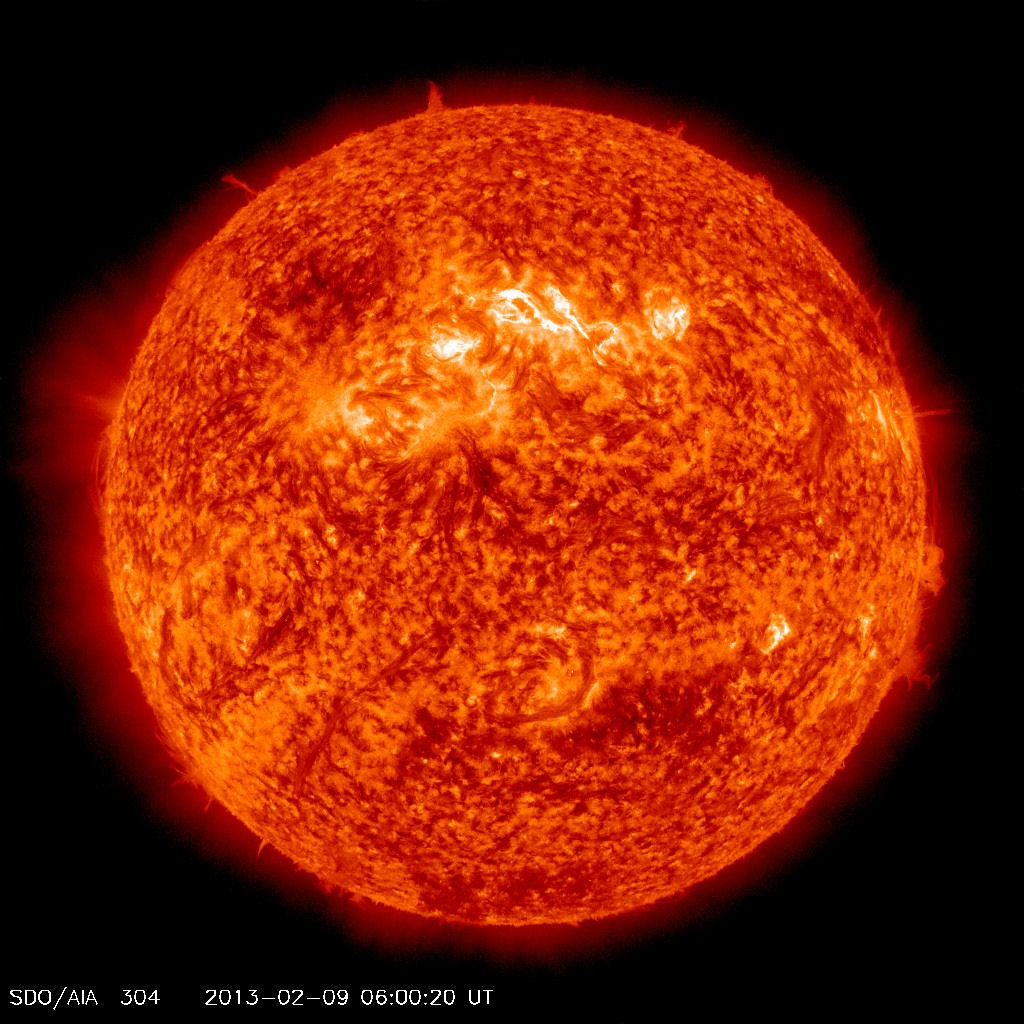
Asteroid Hit or Solar Meridian-Centered CME? I’d Take the Asteroid!


The CME captured by the Solar Dynamics and Heliospheric Observatory (from spaceweather.com)

As the asteroid 2012 DA14 approaches Earth, and is set to pass within 17,000 miles (or less than two Earth diameters) on Friday, at a speed of 17,400 mph, a high probability has also arisen of being struck by a CME (coronal mass ejection) three days earlier. This elicits the question- assuming the worst in each case- of which you’d rather have: a strike by a 15 story wide, 130,000 ton asteroid, or being struck by a CME.

First some background: In the case of the asteroid, NASA reports that this is the closest known approach of an object of this size. (They also add there’s no chance whatever of the thing whacking Earth. Well, assuming it doesn’t get deflected after hitting a geostationary satellite). It was discovered in February 2012 by astronomers at the Observatorio Astronómico de La Sagra; it passed the Earth on Feb. 16th of that year, missing us by a comfortable 2.6 million km (1.6 million miles). The asteroid has a very Earth-like orbit, talking 366 days to orbit the Sun. Its orbit is slightly more elliptical than ours and tilted by about 11° to ours as well. All that’s about to change though: After the encounter this year, the Earth’s gravity will change the orbit of DA14 quite a bit, reducing the period to about 317 days.

The asteroid, with a mass of possibly 10 9  kg would – if it impacts - be about equal to a 20 megaton thermonuclear weapon blast. It obviously would cause considerable damage if it smacked into a city or an island like Barbados – but those odds are even less than our being struck in the first place. The odds are also 3 in 4 that if it did impact it would be an ocean strike, possibly incepting a 20-40 m tidal wave depending on the location, angle of entry, etc.

The CME, meanwhile, was captured by the Solar and Heliospheric Observatory (see graphic)  as it shot away from the Sun at 800 km/s. The initial prediction is that the bulk of the ejected mass will sail over the Earth’s north pole. However, spaceweather.com warns there is still a chance of a glancing blow. The former likely means high latitude observers on Earth will see brilliant auroras, but will experience no serious disturbance. A glancing blow possibly means one or more power grids knocked out such as occurred in Quebec in 1989 after a giant solar flare.

In a 2010 episode (‘Magnetic Storms’) of the series ‘The Universe’, the initial sequence featured a March, 2013 CME event which also triggered brilliant auroras, as far south as Cuba, but which also within hours delivered a head on blow to Earth, that knocked out the entire power grid of the U.S. and every single transformer. Such possibilities were discussed in an earlier blog, e.g. http://www.brane-space.blogspot.com/2012/06/cme-that-you-dont-want-to-see.html


The result of the CME hit depicted then was no power across the U.S. No water, since water in your taps requires electricity to pump it, and no fuel either or gasoline, since gas stations also require electricity to effect pumping. For what awaits us, get another gander at those images after superstorm Sandy Struck NY and NJ in November. Long lines, squabbles over position in lines, fights, and even supermarkets going out of business. In other words, no food either! Such a CME would also knock out GPS satellites, and that would wreak even more havoc. Computer networks everywhere would go down, and without electricity anyway – computers would become museum pieces.

The episode projected some 10-15 million dead since the power wouldn’t be able to come back for years, given all the infrastructure would need to be rebuilt, including transformers, power stations, etc. Imagine then a nation with no power to speak of, hundreds of millions without food, limited canned stores – if they have that, no water, and no way to access critical emergency networks or services. The most vulnerable, as in the case of Sandy, would be the elderly, and sick.


The episode went on to further conjecture of an even worse scenario:  a CME striking at exactly the time when the Earth’s magnetic poles are reversing. With such a reverse there’d be days or weeks with no magnetic field to protect us from the full brunt of high energy solar particles so the entire planet would be affected with up to 2-3 billion dead as a result of all the power knockouts, the starvation to follow, the mayhem. The ‘End of the World’? Technically no, but many would think it was.

So, on that basis, and given my druthers, I’d always pick the hit from an asteroid like 2012 DA14 rather than a full smackdown from a CME.

Let’s hope neither of them transpires!