Showing posts with label Deep Space Climate Observatory. Show all posts

Tuesday, December 29, 2015

Government and Industry Finally Get Serious About Solar Shocks


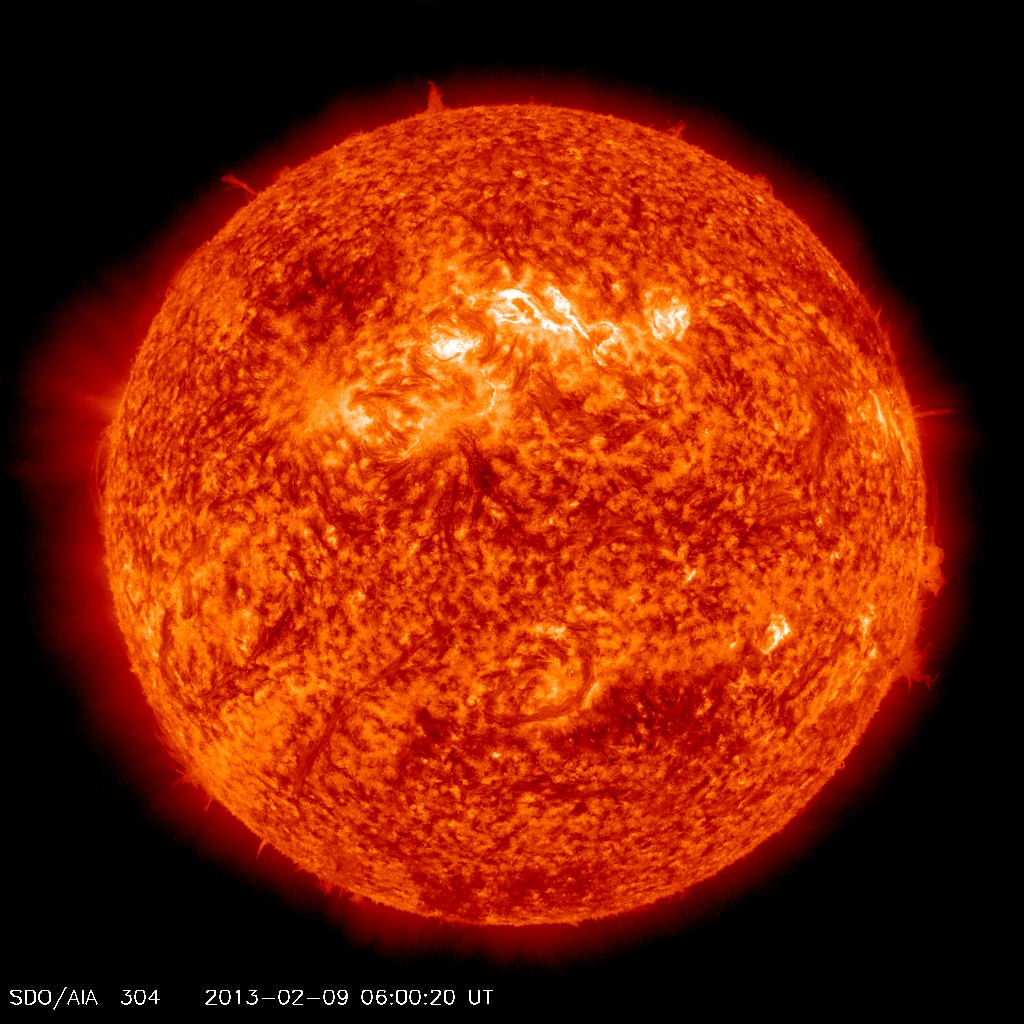
The CME captured by the Solar Dynamics and Heliospheric Observatory in February 2013 (from spaceweather.com)

In previous posts I've written on the dangers from coronal mass ejections (CMEs) such as captured by the Solar Dynamics and Heliospheric Observatory (see graphic)  as it shot away from the Sun at 800 km/s nearly 3 years ago. The initial prediction was that the bulk of the ejected mass would sail over the Earth’s north pole and it did.. However, even a glancing blow would possibly have meant one or more power grids knocked out such as occurred in Quebec in 1989 after a giant solar flare.

CMEs are definitely not to be treated lightly. Powerful CMEs of such magnitude that they merit the name "Carrington events" and originate at the solar central meridian (relative to Earth observers) are events we wish to avoid.

The "ultimate" CME then is that which smacks us broadside, knocking down power grids like tenpins, and - even if not engendering a situation like that depicted in the new series 'Revolution' - at least coming close, for maybe a few days or a week. Hence, it is of interest to attempt to forecast these plasma monsters.


To that end, it is equally important to minimize the havoc that could be unleashed by CMEs, say by disrupting critical technology on which we all depend, say GPS locations and also electric power (In 1989, the electricity to 6 million Canadians was knocked out for over 9 hours owing to a Carrington event from a powerful solar flare)

It was therefore gratifying in the extreme to read that on October 29, the Obama administration had made space weather a priority.  As White House Science Advisor John Holdren said before releasing the relevant documents to the forum:

"We absolutely need to ensure our nation is appropriately prepared to respond and eocver from space weather events".

How serious might this be, so we get a framework? A take from a University of Colorado astrophysicist sheds a good deal of insight, as reported after a near CME hit in 2012:

"It’s believed a direct CME hit would have the potential to wipe out communication networks, GPS and electrical grids to cause widespread blackout.......Just 10 minutes without electricity, Internet or communication across the globe is a scary thought, and the effects of this event could last years. It would be chaos and disaster on an epic scale."

This is probably not an exaggeration. Thus it was good to read in the latest issue of Eos Earth & Space Science News (p. 4) that the White House is getting serious about these events. Their strategy, which you can read about here:

http://bit.ly/SW-Strategy

calls for improving efforts to protect against and mitigate space weather risks, improving the fundamental understanding of space weather, and increasing the accuracy, reliability and timeliness of space weather observations and forecasts.

Let's bear in mind the last is an especially formidable task which yours truly and hundreds of other solar and space physicists had worked on for decades. To give you some idea, a theoretical, quantitative strategy would revolve around obtaining the rate of increase of the poloidal magnetic flux associated with a specific flux rope (e.g. that shows kink or other instability) e.g.

dΦp(t )/dt

Then, for a predictive basis one would require the related function be adjusted for each potential CME (dependent on its current heliographic location) that best fits the total observed data. This function would normally be given in terms of the electromotive force associated with the active region so that:

E(t ) ≡ −(1/c)dΦp(t )/dt

Where the preceding would constitute a forecast from the theory for each CME trajectory.  This would be called a "theoretical forecast" say compared to an empirical forecast, i.e. based on fluctuating microwave bursts. (Rodney V. Souza in 2003 found that microwave fluctuating bursts (fluctuating at seconds intervals) preceded a given CME by 5-15 mins.)

Given the inherent difficulty with both, the short time for responding in the case of empirical forecasts, and the general observational difficulties to nail the theoretical, it is good that at least an "action plan" is being prepared. Readers can see more of this at:

http://bit.ly/SW-Plan

As one participant in the forum (Katherine Sullivan from NOAA) aptly put it:

"Although we have a lot to learn about the physics and phenomenology of space weather, there is no uncertainty about society's vulnerability to these storms".

The academic, commercial and governmental sectors all agree that we have a "golden opportunity" for collaboration "to improve resilience to space weather events" - but it remains to be seen how seriously that commitment applies.

Right now there exists the Advanced Composition Explorer (ACE) satellite which can measure the intensity and magnetic orientation of any CME that sweeps by it. The problem is that ACE is nearly on its last legs and a replacement monitor is needed.

Fortuitously, a fully -ready space craft that can undertake ACE's duties exists. The problem? This Deep Space Climate Observatory (or DSCOVR) sits mothballed in storage at the Goddard Space Flight Center in Greenbelt,  Maryland. It sits idle because the Obama administration's $47.3 million budget request to refurbish and launch DSCOVR has been rejected by the Republican-controlled House since last year.

A first step then is to get this replacement craft into position to help us to at least gauge the orientation from which the next CME comes. .

Saturday, July 26, 2014

Calming the Hysteria: No, Earth Wouldn't Have Been "Destroyed" Had That Flare-CME Struck

Solar flare nearly destroyed Earth 2 years ago: NASA

As usual, much of the media has to use hysteria to command attention. And so numerous media sources reported in the past few days that a monster solar flare- that erupted two years ago (July, 2012) could have "destroyed the Earth", while others asserted "we'd have been sent back to the Dark Ages."  All that, if the event had occurred a week earlier.


According to an astrophysicist from University of Colorado quoted by The New York Post:

"If it had hit, we would still be picking up the pieces,”

He then added:

"I have come away from our recent studies more convinced than ever that Earth and its inhabitants were incredibly fortunate that the 2012 eruption happened when it did.  If the eruption had occurred only one week earlier, Earth would have been in the line of fire.”

Yes, but "line of fire" doesn't mean the end of civilization.

Sadly, much of this was based on exaggeration and hysteria.  Note I had also referenced the effects of CMEs or coronal mass ejections in earlier blogs, and the expected effects on human civilization, e.g.

http://brane-space.blogspot.com/2012/06/cme-that-you-dont-want-to-see.html

Based on the above content (and other posts I've written on the subject) the Post did get this much correct:

"It’s believed a direct CME hit would have the potential to wipe out communication networks, GPS and electrical grids to cause widespread blackout.......Just 10 minutes without electricity, Internet or communication across the globe is a scary thought, and the effects of this event could last years. It would be chaos and disaster on an epic scale."

Well, uh yeah, things would get very inconvenient! Make no mistake people would likely have to do without their computers, smart phones, Ipads, Facebook, GPS systems for 6 months or so, maybe longer. The NASA release also made some rough analogies to the aftermath of Hurricane Katrina and "disabling everything that plugs into a wall socket" as well as "most people wouldn’t even be able to flush their toilet because urban water supplies largely rely on electric pumps.”

In other words, you'd definitely be faced with horrendous and messy issues in the wake - but "back to the Dark Ages" ? Well ok, maybe for a few months. But it would not compare to the aftermath of a nuclear war, for example, which could erupt if we were stupid enough to follow the advice of Johnno McCain and other dumbass Reeptards to "teach Putin a lesson".

But equating not having internet or smartphones or Facebook to the "dark ages" - that's a bit of exaggeration! Well, ok, maybe not given the extent to which most moderns are hooked on all these devices and pastimes.

But as I noted in the above line to do with CMEs, many of the problems that might be caused by their smacking us at the most inopportune time are soluble. For example, our power grids could be protected by the simple expedient of installing large enough resistor -capacitor systems at critical locations (e.g. near power plants or major cities)  in order to sever any CME-driven upward field aligned current connection to the grid. Recall from my basic physics blog, e;g. http://brane-space.blogspot.com/2011/06/introduction-to-basic-physics-electric.html    that resistors act to limit current and also capacitors can do the same by collecting charge.

The problem? Major U.S. power companies don't want to assume the cost for any voluntary installations, which could run $100,000 per transformer. Hence, the grid remains unprotected against the rare - but potentially calamitous - Carrington event CME that smacks us broadside.

Government, of course, could easily provide subsidies to help pay for the C-R systems to protect the transformers, but the moron Tea Baggers infecting our nation (and one whole party)  won't hear of such a thing. They won't tolerate giving any "blank check" to government to subsidize  power companies, especially to build capacitative-resistance systems to protect our power grids. These jerks with their triangle hats still live in the 1790s, after all!

Ok, so forget the "expensive" solution above. Even a bit of help could still be available if we knew the direction of an oncoming powerful CME event and had some time to prepare. Right now such an entity exists: the Advanced Composition Explorer (ACE) satellite which can measure the intensity and magnetic orientation of any CME that sweeps by it. The problem is that ACE is nearly on its last legs and a replacement monitor is needed.

Fortuitously, a fully -ready space craft that can undertake ACE's duties exists. The problem? This Deep Space Climate Observatory (or DSCOVR) sits mothballed in storage at the Goddard Space Flight Center in Greenbelt,  Maryland. It sits idle because the Obama administration's $47.3 million budget request to refurbish and launch DSCOVR has been forthwith rejected by the Republican-controlled House.

So there it sits, and here we sit, on a planet becoming ever more vulnerable to the ultimate 'blowback' from  the Sun's "burps" - as Neil deGrasse Tyson called them on Bill Maher last night.

So maybe, just maybe, the Reepos really don't care if people have to do without Facebook or smartphones for a half a year, or can't flush their toilets for lack of electric power. I mean, they still haven't furnished all the money needed for the Superstorm Sandy victims, many of whom still sit in darkened homes without electricity or running water.

Maybe the Republicans would prefer that condition for the whole country!