The new Medicare enrollment period has begun and seniors are being advised to "move faster this year rather than waiting in the new enrollment period", i.e. to settle on a plan. This from the WSJ Personal Journal piece: 'New Medicare Plans Offer Fewer Benefits', Oct. 19, p. A14).
As this important article notes:
"Medicare enrollees have until Dec. 7 to select coverage for 2027. This year a lot of seniors will be looking for new coverage. Specifically, the 3.2 million people enrolled in Medicare Advantage plans that are closing or withdrawing from their markets, according to 'Chapter' - a national Medicare brokerage."
The piece cites (quotes) a number of seniors who don't want more restrictive plans - which seems to be the norm now with Medicare Advantage. So as the article advises:
"If you want the least restrictive option, you can choose traditional Medicare, but you will need a special supplemental policy- known as a Medigap plan - to protect you from big, out of pocket charges."
Both Janice and I elected to go with traditional Medicare because we knew from friends how restrictive the MA plans were. You couldn't choose your own doctor, for example, and if one needed a special test or scan it was often a gamble whether it would be approved. But Medicare Supplement plans are not cheap. Our total monthly outlays for our plans (we have separate ones) is nearly $600 - and often increases year to year.
Again, let's review the basics: The government pays Medicare Advantage insurers a set amount for each person who enrolls, with higher rates for sicker patients. And the insurers, among the largest and most prosperous American companies, from the get-go developed elaborate systems to make their patients appear as sick as possible, often without providing additional treatment. See graphic (from NY Times, Oct. 9, 2022):
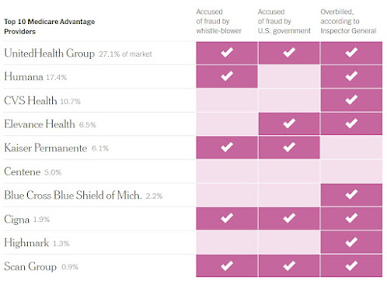
As a result, a program originally proposed to help lower health care spending has instead become a voracious financial gobbler. Now even more costly than the traditional government program it was meant to improve.
A fall, 2022 Kiplinger Retirement Newsletter was clear on what is now happening to new Medicare Advantage beneficiaries: being denied access in record numbers. Indeed, according to Kiplinger, at a rate nearly twice that before the pandemic struck in 2020. Why? Because the number of new Advantage beneficiaries has itself nearly doubled. Naturally, from these early alarms one might expect the costs and restrictions of benefits to increase. And this is what's revealed in the WSJ piece, including there's always kind of a trade - you don't have to pay premiums like Janice and I do for our Medigap plans - but you will get hit elsewhere.
As the article warns:
"Seniors will still have access to lots of Medicare Advantage plans with no premiums. The bite will come elsewhere, including that insurers will increase what you pay when you get care. According to analysts at Leerink Parters, Medicare Advantage plans are raising maximum out of pocket costs - including copays and other charges- by 10 percent on average."
Adding:
"Primary -care doctor visits are mostly still free, but some Medicare Advantage Plans are increasing copays for specialists or switching to coinsurance, which means you pay a share of the total cost rather than a flat amount."
So in the case of an MRI, for example, such as the one I had on May 5th to obtain a better resolution of the cancer lesions manifested in an earlier PSMA scan - you may have to cough up one third. If the MRI total cost was $13, 500 that means you will have to put in $4, 500 of your own. (The same of course applies to the PET/PSMA scans or other special scans or treatments.)
As if this wasn't bad enough we also learn (ibid.):
"Large Medicare Advantage insurers are also trimming many of the extra benefits that are popular with seniors - things like dental plans, coverage for over the counter health products and transportation."
The piece also warns of the 'tricky issues' in drug benefits. Included in these are:
- Stand alone drug plans continue to shrink, to 316 next year - a 55% fall from 2024.
- Many will face a substantial increase in their monthly bill if they choose to remain on the same Part D plan.
- Medicare Advantage drug deductibles are increasing by 30 percent on average.
- Some medications are being moved between tiers raising the costs for people who take them.
- For a small number of MA plans insurers are capping enrollment - meaning that once a certain number sign up- the plan no longer is available.
In respect to the last the WSJ piece advises:
"If you find something you like but you're not ready to decide you might want to check with the insurer that it will be around later."
Good advice amidst a morass of Medicare Advantage confusion.
See Also:
And:
by Wendell Potter | January 15, 2023 - 7:23am | permalink
Excerpt:
Right now, well-funded lobbyists from big health insurance companies are leading a campaign on Capitol Hill to get Members of Congress and Senators of both parties to sign on to a letter designed to put them on the record “expressing strong support” for the scam that is Medicare Advantage.
But here is the truth: Medicare Advantage is neither Medicare nor an advantage.
And I should know. I am a former health-care executive who helped develop PR and marketing schemes to sell these private insurance plans.
And:
by Dean Baker | October 27, 2026 - 4:48am | permalink
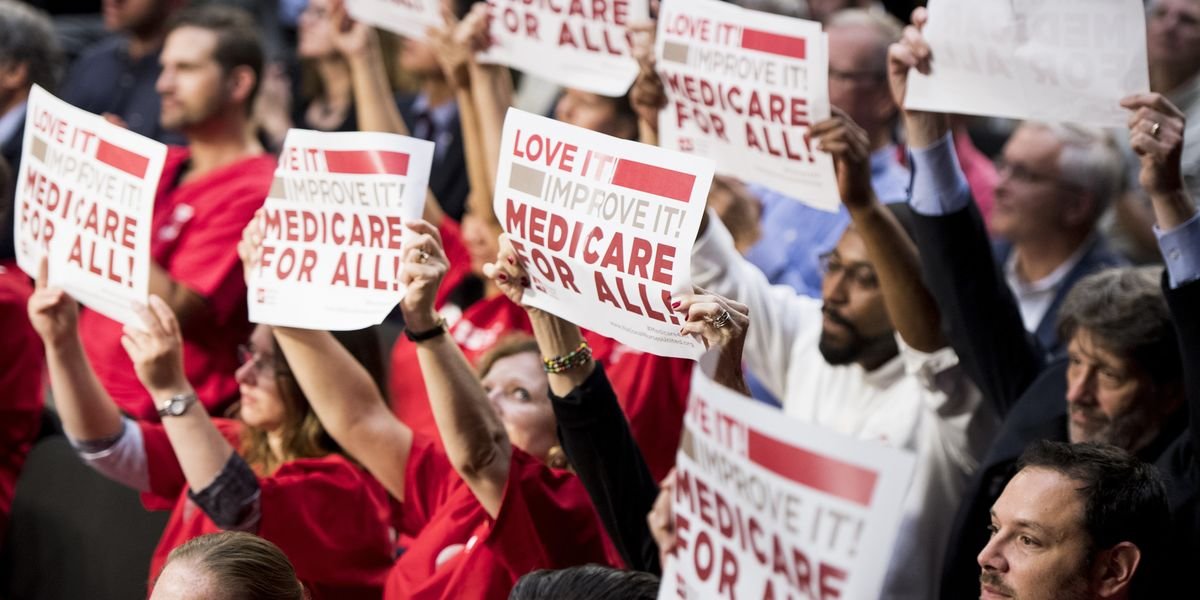
With soaring health care costs and a plunge in coverage rates, there is growing interest in Medicare for All. Polls show that a large majority of the public now favors a universal Medicare system, with even a substantial share of Republicans now backing it.
A universal Medicare system has a huge amount to recommend it. Of course, the main point is to ensure that people can get the health care that they need, but it also eliminates a vast amount of waste in the national health care system.
In addition to the $300 billion a year that we spend directly on operating the nation’s health insurance system, another $1.6 trillion is spent on administrative costs running our health care system by providers like hospitals and doctors’ offices, according to analysis by David Himmelstein, Terry Campbell, and Steffie Woolhandler. These additional costs are all the office personnel and various navigators involved in assisting patients in dealing with insurers. They found that in the United States we spend roughly 31 percent of each dollar in health care spending on administrative costs, whereas under Canada’s universal Medicare system, the cost is just 16 percent of spending.
And:


Excerpt:
Congress must pass a law to stop the deceptive advertising of Medicare Advantage plans. Only Medicare should be able to call itself Medicare.
Unless you’ve been out of the country for the past few years, you’ve seen the ads on TV featuring Joe Namath, Jimmy Walker, or William Shatner hawking so-called “Medicare Advantage” plans.
Medicare Advantage is not Medicare.
It’s private health insurance being offered to people over 65, with the bill paid for by Medicare. Once you get on an Advantage plan it’s very difficult to get off, and if you’ve been on for more than a year you may not be able to go back to regular Medicare with a Medigap plan at all.
And:

No comments:
Post a Comment