Tuesday, May 23, 2017

Trump And Cronies Dance With Saudis While They Screw Millions Of Trump Voters

Image result for Trump dancing with Saudis images
Trump cabinet members Wilbur Ross & Rex Tillerson took turns dancing with Saudis, Trump had his turn too.
Image result for Trump dancing with saudis, images
Trump -above- after Saudis delivered several lessons on how to do the "ardah". He still screwed it up.
Image result for Trump dancing with saudis, images
"No, you asshole! You're doing it the wrong way!"


Many will likely recall how 7 years ago, Trump raked then President Barack Obama over the coals for "bowing" to foreign potentates. One is led to ask how hypocritical one has to be to do that, and then not only bow to the "supreme" Saudi leader but also curtsey, e.g.

http://www.independent.co.uk/news/world/americas/us-politics/donald-trump-saudi-arabia-trip-curtsey-bow-king-salman-gold-medal-honour-barack-obama-bowing-a7747016.html


 then do a sword dance with this ilk, along with two members of his cabinet, Wilbur Ross and Rex Tillerson.  By all accounts in the Saudi-controlled media the trio yucked it up pretty good even as within hours Trump put the final touches on a wretched budget plan to reduce Medicaid spending by $800 billion, and also make food stamps cuts of at least 30 percent. Oh, and make those getting food stamps work. (Clue one: 95% of food stamp recipients already work.  It's just that they can't make ends meet with the jobs they have. Since nearly all the non-working food stamp beneficiaries are children, one guesses Trump and his cronies will make them work.)

The Trump supporters and voters need to take  note here, because it's estimated that up to 2 out of 5 of them depend on one or both of these programs. While they may firmly believe the current media firestorm over Trump's transgressions is fueled by media "hysteria", I can assure them that if the Trump budget passes they will experience hysteria first hand.

In his speech on Sunday,  Trump, as a guest of the Saudi monarch, spoke of a stronger alliance with mostly Sunni Muslim nations to fight terrorism and extremist ideology and to push back against Iran.  For reference, nearly all the 9/11 terrorists hailed from Saudi Arabia, whose Sunni monarchy controls Islam’s holiest sites. Ironically this bunch of freaks - recall ISIS is a Sunni entity too  -  sees itself as the natural leader of the Muslim world and has used its lavish oil wealth to spread its austere version of the faith.

Iran, meanwhile, was given short shrift by Trump, as he wailed about "terrorism" issuing from their faction of Islam. For reference, Iran is the world’s largest Shiite nation and is led by clerics who aspire to export the ideology of political Islam that brought them to power in 1979. But let us bear in mind, that ascension as well as the taking of hostages at the U.S. Embassy in Iran, didn't just occur spontaneously. It was decades building up based on U.S. meddling ending with the support of the brutal regime of the Shah of Iran.

For historical reference,  U.S. oil interests -   in collusion with the then CIA-   deposed Premier Mohammed Mossadegh in a coup d'etat via  in Operation TPAJAX.  His offense? He had sought to audit the books of the Anglo-Iranian Oil Company (AIOC), and implement new rules.  The eventual decision was to remove Mossadegh - the best chance at Iranian democracy.  So if Iran is "extremist" today we are the ones to blame, at least in terms of interfering in their then democratic processes by forcefully removing a head of state (like we did with Salvador Allende in Chile - except more violently in that case).

Let's be clear there is nothing in our Constitution that condones or approves of removing foreign heads of state, for whatever reason.

In some disinformationist quarters the CIA's role in the 1953 overthrow of Mossadegh is dismissed as a "myth" in the same way pro-Warrenites dismiss conspiracy in the JFK assassination as a myth - because it serves their nefarious interests to do so -- in bamboozling our fellow citizens. The truth is the CIA had its hands in the Mossadegh coup d'etat as much as they did in Kennedy's. You can read more details, including how the CIA actually admitted its role here:

http://nsarchive.gwu.edu/NSAEBB/NSAEBB435/

Meanwhile, three days ago, Frederic Wehrey, a senior fellow in the Middle East Program at the Carnegie Endowment for International Peace said:

“We are picking one side in this geopolitical struggle, and there is very little room for gray,.  Sectarianism is a byproduct of this geopolitical rivalry, and we are inadvertently picking one side in this sectarian struggle.”

The question is why did we pick the side that featured most of the vermin responsible for the most destructive attack on the nation in history?  Why also side with the nation with an embedded extremist strain (Wahabbi) that makes Iran's shortcoming pale in comparison?  

The Smithsonian channel's documentary, 'Islam and the West', ought to be required viewing for every American and especially the hysterical subset that believes all Muslims are the next thing to demons. The documentary traces the origins of Islam from Mohammed and to the present day, including how none other than the Brits- in the latter days of their Empire - drew up all the boundaries in the Middle East including for Jordan, Syria, Iraq and Palestine - totally ignoring ethnic and tribal affiliations. Viewing this excellent program will indicate why Trump's siding with the Saudis is a grave mistake.

In the meantime, the spectacle of the Trumpite Trio dancing with the Saudis even as they put the finishing touches on budget plans to undermine many of their own supporters couldn't be lost on the astute observer. It was also jarring to see Trump cozying up to this authoritarian, extremist lot in the way he did though we've already beheld his fondness for strong men, e.g. in Erdogan of Turkey, and Duterte in the Philippines.

See also:
http://www.smirkingchimp.com/thread/eric-zuesse/65437/the-sauds-impunity

And:

http://www.salon.com/2016/01/06/saudi_arabia_funds_and_exports_islamic_extremism_the_truth_behind_the_toxic_u_s_relationship_with_the_theocratic_nation/


Monday, May 22, 2017

Clearing Up The Issue Of "States' Rights" And Federalism - Again


One of the greatest tricks of the peddlers of faux American  history  is to have altered the meaning of federalism  and to have concocted the notion of "states' rights." 

Given the current political climate fueled by pseudo-conservatives - in trying to push "state autonomy" - we ought not be surprised that many press  articles are attempting to bamboozle average citizens saddled with average educations.

Also, because the ‘life cycle’ of most Americans’ political-historical memory barely stretches 5 years, this is increasingly easier to accomplish.  Thus, with a single prominent article it is possible to hoodwink too many and especially get them to accept as facts canards that are anything but. A case in point is the recent WSJ article 'Divided We Rise' (May 20-21, Review, p, C1) by Jeffrey Rosen, the President (if you can believe it) of the "The National Constitution Center" in Philadelphia.

The gist of Rosen's piece is that "people on the Left and the Right are turning to federalism as a way to resolve contentious issues and to calm our polarized politics"

That's a cute, convenient take, but absolute balderdash. He writes first that "federalism has long been a cause on the Right" but in fact, what they've really embraced is anti-federalism. The original meaning and intent of genuine federalism  was put forward by Alexander Hamilton (and even James Madison) in The Federalist Papers. This was a strong union with strong central government - not a loose affiliation with states basically deciding for themselves how their citizens will live and scarcely any checks from the central authority.. 

Madison actually predicted that if the Philadelphia Convention was unable to forge a stronger national government the result would be sectionalism or monarchy, He wrote to Virginia Governor Edmund Rudolph: "Our situation is every day becoming more and more critical...No respect is paid to the federal authority and people of reflection unanimously agree that the existing confederacy is tottering to its foundation."    Madison also was fond of using an analogy originally offered by John Dickinson at the Philadelphia Convention.

Dickinson compared the federal government system to the Solar system. Just as the planets (analogous to states) could not exist as part of that system without the centralized force of gravitational pull of the Sun, so also the federal system could not exist without the centralized pull of the federal government – leading the diversity of states to be one cohesive entity as a united confederacy. Thus do we find the Constitution includes limits on STATE governments.

THIS was the original heart, core and meaning of federalism. Somehow over the centuries it was mutated, however, into anti-federalism or worse, "nationalism" (as Rosen does).  This is in total contrast to the standard definition of nationalism, i.e. "The strong belief that the interests of a particular nation-state are of primary importance." In other words, that a given nation's interests trump those of all others. This is embodied, for example, in Trump's  "America First" codswallop..

Rosen also errs in terms of states' rights when he quotes the (related)  miscasting in a quotation from Rep. Zoe Lofgren ("top Democrat on the House Judiciary Committee's immigration and border security sub-committee"):

"The Constitution, specifically the Tenth Amendment, protects states' rights and it prohibits federal actions that commandeer state and local officials."

Rosen goes on the assert "the framers of the Constitution would be pleased with this emerging consensus", e.g. between federalism as state autonomy and states' rights allegedly embodied in the 10th amendment. Alas, both suppositions are wrong. I already showed how the original meaning of federalism had been twisted, so neither Madison or Hamilton would recognize the word as used by proponents' of "states' rights" today.

States rights itself is an egregious mutation of the actual meaning.  Prof. Garry Wills (‘A Necessary Evil: A History Of American Distrust of Government’, Simon & Schuster, 1999) further reinforces this point in his chapter ‘Constitutional Myths’(p. 108). He notes that citizens alone possess rights, which neither the states nor the federal government share. Both the latter retain powers and prerogatives, but not rights. Hence, the subtext is that rights can only accrue to flesh and blood citizens, not legal or geographical artifacts. What Rosen and Lofgren have done is to conflate rights with prerogatives and powers and ended up spewing bunkum, given the former are NOT the same as the latter.

Lofgren and Rosen also need to read the Ninth Amendment, which states that “the people retain unenumerated rights” "The people:" here refers to flesh and blood citizens, not to a bunch of contractual abstractions (states), or to corporations. As Wills emphasizes and underscores (ibid.):


“The states have no natural rights. Their powers are artificial, not natural – they are things made by contract.”


Hence, the term "state's rights" is bogus, in error. States have prerogatives, not rights, because states exist as governmental entities not as persons or  thinking individuals.  It follows that that states' rights has obviously been a device - like "federalism" construed as state autonomy- to try to dispense with federal government regulation and oversight,  or the extension of federal welfare, or benefits - especially in the realm of health care.

As Prof. Wills has pointed out, the unenumerated rights are all those rights not already specifically declared or described in the existing document. The Founders thereby realized and understood there could exist rights in the future they hadn’t conceived of at the time of the Constitutional Convention, and so allowed those (then) undefined rights to become realized later. In other words, the rights allotted citizens are not limited to the rights actually and specifically delineated, i.e. in the Bill of Rights.

This opens up the basis for positive rights, not merely negative ones. A case in point is the conviction that there are only “negative” rights inherent in the Bill of Rights, and there can be no “positive” ones.   A negative right implies that there are ‘x’ things the government can’t do to you, e.g.  take away your guns or your property without good legal basis ("eminent domain"). . By contrast, positive rights assert there are actual positive rights to which you are entitled under the Bill of Rights, say health care and privacy. Most of those on the Right, who have only passing acquaintance with the Federalist papers, assert positive rights don’t exist, but they are wrong. They merely show they fail to grasp the concept of an "unenumerated right".

No surprise then this meme is pushed by the Right (and some ignorant folks on the left acting as useful idiots) to undercut the basis of any kind of national health system  ("Medicare for all") or even a national benefit system, say like Social Security. "Let the states decide and do it if they want!" is the new mantra, say of Paul Ryan in trying to push his Medicare voucher system.

It also explains the yen of HHS head Tom Price to slash spending on Medicaid over all by giving states the option of a "block grant" or a per capita allotment. So here in Colorado, for example, that may mean allocating the state a fixed amount for next year of $100m. That then will have to suffice to cover the needs of some 125,000  citizens, mainly frail elderly, poor, unemployed or under-employed.  And further, this will supposedly be effected despite Colorado now dealing with an estimated $1.3 b deficit.  Anyone who thinks Colorado or any state can deliver is living in la-la land.

If the Constitution's intent was to limit federal government power it certainly doesn’t say so. In Article I, Section 8 – the longest segment of the document, we see an extended declaration of congressional power. (The States are mainly afforded their power in the articles of confederation). In addition, it ends by clearly delegating to Congress the ability “to make all laws which shall be necessary and proper for carrying into execution the foregoing powers and all other powers vested by this Constitution in the Government of the United States, or any Department thereof."

The reality is the power of the federal government is needed now more than ever, not only to protect citizens' basic rights - especially against the specter of local hate crimes (such as the African American student in College Park, MD recently stabbed in the back by an Alt Right freak) but also to ensure our basic citizen protections ("regulations") are up to par, and benefits are secured and not allowed to be sliced by the states i.e. after being given "block grants" by the anti-federalists in the federal gov't.

Saturday, May 20, 2017

Math Revisited: Tensors

Basic terms:


A tensor of rank 2 is a dyad.

A tensor of rank 1 is a vector.

A tensor of rank 0 is a scalar.


The most basic tensor of all is the unit tensor, defined:

1  =  i^ i^ + j^ j^ + k^ k^  =

(1......0........0)

(0........1.......0)

(0........0.......1)


Also:

1 × C  =  i^ Cx + j^ Cy + k^ Cz  


In all the above, of course, we have yet to introduce time, but will in the next section to do with tying geodesics to the Principle of Equivalence.

Further properties:

A tensor is symmetric if:  T i j   = T j  i

A tensor is anti- symmetric if:  T i j   = -  T j  i

The latter will look something like this:

(0 ……a12………a 13)

(-a12…..0……….a23)

(- a13……-a23……0)


Doubled dummy indices, e.g. ii, jj, kk refer to the trace  (Tr) of a matrix, or the sum of the diagonal elements.  For example, if: i^ i^ + j^ j^ + k^ k^  =


(1......0........0)

(0........1.......0)

(0........0.......1)


Tr (i^ i^ + j^ j^ + k^ k^)  =   1 + 1 + 1  = 3


Diagonalizing tensors.

This is analogous to obtaining the eigenvalues for a matrix in linear algebra. Consider the object below for which we want the principal axis,  a i j.
No automatic alt text available.
we have a i j = 

 With T’ =  A × I × At

Where t denotes the transpose.  Then we obtain, T’ =

(15 …..0……..0)
(0…….11 ....-3Ö2)
(0……..-3Ö2…..8 )

Which is to be diagonalized.  Writing this out:

(15 - l…...0…….....0)
(0……..11- l ....-..3Ö2)
(0……..--3Ö2…....8- l)


This leads to a cubic - i.e. with triple roots -  which are:

l1 = 15,  l2 =  5, and l3 =  14

Substituting l1 in the matrix we get:

(0  ….....0……......0)   ( c x  )
(0……....-4 ....-..(-3Ö2))  ( c y  )
(0……..-(-3Ö2)…..(-7) )   (  c z )

For which the separate equations, e.g. in  c x, c y and c z can be solved. For example,

-4 c y   -   3Ö2  c z  =  0 

 -   3Ö2 c y   -7 c z   =  0


After working through all the solutions, we obtain:

C  =  - Ö (2/3) e2^   +  1/ Ö3  (e3^)


Example  Problem:

In a certain rectangular coordinate system, the directions of whose axes are given by the unit vectors i, j and k, the inertia tensor of an object is given by:

I = K x

(1….0…..0)
(0….1…..1)
(0….1… ..1)

a) What are the principal moments of inertia of the object (the moments of inertia along the principal axis) relative to the origin of the above coordinate system?

b) What is the direction of the principal axis corresponding to the principal moment of inertia and equal to K?

 c)  If the origin of the above rectangular coordinate system is at the center of mass of the object and the total mass of the object is M, what is the change in the inertial tensor of the object if the rectangular coordinate system is displaced parallel to itself a distance ro in the direction:

 (1/ Ö2)j +  (1/Ö2)k?


Solutions:

a) We have:  I = K x

(1….0…..0)
(0….1…..1)
(0….1… ..1)

We write out the determinant with eigenvalue l:

(1 - l….0…..0)
(0….1 - l   ..1)
(0….1… ..1 - l)

Leading to the characteristic equation:

(1 - l)3 – (1 - l) = 0

Factoring:

(1 - l) [ ((1 - l)2 – 1] = 0

Or:

(1 - l) (l2 –  2l) = 0

Yielding eigenvalues: l= 0, l = 2

Then:

T = Kl,  so:

 T1 = 0, T2 = K, and T3 =2K

Or: (0, K, 2K)


b) We have to take:  (I – T1)C

So that:

K [(1….0…..0)
  [(0….1…..1)
  [(0….1… ..1)

- 

K (1….0…..0)](x)
  (0….1….. 0)] (y)
  (0….0… ..1)] (z)

=
 (0….0…..0) (x)
  (0….0…..1) (y)
  (0….1… ..0) (z)   =   0

So that:  0  =

(0)
(z)
(y)   

Which 0 for the x component implies the answer is I.


c) By the analog of the parallel axis theorem:

I o = IG -   M(R2 I – RR)

D I =  I o -  IG   =    M(R2 I – RR)


RR =   r o 2     x

(0….0………0)
(0….1/2…..1/2)
(0….1/2… ..1/2)

D I =   M  r o 2     x

 [(1….0…..0)
  [(0….1…..0)
  [(0….0… ..1)

- 
 (0….0……..0)]
  (0….1/2.. 1/2)]
  (0….1/2… ..1/2)]

= M  r o 2     x

(1….0………..0)
(0….1/2…..-1/2)
(0….-1/2… ..1/2)


Practice Problems:

1. If  1  =  i^ i^ + j^ j^ + k^ k^

Write out the expression for 1 × D  


2. a) Provide a matrix which satisfies:  i^ i^ + j^ j^ + k^ k^  = 7/2


b) Write out the trace for the metric tensor.   g ik   =


(1.....0...............0)

(0.....r2...............0)

(0.....0........r2 sin
f)


c) Give one example of  3 x 3  tensor, then show how it might contain an anti-symmetric and symmetric  tensor (also how to go from one form to the other). 

3. For the example problem given above, use the remaining two eigenvalues, l2 and l3, to diagonaliize the matrix and obtain solutions in c x, c y and c z.

Net Neutrality On The Chopping Block - Thanks To Another Trump Toady

Image result for AjitPai protest images
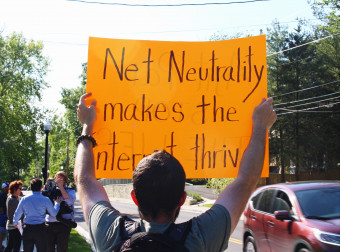
Protesters outside Ajit Pai's home, for net neutrality and against his scrapping of Title II regs.

Two weeks ago, comedian John Oliver delivered a superb explanation of 'Title I' and 'Title II' regs in respect to the internet and how assorted spinners sought to confuse the public on net neutrality. Oliver argued that Title II regulations are designed to protect the net,  i.e.  barricade it against the sole use of private interests.

Those who missed the segment can watch it at this link:

https://www.youtube.com/watch?v=fpbOEoRrHyU

 
Oliver argued the net in its current form is not broken, while noting the FCC was pushing for a 'two tier' system.  Killing net neutrality would allow private companies to go into the fast lane leaving everyone else in the slow line. To get your streaming movies or shows then might take twice as long as it does now, while higher paying corporate entities - like Comcast - speed their ads through with ease. To refresh memories, the Obama FCC - to preserve net neutrality - ceased treating the internet as an unregulated information service- instead reclassifying it as a "telecommunications service". Thereby the FCC could assert authority to regulate the net as a utility under Title II of the Communications Act of 1934.

Oliver was so energized at the prospect of the new FCC chairman (Ajit Pai) overturning the Obama FCC rules that he provided viewers with a rapid link to enter comments at the FCC - supposedly seeking them for 120 days: www.gofccyourself.com. 

This latest influx of viewer comments came quicker than 2 years ago, adding about 150,000 in a little more than a day . But it appears the FCC Trumpazoids anticipated it and created a Box.com account for bulk comment filings. The effect has been that commenters' requests have been getting blocked or tied up by an automated attack.  It seems that barely any have made it through, but we're expected to believe this change was made to "better handle traffic than last time".

Now we know why. According to a story yesterday in the WSJ Business & Finance section (p. B1) it is clear the FCC plans to "chip away at net neutrality". As reported, the FCC on Thursday "approved a plan to begin rolling back Obama era net neutrality rules".  This was accomplished by virtue of the 2 Repukes on the FCC panel overriding opposition from the lone Democrat to push this perfidy through.

Led by Trump  toady Ajit Pai, the FCC is now set to spend the  coming months drafting new rules that, if implemented, will slow down the net considerably for any who use DL'ing, including streaming of videos (including for Netflix and Amazon services).  Pai, like other Trump -appointed hacks (Tom Price at HHS, out to destroy Medicare, Scott Pruitt at EPA, out to destroy that agency or weaken it to the point of uselessness) is convinced the Obama era rules adopted in 2015 have "harmed the internet" by retarding investment in broad band infrastructure. 

In other words net neutrality is a no-no because it represents the continuation of "heavy handed regulation which will chill investment in a service increasingly critical to life in American society".

According to Pai, mastering the lingo of Wall Street speak (WSJ, today, p. A11), the small ISPs are being left out of the market because they can't compete with the big boys. Pai claimed he "heard from 19 small, government -owned, municipal broadband providers" who insisted that Title II regs stood in the way of their further investment. In effect, depriving hundreds of thousands living in those municipalities of accessing new services and the small ISPs from deepening their networks.

In Pai's mind the basic error of too many on the left is thinking "there is a dichotomy between the consumer and the market". No, there isn't. It's all in our imaginations - or our paranoid ideations- take you pick. According to Pai (ibid., today):

"To me, markets and market -oriented policies have delivered far more value to the consumer than pre-emptive regulation ever has."

It appears then that Pai like his FCC R-commissioners, is ignorant or oblivious to the lessons of the 1996 Telecommunications Act.  That also was promised to us as the be-all 'elixir' to finally get our cable TV rates down because of increased market competition. Instead, after a few years we found (n Maryland) competition diminished and less resourceful companies moved out allowing Comcast to charge whatever it wanted.  People were furious because they'd been sold the "de-regulated bait and switch".

If Pai's arguments were really sound why not first do all he and the FCC can to make all net speeds much higher as opposed to "comparable to Estonia" as Oliver joked in his piece.  The reason is that Pai and his cronies want to slow net speeds down even more for the rest of us so that private entities, that can pay a lot more, get preferential treatment in the form of much greater speed, efficiency.

Writing in his book, The Problem of the Media, Robert McChesney had this to say (p. 51);

"The corruption in media policy making culminated in the passage of the 1996 Telecommunications Act, arguably one of the most important pieces of U.S. legislation. The law rewrote the regulatory regime for radio, television, cable television, and satellite communication - indeed, all of electronic communication including the internet.

The operating premise of the law was that the new communications technologies - combined with increased appreciation for the genius of the market- rendered the traditional regulatory market moot.

The solution therefore was to lift regulations and ownership restrictions from commercial media and communication companies, and allow competition in the marketplace to develop, and reduce the government's role to that of protecting private property.

There was virtually no dissent whatsoever to this legislation from either party, the law sailed through both houses of congress, and was signed by a jubilant President Clinton in February, 1996. Corporate CEOs regarded it as their "Magna Carta"."


The preceding  lesson from McChesney ought to be a no-brainer for us now: not to be fooled again by the "deregulation is good for ya" banter. Fool us once, shame on them, fool us twice, shame on US.

See also:

http://www.smirkingchimp.com/thread/paul-rogat-loeb/72909/how-the-christian-coalition-and-moveon-saved-internet-neutrality-and-why-we-need-to-save-it-again
 

Friday, May 19, 2017

Skewering The Myth Of "Absolute Individual Sovereignty"

No man is an island entire of itself; every man
is a piece of the continent, a part of the main;
if a clod be washed away by the sea, Europe
is the less, as well as if a promontory were, as
well as any manner of thy friends or of thine
own were; any man's death diminishes me,
because I am involved in mankind.
And therefore never send to know for whom
the bell tolls; it tolls for thee
  - John Donne


In the fantasies of the Libertarian segment of humanity,  each human is an autonomous "island" unto himself and in an absolute sense. He or she requires no government "nannyism" or oversight (in governance)  since any degree of such limits and impedes the Libbie's imagined absolute "inalienable" right to total individual sovereignty and liberty.  The grandest exposition of these memes probably was compliments of Ayn Rand, in her "bible" : The Virtue of Selfishness. 

For example, on the issue of government financing in a free society, Rand writes (p. 116):

"Since the imposition of taxes does represent an initiation of force...in a fully free society, taxation, or payment for government services, would be voluntary. Since the proper services of government - the police, the army, the law courts - are demonstrably needed by individual citizens, and affect the individual's interests directly, they should be willing to pay for such services as they pay for insurance.....Men would voluntarily pay for insurance protecting their contracts."

One method of such voluntary government financing would be a government lottery
"


and (ibid.):


"A fully free society is one that has been constitutionally reduced to only its most proper, basic functions"

In other words, Steven Bannon's destruction of the administrative state come to fruition. No oversight or regulations regarding food quality control, so you can get botulism, E coli or salmonella infections at any time, no CDC funding so if the Bird flu strikes you're on your own, and no regulation of worker safety so you can be killed on the job any time and no one will care - at least in the company that developed the meat cutter or other machine that did you in.

All of these memes have been regurgitated again in an essay, 'A Controlling Concept', by Iloilo Margaret Jones, appearing in the April issue of Intertel's Integra.   In her opening paragraphs Ms. Jones professes that each day she begins her commitment to one overarching concept: the "absolute sovereignty and inviolate nature of each human being on Earth."

She never elaborates on what she means by "inviolate nature" of each human, but in the context of her essay as a whole it likely means no human can be "violated" by any external entity, especially a government.  This assumption is supported when she writes:

"Government, as we all know, is for maiming and hamstringing productive people very, very slowly and keeping us alive and functioning just enough to continue to produce a bit of 'marginal utility' for the state'. Then we wonder why so many people need Prozac and other opiates!"

Actually, "so many people need Prozac" because of the widening gulf of inequality spurred on by: 1) wage stagnation since 1973; 2) job losses driven by automation and globalization, as well as  (3) a perverse capitalist imperative (exhibited in corporations) known as Pareto utility. See e.g.

http://brane-space.blogspot.com/2011/06/modern-economics-its-evil-basis-pareto.html

And if one is lucky enough to have a job it is more often than not in a proto-fascist corporation. These can dictate how underlings wear and style their hair, when they can eat, how long they may use the rest room (and how many times an 8-hour day), how often drug tests are imposed, as well as invoking the right to rifle through belongings in your desk any time they want. They can also monitor you through the day using hidden cameras, and freely inquire concerning off-hours alcohol consumption, exercise habits as well as childbearing intentions. Why doesn't Iloilo Jones bitch about these corporate infringements on her precious "individual sovereignty and liberty"?  Well, because "government" is the standard go-to 'tackling dummy' for all dedicated libbies. Like the 'great Satan" is to the Iranian mullahs.

Jones even goes so far as to try to recruit the Declaration of Independence to her cause, writing:

"The Declaration of Independence was written to free humans from oppressive government . Unfortunately, it took only a few years for many of those same authors to decide to put into place a replacement government, organized and created with enough flaws to allow the present conditions to prevail. What happened to the inalienable rights elucidated in the Declaration?"

Here, she mistakenly invokes the Declaration as the cornerstone of individual rights and governance when it is in fact the Constitution - written later- that articulates these in the Bill of Rights.  The "replacement government" she slams is none other than the one that is constitutionally -based. The Declaration was not written to "free humans from oppressive government" but to posit a basis for Americans to revolt against British rule. As summarized  in Wikipedia:

"The Declaration of Independence is the statement adopted by the Second Continental Congress meeting at the Pennsylvania State House (Independence Hall) in Philadelphia on July 4, 1776, which announced that the thirteen American colonies, then at war with the Kingdom of Great Britain, regarded themselves as thirteen newly independent sovereign states, and no longer under British rule. Instead they formed a new nation—the United States of America."

The Declaration also laid the basis to remove a government if it fails to adhere to the Constitution and principles of liberty enshrined therein, e.g.

"Governments are instituted among Men, deriving their just powers from the consent of the governed, — That whenever any Form of Government becomes destructive of these ends, it is the Right of the People to alter or to abolish it, and to institute new Government"

But again, this is taken to be in the context of a working Constitution, not in some libertarian "individual liberty" vacuum. "Consent of the governed" is then manifest through the representatives of the people who form the government and they are sworn to uphold the Constitution. It is not, as Iloilo imagines, a prescription for individual anarchy devoid of any constitutional contexts and by extension governance, say in the federal system established under the Constitution.

Governance, further,  presumes and demands the non-passive act of governing, which means the projection of force for enforcement of laws  - arising from the Constitution, or federal, state and local statutes.  Someone is invariably and actively setting standards of expected action, and also providing the means to uphold the standards. In other words, force inevitably backs up governance. Why do you think cities maintain police forces, and the nation a large volunteer standing army - along with assorted weapons to control crowds?  It is to sustain coherent and FORCE-ful governance.

The libertarians, then, espouse a philosophy which cannot possibly work in the real world - because that world implicitly recognizes and declares government the primary agent of force, i.e. to enforce laws. Look around for a "force-less" government, i.e. which retains adherence and respect for its laws with no use of force. I defy you to name one.

If governments aren't enabled to enforce their laws , what’s the point? It’s all an exercise in mental masturbation. People can do whatever they want: set up sex store emporiums or pot shops next to schools, or sell cocaine  and semi-automatic weapons in open stalls on the sidewalks of major cities!  Freedom thereby becomes perverted into a veritable "free for ALL". In other words, unless governance declares limits to actions - and someone (coercively) enforces governance, a functional society becomes  impossible. Maybe there IS a docile libertarian principle of “governing suggestion”- but this in no way is the same as “governance”. I also warrant such "suggestion" will always remain that and never be adopted.

One of the examples assorted libertarians invoke is that public tradespeople or entrepreneurs ought to be free  to decide with whom they trade. Thus, the druggist, the restaurateur, the hobby store, the home renovation store owner - whoever- ought to be free to decide with whom they trade. Of course, this is a prescription for absolute chaos. If every person, corporation, etc. could decide with whom they trade we'd have market bedlam. Economics would be in an even worse predictive position than it is presently.

In the preceding context it was inevitable Iloilo Jones would take on taxes, the favorite target of Libertarians since the year dot. According to her:

"I am against any tax.  In my eyes there is no acceptable level of taxation, being as it is the use of force to steal production."

Yes, this lady really wrote that and is a member of Intertel, an organization made of the top 1 percent of I.Q.  She literally, despite that qualification, believes she shouldn't pay a red cent for any tax, never mind that taxes cover such civil necessities as roads and highways, military defense, and protection of the population - e.g. by the research of NIH, CDC and other agencies- from pandemics or other health threats.  So she'd rather risk worms in her brain from eating unregulated pork than pay a buck in tax. Oh, her solution for military defense, you have to read this to believe it:

"I would support and join a volunteer militia too!"

Really, Iloilo? I am sure the one million man North Korean army will be elated to hear that as well as the three million man Chinese army - especially if both decide to invade the US of A if enough of you libbies get into power!  Seriously, Iloilo appears to be caught up in the 1770s when "volunteer militias" were the main national defense. She needs to bring herself up to date on modern warfare, maybe starting with World War I?

Her polemic against taxation echoes Rand's from her 'Virtue of Selfishness'.  Recall Rand's statement again (p. 116):

"Since the imposition of taxes does represent an initiation of force...in a fully free society, taxation, or payment for government services, would be voluntary"

Hence, her appeal to a "lottery" to pay for military needs. Well, that would have to be a hell of a lottery to cover everything from F-35s to manning over 600 bases around the world!

One of Jones' most nonsensical statements I've saved for the last, where she writes:

"If a conflict arises between individual and public good, then public good, existing as it does as a only a fictional collection of the good of separate individuals, must be abandoned for the good of the individual."

Let's pierce this codswallop in one fell swoop. Consider the "anti-vaxxers" adamantly gaining support that their stance - to refuse any and all vaccinations - is part of their "personal liberty" and an  "individual good".  Hence, any demand - say from CDC or other gov't agency  - they get vaccinated, against measles, whooping cough, mumps, diphtheria etc. is unwarranted because the anti-vaxxers are really just a "fictional collection" of separate individuals.  All vaccinations must be "abandoned for the good of the individual", i.e. the anti-vaxxers.

But we know the public collective of a vulnerable society is real  and hence its "good" (not getting sick from an unvaccinated idiot) is as well. Recent evidence shows this with assorted measles outbreaks, as well as whooping cough in various places. Hence, these "fictional collectives" of anti --vaxxer individualists pose actual health threats to the rest of us. As any specialist from the CDC can tell you, it is precisely "herd immunity" which protects the aggregate, say from a future smallpox pandemic. This is assuming that horrific virus ever emerged again (even from a biological attack or release, since both the U.S. and Russia retain samples).

What this example also shows is there can exist no "individual good" apart from the societal or aggregate good. If healthcare is a universal, collective good - as it is - then it follows there can be no "individual good" that foregoes it.   If Ms. Jones somehow contracts Avian flu or an E. Coli infection - it behooves the larger society to learn how she was infected. The reason is that these infections can impinge on the overall public good, i.e. the health of the larger society. If the larger public good didn't really exist - as she claims - there'd be no worries about possible epidemics or pandemics, such as occurred with the Spanish flu in 1918. (Up to 100 million estimated killed by that virus).

Thus, if no investigation of her condition was enabled or allowed, and a pandemic or widespread infection occurred, it conceivably could affect the entire national productivity. (Indeed, some gaming of future infections, say from a Bird flu pandemic, contemplates up to 50 percent of the working U..S. population being disabled.)

Prof. Ernest Partridge highlighted Jones' mode of erratic thought in his 2012 article, ‘Liberals and Libertarians’:

“Now consider the implications of this denial of the "independent existence" of "the public" and "society." If there is no "public," then there are no "public goods" and there is no "public interest." If there is no "society," then there is no "social harm," or "social injustice" or "social (and public) responsibility." It then follows that government has no role in mitigating "social injustice" or promoting "the public interest," since these terms are fundamentally meaningless."

Hence, if Jones' postulate of government having no role in establishing a "public good" were true, then it follows logically it should have no role in halting a Bird flu, smallpox, or diphtheria epidemic. Nor should it have any role in investigating a massive salmonella or E. coil outbreak, never mind how many people suffer loss of kidney function from the latter and need dialysis.  Why do so if no public good, i.e. that affects the larger society, exists?

A few things for Iloilo Jones and her Libertarian friends to ponder.

Thursday, May 18, 2017

Math Revisited: Non-Euclidean Geometry

My first exposure to non-Euclidean Geometry occurred in late 1963, as I put the finishing touches on my science fair project's  model of a “dual” universe, consisting of matter and antimatter in dynamic equilibrium. I proposed the hypothesis that matter and anti-matter universes co-existed not only in a kind of energy equilibrium, but one of coupled space as well. Thus, each mass-energy component occupied a differently curved space-time, both being non-Euclidean. One of these (matter) had positive curvature and the space-time was Riemannian (after Bernhard Riemann), while the other (anti-matter) had negative curvature and the space time was Lobachevskian (after Janos Bolyai and Nicholai Lobachevsky – who developed it).

In my actual model I employed a transparent sphere for a postively curved - Riemannian geometry and inside it, enfolded within, a negatively –curved opaque space. Thus did I portray both antimatter and matter in one superspace or super-manifold. For convenience – the two spaces are depicted separately above (Fig. 1), the positive (Riemannian) on the left, and the negative (Lobachevskian) on the right.

As can be ascertained by inspection (looking carefully at the meridian circles and latitude parallels in the Riemannian sphere), there are no two parallel lines in the Euclidean sense, since any two geodesics (curves of shortest path) must intersect(see Fig. 2 below)

. Thus, the sum of the angles of the triangle formed by 3 geodesics will always total > 180 degrees. Looking at the spherical geometry, it’s also easy to see why positively curved Riemannian geometry was the first to be developed – because it was based on the already familiar geometry of the sphere. (From which we use spherical trigonometry to obtain distances and angles, e.g. using a law of sines of the form: sin a/ sin(A) = sin b/ sin (B) where common letters refer to sides and capital letters to angles.)

Conversely, the angles on a negatively curved surface formed by three geodesics, always total less than 180 degrees. Also, on a negatively curved surface both the circumference and area of a circle increase faster (with increasing diameter) than for Euclidean space (the converse holds for the positively curved space).

Of course, at the time I didn’t realize the proper terms for the respective spaces were: elliptic (for Riemannian or +-curved), and hyperbolic (for Lobachevskian or negatively curved space. Nor did I appreciate at the time  that all three geometries – Euclidean, elliptic and hyperbolic were actually related to each other via a model known as the Poincare disk (Fig. 3).


In his disk model, Poincare depicted a hyperbolic plane within a Euclidean plane. The difference is that straight lines in Poincare’s disk once they are the same as geodesics (great circles) are warped. Thus, all straight lines on the disk appear to be curved lines – as shown – unless a particular line traverses the midpoint of the disk, in which case the apparent bending or warp is reduced to zero. So it appears as a straight line.

Another unique difference of the Poincare disk model from an ordinary circle is that the boundary of his model is infinitely far away or we would say “at infinity”. Another peculiar aspect concerns how right angles are formed and where. For example, the geodesic shown in the Poincare disk model makes right angles at either boundary. Similarly, any two geodesics that intersect (imagine another straight line 90 degrees different in orientation from that shown also passing through the disk center) form EUCLIDEAN angles at the point of their intersection.

Thus, the disk model is extremely valuable in that it permits discussion of non-Euclidean geometry in Euclidean terms. Let’s carry this forward looking at the curve PQ on the disk, and also the intermediary points A, B along it. Let’s assume we’d like to find the length x = AB, a segment of the curve PQ. Then one can show:

x = ln [(AQ/AP)/ (BQ/ BP)]

which uses a property common to natural logarithms called the ‘cross ratio’

Note the above definition contains embedded within the definition for points (A,B) , line (AB= x), length x, as well as “angle” – defined in terms of the Euclidean angle subtended at the point of intersection by tangents to the lines viewed as circular arcs in the putative Euclidean plane.

Let’s carry this forward looking at the curve PQ on the disk, and also the intermediary points A, B along it. Let’s assume we’d like to find the length x = AB, a segment of the curve PQ. Then one can show:

x = ln [(AQ/AP)/ (BQ/ BP)]

which uses a property common to natural logarithms called the ‘cross ratio’.  The above definition contains within it the definition for points (A,B) , line (AB= x), length x, as well as “angle” – defined in terms of the Euclidean angle subtended at the point of intersection by tangents to the lines viewed as circular arcs in the putative Euclidean plane.


. In the case of hyperbolic geometry the law of sines  takes a different one from that for spherical geometry (understandable given that the sum of angles in a hyperbolic triangle < 180 degrees!).  First, let’s recall the law of sines for the Euclidean case: 
a/ b = sin(A)/ sin(B).


For the spherical case:

Sin A/ sin a = sin B/ sin b = sin C/ sin c


where A, B, C denote ANGLES and a,b,c denote measured arcs.


Now for the hyperbolic case we have:
sin (A)/ sin(B) = {(sinh(a/k)/ sinh(b/k)}

where A, B, a, b again have the standard definitions as per angles and sides, and k denotes a positive constant that is often confused with curvature.  To be more specific, the value of k depends on the choice of the units of measurement. The value of k also expresses a definite length, all other factors being equal.

 For example, consider a number of concentric horocycles (such as QABP in Fig. 3) at a distance x from each other. Let their corresponding arcs have lengths: a1, a2, a3…..an. The ratio of each one to the next is then exp (x/k) where a1, a2, a3 etc. form a geometrical progression with the quotient:

exp (- x/ k) = 1  / (exp(x/k))

In other words, if the first arc is 1, the 2nd is 0.9, then the third is (0.9)2 = 0.81 and the fourth is (0.9)3  =  0.729 and so on.

 For those who may not know, “sinh” defines the hyperbolic sine. From calculus texts this is defined based on the exponential function, exp(x) as:

sinh(x) = ½ (exp(x) – exp(-x))

 with coordinates taken on the “unit hyperbola”: x2 – y2 = 1

 Similarly, the hyperbolic cosine (cosh(x)) is defined:


 cosh(x) = ½ (exp(x) + exp(-x))

In fact, when formulations are made one can obtain identities which parallel those of the standard trig functions. For example, in the latter we have:  cos2(x) + sin2(x) = 1, and in the hyperbolic sense one can prove:
 cosh2(x) - sinh2(x) = 1


 The hyperbolic cosine is useful to know when venturing into hyperbolic geometry because it is used to express a relation associating the 3 sides of a right triangle in hyperbolic space:
cosh(c/k) = cosh (a/k) cosh(b/k)

Many more detailed investigations of non-Euclidean geometry are possible, and also seeing how they link up with Euclidean geometry in a more general formalism. The basis for doing this entails taking a more comprehensive analytic (e.g. 'manifold') approach,  wherein we associate lines and points with a geometry. A simplified form for this may be expressed using the matrix formulation in 4(a). 


Where the left side denotes a line [u1, u2, u3]. If one finds that the point specified by (x1, x2, x3)  is the same as for another point specified (y1,y2, y3) such that the matrix relation in 4(b) is true then we can say that the correlation constitutes a polarity. It is possible that a suitable choice of polarity can be found for any combination of points for a line [u1, u2, u3] such that: u1 = x1, u2 = x2 and u3 = cx3.  In this case, if c = +1, the geometry is elliptic (e.g. Riemannian), and if c =-1 it is hyperbolic.   This gets us into the area of projective geometry.


Practice  Problems:

1. Consider a triangle in hyperbolic space as computed by an interstellar ship traversing it. The dimensions are: a = 1 pc, b = 2 pc and c is unknown where pc denotes parsec (1 pc = 3.26 light years).  Using this and the equation associating the 3 sides of a right triangle in hyperbolic space, with k = 1, find the dimension of c. Thence, find the ratios of the sines of the angles, e.g. (sin A/ sin B)

2. Consider the Lobachevskian surface shown in Fig. 1.  Assume  it displays concentric horocycles such that exp (- x/ k) =      1 / (exp(x/k)) and when the ratios for x/k are taken the progression is of the form: 1, 0.5, 0.25, 0.125 etc.  Use this to deduce the curvature k, if k = -1/ k2.  Is the non-Euclidean surface shown above a Riemannian or Lobachevskian space? Give reasons.