Showing posts with label radiation risk during Mars missions. Show all posts

Friday, December 5, 2014

Orion Blasts Off - But How Long Until Mars Landing?

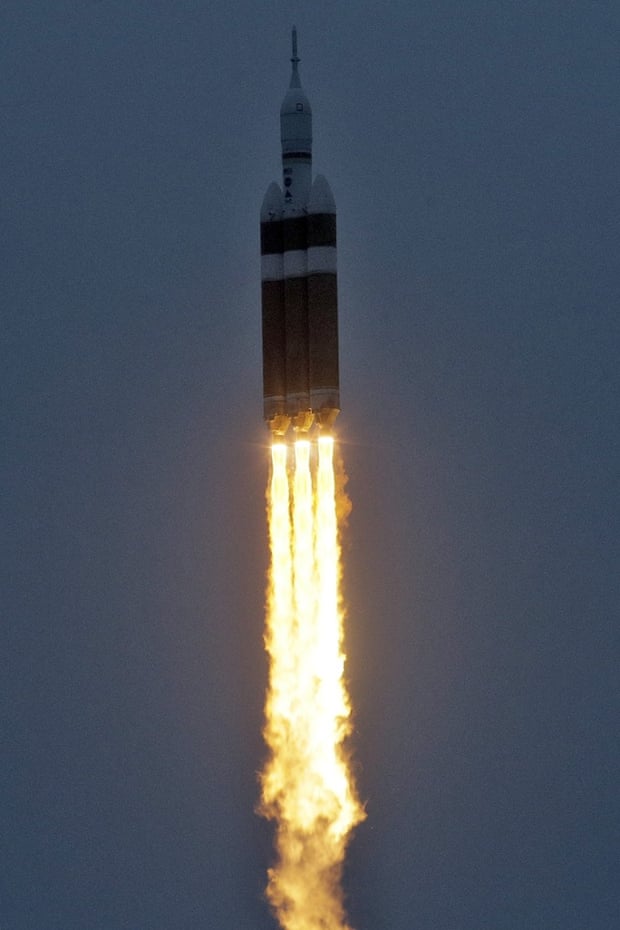
NASA's Orion spacecraft.
The sight of the Orion spacecraft blasting off this morning - one day late- from Cape Canaveral, was awe inspiring. It brought back the memories of the Apollo launches in the late 60s-early 70s when humanity yet had a vision of manned space exploration. In the intervening decades, of course, that vision was gutted and diminished- mostly by misplaced national priorities and wars of choice (as well as tax, budget cuts). But those of us dedicated to humanity's quest for new worlds, knew that it couldn't persist - we'd be mad to allow it.

True, NASA had to postpone the initial launch on Thursday after a boat entered the launch area, strong winds forced automatic aborts, and two valves failed to close properly. But at no time was I concerned that the launch - when it did occur- would come to perdition like two previous commercial space efforts, including the brutal crash of Virgin Galactic's "Space Ship Two".

But this morning's launch went smoothly, and cameras mounted on the rocket beamed back stunning pictures of the Earth as Orion blasted into the sky. The mission could have huge implications, despite its brief four-and-a-half-hour duration. Orion will fly farther than any spacecraft made for astronauts has in decades, about 3,600 miles (5,800km) above the Earth’s surface, and is a test case for a capsule that NASA hopes will one day land on Mars.

This brings up the question: How long it will be before humans land on Mars?  Right now, the projections - despite today's launch- are drawn out with the first manned test launch not for another seven years - or 2022. (NASA has planned a second unmanned flight for 2018, and a manned mission to travel around the moon for the 2020s.) Much of this delay can be placed at the feet of Obama who, in 2010, cut the budget for Orion by 20 percent which resulted in the loss of 600 engineer jobs for the program. The jobs have come back, especially here in Colo. - but the time projection for ultimate landing, say on an asteroid,  remains set back 10 years.


That's a long time for space junkies! In the meantime we're supposed to be content with the pathetic, 'small ball' commercial space ventures. Pardon me if I snooze - or at least watch old Star Trek episodes! I really don't give two craps if some celebrity boards the 'Space Ship Two' - assuming Branson finally gets it fixed - to take a five minute junket 28 miles up to the "edge" of space. YAWN!

Meanwhile, the first Mars landing is not expected to occur using Orion until "the 2030s". What!? I'll likely be dead by then! What the hell, I'm supposed to witness this milestone as a freakin' ghost? Of course, there is the suicidal "Mars One" which is supposed to land 4 humans there by 2022- but let's get our heads screwed on straight. That mission is one way only (presumably the cargo will be left a few years earlier for the Mars-o-nauts to construct their prefabs) and the would -be colonists will be left to fend for themselves with no coming back to Earth.

And let's not fool ourselves, there's no assurance the crew will survive for long - assuming they do land safely without adequate redundant systems- given the radiation experienced in transit. (See the paper: ''Measurements of Energetic Particle Radiation in Transit to Mars on the Mars Science Laboratory"). 

That showed for a 253 day journey from Earth to Mars, radiation levels of up to 0.33 sievert  (for one way) would be experienced.  And this is likely an underestimate-  because it assumes the ultimate standard for current radiation exposure protection - but which the organizers of Mars One would have to plow much more money in to realize. I suspect the actual radiation exposure for the 'Mars One' crew will be twice that amount.

One way or another, however, we have to get to Mars, and we need to colonize it as a first step to interstellar colonization. This is not fantasy or science fiction but hard reality, if we wish our species to survive. (If we don't, then of course it's a moot point.)   As Isaac Asimov put it, in his Barbados Queen's Park lecture in February, 1976:

"Manned space exploration is not an option or a luxury. No sane intelligent species in the cosmos willingly leaves all its ‘eggs’ in one basket, in this case on one planet. Any large asteroid, remember, could take us out with one strike. This could happen in 50 years or in 5,000 or 500,000. It doesn’t matter when. It will be the end of humanity if we choose to never explore and disperse ourselves….for our own protection”


Are we smarter than the dinosaurs? Recall they went extinct owing to the  Chicxulub impact 65 million years ago. They had no way to prevent their demise, or even detect it in advance. They lacked the brains to do the mathematics for celestial mechanics and the anatomy to construct rockets. We, on the other hand, possess the brains to do both including the ability to compute complex orbits and trajectories as well as design and build rockets. These include providing us with the options to take out an asteroid, or to depart the Earth for new worlds.  Or do both! We don't have to be hostage to the inevitability of another monster (Torino scale 10) asteroid strike. The only question remaining is whether we will act in time. Dr. Asimov believed we would, because he had ultimate faith humans would be intelligent enough to do the right thing.

Speaking for myself, I am not so sure.

Friday, December 13, 2013

Why Would Nearly 200,000 Sign Up For a Mars Suicide Trip?


Back in March, I questioned why any married couple would want to go on a 16-month jaunt to Mars and back. Never landing, only making a pass then returning (hopefully!) in one piece to Earth. The private, non-profit project is being called “Inspiration Mars” with the initial front money coming from multi-millionaire investment consultant Dennis Tito (The first ever space tourist, i.e. aboard a Russian Soyuz craft). The cost estimate? About $1 billion. NASA will not be involved.

The planned Mars mission would cover 150 million miles and take 501 days overall. While the Apollo 8 crew actually orbited the Moon for 20 hours before returning, the Mars couple will only do a brief Mars "flyby" (since their trajectory is based on the 'sling shot' effect'), lasting maybe an hour if that, before proceeding on their long voyage home. In other words,  enduring 500 -plus days of being cooped up in a large closet-sized space for a reward of only about an hour of actually seeing the Red Planet, and that from a spacecraft a hundred miles up. (A married couple that passes all appropriate tests has been deemed ideal because two strangers might not tolerate each other in a confined space  - with no Wifi, no cell or smart phones, but maybe lots of regular books via Nook.)

Now, as if to out-do that, we learn the next phase of a Mars One trip is being readied: to sift through nearly 200,000 volunteers from around the world who've signed up to be (ostensibly) the first to "land on Mars and colonize it."  A robot prelim space craft is slated for launch in 2018, and that  mission aims to pave the way for the final volunteer crew of 4 by testing technology they will need should they reach the red planet in good enough shape to start the first human space colony. (Translation: They haven't yet croaked from receiving nearly the same amount of radiation as those 5 km from the Hiroshima atomic blast.)


The US aerospace company, Lockheed Martin, which has worked on scores of NASA missions, has agreed to draw up plans for a lander based on the US space agency's Phoenix probe that touched down on Mars in 2008. The lander will launch with a communications satellite that will go into orbit over Mars and provide video and data links from the surface of the planet back to Earth. A UK company, Surrey Satellites (SSTL), has signed a contract to work on the communications probe.

Bas Lansdorp, CEO of MARS One told reporters at a press briefing in Washington D.C. on Tuesday that the robotic mission was "the first step in Mars One's overall plan of establishing a permanent human settlement on Mars". Lansdorp believes the mission to Mars would cost as little as $6bn, but Michael Listner, an expert on space law has put the total bill at closer to $1TRILLION. Most of the cost must be paid for by philanthropists, sponsorship, and broadcast rights.

In respect of the latter, since the Mars One business model incorporates a real risk of death in this space venture – a reality TV show will follow the 4 final astronauts through their mission. You will be able to see just about all their meltdowns when micro-meteoroids strike the hull, as well as the frantic prayers when a large solar flare goes off (we're talking about an X class monster) and high intensity radiation is hurtling towards them. The total time to get there, by the way, will be 200 days.

When I first learned that so many around the world had signed up for the mission, the first thing that occurred to me is how much they really knew about the risks. The second thought is that perhaps - in the words of author Barbara Ehrenreich- they truly were "bright-sided" by too much optimism from the CEO (Lansdorp) and the investors.  Make no mistake that a one-way trip to Mars would face an enormous number of technical and practical hurdles that aren’t close to being figured out. NASA’s intrepid rover Curiosity has started addressing one of the questions: radiation exposure on the journey.

During the Rover’s nearly 9-month journey through space Curiosity’s radiation assessment detector  found a serious amount of radiation bombarding the spacecraft. How would humans fare in that scenario? According to a paper published in the journal Science in May:


"It is clear that the exposure from the cruise phases alone is a large fraction of (and in some cases greater than) currently accepted astronaut career limits."


This means that by the time the crew lands, assuming they make it and we don't see a "units error"  like we did some years ago (where English units were confused with metric - sending the robot craft off into space - missing Mars entirely) they will already be suffering from radiation over-exposure.   Now, to be clear, the radiation issue isn't necessarily a "show stopper" - but it means the proposed craft would need adequate shielding, and that means more money- cost. Is $6b too low then? Probably! That low figure gets you the basic "no frills"  craft to get there, but the highest probability of arriving as a corpse.


Let's process this in more detail, as published in the earlier mentioned Science paper: 'Measurements of Energetic Particle Radiation in Transit to Mars on the Mars Science Laboratory"

That paper revealed that the spacecraft containing the Curiosity Rover for its 253-day, 350-million-mile (563 million km) trip to Mars, indicated a radiation dose equivalent for even the shortest round-trip with current propulsion systems and comparable shielding at 0.66 Sievert (Sv) in a range of plus or minus 0.12 Sv.  NASA lifetime astronaut limits are between 0.6 and 1.2Sv, depending on sex and age. So that's at best more than half a career of radiation exposure, even disregarding time spent on the surface, or indeed on any preparatory missions.


Without radical progress in reducing the duration of the Mars journey and breakthroughs in increasing the radiation shielding of craft, suits and other habitats, human trips to Mars will likely be ruled out by NASA for exposing astronauts to more than a three per cent increase - such as stipulated in "Risk of Exposure-Induced Death" for fatal cancer, a threshold set in the aftermath of Hiroshima.


But let's assume the Mars One crew makes it. Of course, their real work now begins. They will have to set to work setting up the portable living quarters using the materials already dropped off by earlier robot craft. Think this will be a walk in the park? Think again! Mars' gravity is about 38 per cent that of Earth, and temperatures average around -60°C (-76°F). Low thermal inertia contributes to freezing winds estimated to be upwards of 90kmph (60mph).  THINK of trying to do housing or energy unit assembly in those conditions!


As if that's not enough, abrasive dust storms lasting months on end were witnessed by Mariner 9 in 1971. And although there is some water vapor in the atmosphere and perhaps two per cent by weight in surface soil, the atmosphere is mostly carbon dioxide.   So now, what if during your construction labors you face a storm of meteoroids which puncture the portable living quarters or the hydroponics facility on which your food depends? Will enough life support-shelter redundancy have been provided by the system designers......at $6n?  Will you and your team be able to survive even one meteoroid storm? Bear in mind here that with Mars' tenuous atmosphere you won't have the benefit of these rocky missiles burning up as they do(mostly) while passing through Earth's thicker atmosphere.

 
 If it was me, I'd be more inclined to sign up if I knew $1 trillion was being spent because it is more likely all the necessary bases were being covered- with far fewer aspects left to chance.

The oddest thing of all, however, may be that so many people are willing to leave all their loved ones behind on Earth.....forever.... With no chance of ever seeing planet Earth again, they'd truly be on their own and there won't be any "ET  Earthman call home" either.

For those who want to get a rough idea of what our intrepid would-be Mars One explorers are in for, there's a somewhat schmaltzy scifi film entitled 'Escape from Mars' (1999).  If you can ignore some of the bad acting, there are enough realistic elements of the dangers faced on a Mars trip to make anyone think twice.