Showing posts with label Mars One. Show all posts

Tuesday, May 1, 2018

Why The Aurora One Station ("Space Hotel" ) Is More A Pipedream Than Practical Plan

No automatic alt text available.
Artist's conception of the Aurora Space Station ("Hotel") billed as "the first luxury hotel in space."

I used to think that "Mars One" was the dumbest space concept to ever emerge. For reference, this was the brainchild of commercial space fantasist  and Mars One CEO Bas Lansdorp who imagined sending ten billionaires to the Red Planet at a price of $10b each. No thought of the 563 million km, 250-odd day trip exacting a radiation exposure of 0.60- 0.80 Sievert (Sv). This compared to the NASA lifetime limits of 0.6- 1.2 Sv.

NO special training, or at least not too tasking, just enough to teach  the 10 super rich guys how to use the special on board meal packets - so they don't end up eating each other before getting radiation sickness.

Then there was the “Inspiration Mars” nonsense  which would dispatch a couple (husband and wife)  150 million miles and take 501 days overall to do a brief Mars "flyby".   In other words,  enduring 500 -plus days of being cooped up in a large closet-sized space for a reward of only about an hour of actually seeing the Red Planet, and that from a spacecraft a hundred miles up.   This was the vision of  multi-millionaire investment consultant Dennis Tito (The first ever space tourist, i.e. aboard a Russian Soyuz craft). 

Now, we behold the next loopy iteration in the Aurora One Station or "Space Hotel" as it's been called, to be engineered by Houston-based Orion Span. They plan to launch this "modular" station in 2021 and welcome its first guests the following year. (Well, they have to make sure it's orbit worthy first, and doesn't suddenly crash or go into a rapidly decaying orbit.)

The hotel platform will - if all goes right - orbit 200 miles above the Earth and offer its six guests (at $9.5 million per person)  a grand total of "384 sunrises and sunsets" as the craft orbits the planet for 12 days.  Oh yeah, two specially trained crew members will accompany the space tourists, to hopefully bail the modular station out of any difficulties - say a shortage of space rations or a misfiring toilet.

According to Orion Span's founder, Frank Bunger,  a former software engineer, quoted in Bloomberg News:

"We want to get people into space because it's the final frontier for our civilization. We're not selling a 'hey let's go to the beach' equivalent in space. We're selling the experience of being an astronaut. You reckon that there are people who are willing to pay to have that experience."

And the $64 question then becomes: Are these presumed space touristas prepared for space sickness?  Will they take Gravol with them - in liquid mush form?   Are they going to be able to psychologically handle being cooped up with 5 strangers in a 35'  by  14' cabin - about the size of a large living room in a regular home?  We don't know. All we do know is that the likely space tourists are enamored of the idea of being in space and seeing a bunch of sunrises, sunsets.

Then there is the matter of money, funding to support the first Aurora One space hotel expedition.  Given a 12-day sojourn and the need for enough supplies, as well as redundancy built into the craft (for safety) let's be clear that a price of $9.5 million per person will barely pay for the raw materials for module construction.    Based on past space ventures, a decent estimate when all is said and done, is roughly $200 b for the first tourist expedition. 

Furthermore (ibid.) "Orion Span has yet to contact a launch provider, either for its initial flights, i..e. to build the actual station, or for customer flights."    You may be sure that when Orion Span does finally contact a launch provider, that outfit will want a hefty cut for supplying the rockets, etc. 

Indeed, in the words of Phil Larson, who worked with Elon Musk's Space X, quoted in the WSJ piece:

"The startup's aggressive four year time frame may be a ploy to assess what kind of market may be out there for this."

But let's be clear that a ploy isn't a real plan. It is basically a PR gimmick to try to test the waters to find out how much support there is - among launch "providers" especially - to cooperate in such an "entertainment"  venture.   My bet is there aren't very many who will sign on unless Orion Span can show the demand (from very rich millionaires or billionaires)  is there on  continuing basis.   When one thinks about it, as opposed to guzzling PR, it is basically a dumb idea to send 4 wealthy tourists into orbit for 12 days just to take perspective views of sunrises, sunsets. (I suspect any of these wealthy space travelers to be will also check with an actuary as to the odds of surviving such a space junket. It may also get them to rethink their estate plans!)

Van Espahbodi,  managing director of Starburst Accelerator LLC, also referenced in the piece, suggests "the public relations push behind Orion Span may be an effective way to help the company attract funding."

Maybe, and that also will indicate how many launch providers really believe in an inherently dumb idea,  to the point of adequately funding it, providing launch vehicles.


Saturday, October 1, 2016

One Way Death Trip To Mars Compliments of Elon Musk? No Thanks!


Mars' surface as it might appear to passengers on Elon Musk's space ship - if they last that long.

It seems too many want to get to Mars in a hurry, and safety systems be damned. I noted three years ago the “Inspiration Mars” nonsense  which would cover 150 million miles and take 501 days overall to do a brief Mars "flyby".  Then there was "Mars One" through which nearly 200,000 volunteers from around the world signed up to "land on Mars and colonize it."  That has since been whittled to four, and meanwhile a robot prelim space craft is slated for launch in 2018, and that  mission aims to pave the way for the final volunteer crew by testing technology they will need should they reach the red planet in good enough shape to start the first human space colony. But the odds are they won't They will likely arrive DOA - if they get there in one piece at all - by virtue of receiving nearly the same amount of radiation as those 5 km from the Hiroshima atomic blast.

Now, we have wannabe commercial space pioneer Elon Musk, who recently declared in a speech ( at the International Astronautical Congress) entitled “Making Humans a Multiplanetary Species”,  that his goal was to “make Mars seem possible. To make it seem like it’s something we can do in our lifetimes. That you can go.” Musk, not meek about his ambitions, showed a video of his imagined Mars  rocket taking off from the Kennedy Space Center with 100 people on board, refueling in orbit and then landing on the surface of Mars. The audience fairly gasped at such a wondrous sight when NASA wasn't making similar plans until the 2030s.

By contrast, Musk's vision featured an ambitious timeline, starting with the first launch of an unmanned craft as soon as 2018, then the first paid passengers making their way to the Red Planet by 2024-25.  When asked if he himself would make the trip, he said "I'd have to get all my plans for succession in order first."  Just as well, because it's doubtful anyone would survive that trip any more than the Mars One journey.

Musk's design imagines a Mars rocket a towering 400-feet tall, with lots more thrust  than the Saturn V that took the Apollo astronauts to the moon. He acknowledged the immense, if quixotic, challenge he was undertaking would begin not just with creating a spacecraft that could keep dozens of humans alive for extended periods but with producing rocket fuel from the resources on Mars. And he acknowledged the difficulties of lowering the cost of the flights from $10 billion a person to $200,000 or less, in part by reusing rockets to fly repeat missions ferrying lots of people.

Now, try to imagine this, paying $10b each for a one way death trip. As one late night comic put it: "What better way than this to get rid of the billionaires!"

Let's also bear in mind that currently Musk’s Falcon 9 rocket is grounded, after blowing up for a second time. The maiden flight of its more powerful Falcon Heavy has been delayed again and again. I ask in all seriousness, would you really trust this guy to get you to Mars in one piece?

Musk, like Bas Lansdorp, CEO of MARS One, is also vastly understating the costs,, which he estimates at maybe $100b - say for 10 billionaires to take the first trip at $10b each. But as I've previously noted the more likely price of a first manned trip is $1 trillion - in today's dollars, and probably at least $1.4 trillion by the time the first ship is ready to launch in 8 years. That math would require at least 140 billionaires ready to launch to the Red Planet. I don't think there are that many who'd pay for a death ticket no matter how exciting Musk makes it. They want to remain here on good old planet Earth to see how many more hedge funds they can control, and how many resources they can consume for themselves.

Less clear is how SpaceX would pay to get to even that point. Musk did say he would “make the biggest contribution I can” of his own wealth, and at one point he joked that the company might have to use Kickstarter, the online fundraising platform, to raise money. Somehow, I don't think that would work for a project of this kind. Apart from that and outside of a few ambiguous technical details of the spacecraft he offered few specifics on how this monster ship would get built, where and what propulsion system might be used.

Nor did he address the hazards of radiation exposure for such a voyage- which might be just as well. To be clear, the radiation issue isn't necessarily a "show stopper" - but it means the proposed craft would need adequate shielding, and that means more money. Is $1 trillion too low then? Probably! That low figure gets you the basic "no frills"  craft to get there, but the highest probability of arriving as a corpse.

Reference can be made to a paper entitled  'Measurements of Energetic Particle Radiation in Transit to Mars on the Mars Science Laboratory" .  It revealed that the spacecraft containing the Curiosity Rover for its 253-day, 350-million-mile (563 million km) trip to Mars, indicated a radiation dose equivalent for even the shortest round-trip with current propulsion systems and comparable shielding at 0.66 Sievert (Sv) in a range of plus or minus 0.12 Sv.  NASA lifetime astronaut limits are between 0.6 and 1.2Sv, depending on sex and age. So that's at best more than half a career of radiation exposure, even disregarding time spent on the surface, or indeed on any preparatory missions.


The takeway? Without radical progress in reducing the duration of the Mars journey and breakthroughs in increasing the radiation shielding of craft, suits and other habitats, human trips to Mars will likely be ruled out by NASA for exposing astronauts to more than a three per cent increase - such as stipulated in "Risk of Exposure-Induced Death for Fatal Cancer", a threshold set by a working group panel of radiation specialists in the aftermath of Hiroshima

Make no mistake that getting to Mars is exceedingly difficult. On average, it’s 140 million miles from Earth, though the planets do come to within about 35 million miles of each other every 26 months.  But that doesn't mean you can make a 35 m mile direct trip from Earth to Mars. From the laws of celestial mechanics and Newtonian dynamics you still need to plot a long, curving arc or trajectory. Even under the best circumstances it would take months to get there, being exposed to radiation levels unheard of on Earth.

Musk claims SpaceX could do it in 80 days and eventually in 30, but I doubt it, and I'd have to see the rocket design and trajectory - as well as source of propulsion first.

As I also previously noted, referencing radiation levels,  the deep space environment can also be tremendously harsh on ordinary space faring. Of the 43 robotic missions to Mars, including flybys, attempted by four different countries, only 18 have been total successes. You can be sure with any humans aboard that percentage would be lower, maybe even zero.

Musk - conveniently -  didn’t address the explosion that blew up one of his rockets earlier this month. He has previously said the incident, which occurred while the rocket was being fueled ahead of an engine test firing, was the most “difficult and complex” the company has ever faced. This follows another Falcon 9 failure last year, when it blew up a couple minutes into flight.

It would be tremendous if a bunch billionaires - starting with Donald Trump after he loses this election  took Musk up on his offer to get them to Mars. But I somehow doubt even Trump is dumb enough to do it.

Friday, December 5, 2014

Orion Blasts Off - But How Long Until Mars Landing?

NASA's Orion spacecraft.
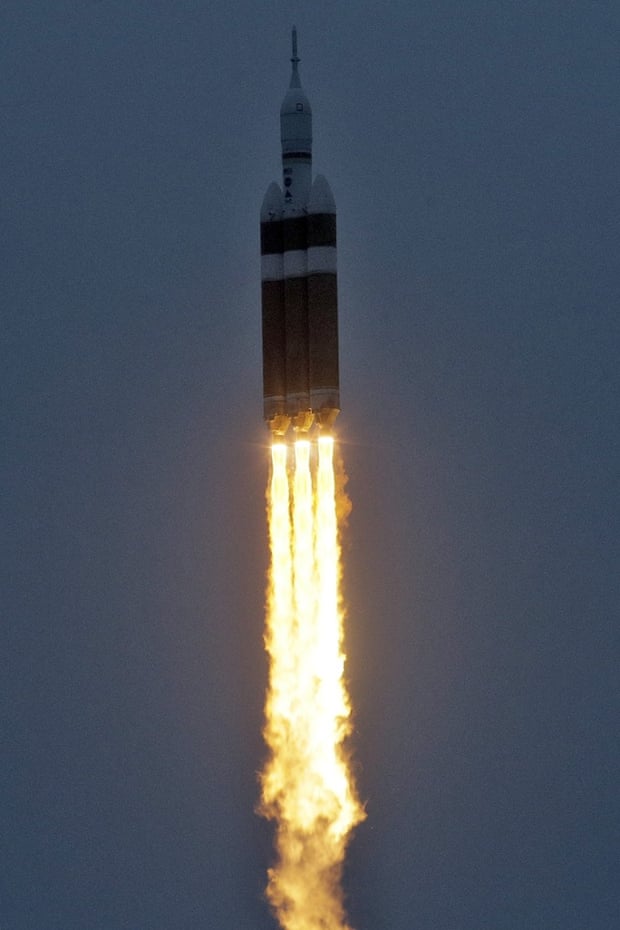
The sight of the Orion spacecraft blasting off this morning - one day late- from Cape Canaveral, was awe inspiring. It brought back the memories of the Apollo launches in the late 60s-early 70s when humanity yet had a vision of manned space exploration. In the intervening decades, of course, that vision was gutted and diminished- mostly by misplaced national priorities and wars of choice (as well as tax, budget cuts). But those of us dedicated to humanity's quest for new worlds, knew that it couldn't persist - we'd be mad to allow it.

True, NASA had to postpone the initial launch on Thursday after a boat entered the launch area, strong winds forced automatic aborts, and two valves failed to close properly. But at no time was I concerned that the launch - when it did occur- would come to perdition like two previous commercial space efforts, including the brutal crash of Virgin Galactic's "Space Ship Two".

But this morning's launch went smoothly, and cameras mounted on the rocket beamed back stunning pictures of the Earth as Orion blasted into the sky. The mission could have huge implications, despite its brief four-and-a-half-hour duration. Orion will fly farther than any spacecraft made for astronauts has in decades, about 3,600 miles (5,800km) above the Earth’s surface, and is a test case for a capsule that NASA hopes will one day land on Mars.

This brings up the question: How long it will be before humans land on Mars?  Right now, the projections - despite today's launch- are drawn out with the first manned test launch not for another seven years - or 2022. (NASA has planned a second unmanned flight for 2018, and a manned mission to travel around the moon for the 2020s.) Much of this delay can be placed at the feet of Obama who, in 2010, cut the budget for Orion by 20 percent which resulted in the loss of 600 engineer jobs for the program. The jobs have come back, especially here in Colo. - but the time projection for ultimate landing, say on an asteroid,  remains set back 10 years.


That's a long time for space junkies! In the meantime we're supposed to be content with the pathetic, 'small ball' commercial space ventures. Pardon me if I snooze - or at least watch old Star Trek episodes! I really don't give two craps if some celebrity boards the 'Space Ship Two' - assuming Branson finally gets it fixed - to take a five minute junket 28 miles up to the "edge" of space. YAWN!

Meanwhile, the first Mars landing is not expected to occur using Orion until "the 2030s". What!? I'll likely be dead by then! What the hell, I'm supposed to witness this milestone as a freakin' ghost? Of course, there is the suicidal "Mars One" which is supposed to land 4 humans there by 2022- but let's get our heads screwed on straight. That mission is one way only (presumably the cargo will be left a few years earlier for the Mars-o-nauts to construct their prefabs) and the would -be colonists will be left to fend for themselves with no coming back to Earth.

And let's not fool ourselves, there's no assurance the crew will survive for long - assuming they do land safely without adequate redundant systems- given the radiation experienced in transit. (See the paper: ''Measurements of Energetic Particle Radiation in Transit to Mars on the Mars Science Laboratory"). 

That showed for a 253 day journey from Earth to Mars, radiation levels of up to 0.33 sievert  (for one way) would be experienced.  And this is likely an underestimate-  because it assumes the ultimate standard for current radiation exposure protection - but which the organizers of Mars One would have to plow much more money in to realize. I suspect the actual radiation exposure for the 'Mars One' crew will be twice that amount.

One way or another, however, we have to get to Mars, and we need to colonize it as a first step to interstellar colonization. This is not fantasy or science fiction but hard reality, if we wish our species to survive. (If we don't, then of course it's a moot point.)   As Isaac Asimov put it, in his Barbados Queen's Park lecture in February, 1976:

"Manned space exploration is not an option or a luxury. No sane intelligent species in the cosmos willingly leaves all its ‘eggs’ in one basket, in this case on one planet. Any large asteroid, remember, could take us out with one strike. This could happen in 50 years or in 5,000 or 500,000. It doesn’t matter when. It will be the end of humanity if we choose to never explore and disperse ourselves….for our own protection”


Are we smarter than the dinosaurs? Recall they went extinct owing to the  Chicxulub impact 65 million years ago. They had no way to prevent their demise, or even detect it in advance. They lacked the brains to do the mathematics for celestial mechanics and the anatomy to construct rockets. We, on the other hand, possess the brains to do both including the ability to compute complex orbits and trajectories as well as design and build rockets. These include providing us with the options to take out an asteroid, or to depart the Earth for new worlds.  Or do both! We don't have to be hostage to the inevitability of another monster (Torino scale 10) asteroid strike. The only question remaining is whether we will act in time. Dr. Asimov believed we would, because he had ultimate faith humans would be intelligent enough to do the right thing.

Speaking for myself, I am not so sure.

Thursday, May 15, 2014

Why Can't We Go To Mars By 2025?


Mars as it might appear during flyby on August 20, 2018 for the 'Inspiration Mars' couple, before heading back to Earth. (From European Space Agency)

 No, I'm not talking about the much ballyhooed plan  by a consortium of private space specialists- backed by a tycoon- to send a ‘bare bones’ mission to Mars in four years. This would be a “no frills” 16 month flyby journey that will feature a husband and wife team, given such would more likely be able to handle being cooped up for well over a year in a cabin half the size of an RV.

The planned Mars mission would cover 150 million miles and take 501 days overall. While the Apollo 8 crew actually orbited the Moon for 20 hours before returning, the Mars couple will only do a brief Mars "flyby" (since their trajectory is based on the 'sling shot' effect'), lasting maybe an hour if that, before proceeding on their long voyage home. In other words,  enduring 500 -plus days of being cooped up in a large closet-sized space for a reward of only about an hour of actually seeing the Red Planet, and that from a spacecraft a hundred miles up.

Nor am I referring to the  Mars One project whereby a  robot prelim space craft is slated for launch in 2018, and that  mission aims to pave the way for the final volunteer crew of 4 to land on the Red Planet by 2022 by testing technology they will need should  they reach the red planet in good enough shape to start the first human space colony. (Translation: They haven't yet croaked from receiving nearly the same amount of radiation as those 5 km from the Hiroshima atomic blast.)

What I am about here is a real, properly paid for Mars project, with the multiple safety redundancies built into it, as they were for the Apollo Moon project. In other words, this would be so mammoth that it would require government, (NASA) mustering the resources to make it possible. Hence, it would cost much more than the two cheapo projects cited above, more likely in the vicinity of hundreds of billions of dollars.


William Gerstenmaier, NASA’s associate administrator for human space exploration, recently told of the need to “break the paradigm” of current funding, adding. “We cannot do it at the same budget level we’re at today. It’s just not going to work.”

Indeed, and it is downright, damned pathetic given how much we piss on Afghanistan in a useless holding pattern of futility every month. What we've already pissed down the toilet in Afghanistan could have easily funded a proper Mars' program and had us well on the way to making a manned landing by 2025 or possibly 2020.

Meanwhile, former astronaut and NASA honcho Charles Bolden said he would “get down on my hands and knees and beg and plead” with Congress to support human space exploration.  But the point is, he shouldn't have to! It ought to be clear to all but the most hide bound and stupid that we can't remain on this planet forever, if we value species' survival.

It was, in fact,  science writer Isaac Asimov- in his Barbados lecture at Queen’s Park Theater in 1975

  who said (tape recorded at time):

“Manned space exploration is not an option or a luxury. No sane intelligent species in the cosmos willingly leaves all its ‘eggs’ in one basket, in this case on one planet. Any large asteroid, remember, could take us out with one strike. This could happen in 50 years or in 5,000 or 500,000. It doesn’t matter when, it will be the end of humanity if we choose to never explore and disperse ourselves….for our own protection”


The first time I heard this it made eminent sense, and it does so now. It is hubris of the first order to believe that we can just “scotch” on this Earth, and never fret that we face no threats of extinction. A Torino-scale 10 asteroid, with a size on the order of just a quarter the asteroid Ceres would utterly destroy the human species and leave not a trace. Within the hour or so of its major interaction, all life on Earth would cease. The utter folly of never having extended ourselves to locate an alternate abode would become quite evident. But by then it would be way too late!

Even a Torino-9 asteroid would render most human life extinct as a result of the effects of a nuclear winter scenario: so many trillions of dust hurled into the atmosphere from the obliterating impact that sunlight would be reduced and a suffocating winter lasting decades ensue – with death of most plant life.

With that extirpation, any remaining human life would certainly follow.

Thus, the appeal to robot  space craft (unmanned) alternatives, hence the case made, i.e. that NASA can arguably do more with unmanned exploration since crafts are lighter and easier to land, and there are no worries about life support, and there is no need for a return trip.

All well and good, but when a Torino 9 or 10 event is bearing down on you and you haven't done duck squat to find even one livable colony for humans, then it's time to say 'Hasta la vista!'  Your days are numbered.

Sadly, the idiots who yap about the need for robot craft  instead don't get that it isn't a matter of "too little money" for budgets but rather too much money wasted on military bullshit.  Consider just the money squandered on Iraq and Afghanistan - both wars of choice in which no direct U.S. security was involved. The estimate for these is $4 TRILLION.   Four fucking TRILLION!

Just $1 trillion could have provided enough for:

- A 'Cadillac' deluxe mission to Mars with all the niceties (driven by ion propulsion)

- Enough supplies to set up a base for further missions

- Enough for additional robot exploration and probes to the outer solar system

- A solar optical telescope with high resolution

The fact we have no manned space program and have to rely on the Russians  (we can't even do that any more after the Obama-ites pissed them off with trade sanctions etc.) and a bunch of wannabe commercial space jockeys (e.g. at Space X) has been a matter of choice. The choice that we as a nation would rather be a military empire than an explorer of new worlds - which latter obviously requires vastly more vision and intelligence.

The problem is that all military empires come to an end, while explorer nations are dynamic and their investments in space, for example, find many other applications which increase and enhance their economic health - as opposed to sapping it.  The usual canard-laden argument trotted out is "there's no money for manned space efforts and just look at our debt" etc.  But that's rife with holes you could drive ten Mack trucks through, namely that the major proportion of debt has been incurred by wars of choice and not paying for them.  Hell, Iraq alone is estimated to cost us $3 trillion while Afghanistan could easily reach $2 trillion if we are actually stupid enough to remain until 2024.. (And recall Bush Jr. launched both without even raising taxes, which was the usual course of action for previous Presidents if they regarded what they were doing as waging real wars..)

As I've noted previously, there's absolutely NO reason this nation couldn't have had a viable manned space program (with Mars as the goal), while preserving Social Security and Medicare, and enabling minimal interest student loans, plus a terrific infrastructure repair program - if we'd made alternate choices.  Those choices, however, would've entailed not sticking our beaks into business and events around the world and acting as Cop of the world. (What JFK called the mindset of Pax Americana, or trying to enforce the peace by use of American weapons of war.)

JFK understood, as few presidents since (with the possible exception of Jimmy Carter) that a nation cannot squander its resources on wars or building a far flung military empire, and also expect to invest in its own people and domestic infrastructure and future. He tried his best to divert the existing trend to make war for the sake of it (according to the document NSC-68) but paid the ultimate price for his courage.

Thomas Friedman, who I've usually derided as a Neoliberal tool and hack, did get one thing right when he wrote in his NY Times column two weeks ago: "We cannot expect to do nation building in other countries if we can't first do nation building in our own".   His point being that it's preposterous to help 'build' other nations when our own is falling into rack and ruin as our people struggle for crumbs in a depleted resource-economic environment.

Can we do one thing to partially reverse the trend to self-destruction? Perhaps the most significant is to put away our false pride and make peace with the Russians, to enable mutual cooperation to continue on the International Space Station. (See previous post)  This is no exaggeration, but the future survival of Home Sapiens may well depend on it.