
Jim Truran of University of Chicago, winner of 2020 Laboratory Astrophysics prize for his body of cutting edge work over a lifetime
When Janice asked me what was the best presentation - after the solar ones described last week - I had to ruminate for some time over the 3 talks just described (after the solar ones) and then chirped up: "The leading (11:00 a.m.) Tuesday session talk on Laboratory Astrophysics! Specifically, the application of nuclear physics lab results to Astrophysics!" The talk was actually entitled:
"Jim Truran's Contributions to Nuclear and Laboratory Astrophysics"
I was excited because for years, hell decades, I'd been hammering on connections between laboratory experimental results (i.e. in spectroscopy, plasma physics, nuclear physics) which had direct application and connections to astrophysical processes. For example, Jim Lawler's yeoman work (at Univ. of Wisconsin) in laboratory atomic physics which has made major contributions to stellar spectroscopy, i.e. by measuring transition probabilities which have also enabled more precise determinations of stellar elemental abundances..

Such hard core experimental connections gave the lie to books like two recent ones of author David Lindley (e.g. 'The End Of Physics' (1993), and now 'The Dream Universe') which have argued that modern physics has lost its way amidst a morass of obscure "mathematical elegance" which bears little relevance to the real world.
Anyway, this particular AAS lecture refers to the 2020 Laboratory Astrophysics Division prize talk given by Jim Cowan in honor of LAD prize winner, Jim Truran. This was for his work at the Univ. of Chicago using nuclear decay chronometers to determine the ages of stellar and terrestrial material. Prof. Truran's primary work was in discovering neutron and explosive processes in stars, e.g.. connected to supernovae. This entailed examining the s-process in stars and the r-process in low metallicity stars.
It is useful here to distinguish the two, noting first that because we are referring to neutron collisions and capture, there is no Coulomb potential barrier involved. This is because neutrons have no charge unlike protons, which would partake in the p-p fusion reaction, and hence have to surmount the Coulomb barrier because of their positive charge. (I.e. manifest as a repulsive effect between two like charges trying to fuse.)
In essence, we are looking at reactions occurring at relatively lower temperatures (assuming free neutrons already present in the gas), wherein the reactions result in atomic nuclei that are either stable or unstable against the beta decay reaction, i.e.
Z X A+1 + e - ® Z+1 X A + 1 + u + g
If then the beta decay half life (b T½ ) is short compared to the time scale for neutron capture, then the neutron capture reaction is said to be a "slow" or an s-process. Such reactions tend to yield stable nuclei - either directly or secondarily, i.e. via beta decay. Conversely, if (b T½ ) is long compared to the time scale for neutron capture the reaction is termed a "rapid" or r-process reaction, yielding heavy, neutron rich nuclei. (But also more unstable - which we will get to.)
Prof. Cowan began his presentation by laying out the scope of the problem, i.e.


Thus, even as far back as 1959, Cameron was able to estimate solar system abundances, which - as we inspect the graph above - disclose he wasn't too far off the results obtained by Lodder (using improved techniques) some 46 years later. What both found is that the elements are mostly made in combination but some are forged in one single process or the other, that is, the s- or r-process.
All of this is relevant as we note the role of the s-, and r-processes in the slide and their respective manifestations as so-called abundance peaks, a number of which can be easily isolated.
Jim Truran and collaborators showed that the way to solve the problem of solar abundances of the elements was by way of isotopic deconvolution referenced to the s- and r-process, e.g.

Here it was clear that the key elemental peaks grouped in series and were separated by process (red or blue graph line). For example, in the s-process (blue graph line) note how the peaks for strontium (Sr), Barium (Ba) and lead (Pb), dominate. Meanwhile, the r-process discloses peaks for selenium (Se), Xenon (Xe) Tellurium (Te) as well as for the rare earth elements (REE) and a third peak for gold (Au), Platinum (Pt) and Osmium. Jim Cowan pointed out that these abundance models first appeared ca. 1957 and were done without computers - since none existed for such work at the time.
Going back over my own notes from a stellar evolution course in 1970, I see reference to the s-, r-processes in a 1957 paper (famously called the "B2FH" paper after the authors surname first initials: Burbidge, Burbidge, Fowler and Hoyle) in which we learn the r-process is applicable to the production of isotopes in the mass number range: 70 < A < 209. A quick glance at the slide above shows this to be spot on. However, the s-process of neutron capture is said to be applicable to the range: 23 < A < 46 only. Even more relevant here, Truran made his own discovery of explosive stellar processes -leading to nucleosynthesis - independently of B2FH.
Cowan also stressed that the connections between nuclear physics and astrophysics underscored the need for good facilities to pursue productive research one of the fruits of which turned out to be the historic slide shown below:

Here there are several components to note: first, the tiny black boxes to the left edge of the multi-colored 'stream' expanding to the right; second, a black line wending its way to the right of the minuscule boxes, and third a red (magenta) line to the right of that. The black mini-boxes define what we call the "valley of b stability". To the right, the black solid line defines the s-process and elements with greater radioactivity. The red line - further right - defines the r-process in which neutron capture occurs so quickly that we have radioactive nuclei with half life less than 1 second.
The B2FH paper refers to neutron capture time scales from 0.01 sec - 10 sec. We now know, thanks to Jim Truran's contributions, the neutron capture times are much much less than the b decay times, or from 0.01 - 0.1 sec. This is also why the site for the r-process has been very hard to identify for decades, while we have the s-process well identified in AGB (Red Giant) stars.
Basically, by 1957 - to make a long story short - we learned how the elements were made by both explosive and neutron capture processes. What Jim Truran's work showed, especially tied to the Facility for Rare Isotropic Beams (FRIB) is that:
Challenges to our understanding both of the nature of stellar explosions and the synthesis of heavy elements are inextricably tied to uncertainties in the underlying nuclear physics.
The gradual success in surmounting these challenges - and the uncertainties in the nuclear physics- initially led to supernovae as the initial suspects for the r-process. For example, the material in the Crab Nebula was originally considered as early as 1957. A number of variations were later considered, depicted in the slide below:

The problem was that most of these models couldn't explain what the laboratory results disclosed in terms of the element abundances. Thus, they were unable to reproduce r-process material at the heaviest peaks, like platinum and gold. The model that came closest was the last requiring neutron star and black hole mergers. Jim Truran also pursued other models, such as: helium-rich regions regions of exploding supernova and prompt explosions of low mass, Type II supernovae. Truran worked on these for many decades, trying to see if supernovae in the He-rich regions could explain it.
Ultimately, the best result was obtained via a neutron star collision model from Al Cameron, who had been Jim Truran's Ph.D. thesis adviser.

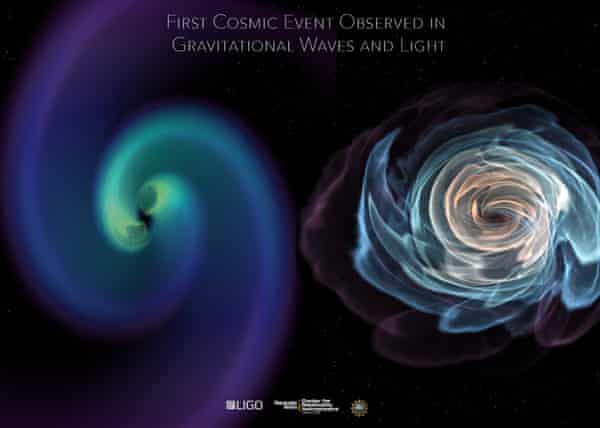
This was also reinforced after the first gravitational wave detection from a binary star collision 2 years ago. In the case of Cameron's model we find a multi-stage process. First, at v ~ 0.25c an EM spectra 'kilonova' -type event (a blue spectrum after 1 day) indicating light r-process nuclei, elements like xenon, silver. Then a week or so later - look to the right - we get another (red) spectrum consistent with heavy r-process nuclei - things like gold and uranium. So far this model presents the best for determining the site of the r-process.
As an ancillary benefit, Jim Truran's work on the periodic table, starting a decade ago with the Lanthanides (lanthanum up through technetium) has resulted in a measurement of all their atomic properties, which then enabled more precise abundance determinations that can be applied to stellar astrophysics. I.e. the data could then be used to make more precise abundance determinations for these elements in the stars.

More recently, Jim has worked through the iron peak elements (from Scandium through zinc) As can be seen from the slide, the chief current atomic data enhancements have been made in: the neutral species (blue coded elements), the neutral and ion species (green coded elements), and the ionized species (orange-coded elements) while the yellow (e.g. calcium) is under study and from September its atomic properties have been measured.
Jim Truran has also made contributions to galactic chemical evolution as well as carried out important studies of the s-process in carbon-detonation models of Type Ia supernovae. More recently, he was instrumental in the development of the FLASH simulation code and its application to thermonuclear supernovae. It will be of intense interest in the coming years to see what further major contributions Jim makes to explosive stellar events as well as the atomic and nuclear physics driving them.
See Also:
Heavy Elements Problem May Finally Be Solved By Ne...
Detection Of Gravitational Waves From Colliding Bl...

The problem was that most of these models couldn't explain what the laboratory results disclosed in terms of the element abundances. Thus, they were unable to reproduce r-process material at the heaviest peaks, like platinum and gold. The model that came closest was the last requiring neutron star and black hole mergers. Jim Truran also pursued other models, such as: helium-rich regions regions of exploding supernova and prompt explosions of low mass, Type II supernovae. Truran worked on these for many decades, trying to see if supernovae in the He-rich regions could explain it.
Ultimately, the best result was obtained via a neutron star collision model from Al Cameron, who had been Jim Truran's Ph.D. thesis adviser.

This was also reinforced after the first gravitational wave detection from a binary star collision 2 years ago. In the case of Cameron's model we find a multi-stage process. First, at v ~ 0.25c an EM spectra 'kilonova' -type event (a blue spectrum after 1 day) indicating light r-process nuclei, elements like xenon, silver. Then a week or so later - look to the right - we get another (red) spectrum consistent with heavy r-process nuclei - things like gold and uranium. So far this model presents the best for determining the site of the r-process.
As an ancillary benefit, Jim Truran's work on the periodic table, starting a decade ago with the Lanthanides (lanthanum up through technetium) has resulted in a measurement of all their atomic properties, which then enabled more precise abundance determinations that can be applied to stellar astrophysics. I.e. the data could then be used to make more precise abundance determinations for these elements in the stars.

More recently, Jim has worked through the iron peak elements (from Scandium through zinc) As can be seen from the slide, the chief current atomic data enhancements have been made in: the neutral species (blue coded elements), the neutral and ion species (green coded elements), and the ionized species (orange-coded elements) while the yellow (e.g. calcium) is under study and from September its atomic properties have been measured.
Jim Truran has also made contributions to galactic chemical evolution as well as carried out important studies of the s-process in carbon-detonation models of Type Ia supernovae. More recently, he was instrumental in the development of the FLASH simulation code and its application to thermonuclear supernovae. It will be of intense interest in the coming years to see what further major contributions Jim makes to explosive stellar events as well as the atomic and nuclear physics driving them.
See Also:
Heavy Elements Problem May Finally Be Solved By Ne...
Detection Of Gravitational Waves From Colliding Bl...

.svg)