Showing posts with label LIGO. Show all posts

Tuesday, October 17, 2017

Heavy Elements Problem May Finally Be Solved By New Gravitational Waves Detection From Colliding Neutron Stars

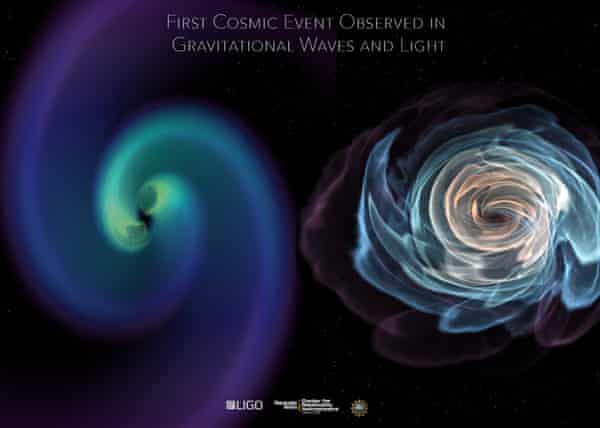
Neutron star merger seen in gravity and matter


Diagram of laser interferometer such as employed by LIGO (from Wikipedia)

The news that a collision of two neutron stars has precipitated another detection of gravitational waves by LIGO (Laser Interferometer Gravitational Wave Observatory), has the world of astrophysics abuzz and with good reason. It confirms the import of the laser interferometer principle used in gravitational wave detection (see diagram 2) and biw in the setting of another type of collision- between two neutron stars. Recall the original report occurred in February, last year, based on detecting gravitational waves from two colliding black holes in late 2015.

LIGO’s  original discovery, accepted for publication in Physical Review Letters,  

Based on the data cited in the above link, the two black holes were each roughly 30 times the mass of the Sun. They evidently merged some 1.3 billion light years from Earth. The  gravitational waves themselves were generated in the final moments before the black holes merged. The signal was brief but definitive and we on Earth have now received it.

LIGO features 2 L-shaped detectors (one in Hanford, WA, the other in Livingston, LA)  made up of two perpendicular arms totaling 2.5 miles long. Then a laser beam is split and travels along both arms, bouncing off respective mirrors to return to the L-intersection. Normally, the beams are aligned so they balance each other out and hence there's nothing to detect. But if a gravitational wave is intercepted it creates a tiny mismatch which is what LIGO detects. (One of the authors of the paper has referred to it as a "chirp".  The effect of this chirp or ripple changes the arms' lengths by a tiny amount, and that change can be detected by lasers.)

To determine the specific location of the source multiple detectors are used, both to distinguish signals from other "noise" by confirming the signal is not of earthly origin, and also to determine direction by means of triangulation.  In such triangulations a third LIGO site is used, namely one near Pisa, Italy, with a 3 km interferometer. The technique uses the fact that the gravitational waves travel at the speed of light and will reach different detectors at different times depending on their source direction. Although the differences in arrival time may be just a few milliseconds, this is sufficient to identify the direction of the origin of the wave with considerable precision.


In 1915 Albert Einstein, in a remarkable achievement of theoretical physics, used an abstruse form of math known as tensor calculus to predict the existence of gravitational waves. This was by way of showing how gravitational distortions arise when mass or energy warp space-time.  The ground breaking field equation that relates these parameters was summarized:

G mn   =  - ½ g mn  G=  - 8 p T mn   

Where the  T mn    denotes the associated  “stress-energy” tensor which incorporates internal stresses, the density of matter and its component velocities (u, v, w or in some texts: u1, u2 and u3).  


Now, the collision of a pair of neutron stars has again brought gravitational waves front and center given it may finally  resolve how the heaviest elements originated. The collision itself occurred some 130 million years ago when dinosaurs still walked the Earth, but the signal was only detected on August 17, 2016 given light propagates at a finite speed: 300,000 km/s.

Recall that the current theory of stellar evolution postulates that elements are built up in the cores of heavy stars (> 10 solar masses)by nucleosynthesis a la successive fusion reactions.  A key transition point occurs after carbon is formed in the core, and reaches a critical density and temperature to detonate. The resulting deflagration, which includes the core separating from the exploding outer layers, turns the star into an instant nuclear factory. Nickel and iron are formed as well as lighter elements in the imploding shells including of: magnesium, sulphur, silicon, manganese, chromium and a host of lesser atomic weight elements- are evolved.


The problem is that no heavier elements than iron can be envisaged although some theoreticians have postulated they can arise in the context of supernova explositions.  In the latter case a stage is reached whereby differing  neutron fluences  arise. These fluences, if conditions are right,  can then produce the elements known as actinides such as uranium and thorium but no longer containing  the A=130 abundance peak.  This is believed to occur over seconds time scales via the r-(rapid  neutron capture) process.  But the only modern nearby supernova, 1987A, has not revealed r-process enhancements. Modern thinking is that the r-process yield may be ejected from some supernovae but swallowed up in others as part of the residual neutron star.

Note that the neutron star is an ultradense stellar remnant of a  core-collapsed by supernova. The neutron star is the smallest, densest  known to exist with diameter scales typically about 12 miles wide.  One  teaspoon of neutron star material would have a mass of about a billion tons. The core is a soup of pure neutrons, while the crust is smooth, solid and 10 billion times stronger than steel. Basically to achieve neutron star status protons and electrons are forced so closely together that they fuse, merge. e- + p +  ->   n.

So the current excitement is that the gravitational wave data from these colliding neutron stars may finally solve the heavier- than- iron elements origin problem.  Dave Reitze, executive director of LIGO, said in an interview with the Guardian: “What is amazing about this discovery is it is the first time we’ve got a full picture of one of the most violent, cataclysmic events in the universe. This is the most intense observational campaign there has ever been.”

The 100-second hum picked up by LIGO has told the story of how the two neutron stars to be, each slightly heavier than the Sun, approached their demise. Initially separated by 200 miles, they circled each other 30 times a second. As they whirled inwards, accelerating to 2,000 orbits each second, the signal rose in pitch like a train whistle or ambulance alarm approaching. Two seconds later, NASA’s Fermi space telescope picked up an intense burst of gamma rays, emitted as shockwaves propagating through jets of matter funneled out of the poles during the energetic impact of the collision.

  The chief problem here is the estimate of the source volume.  This is facilitated in the neutron star case given we have that the components are separated by less than 300 km and accelerating to 2,000 orbits each second. This necessitates a tiny volume and implies that a lot of mass-energy will be distorting the associated region of space-time, and in this case leading ultimately to a black hole from the collision.  This distortion itself is bound up with the stress-energy tensor T mn.

Note that the most common parameter describing the amplitude  for a gravitational wave is a dimensionless "strain" h = 2 ∫∫ g' dt ². ... Thus h is twice the fractional change in displacement between two nearby masses due to the gravitational wave. 

According to Prof Andreas Freise, a LIGO project scientist at the University of Birmingham: 

Neutron stars are at this sweet spot between a star and a black hole.  When two of them collide, we expect them to immediately collapse into a black hole, leaving behind a bit of dust and stuff.”

David Shoemaker, spokesman for the LIGO Scientific Collaboration, said: “It’s [probably] the first observation of a black hole being created where there was none before, which is pretty darn cool.”

The recent observations also herald a new era of rapid-response astronomy, in which transient and unexpected cosmic events can be observed in detail for the first time. When LIGO's software picked up a signal at 13:41  GMT on 17 August, Shoemaker was one of a small team at LIGO to be alerted by a ringtone on his phone reserved for when black holes or neutron stars collide.

Within an hour, the detection had been confirmed by Virgo, a European gravitational wave detector near Pisa, the source of the signal had been triangulated to a small patch of sky and a global alert was triggered.

Prof Stephen Smartt, of Queen’s University Belfast, had been leading a five-day observation run of supernovae on the New Technology Telescope at La Silla, Chile, when the news came in. Smartt’s team, and those on other telescopes, observed the faint new blob and measured its spectrum to assess the chemical composition. The blob was a fireball of radioactive heavy chemical elements, known as a kilonova, that had been blown out from the collision at one fifth of the speed of light shortly after the gamma ray burst.

As I pointed out earlier, previously astrophysicists had speculated that the sheer rapidity of neutron capture (via r-process) would be enough to force extra neutrons into the nuclei of atoms, forging heavy elements like uranium. .  Later the conjecture altered to considering the sheer mega-force of neutron collisions in violent events to forge heavy elements like gold and platinum  But until now this idea was purely theoretical.  After all, what kind of violent cosmic event would be needed to make it work?  In the words of Prof. Freise:

People have been looking for that forever,”

Adding:

This is the first real confirmation that heavy elements such as gold, platinum and uranium are either solely or predominantly produced in binary neutron star collisions. The wedding band on your finger or the gold watch you’re wearing was most likely produced a billion years ago by two neutron stars colliding. That’s pretty cool.”

Let's also reference that earlier this month, three U.S. astrophysicists (Rainer, Weiss,  Barry C. Barish and Kip S. Thorne)  who played a crucial role in the development of LIGO were awarded the Nobel prize in physics for the first detection of gravitational waves. Shoemaker pointed out that two of the new laureates – and others – had been working on the project long before it captured the world’s attention.  As he observed:

This kind of thing doesn’t happen because there are suddenly neat instruments. It’s decades of work and people working together in a collaborative way. It’s quite phenomenal.”

Indeed it is. For those interested the findings were published on Monday in a series of papers in journals including Science, Nature and Physics Review Letters.  For an abstract of the work appearing in the latter, see:

https://journals.aps.org/prl/abstract/10.1103/PhysRevLett.119.161101


Saturday, October 8, 2016

Black Holes - Where There Is No Space

Image result for brane space, black holes


It seems incomprehensible, and more than a few people are unable to get their heads around it, but there are astronomical objects where space does not exist. Let me rephrase that by saying the space is not that which is conformal space-time that can support the laws of physics. Since the space  literally occupies a one-dimensional point at the hole's singularity, and an infinitely small point is occupied by a collapsed, stellar scale mass, then the laws of physics (which incorporate causality) do not apply.

The threshold for making this cut is given by the well known Schwarzschild radius or:

R(s) = 2GM/c2

where G is the Newtonian gravitational constant, c is the speed of light in vacuo, and M is the gravitating mass. Once a stellar remnant collapses within this radius, light cannot escape and the object is no longer visible, hence effectively "air tight" to use the words of the article. It is a characteristic radius associated with every mass of macroscopic scale

Such is the case with the stellar- collapsed black hole., but we need to explore the specific conditions for the zero space singularity in more detail. It depends really on a spherically symmetric solution    (Kurt Schwarzschild's  solution)  of Einstein's general relativity field equations, viz.

ds2 = -(1- 2M/r)dt2    + dr2 / (1 - 2M/r)  + r(dq2 + sinq 2 )   

Where r, q,  φ  are spherical coordinates, for this conventional Schwarzschild metric..

As noted by Ciufolini and Wheeler ('Gravitation and Inertia', Princeton University Press, p. 69), for the above defined Schwarzschild metric the r = 2M region is a "mere coordinate singularity".  However, they note that the r = 0 region (where g00   = - g11  referring to the Einstein field potentials). is "a true geometrical singularity". In other words, expressing a region of no causality-based space time that we recognize. Of course, there are many different solutions, among which we find those well -behaved. The authors point out a specific example on p. 67 where "it is possible to extend analytically the Schwarzschild  solution to cover the whole Schwarzschild  geometry."

To fix ideas, reference is then made to a diagram on p. 66 showing an "Einstein -Rosen Bridge" or "wormhole connecting two regions in one Euclidean space."   It is emphasized that the sequence of diagrams (Fig. 2,9a, 2.9b, 2.9 c) denote "alternative interpretations of the three-dimensional maximally extended metric of Kruskal at time t' = 0"  For those interested, this referenced metric is given as (p. 67):

ds2 =   (32 M3  / r) [exp (-r/ 2M)] (- dt' + dx' )  + r (t', x') (dq2 +  sinq 2 )

This is after transformation of the original Schwarzschild metric using the Kruskal -Szekeres coordinates given at the top of page 67.

The point is that a suitable mathematical approach can be used where one avoids a "spaceless" (e.g. true singularity) outcome, and instead engenders one with a space-time "escape hatch" - the Einstein-Rosen Bridge.

Obviously, in this post, many details are being left out including for the wide array of divergent black hole conditions (e.g. for angular momentum, rotation - rotating or not) and geometry, e.g. for Kerr black holes, see e.g.

http://www.daviddarling.info/encyclopedia/K/Kerr_black_hole.html

I only touch the bare surface here to encourage readers to investigate many more aspects on their own.

Granted, no one has ever seen a black hole but we know how to recognize the physical evidence for its existence: very powerful and periodic bursts of x-rays, registered on sensitive satellite detectors. Mathematically, the very brief periods of less than a millisecond betray an extremely compact volume. The x-rays indicate accretion to a large mass. Together, these can be matched to predictions given in the Einstein general relativity equations and Voila! the black hole emerges as an object consistent with the observations.

In general black hole identification is predicated upon observing its effects as a member of a binary (double) star system. Thereby, the black hole presence is inferred from x-rays given off when the companion star’s gaseous layers are sucked into it. As those accreting gaseous layers are pulled through the hole's event horizon, they are condensed and the impacting plasma leads to intense heating and x-rays.

The most convincing recent find which puts the question of black holes existence to rest once and for all has been via the Laser Interferometer Gravitational Wave Observatory (LIGO). e.g.

https://journals.aps.org/prl/abstract/10.1103/PhysRevLett.116.061102


The recent LIGO detection provides the first direct evidence for gravitational waves but also opens the door to using them to study the powerful cosmic events that create them, in this case two colliding black holes. Based on the paper cited in the above link, the two black holes are  each roughly 30 times the mass of the Sun. They evidently merged some 1.3 billion light years from Earth. The  gravitational waves themselves were generated in the final moments before the black holes merged. The signal was brief but definitive and we on Earth have now received it.

It is in fact the most direct observation for black holes ever made.

Meanwhile, the total current assay of black holes may be dramatically underestimated. This is a result of difficulty of detection, as is the case with all forms of dark matter. Despite that, the research thrust goes on, along with black hole identifications in a variety of formats and scenarios.

Those who want to investigate more, can consult any or all of this sampling of research papers, from The Astrophysical Journal, on the American Astronomical Society website:

1) On the Correlations of Massive Black Holes with Their Host Galaxies

http://iopscience.iop.org/0004-637X/637/1/96/fulltext

2) The Jet Power, Radio Loudness, and Black Hole Mass in Radio-loud Active Galactic Nucleihttp://iopscience.iop.org/0004-637X/637/2/669/fulltext

3) Binary Mergers and Growth of Black Holes in Dense Star Clusters
http://iopscience.iop.org/0004-637X/637/2/937/fulltext

4) Black Hole Advective Accretion Disks with Optical Depth Transition

http://iopscience.iop.org/0004-637X/637/2/968/fulltext

5) Black Hole Masses and Eddington Ratios at 0.3 less than z less than 4http://iopscience.iop.org/0004-637X/648/1/128/fulltext

Dozens and dozens of other papers are also available, which show in concert that the black hole is no mere macguffin created by some math genius fantasizing in his parents' basement, but a valid object of inquiry worthy of serious scientific investigation.

Sunday, March 6, 2016

"At Its Heart Science Is Based On Faith?" -- Errr....No!


The issue of whether science is based on faith, like supernaturalist religion, is one that repeatedly occurs in debates - almost like the return of a bad penny. But in fact it is nonsense.

Look at your computer:  laptop, desktop or Ipad,  at which you're sitting and reading this post. Is the computer real?  Can you interact with it, i.e. scroll down, change pages, reduce scale ....etc....or is it merely a figment of your imagination in which you must invest faith that it really exists? I submit you know it is real and you need no "faith" to believe so or that you can interact with it.  In fact, the computer comprises  hard core evidence of the factuality of science - specifically quantum mechanics - because without the phenomenon of quantum tunneling computers could not exist, nor could video games, HDTVs, smart phones or dozens of other devices we take for granted.

My point here is that if  scientific knowledge is based merely  on an internal (subjective) faith in its methods of inquiry, there would be no hardware ever emerging from discovery of first principles. Nor would there be advances in the hardware. The reality of the hardware (such as working telescopes - like the one shown in the image accompanying this blog-  and computers,  scanners, GPS systems etc), implies that science must be based on something radically different from faith. In essence, there must be a substantial and objective dimension to scientific knowledge, i.e. that exists apart from the scientist's mind and personal beliefs.

For example, there is no disputing the reality of high-speed computers and micro-processors, medical imaging and diagnostic devices (e.g. MRIs), more efficient telecommunications systems -including fiber optics relays, and novel advances in gene mapping (such as to arrive at the human genome) and splicing techniques as applied to genetic engineering. Collectively, these show two things: 1) that science as a process cannot be "standing still" - since technology advances and technology is the offspring of applied or basic scientific research, and 2): these researches can generate real, physical counterparts in the objective world. (So they are in no ways the same as "souls", "demons" etc.)

Let's go one further and refer to the monumental achievements of celestial mechanics. The name conveys exactly what the subject embodies: Mechanics applied to the dynamics of celestial objects. A typical diagram from my own Celestial Mechanics notes when I took it at Univ. of South Florida, is shown below:


The diagram shows assorted "orbital elements" for a planet of mass m2 (the Sun is m1) and these could be used as a basis for orbital energy analysis and also to predict future positions.  By inclusion of Newtonian dynamics one could also map the trajectories of spacecraft to distant planets, as well as the Moon.


Is the wonderfully sophisticated mathematics of celestial mechanics and astrodynamics based on "faith"? Hardly! If it were indeed so then we'd never have been able to land men on the Moon- nor would we have trusted "faith" to get Apollo 11 there first, on July 20, 1969. Nor would we have used it to send the Mars Curiosity Rover to the Red Planet, e.g.

or indeed would we have been able to dispatch the NASA New Horizons spacecraft on its recent flyby of the planet Pluto to capture extraordinary images, e.g.
 
The fact we have been able to accomplish these space feats shows clearly celestial mechanics is not based on any "faith" but on precise physical and mathematical laws which remain invariable over appreciable lengths of time. (Hence, enabling me to predict the position of Jupiter 100 years from today's date.)

It was therefore disturbing to read a recent (Mar. 2) WSJ essay by Matt Emerson ('At Its Heart Science Is Faith -Based Too') that attempts to portray science in the same mold as religion - based on faith.  But mixing science and religion up like he does serves the interest of neither.

To attempt to validate his argument he quotes a passage from Paul Davies' book, 'The Mind Of God':

"Just because the Sun has risen every day of your life, there is no guarantee that it will tomorrow. The belief that it will, that there are indeed regularities of nature - is an act of faith, but one which is indispensable to the progress of science."

Emerson seems not to grasp that just as there is artistic license, there is a degree of "scientific license" in popular books written by serious physicists. This is the case here, because if the laws of celestial mechanics are indeed precise - and moreover apply at the macro level of space craft, planets and asteroids (so exist independent of the Heisenberg Uncertainty Principle) then indeed the Sun must rise tomorrow, meaning that the Earth will continue rotating on its axis so that the current night side will see the dawn. (The Sun itself does not move, of course.)

What we actually have then isn't faith, but a mathematically -based expectation that is repeatedly confirmed. In order for it not to be confirmed all the laws of physics and celestial mechanics would have to be suspended and as even Davies acknowledges on the same page (81) if this were to transpire science would become merely a "charade"  since all regularities would then be treated as belonging to the realm of the random.

In this case you'd never be able to trust that the Newtonian law of gravitation remains as it is, as opposed to being suspended,  with disastrous consequences. Instead of rain or snow falling to Earth then one fine day it might levitate up toward the sky, and your  cup of coffee would instantly disperse as if suddenly in a weightless environment. Hence, all laws of physics would then become quixotic and chaotic.

Alas, Emerson misreads these fundamentals and hence misreads recent scientific discoveries such as the gravitational waves by LIGO (Laser Interferometer Gravitational Wave Observatory) when he writes:

"When the scientists searching for gravitational waves set up LIGO to detect the waves they did so believing that Einstein's mathematics would be reliable and deep space would respond as their calculations had forecast. And they  kept us this faith even when by 2010 they saw no confirmation.."

In fact, this sustaining of the LIGO project was not predicated on "faith" but on the realization that more time was simply needed to find the source object (in this case, 2 colliding black holes) which could generate the necessary magnitude of gravitational waves to meet the measurement threshold.. Einstein's tensor equations were already known to be more than up to the task once the required source object was found.

Of course, given his earlier missteps it was inevitable Emerson would reach his last bogus conclusion in the form of a plaintive (if pathetic) question:

"If the combination of faith and reason can deliver the sound of two black holes colliding over a billion light years away - confirming a theory first expressed in 1915- what is so unthinkable about the possibility that this same combination could yield the insight that God became Man?"


Well, a number of reasons.  For one thing there is no hard evidence for the localization of a purported infinite entity into the form of a human. Secondly,  real science must always explain the unknown in terms of the known, or the relatively more known. Supernaturalists, by contrast, inevitably invoke the more unknown to explain the unknown. How, for example, does Emerson account for his God at all? He doesn't! Classical logicians refer to this fallacy as:  ignotum per ignotius:  “explaining the unknown by means of the more unknown.”  This is the fallacy Emerson has committed, given any natural object - like a black hole  - will always be more known than a supernatural construction like a god-Man.

More to the point, the claim fails other tests that negate any remote comparison to the gravitational wave find.  Can it be set against original and actual scientific hypotheses? No, it cannot.  Can it admit the basis of numerous empirical tests- and moreover- can it be susceptible to any form of prediction? NO, again, it cannot.


 If the answer is ‘No’, then we cannot place it into any scientific context. It will then have to be admitted that “faith” be enjoined to embrace or accept it, since no scientific rationale will permit true scientific inquiry. Hence, an incarnated deity cannot be a genuine object of scientific inquiry.

We can, however, pursue gravitational waves, black holes, colliding galaxies, pulsars and other astrophysical objects knowing the a priori physical tests can be met.  
It is this testing of reality which provides a coherent basis for scientific claims, and which bestows on science a legitimacy founded in reality rather than wish fulfillment fantasies.  This is a basis, moreover, for which theological claims have no counterpart, despite that fact that theologians have often tried to make their claims sound like proven theories. The most often used tactic is to present some sort of "evidence" or other for a theological fiction, thereby exposing themselves to scientific scrutiny and criticism.


The best policy for Emerson, to prevent subjecting religious claims to harsh scientific scrutiny, would be not to mix issues of faith and science in the future. No matter how much he may want it,  neither modern physics  nor any other branch of science  will validate the basis that a god-Man ever existed. And not to put too fine a point on it, but even many theologians (such as based in the Jesus Seminar) deny any credible basis for such a belief. 

 
See also:
http://brane-space.blogspot.com/2014/07/god-and-astronomy-what-bob-berman-gets.html


Friday, February 12, 2016

Detection Of Gravitational Waves From Colliding Black Holes Vindicates Existence For Both


Depiction of the gravitational disturbance from two colliding black holes dispersing gravitational waves

In 1915, in a remarkable achievement of theoretical physics, Albert Einstein used an abstruse form of math known as tensor calculus to show how gravity arises when mass and energy warp space time. The ground breaking Einstein field equations can be summarized in the tensor form:

G mn   =  - ½ g mn  G=  - 8 p T mn   

Where the  T mn    denotes the associated  “stress-energy” tensor which incorporates internal stresses, the density of matter and its component velocities (u, v, w or in some texts: u1, u2 and u3).   From this one can see that if no matter is present, one would have:  G mn   =  0

If matter is present there must then be internal stresses and velocities so that:  G mn   =  K mn  where  (as seen from the field equations):  K mn   = - 8 p T mn   
 
We have then for the  T mn  : analogous to the g’s in standard form


T 11      T 12      T 13        T 14
             T 22     T 23         T
24                         

                         T 33         T 34
                                         T 44


=


p 11  + r u2, p 12 + uv,    p 13    +r uw,  - ru    


                    p 22  +
r v2,   p  23  +r vw,    - rv   


                                             p 33 +
r w2 ,      - rw 
      
                                                                            
r
 
Which again is still vastly oversimplified. A year later, based on these equations Einstein predicted that massive objects undergoing the right kind of oscillating disturbance should actually emit ripples in space time: gravitational waves that propagate at light speed. Of course, this prediction remained controversial for decades because the mathematics of general relativity  - a tiny bit of which is presented above - is so complicated. Besides, many theoretical physicists noted that even if the waves did exist, detecting them would test the very limits of our technological capability. This is given that most predictions included estimates for their wavelength as low as  10 -14 m. To fix ideas this is about the diameter of an atomic nucleus and is only an order of magnitude larger than the fermi (fm). (The LIGO design is such that it is capable of detecting a gravitational wave with a wavelength 1000 times less than the diameter of a proton.)
 
One of the earliest pioneers in gravitational wave detection was Joseph Weber of the University of Maryland. In 1969 Weber even claimed to have discovered them. He used a detector consisting of two massive aluminum cylinders 1.5 m long and 0.6 m wide, one of which was in Illinois, the other in College Park, Maryland.   Weber's contention was that a gravitational wave would stretch a bar and cause it to vibrate like a tuning fork and electrical sensors could then detect the stretching.
 
Weber's problem was that other physicists were unable to reproduce his published results, leading some - like IBM physicist Richard Garwin-  to argue that the universe would have had to have converted all its energy to gravitational radiation in 50 million years for Weber's claim to be valid.
 
While Weber's efforts were stillborn, he is still regarded as the father of gravitational wave detection and his research triggered the development of the LIGO (Laser Interferometer Gravitational Wave Observatory). Now, we have learned that an international team using LIGO has detected a slight stretching and squeezing of space-time from one of the most violent events in astrophysics: two colliding black holes.
 
LIGO’s discovery, accepted for publication in Physical Review Letters,  see abstract e.g.
https://journals.aps.org/prl/abstract/10.1103/PhysRevLett.116.061102

not only provides the first direct evidence for gravitational waves but also opens the door to using them to study the powerful cosmic events that create them.
 
Unlike Weber's aluminum drum detectors, LIGO features 2 L-shaped detectors (one in Hanford, WA, the other in Livingston, LA)  made up of two perpendicular arms totaling 2.5 miles long. Then a laser beam is split and travels along both arms, bouncing off respective mirrors to return to the L-intersection. Normally, the beams are aligned so they balance each other out and hence there's nothing to detect. But if a gravitational wave is intercepted it creates a tiny mismatch which is what LIGO detects. (One of the authors of the paper has referred to it as a "chirp".  The effect of this chirp or ripple changes the arms' lengths by a tiny amount, and that change can be detected by lasers.
 
Based on the paper cited in the above link, the two black holes are each roughly 30 times the mass of the Sun. They evidently merged some 1.3 billion light years from Earth. The  gravitational waves themselves were generated in the final moments before the black holes merged. The signal was brief but definitive and we on Earth have now received it.

The measurements are dramatic proof that gravitational waves do exist. The signal in the detector matches well with what's predicted by Einstein's original theory, according to Saul Teukolsky, of Cornell University, who was briefed on the results. It matches predictions of the ripples produced by two large black holes, in the final moments before they merge, swirling together at an enormous speed.

Another gratifying aspect is that this find puts the question of black holes existence to rest once and for all. It is in fact the most direct observation of black holes ever made. We acknowledge that black holes can't be seen with ordinary telescopes, so their existence has been inferred by the x-rays detected from binary systems.  Mathematically, the very brief periods of less than a millisecond betray an extremely compact volume. The x-rays indicate accretion to a large mass. Together, these can be matched to predictions given in the Einstein general relativity equations and Voila! the black hole emerges as an object consistent with the observations.


Unlike the x-rays signals from binary systems (stellar envelope mass accreting onto the hole's event horizon to generate them) the newly detected  gravitational signal comes directly from the holes, and it is virtually incontrovertible proof that the holes are out there.

As Teukolsky avers:

"If black holes didn't really exist, you couldn't explain these waves,"

We will now await other confirmations of this find, but certainly from the Physical Review Letters paper it looked very much like 'case closed'.