Showing posts with label black holes. Show all posts

Friday, March 9, 2018

Perhaps The Strangest Supernova: One That Re-Explodes

Image result for luminosity graph of iPTF14hls supernova
Light curve for the exploding star designated iPTF14hls (yellow) and the light curve (blue) for a normal  Type II supernova.

Imagine an astrophysics class and the lecturer asks: "What could possibly be the strangest supernova you can imagine?"   One student might actually chirp up: "Well, one which explodes and then leaves two cores behind, one forming a neutron star, the other a black hole."

Of course, such a scenario is preposterous because it ignores all the fundamentals of stellar physics and stellar evolution. To wit, collapsing stars in the throes of a supernova never leave behind two cores, only one. It's either a neutron star or black hole, not both. But one answer that might be deemed equally implausible is that of a collapsing stat that re-explodes, never reaching the climax/

This acknowledges that a normal supernova - or exploding star - is a one off event. The star explodes, it's dead, it's done, finito. The layers ejected from the event then also cool and expand, leading to a "supernova nebula" such as the Crab Nebula, e.g.

The Crab Nebula

This was the result of a supernova explosion observed in 1054 A.D. and which left behind a highly compact neutron star or pulsar.

But in the actual case of the star  iPTF14hls, there is no definitive ending explosion, say leading to either a neutron star of black hole. In the word of astrophysicist Iair Arcavi:

"A supernova is supposed to be a one time thing - the star explodes, it's dead, it's done. This is the weirdest supernova we've ever seen ...it's like the star that keeps on dying."

The star was discovered in September, 2014 at Mt. Palomar Observatory and at the time it looked like a typical Type II supernova in a galaxy 500 million light years distant.   Typical type II origin stars reach masses up to 50 times that of the Sun, and glow for 100 days before starting to dim. The first sign that iPTF14hls was unusual came a few months after its discovery, when it started growing brighter. This turned out to be one of five irregular cycles of brightening and dimming.

Stranger yet, data collected from Sept., 2014 through June, 2016, show that the supernova remained bright for more than 600 days.  By December of 2017 the eruption just showed signs of winding down.  Normally, layers of gas ejected from a star in the throes of a supernova slow and cool as they expand. But iPTF14hls maintained a high temperature between 4700 and 5700 Celsius for the entire time it was observed. Moreover, its outer layers didn't slow down as they should have.
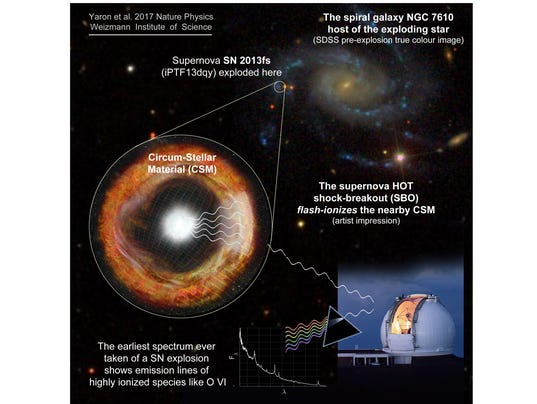
Related image
The artist's sketch above depicts the normal sequence of events for this type of supernova.

What about theories to account for the anomalous behavior of this supernova?  Well, at least one suggests that those stars with masses in the range:

        95 Ms       <     130    Ms

where Ms   denotes "solar mass",  can explode several times in succession. (Though these types of cyclic star deaths have never been seen before).   The basic idea behind such models is rooted in the basic equations governing stellar structure, e.g.

The binding or total energy of a star ET is:

  ET  = K + V  = GM2/ 2R  + (- GM2/ R) = - GM2/ 2R

where G is the Newtonian gravitational constant, M is the stellar mass and R is the radius. V is the potential energy and K the gas kinetic energy.

But:  W=  - GM2/ 2R    so: K =   -W/ 2 

And:    ET  =  W/ 2 = -K   (or K  =   -  W/ 2)  

Thus, the total energy of a star is negative and equal to half the gravitational potential energy or the negative of the gas kinetic energy.

Now, internal energy U also factors in:

U = P/ (g   - 1) r 

where  r   is the density of the stellar material, P the pressure and   g  the ratio of specific heats.  Further, we can write:

3 ò (P/r) dm = 3 ò U (5/3   - 1) dm = 2 K =   2 ( -  W/ 2 )   =   -  W


 Basically then, in the case of a potentially collapsing stellar mass,  we need the internal energy U to be large enough to counterbalance the negative of gravitational potential energy:  - W=  GM2/ 2R .   We suspect the internal energy arises from a heating effect whereby gamma rays are converted into electrons and their antimatter counterpart, positrons, e.g.

g     ->   e-  +    e+


Without sufficient internal energy the core collapses and gets hotter. This vastly additional heat would then trigger a partial explosion in which the star blows off a large amount of gas.  But....after the explosion - lo and behold - the electrons and positrons recombine into gamma rays, e.g.

e-  +    e+    - >   g 

This also generates internal energy and helps to prevent the remaining stellar core from collapse.  This cycling reaction, we believe, enables the star to blow off mass several times before finally ending in a supernova flash.   Ultimately, given the initial mass (see the mass range provided earlier for iPTF14hls)  the remnant core from such a supernova would collapse to a black hole of mass   40  Ms.


The problem with the above theory, neat as it appears, is that it also predicts the star will expend all its hydrogen in the first explosion.  That doesn't comport with iPTF14hls which expelled an equivalent hydrogen mass of   50  Ms   in  2014.  (The amount of energy released in the most recent explosion is also greater than it should be).

Even more mysterious?  Palomar Observatory photographic plates show yet another birght burst from the same part of the sky in 1954.  This indicates a star that's exploded multiple times over a more than 50 year period.  

 "Zombie" star? Maybe this is one that merits the name.. Strange? You bet.

Wednesday, February 14, 2018

Selected Questions -Answers From All Experts Astronomy Forum (Gravity Wells)

Image result

Question -

I actually have two questions, I know that the answers may be highly
theoretical because of limited knowledge we have of black holes, but any
answer - even theory - is welcome.

1. If a photon has no mass, how come light is drawn into a black hole?

2. What method of propulsion do black holes use the move themselves
through space? How is their movement in a vacuum achieved?

Thanks for your time mate


Answer -

You are quite correct in assuming that the answers are 'highly
theoretical', and I don't see how these can be made much simpler than
provided below.

First, a physical definition. For a term we call "inertia". This is any
resistance to change in position or motion.

You can think of it as a kind of "foundational" mass. It is the most
basic, fundamental concept we have by which "mass" can be recognized.

That is, when we perform an experiment and find that 'X' (whatever 'X' is)
exhibits a resistance to change its position or motion.

Keeping that thought in mind, we come to the photon. We already know that
light carries energy, usually expressed in a simple form as:

E = hf

where h is the Planck constant, and f is the frequency of the light.

But what many general readers do not know is that light also carries
momentum. For example, whenever light is emitted from some source there is
a tiny but definite "recoil" effect. (Something like you experience from
the stock of a rifle, if you've ever fired on a rifle range).

This recoil betrays the presence of what we call "momentum" to do with the
photon.

This is given by the product of one over its speed (1/c) times the energy,
E. Writing the momentum as p:

p = E x (1/c)  = E/c


We already have a good hint that photons have mass-inertia associated
with them from Einstein's equation:

E =  m c 2     (E = mass x speed of light squared).

Therefore, the mass is:

m =  E /   c 2 (Energy divided by speed squared).

This equation (above) can be combined with the earlier one we obtained
 (E   = p c) to give:

m = p / c

Thus, the "mass" associated with a photon is its momentum divided by its
speed, c.

Other experiments validate this, including one in which a (true) radiometer is
bombarded with light, and turns it vanes - spins them around. This is a
result of the pressure of light exerted on the vane surfaces. (You perhaps
have seen this device in action, though most of them are really toys that
operate on a different principle from the real ones).

Basically, light cannot possibly exert any "pressure" unless it also
carries mass, or inertia.

Having said all this, it is important to recognize that in all these cases
I've noted we are looking at photons MOVING!

Once they cease to move, they no longer exhibit mass.

Thus, what you are really thinking of when you say "if a photon has no
mass", is REST MASS. The mass it exhibits when at rest.

And, of course, this is zero.

Hopefully, you can see from the above, that there is no contradiction. The
light that is prevented from escaping from black holes or drawn into them,
is moving - NOT at rest. Hence, it exhibits all the properties of mass or
inertia.


Regarding your second question, black holes like the stars they collapsed
from occupy specific regions of space-time. Hence, they are not
"propelled" like rockets or anything.

Rather, as part of a dynamical system (say the galaxy) they will move in
accord with the Newton's law of gravitation - given their distance from
the mass center of the galaxy, and the nature and masses of nearby bodies.

Since space itself is a vacuum, this motion is no more mysterious than the
planets of our Solar System moving "through a vacuum". Vacua provide no
impediment to motion, and indeed, every body in the cosmos will move under
the influence of the gravitational forces at work in its neighborhood.

The bottom line is that the presence of gravity means that NO body in the
universe can remain "still" or "motionless".

Saturday, January 14, 2017

Parsing The Fine Points oF Ultraluminous X-Ray Sources

Image may contain: night
Depiction of NASA's NuSTAR Orbiter with which the latest ULX was discovered.

Consider an x-ray source of 10 Ms (ten solar masses), or three times the theoretical maximum for a neutron star mass. Can we not say that the former object is more likely to be an ultraluminous x-ray source (ULX) than the latter? Let's back track and see why this became an issue, and a question.

As I've noted in previous posts over the years, we do not detect black holes directly but indirectly, Thus, in the case of macro-scale black holes (as opposed to quantum scale Hawking mini- black holes), we observe them indirectly as a members of binary (double) star systems, in order to infer their presence. In this situation  x-rays are given off  from the companion star’s infalling material - from its gaseous layers As the extraneous matter is severely compressed by the black hole's gravity, it gives off the characteristic x-rays.

A new insight arose when it was realized that these x-rays can exert outward radiation pressure on the infalling material. Then - at some critical value  (the "Eddington limit") the radiation pressure and gravitational pressures balance.  Thereby the further infall- because it must disturb this balance,   ramps up the luminosity of the object.

In the 1980s, astrophysicists discovered point like x-ray sources with luminosities that exceeded the Eddington limit for neutron stars by at least an order of magnitude. These were dubbed ultraluminous x-ray sources and were presumed to harbor massive (e.g. 10 Ms ) black holes, as opposed to neutron stars.  But this assumption had to be rejected by 2014 when the first neutron star ULX was discovered.

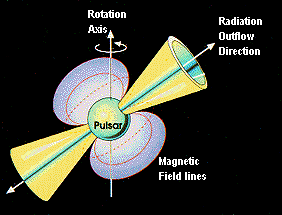
A fluke? No, given a second ULX has been discovered which displays a coherently pulse x-ray emission, in other words which could only originate from a neutron star. (Which is why they are also referred to as "pulsars" because of the very rapid radio and x-ray emission signal).  The pulsations, also, from an astrophysical perspective, require separation between the rotation axis and magnetic poles, i..e. an actual surface which black holes lack.

In the case of the new ULX, designated NGC 7793P13 or "P13", 0. 42s pulsations have been found by Felix Furst of Caltech and his colleagues, and published in The Astrophysical Journal (831, L14, 2016). The full paper can be found here:

http://authors.library.caltech.edu/71748/1/F%C3%BCrst_2016_ApJL_831_L14.pdf


To be sure, accounting for a neutron star's super Eddington limit luminosity is not necessarily a major impediment. So, if a neutron star's magnetic field is strong enough the infalling material can be funneled to its magnetic poles while the radiation escapes sideways, e.g. Image result for image of neutron star with radiation escaping sideways

However, in P13's case the field strength implied by the luminosity is so high that the magnetic funnel must be extremely narrow. Such a geometry would yield sharply peaked ('burst') pulses but as it turns out P13's pulses are sinusoidal.

So despite the author's attempts, one must acknowledge that the exact manner by which the two neutron ULX sources evade the Eddington limit must remain a mystery.

Saturday, October 8, 2016

Black Holes - Where There Is No Space

Image result for brane space, black holes


It seems incomprehensible, and more than a few people are unable to get their heads around it, but there are astronomical objects where space does not exist. Let me rephrase that by saying the space is not that which is conformal space-time that can support the laws of physics. Since the space  literally occupies a one-dimensional point at the hole's singularity, and an infinitely small point is occupied by a collapsed, stellar scale mass, then the laws of physics (which incorporate causality) do not apply.

The threshold for making this cut is given by the well known Schwarzschild radius or:

R(s) = 2GM/c2

where G is the Newtonian gravitational constant, c is the speed of light in vacuo, and M is the gravitating mass. Once a stellar remnant collapses within this radius, light cannot escape and the object is no longer visible, hence effectively "air tight" to use the words of the article. It is a characteristic radius associated with every mass of macroscopic scale

Such is the case with the stellar- collapsed black hole., but we need to explore the specific conditions for the zero space singularity in more detail. It depends really on a spherically symmetric solution    (Kurt Schwarzschild's  solution)  of Einstein's general relativity field equations, viz.

ds2 = -(1- 2M/r)dt2    + dr2 / (1 - 2M/r)  + r2  (dq2 + sin2  q dφ2 )   

Where r, q,  φ  are spherical coordinates, for this conventional Schwarzschild metric..

As noted by Ciufolini and Wheeler ('Gravitation and Inertia', Princeton University Press, p. 69), for the above defined Schwarzschild metric the r = 2M region is a "mere coordinate singularity".  However, they note that the r = 0 region (where g00   = - g11  referring to the Einstein field potentials). is "a true geometrical singularity". In other words, expressing a region of no causality-based space time that we recognize. Of course, there are many different solutions, among which we find those well -behaved. The authors point out a specific example on p. 67 where "it is possible to extend analytically the Schwarzschild  solution to cover the whole Schwarzschild  geometry."

To fix ideas, reference is then made to a diagram on p. 66 showing an "Einstein -Rosen Bridge" or "wormhole connecting two regions in one Euclidean space."   It is emphasized that the sequence of diagrams (Fig. 2,9a, 2.9b, 2.9 c) denote "alternative interpretations of the three-dimensional maximally extended metric of Kruskal at time t' = 0"  For those interested, this referenced metric is given as (p. 67):

ds2 =   (32 M3  / r) [exp (-r/ 2M)] (- dt'2  + dx'2  )  + r2  (t', x') (dq2 +  sin2  q dφ2 )

This is after transformation of the original Schwarzschild metric using the Kruskal -Szekeres coordinates given at the top of page 67.

The point is that a suitable mathematical approach can be used where one avoids a "spaceless" (e.g. true singularity) outcome, and instead engenders one with a space-time "escape hatch" - the Einstein-Rosen Bridge.

Obviously, in this post, many details are being left out including for the wide array of divergent black hole conditions (e.g. for angular momentum, rotation - rotating or not) and geometry, e.g. for Kerr black holes, see e.g.

http://www.daviddarling.info/encyclopedia/K/Kerr_black_hole.html

I only touch the bare surface here to encourage readers to investigate many more aspects on their own.

Granted, no one has ever seen a black hole but we know how to recognize the physical evidence for its existence: very powerful and periodic bursts of x-rays, registered on sensitive satellite detectors. Mathematically, the very brief periods of less than a millisecond betray an extremely compact volume. The x-rays indicate accretion to a large mass. Together, these can be matched to predictions given in the Einstein general relativity equations and Voila! the black hole emerges as an object consistent with the observations.

In general black hole identification is predicated upon observing its effects as a member of a binary (double) star system. Thereby, the black hole presence is inferred from x-rays given off when the companion star’s gaseous layers are sucked into it. As those accreting gaseous layers are pulled through the hole's event horizon, they are condensed and the impacting plasma leads to intense heating and x-rays.

The most convincing recent find which puts the question of black holes existence to rest once and for all has been via the Laser Interferometer Gravitational Wave Observatory (LIGO). e.g.

https://journals.aps.org/prl/abstract/10.1103/PhysRevLett.116.061102


The recent LIGO detection provides the first direct evidence for gravitational waves but also opens the door to using them to study the powerful cosmic events that create them, in this case two colliding black holes. Based on the paper cited in the above link, the two black holes are  each roughly 30 times the mass of the Sun. They evidently merged some 1.3 billion light years from Earth. The  gravitational waves themselves were generated in the final moments before the black holes merged. The signal was brief but definitive and we on Earth have now received it.

It is in fact the most direct observation for black holes ever made.

Meanwhile, the total current assay of black holes may be dramatically underestimated. This is a result of difficulty of detection, as is the case with all forms of dark matter. Despite that, the research thrust goes on, along with black hole identifications in a variety of formats and scenarios.

Those who want to investigate more, can consult any or all of this sampling of research papers, from The Astrophysical Journal, on the American Astronomical Society website:

1) On the Correlations of Massive Black Holes with Their Host Galaxies

http://iopscience.iop.org/0004-637X/637/1/96/fulltext

2) The Jet Power, Radio Loudness, and Black Hole Mass in Radio-loud Active Galactic Nucleihttp://iopscience.iop.org/0004-637X/637/2/669/fulltext

3) Binary Mergers and Growth of Black Holes in Dense Star Clusters
http://iopscience.iop.org/0004-637X/637/2/937/fulltext

4) Black Hole Advective Accretion Disks with Optical Depth Transition

http://iopscience.iop.org/0004-637X/637/2/968/fulltext

5) Black Hole Masses and Eddington Ratios at 0.3 less than z less than 4http://iopscience.iop.org/0004-637X/648/1/128/fulltext

Dozens and dozens of other papers are also available, which show in concert that the black hole is no mere macguffin created by some math genius fantasizing in his parents' basement, but a valid object of inquiry worthy of serious scientific investigation.

Friday, February 12, 2016

Detection Of Gravitational Waves From Colliding Black Holes Vindicates Existence For Both


Depiction of the gravitational disturbance from two colliding black holes dispersing gravitational waves

In 1915, in a remarkable achievement of theoretical physics, Albert Einstein used an abstruse form of math known as tensor calculus to show how gravity arises when mass and energy warp space time. The ground breaking Einstein field equations can be summarized in the tensor form:

G mn   =  - ½ g mn  G=  - 8 p T mn   

Where the  T mn    denotes the associated  “stress-energy” tensor which incorporates internal stresses, the density of matter and its component velocities (u, v, w or in some texts: u1, u2 and u3).   From this one can see that if no matter is present, one would have:  G mn   =  0

If matter is present there must then be internal stresses and velocities so that:  G mn   =  K mn  where  (as seen from the field equations):  K mn   = - 8 p T mn   
 
We have then for the  T mn  : analogous to the g’s in standard form


T 11      T 12      T 13        T 14
             T 22     T 23         T
24                         

                         T 33         T 34
                                         T 44


=


p 11  + r u2, p 12 + uv,    p 13    +r uw,  - ru    


                    p 22  +
r v2,   p  23  +r vw,    - rv   


                                             p 33 +
r w2 ,      - rw 
      
                                                                            
r
 
Which again is still vastly oversimplified. A year later, based on these equations Einstein predicted that massive objects undergoing the right kind of oscillating disturbance should actually emit ripples in space time: gravitational waves that propagate at light speed. Of course, this prediction remained controversial for decades because the mathematics of general relativity  - a tiny bit of which is presented above - is so complicated. Besides, many theoretical physicists noted that even if the waves did exist, detecting them would test the very limits of our technological capability. This is given that most predictions included estimates for their wavelength as low as  10 -14 m. To fix ideas this is about the diameter of an atomic nucleus and is only an order of magnitude larger than the fermi (fm). (The LIGO design is such that it is capable of detecting a gravitational wave with a wavelength 1000 times less than the diameter of a proton.)
 
One of the earliest pioneers in gravitational wave detection was Joseph Weber of the University of Maryland. In 1969 Weber even claimed to have discovered them. He used a detector consisting of two massive aluminum cylinders 1.5 m long and 0.6 m wide, one of which was in Illinois, the other in College Park, Maryland.   Weber's contention was that a gravitational wave would stretch a bar and cause it to vibrate like a tuning fork and electrical sensors could then detect the stretching.
 
Weber's problem was that other physicists were unable to reproduce his published results, leading some - like IBM physicist Richard Garwin-  to argue that the universe would have had to have converted all its energy to gravitational radiation in 50 million years for Weber's claim to be valid.
 
While Weber's efforts were stillborn, he is still regarded as the father of gravitational wave detection and his research triggered the development of the LIGO (Laser Interferometer Gravitational Wave Observatory). Now, we have learned that an international team using LIGO has detected a slight stretching and squeezing of space-time from one of the most violent events in astrophysics: two colliding black holes.
 
LIGO’s discovery, accepted for publication in Physical Review Letters,  see abstract e.g.
https://journals.aps.org/prl/abstract/10.1103/PhysRevLett.116.061102

not only provides the first direct evidence for gravitational waves but also opens the door to using them to study the powerful cosmic events that create them.
 
Unlike Weber's aluminum drum detectors, LIGO features 2 L-shaped detectors (one in Hanford, WA, the other in Livingston, LA)  made up of two perpendicular arms totaling 2.5 miles long. Then a laser beam is split and travels along both arms, bouncing off respective mirrors to return to the L-intersection. Normally, the beams are aligned so they balance each other out and hence there's nothing to detect. But if a gravitational wave is intercepted it creates a tiny mismatch which is what LIGO detects. (One of the authors of the paper has referred to it as a "chirp".  The effect of this chirp or ripple changes the arms' lengths by a tiny amount, and that change can be detected by lasers.
 
Based on the paper cited in the above link, the two black holes are each roughly 30 times the mass of the Sun. They evidently merged some 1.3 billion light years from Earth. The  gravitational waves themselves were generated in the final moments before the black holes merged. The signal was brief but definitive and we on Earth have now received it.

The measurements are dramatic proof that gravitational waves do exist. The signal in the detector matches well with what's predicted by Einstein's original theory, according to Saul Teukolsky, of Cornell University, who was briefed on the results. It matches predictions of the ripples produced by two large black holes, in the final moments before they merge, swirling together at an enormous speed.

Another gratifying aspect is that this find puts the question of black holes existence to rest once and for all. It is in fact the most direct observation of black holes ever made. We acknowledge that black holes can't be seen with ordinary telescopes, so their existence has been inferred by the x-rays detected from binary systems.  Mathematically, the very brief periods of less than a millisecond betray an extremely compact volume. The x-rays indicate accretion to a large mass. Together, these can be matched to predictions given in the Einstein general relativity equations and Voila! the black hole emerges as an object consistent with the observations.


Unlike the x-rays signals from binary systems (stellar envelope mass accreting onto the hole's event horizon to generate them) the newly detected  gravitational signal comes directly from the holes, and it is virtually incontrovertible proof that the holes are out there.

As Teukolsky avers:

"If black holes didn't really exist, you couldn't explain these waves,"

We will now await other confirmations of this find, but certainly from the Physical Review Letters paper it looked very much like 'case closed'.

Tuesday, September 30, 2014

Einstein 'Stole' Relativity From Others? Irredeemable Codswallop!


Every so often a question comes out of 'left field' and appears  at ‘All Experts’ (Astrophysics forum) that confounds  and also piques curiosity. In this most recent case the person wrote:

"Up till now I have read that Einstein definitely stole much of his work from others, simply plagiarising them. What interests me now is that a current scientist is claiming , re a recent study,


 that Einstein was wrong and that black holes cannot exist.

Is this correct, that, with no black holes in the Universe, Einstein has a gaping flaw in his theories?"

There are two literal howlers that emerge in the question, and it's well to  consider each in turn:

1)     The belief that Einstein somehow plagiarized all the previous work of others, in particular Lorentz and Poincare, and

2)     The belief  that Einstein was responsible for the black hole concept. (A subsidiary howler is that black holes "cannot exist" which I will consider in conjunction with the claim Einstein was the creator of the black hole concept)

Let’s take (2) first, which is the more straightforward to deal with. As I pointed out in my response:

First of all, Einstein never claimed that black holes existed. What Einstein actually showed was a kind of precursor to the idea in one of his papers (‘On the Influence of Gravitation on the Propagation of Light’). Therein he described  how light could bend in a gravitational field. He found this angle of deflection of starlight - say from a distant star passing near the Sun during a total eclipse, was:

a   = 2k M/ c2 R

In truth, though Einstein provided a quantitative method to estimate gravitational bending of light, he himself never believed a celestial body could collapse in on itself such that its own light rays would never escape.

That didn't emerge until Karl Schwarzschild showed the Einstein field equations could be used to show such collapse. A simplified threshold for making this cut is given by the well known Schwarzschild radius or:

R(s) = 2GM/c
2

where G is the Newtonian gravitational constant, c is the speed of light in vacuo, and M is the gravitating mass. Once a stellar remnant collapses within this radius, light cannot escape and the object is no longer visible.  R(s) then is a characteristic radius associated with every mass of macroscopic scale.   It is this that (technically) gave rise to the black hole concept.

(Incidentally, the term "black hole" never existed until 1964 when it appeared in a science article written by journalist Ann Ewing.)

I added:

This is another thing, IF black holes were fictitious objects then a heck of a lot of astrophysicists are wasting their time on them in their research. What good reason would there be to do so? And more importantly, why would esteemed journals like the Astrophysical Journal publish such fictitious, "fantasy" work? It makes no sense so the onus is on those who claim they don't exist to explain and explain in full!

Some recent titles of papers on black holes appearing in recent issues of the Ap. J.:


'Illuminating Massive Black Holes with White Dwarfs: Orbital Dynamics and High-energy Transients from Tidal Interactions'


'Single-epoch Black Hole Mass Estimators for Broad-line Active Galactic Nuclei: Recalibrating Hβ with a New Approach'

'Roche-lobe Overflow Systems Powered by Black Holes in Young Star Clusters: The Importance of Dynamical Exchanges'

All of these appeared in Ap. J.,  Vol. 794,  No. 1, Oct. 10. 2014

E.g.

http://iopscience.iop.org/0004-637X/794/1

Again, and not being facetious, if black holes don't exist why all the papers on them?

 The point emphasized is that if black holes genuinely were an impossible fiction, they’d never be granted the space they have in a peer-reviewed journal like the Ap. J.

 
Then there is the nonsense about Einstein "plagiarizing" earlier work. As I pointed out:

As for the claim that "Einstein definitely stole much of his work from others, simply plagiarising them" - all I can say is: ‘Bollocks’! What evidence is there for this? WHO made the claim and where? In what peer-reviewed paper or source? If it is just sappy opinion blabbed in some rag of a newspaper the claim isn't worth anything. There has to be substance to it. This again reinforces the cautionary note that what must be careful about what one reads and always do very careful cross-checking. Don't believe the first thing you see even if it might resonate at some level.

Also, if Einstein did plagiarize previous work, how come no other serious physicists have come to this conclusion?

Look, the world is full of iconoclasts all trying to make a name for themselves (like that astronomer who claimed to 'prove black holes don't exist' cited in the Daily Mail) and some do - for a time. But it never lasts, because ultimately it is usually found they were too quick on the draw and overlooked key facts - as you did in merely putting this question forward- presuming that Einstein himself had anything to do with black holes.


 The questioner clearly couldn’t accept this response and wrote in a further comment after giving his ratings:

"Look up "Relativity priority dispute" on wikipedia to see that it isn't just fringe people who have evidence that Einstein ripped off other scientists' ideas. Roger Schlafly now has a book out "How Einstein ruined physics", which goes into detail on this issue.”

 
Relativity priority dispute? Who would have ever thought? I'd never before heard of such a thing, since in all the monographs and peer-reviewed papers I've read - such as in Physical Review D- all the papers citing Einstein or his work never ONCE referred to "plagiarism" or not giving enough credit to predecessors. So where did this odious meme or claim come from? What nest of vipers hatched it and spread it in assorted books and all over the net?

 As I responded to the questioner:

I did look up the so called "relativity priority issue" and the consensus appears to be Einstein was still original in his particular development. Yes, Poincare, Lorentz et al had seminal ideas predating the special theory but it was still left to Einstein to put them together and it was Einstein who first applied the tensor calculus to put them in that setting - paving the way for general relativity. Alas, much of the "plagiarism" nonsense originated as Nazi propaganda. See also:


As noted therein:

"Since Einstein was Jewish, the Nazis had to argue that he was no scientific genius, but rather a typical Jew of limited abilities. This 1939 article comes from the Mitteilungen über die Judenfrage, a newsletter published by the Institut zum Studium der Judenfrage, the most prestigious of the Nazi research institutes on the “Jewish Question.”
 
It is typical of much Nazi propaganda directed against Einstein. It makes, among other things, the interesting claims that there is nothing new about the Theory of Relativity, and even if there were, Einstein plagiarized it."

The Nazis just couldn't stomach that a Jew could develop ground breaking theories of physics, because - of course - they held Jews in such contempt and even consigned them to a "final solution".

The other fact above all, cited by more than one source, is that if Einstein had indeed plagiarized previous work he'd never have been published in journals like 'Zeitschrift fur Physik'. The nonsense that the referees were too dumb to learn of it because Einstein provided few references is just plain balderdash.

 
Then there is the guy he cites, Roger Schlafly. At first the name didn't ring a bell but then the surname jibed and I instantly related it to an extremist right winger, Phyllis Schlafly, who's  always been dedicated to an American nativist imperium and dominion. Then Roger had to be related to her in some way and it turns out he's her son. That the 'apple' never falls far from the tree was evident from this Rational Wiki synopsis of this character:


"Roger Schlafly writes two blogs. At Dark Buzz, a science-focused blog, he conveys "ideas and information that are essential to understanding our world...ignored by the mainstream media".[ There, he engages in quite a bit of Einstein-bashing and frequently labels him a plagiarist and fraud. He frequently writes about Henri Poincare, a French physicist who he believes is a victim of under-appreciation because of Einstein, despite that everyone seems to know the name

 He writes from (as you'd expect) the perspective of a right-wing, white male heterosexual American Christian with libertarian leanings, and has cited the white nationalist website VDARE”

Like Larry Schweikart with his false liberal history nonsense, Schlafly turns out to be another putz who wants to turn scientific iconoclast. But why would anyone take the scribblings of  a white nationalist sympathizer and the son of Phyllis Schlafly seriously? Besides, his specialty isn’t even physics but electrical engineering and math. While true, physics is  needed in electrical engineering and math is used in physics, neither Schlafly specialty is as concentrated as one expects in graduate specialist  Physics courses.   Fair question: Could he pass a  Ph.D. comprehensive exam in mechanics, thermodynamics, general relativity or quantum mechanics? I seriously doubt it. (I will post one of these soon, to see if he can.)

 I mean, as  one of the (negative) reviewers of Schlafly’s book also noted (correctly):

"Lorentz himself said in 1927:

'Only the true time existed for me. I regarded the transformation of time merely as a heuristic working hypothesis. Thus, the theory of relativity is, in fact, exclusively Einstein's product.' "

So if even  Hendrik Lorentz acknowledged Einstein’s priority in special relativity – why not Roger Schlafly or the person who asked the Einstein question at All Experts? Well, not Schlafly because as a white nationalist sympathizer  it would not be his wont to be fair to a Jew – who white nationalists and earlier Reich propagandizers  never regarded as equal to "Aryans". Hence who'd try to diminish Einstein’s accomplishments.  As for the naïve questioner, well, all I can say is that he was misled by Schlafly’s apparent academic creds into buying into this hogswill and that he really had a case – he didn’t.

Others who may dispute this - for whatever reason, even if they genuinely question Einstein's honesty - are invited to look up and read his most seminal paper on special relativity: 'Does the Inertia of a Body Depend On Its Energy Content?' (Annalen Der Physik, Vol. 17, 1905). Therein the doubters will see first hand how Einstein ingeniously used the Lorentzian  radical :

[1 - (v/c)2)]1/2


Einstein deftly uses this to arrive at his most famous equation:  


  E  = Mc2   

To quote the reviewer again:

“In summary, if nothing of what we think Einstein did was actually his original work, how in the world can we say that Einstein ruined physics? Assuming that Physics is ruined, and assuming Dr. Schlafly's thesis is correct regarding Einstein's dishonesty, I would rationally tend to blame those who `really' developed Modern Physics, those of us who were so naïve as to allow ourselves to be deceived by Einstein for over 100 years, or both.... But not Einstein, whose only crime was -apparently- to be a thief!!!”


Points well taken!


And further advice to those who jump on claims that seek to take down a genuine genius of physics: Look at the source! Find out all you can about him or her before jumping the gun and conferring validity on his assertions!