Showing posts with label collisionless shocks. Show all posts

Tuesday, March 22, 2016

Coronal Mass Ejections and Collisionless Shocks (2) - With Problems

In the previous instalment I noted that the dissipation associated with collisionless plasma can be attributed to Landau damping and this may be the most common form to excite a shock associated with CMEs. But even more germane is the two stream instability which can be thought of as the inverse of Landau damping, where a greater number of particles that move slower than the wave phase velocity vph (as compared with those that move faster), leads to an energy transfer from the wave to the particles.  In the case of the two stream instability, when an electron stream is injected to the plasma, the particle's velocity distribution function has a "bump" on its tail:
No photo description available.

In the region where the slope is positive (f(v)  / v > 0) there is a greaterI number of faster than slower particles so a greater amount of energy is transferred from particles to associated (e.g. Alfven) waves.  Since f eb contains more fast than slow particles a wave is excited, and there is inverse Landau damping such that plasma oscillations with vph in the positive gradient region are unstable. We expect  vph  to occur where the gradient:(f(v)/ v) êwr/ k  = maximum. Instability can result provided: 


we  2   >   k2v2  or  êkv ê  <   we  .


Resonant electrons (at vph  »  we/ k)   are the first to be affected by the local wave-particle interactions and have distributions altered by the wave electric field, E1, such that the total energy balance:


S Etot = ½ E1 w + E1 k    =  ½[ ½ eo | E1|2]  +  ½ r | |2         


For which the wave energy (E1 w) is balanced against the kinetic (particle) energy (E1 k ). Thus, for S Etot = const. then as decreases, ½ eo | E1 |2]   increases. In Landau damping the exact opposite occurs, so as the decrement associated with f(v)/ v decreases, the wave amplitude (and  E1 w) decreases, particle kinetic energy increases- i.e. energy is fed to the particles at expense of waves.


For reference, the longest known radio signatures for coronal shocks are the Type II radio bursts. These are narrow band (Dn/n ~ 0.1)  ) radio emissions excited at the local plasma frequency for which the drift rate :


dn/dt ~ ( - 0.2 MHz/s)

Where the negative sign indicates a drift toward lower frequencies. This is as the shock propagates outwards through the corona. Derived measurements disclose a radial velocity on the order of 1000 km/s. In 60 per cent of cases there is a clear harmonic structure with a frequency of occurrence of once every 100 hours. The Type II bursts are accompanied by weak polarization. The original excitation is usually by a fast mode MHD shock though the mechanisms previously considered, i.e. via Landau damping and two stream instability, must also be considered.

If we know the ambient free electron density associated with the event, it is possible to estimate the pure plasma  frequency (n)  using:

1)      n   =   9000  Ö N    or    2) n   =   9  Ö N   


In the above (1) is used to get MHz if the units for N are in c.g.s. units, and (2) for S.I. units. Bear in mind:we   =   2p n.

It is also useful to note that radio waves cannot propagate through a medium in which the plasma frequency  is greater than the radio frequency.


Problems:

1)For a hydrogen plasma, a lab generated shock of Mach number M= 80  with the temperature at T =   10 5    K is found to have an ion gyroradius of 0.22 cm.  If    e  =  1.9 x 10 7  /s  what would be the magnitude of the associated magnetic field (B)?

2)Find the associated plasma frequency and use it to obtain the Debye length and plasma parameter if n is a value typical of the solar corona  (10 16 /m3). Find also the frequency n of the associated radio emission.


3)If the shock speed is u =  10 7  cm/ sec, estimate the wave number k w.  

4)Hence, or otherwise, use the equation below to obtain the ion velocity  v o   if the  frequency w  = 10 10 / s
No photo description available.
(Note: m is the electron mass, and M =  mi, the ion mass.)


5)Based on all the above information, estimate the maximum magnetic field B m using the shock equation.


6) The frequency of a critical layer as a function of electron density is given by:

n   =  e/2p  Ö( N/ εo m e )

Show that this can be reduced to the simplified form:
n   =   9  Ö N
(Hint: εo  =  8.85 x  10 -12  farad m-1 )

Monday, March 21, 2016

Coronal Mass Ejections and Collisionless Shocks (1)


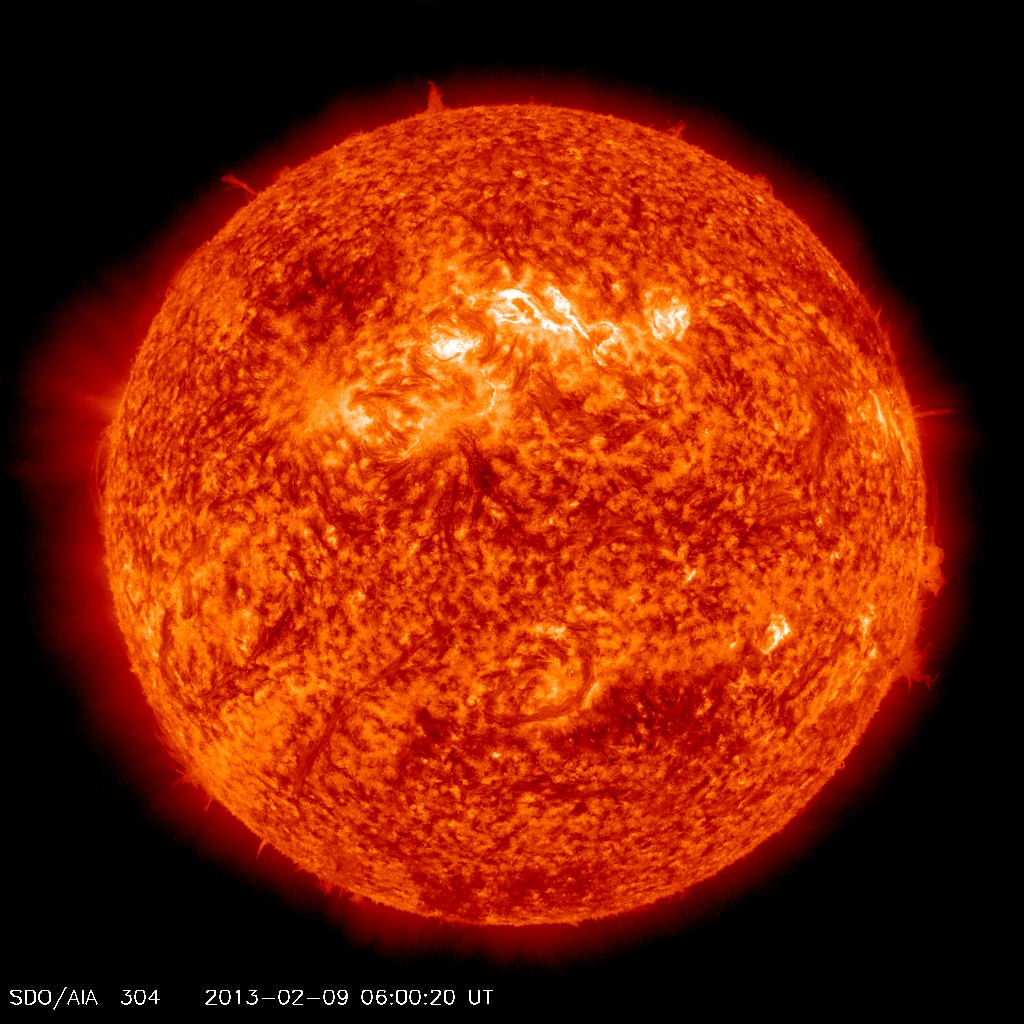
The CME captured by the Solar Dynamics and Heliospheric Observatory in February, 2013.

Coronal mass ejections are powerful, energetic events on the Sun which can also have serious repercussions for terrestrial life, see e.g.

http://brane-space.blogspot.com/2012/06/cme-that-you-dont-want-to-see.html

How do coronal mass ejections occur? This is believed to happen via a sudden, mass transient ejection probably via a high Mach number shock wave. It has also been found that collisionless shocks form ahead of CMEs when the latter’s velocity exceeds the Alfven velocity of the ambient plasma in the corona. Recall this Alfven velocity is given by:


VA     =  Ö (Bo / mo   r o)


To fix ideas, let us recall the corona is a collisionless plasma . (Recall in the limit 1/N << 1 and 1/N ® 0  we say a plasma is “collisionless” where:N  =   4p n o  l3 D  / 3   and n o  is the number density with   lthe Debye length.   (See example problems from Jan, 23rd). Let a coronal plasma have number density n = 10 16 /m3)  and a kinetic temperature T =10 6 K.  The plasma parameter is defined:


L  =  n o  l3 D

Where the Debye length

lD,s =[kT s εo / 4p  Z s2 n s  e2 ] ½

Here:  Z s   = 1 so that:

l D,s   =

[(1.38 x 10⁻²³  (10 6 K) (8.85 x 10 -12 F/m)  / (4p)  (10 16/m3)  e2 ] ½

l D,s   =  1.9 x 10 - 4   m

L  =  7.3 x 10 4   

And N  =   4p n o  l3 D  / 3 

N =  (4p)(7.3 x 10 4   ) / 3  »   3.1 x 10 5   

Therefore:   1/N   =   1/ (3.1 x 10 5 )
 

1/N = 3.2 x 10 - 6   


 1/N ® 0  , hence the  plasma is “collisionless” so that this meets the condition.

Then we may use the collisionless Vlasov-Boltzmann equation for a plasma description, e.g.:


v f x/ x  - q(s)/m(s) [ j/ x  · f s/ v]  = 0

where (f s) is any function of the constant of the motion.

This, along with its collisional form, has been called “the most important equation in plasma physics”.[1] The associated Poisson equation is:

Ñ E = 4p e (ò fe d3 V - òf i d3V) = 0


where the e, i –subscripts denote electrons and ions, respectively and f refers to the appropriate distribution for each.

In the classical theory of shock waves in collisionless plasmas, one would not expect dispersion to be a sufficient condition to incite a shock.  (A dispersion relation implies that a relationship exists between the plasma frequency w and the wave number k. )  What it can do is form a large amplitude fixed wave called a “soliton”. (‘Steepening’ + dispersion yields solitons, while steepening + dissipation yields shocks). These soliton solutions ensure no turbulence (due to shocks), thereby meeting the collisionless condition. To estimate M we use (e.g. Sakai and Ohsawa, 1987)[2]:

B m =  (2M – 1) Bo

Or in terms of the ratio of the magnetic fields:


M =  2 [B m  / Bo] + 1

To reach an M= 80 value, say which might conceivably apply for coronal shocks, one would need:
[B m  / Bo]  »  39.5


I.e. the ratio of the maximum magnetic field intensity to the equilibrium value is at least 39.5.

 Compression is also critical to have an effective shock and we have the condition, based on the plasma number density N:

DN/ N   =  DB/ Bo  [1 - DB/ 2 B] - 1

We already saw for the equilibrium collisionless corona:

N »   3.1 x 10 5   

It is instructional here to determine the trigger or break point for the transient, or CME. This should be reached when the massive influx of dissipating particles is so great that:

DN/ N    ® ¥

 
By inspection we see that if DB = 2B :

¥   =   2B/ Bo  [1 – 2B/ 2 B] - 1

 
To achieve this one would most likely need a strong two-stream instability requiring (cgs units):
M > 1 +  [8p N Te / B2 ]  1/3

This elicits the necessary magnitude for B given our values. A typical soliton –like plot will appear:

No photo description available.
The relevant equation for a soliton embodying a dissipative term to evolve into a shock can be written:

(- v o  + c s   + v)  v / x’  -  m 2 v / x2  +  a 3 v / x3

Where the underlined term above is the dissipative term. In a collisionless plasma such as the corona under consideration, the dissipation can be attributed to Landau damping and this may be the most common form to excite a shock associated with CMEs. For all such collisionless shocks the dissipative length scale, L << l mfp   , the mean free path.  

The preceding equation can be derived using an analog to Newton’s 2nd law of motion, viz.
a v” = F(v)  = a d2v/ dt2   =    -dF / dv

Where:   F  =  (c s   -  v o) v 2 / 2   +     v3/ 6

Is the Sagdeev Potential.


(To be continued - with problems)


[1] D.R. Nicholson:1983, Introduction to Plasma Theory,  John Wiley, p. 43

[2]J.-I. Sakai and Y. Ohsawa:1987, Space Sci. Rev., 46, 113.