Showing posts with label McGeorge Bundy. Show all posts

Saturday, September 23, 2017

Why Did Ken Burns Omit NSAMs 263, 273 In His Vietnam War Documentary?

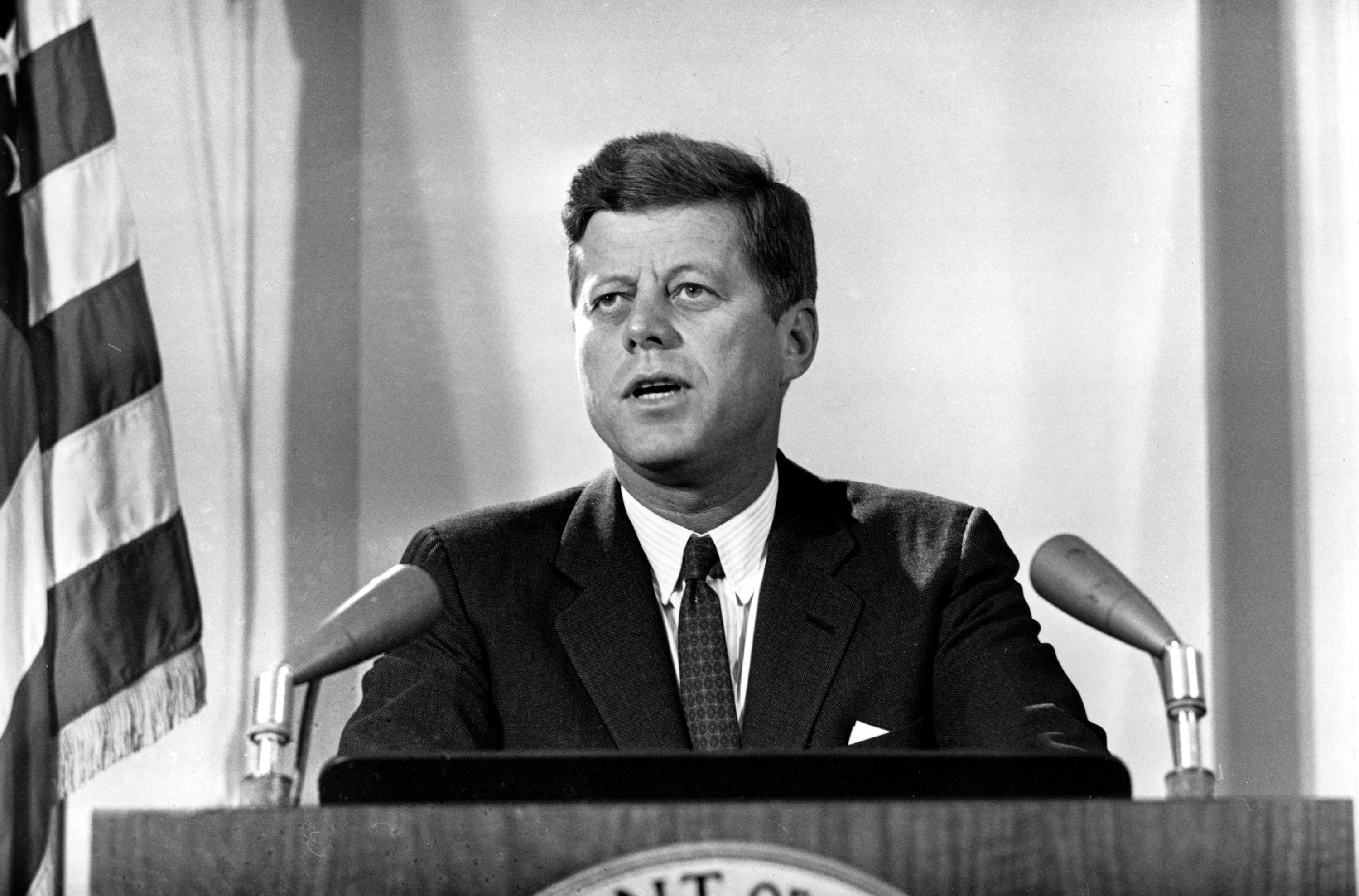
JFK
JFK speaking on the problems in Vietnam in late 1963.


As I finished watching the 2nd and 3rd episodes of Ken Burns' documentary 'The Vietnam War', one - actually TWO - notable historical references were glaring by their absence: 1) any mention of John F. Kennedy's National Security Action Memorandum 263 (at the end of Episode 2', 'Riding the Tiger') and  (2) any mention of  LBJ's NSAM 273 in Episode Three ('The River Styx).  Of course, I had feared such an omission when I wrote my September 16th post, which is why I supplied a lot of the document details and backstory then, including reference to the cover letter by McGeorge Bundy, e.g.

http://www.jfklibrary.org/Asset-Viewer/w6LJoSnW4UehkaH9Ip5IAA.aspx

Usually carelessly cited as NSAM 263 by amateur researchers or "buffs"  and the actual heart of the NSAM  (sections IB(1-3) of the report cited in the letter) appearing in  Document 142 of The Pentagon Papers: ‘Report of McNamara - Taylor Mission to South Vietnam'

So the question becomes: Why - in the course of 10 years preparation -  couldn't Burns, or his assistant Lynn Novick, have found this NSAM which clearly stated Kennedy's intent to withdraw all forces from Vietnam? Why also, could they not find NSAM 273 from Johnson which clearly nullified JFK's NSAM and expanded the war? Again, for more on the origin backstory of LBJ's NSAM -273 check out the information in the link below:


One possible reason for the omission was deliberate, i.e. to avoid contention or controversy. Much of this can be laid at the feet of the late Vince Bugliosi who contended  the evidence was "ambiguous" in his cinder block book, Reclaiming History .  This also reinforced a meme of uncertainty that was pronounced at least until 2013.


Referencing the matter, James K. Galbraith writing in The Nation (Nov. 22, 2013) explained regarding Kennedy's NSAM 263 and intent to pull out:

In 2003, this was controversial. Many historians had denied it. Peter Dale Scott, John Newman, and Arthur Schlesinger were exceptions. They were right, and documents and tapes released under the JFK Records Act proved them right. The issue was resolved by early 2008 when Francis Bator, who had been President Johnson's Deputy National Security Adviser, opened his reply to my letter in the New York Review of Books with these words:
Professor Galbraith is correct [Letters, NYR, December 6, 2007] that “there was a plan to withdraw US forces from Vietnam, beginning with the first thousand by December 1963, and almost all of the rest by the end of 1965…. President Kennedy had approved that plan. It was the actual policy of the United States on the day Kennedy died.
He adds that Bator followed with a qualification  to the effect there existed an agreed upon determination of "essential functions" to be carried out by the South Vietnamese by the end of 1965.   This again may have introduced an element of uncertainty which Burns and Novick preferred not to confront, far less resolve.  But is it valid?

An even more substantive source is cited by long time JFK researcher James Di Eugenio in his book, 'Reclaiming Parkland'.  This would be for historian Frederik Logevall in a book published n 1999 - years before Bugliosi's book and "proving beyond any doubt that from the moment Johnson took office until he was inaugurated in 1965, America was going to war in Vietnam". And true to its basic theme Burns' documentary showed Johnson amping  up  aggression from March, 1965 with the first American ground forces and also using fully initiated  air strikes instead of merely retaliatory ones.

While Burns and Novick's documentary does devote about five minutes to the Tonkin Gulf Incident (and subsequent Resolution) it doesn't connect them to Johnson's NSAM 273. The Tonkin Gulf incident itself started, according to Burns and Novick,  because on July 30, '64 Americans initially guided South Vietnamese gunships to attack N. Vietnamese targets - prompting N. Vietnamese response - then U.S. air attacks. There followed the main incident on August 4th, 1964 when American radio operators  mistranslated North Vietnamese radio traffic and concluded a "new military operation was imminent." 

Actually, Hanoi had merely called upon torpedo boat commanders to be ready for a new raid by the South Vietnamese.  Then the Maddox and fellow destroyer, the Turner Joy,  braced for a fresh attack.  No second attack came, as the Burns' documentary noted,  but "anxious radio operators aboard Maddox and Turner Joy convinced themselves one had".  LBJ then decided the "probable attack" (sic)  should not go unanswered, claiming the non-attack was "open aggression against the United States of America". This led directly to the Tonkin Gulf Resolution passed in the Senate by 88-2, and in the House with total 'Aye' votes.

This still doesn't account for the omission of mention of either NSAM 263 or NSAM 273. But James Di Eugenio's research is crystal clear (p. 164):

"Concerning the differences between NSAM 263 and NSAM 273, first let us dispose of the obvious. Johnson never removed the first thousand troops as Kennedy's NSAM 263 had forecast. Because as is made clear in the book (Newman's 'JFK and Vietnam') ...he wanted to create the illusion there was no breakage in policy, when in fact he was planning for that split within days of taking office. The important difference was that the latter order reversed Kennedy's previous one by allowing for direct American naval involvement in the Tonkin Gulf. This in turn led to the Tonkin Gulf incident in the late summer of 1964. LBJ had been preparing for that since he already had the resolution to attack Vietnam in hand."

In my Sept. 16th post, I described how  Johnson - according to FOIA released documents in John Newman's book- - secretly courted the military to fire up American aggression though Kennedy was steadfastly against it. (Especially after his visit to Saigon in 1951 as Di Eugenio points out and Burns' documentary notes in Episode 1.)   These back channel efforts to curry favor with the military entailed setting up a network to receive actual Vietnam intelligence behind Kennedy’s back – while ensuring the spooks and Pentagon sources delivered only doctored pap to JFK.  The latter always portrayed the situation much better than really obtained.  Di Eugenio then leads to understand how exactly Kennedy's NSAM 263 germinated (p. 164):

"Knowing that the American-backed South Vietnam effort was failing, the Pentagon chose to disguise this with a whitewash of how bad things really were. Therefore, Kennedy was going to hoist the generals on their own petard: If things were going so well, then we were not needed anymore."

Of course, Kennedy would have already distrusted the generals after they tried to force his hand to bomb and invade Cuba during the Cuban Missile crisis. We now know in retrospect - and from Robert McNamara when he visited Cuba in 1992, that would have led to a nuclear war. JFK  knew from then not to trust anything the Joint Chiefs said, and he must have at least suspected Johnson's collusion with them which Frederik Logevall and John Newman had exposed in their own books via thousands of pages of documents released under the JFK Records Act.

Had Burns and Novick integrated this background into their Part 3, the episode would have made much more sense and not seemed so irrational, i.e. S. Vietnamese gunboats  simply attacking North Vietnamese targets out of the blue and the U.S. mounting airstrikes when the North Vietnamese were the victims not the aggressors.  The pattern, in other words, would have been evident and the objective clear.

So why not 'go there'?  Probably a combination of Johnson hagiography, see e.g. 

http://brane-space.blogspot.com/2015/01/hagiographers-masquerading-as.html


And a deliberate choice to avoid controversy. But by this avoidance, or dodge, they ended up with a Part Three that was much less coherent than it needed to be. So they avoided controversy at the expense of coherence.  Undoubtedly,  they didn't wish to portray LBJ in any more negative way than he already would be by vastly expanding the conflict using a pretext (Tonkin Gulf incident).

Had they actually delved deeper, say beyond hagiography in the opening segment of the episode, they'd have acknowledged LBJ was not the charming, "Great Society" creator they portrayed but a no good rapscallion and murderer.   Could Johnson have actually stooped to have anyone killed? The Dallas Morning News story from March 23, 1984  (see image inset) is quite blunt about it. Billie Sol Estes reported that Johnson had Henry Harvey Marshall, a USDA official in charge of the federal cotton allotment detail,  killed because he had attempted to link Estes’ nefarious dealings to the then Vice-President.  While Estes ended up doing prison time, he did have his say before a grand jury (which subpoenaed him) after his release in 1984. As reported in news story, Estes linked Johnson and two others to the slaying of Marshall.  

Image may contain: 3 people

 In the follow-up grand jury investigation, Johnson, his one-time aide Cliff Carter, and ‘Mac’ Wallace were all deemed “co-conspirators in the murder” of Marshall. How is this useful? Because it is prima facie evidence that LBJ could also have cooperated in at least enabling Kennedy's assassination in order to expedite the war for the generals he always wanted (in return for which he'd have the presidency).

Most of us who are researchers in the area of deep politics firmly believe that Vietnam was the “Devil’s deal” LBJ struck with his JFK assassination collaborators (CIA, Generals), in order that he be catapulted into office – while facing  felony charges(barely days before) .  This isn’t “blowing smoke” either. As Steve Kornacki reported in his ‘UP’ journal on MSNBC, the morning of Nov. 23, 2013.   Using tapes and  displayed FOIA and media documents, Kornacki showed that Johnson was about to be exposed as an influence peddler in conjunction with the Bobby Baker scandal by LIFE magazine in its upcoming issue (to be published the week of Nov. 25, 1963.(

A paper trail of bank statements and payments was to have been included, and as Kornacki pointed out a Senate investigation would likely have ensued with LBJ being dumped from Kennedy’s 1964 ticket.  In other words, LBJ had by far the most to gain from JFK’s assassination, since he’d then be next in line as President, and not have to face justice in the Baker scandal.

Burns and Novick? Maybe they were aware of these nefarious connections, maybe not. But the most straightforward reason for omitting anything to do with NSAMS 263 and 273 is that  considering them (seriously!) meant heading into the heart of the Kennedy assassination.  That also meant considering LBJ clearly as a bad actor - not in firing any shots - but in expediting planning, say "helping" with the Big D motorcade route leading right into an area ideal for triangulated crossfire.  Hell, he already had his NSAM 273 prepared before JFK was even shot. Sadly, the two Vietnam War documentarians' omission has meant a more superficial understanding of the origin of the Vietnam War, specifically Johnson's primary role.

No surprise as Di Eugenio notes (p. 165), "in his first meeting on the issue held just forty-eight hours after Kennedy was killed, he made it clear to all his approach to Vietnam was much more militant, much more confrontational than JFK's"

No wondering at this if LBJ was also the one who engineered Henry Marshall's execution, and removed Kennedy to get his Vietnam War.

Too cynical and disingenuous?  Then you need to do much more research on the Kennedy - Johnson document background to the Vietnam War, and into the JFK assassination itself.


Saturday, September 16, 2017

Ken Burns' Series On Vietnam War A Must See For All Citizens


Once more, documentary TV series ('The Civil War', 'Baseball') creator Ken Burns has produced a gem, this time an 18-hour series on the Vietnam War to be televised over ten days on PBS starting Sunday.  Burns in a recent WSJ spotlight piece acknowledges the series" takes no sides on the war", neither left nor right. What he does is to enlist a wide range of eyewitnesses to history, including U.S. and Vietnamese veterans (including the North Vietnamese), family members and anti-war activists. All play their role and contribute to the series' staggering breadth and depth.

To Burns' credit the series is also unsparing in its rightful criticism of military and political leaders (with more than ample reason, as I will subsequently show).  These felons of history - especially the odious LBJ - deliberately carried out nefarious policies (like using Agent Orange on crops) in support of an unpopular and corrupt South Vietnamese regime, then escalating engagement despite doubts that they could prevail. This dynamic was particularly applicable to Johnson and Nixon given JFK had earlier (1963) tried to extricate the U.S. from this miasma that killed over 58,000. There is no issue on that, nor that  John F Kennedy actually attempted to prevent it by signing  National Security Action Memorandum 263. 

Burns goes all the way back to the French establishment of Indochina in 1858 as the spark point for future conflict, but the American involvement is less defined. What we do know is that soon after the 1960 election  Johnson - according to FOIA released documents- secretly courted the military to fire up American aggression though Kennedy was steadfastly against it  The back channel efforts to curry favor with the military (especially prime JFK hater Gen. Curtis Lemay) entailed setting up a network to receive actual Vietnam intelligence behind Kennedy’s back – while ensuring the spooks and Pentagon sources delivered only doctored pap to JFK.    (Months later Kennedy became aware of this which clinched one more reason for him to dump Johnson from the 1964 ticket) In many nations, this would be regarded as high treason, and anyone who did it (and was found out)  put before a firing squad.

Much of the credit in digging up the relevant records goes to Military Science Professor John Newman in his book, JFK and Vietnam which documents that by November 24, 1963 – two days after Kennedy was dead (and before he was even laid to rest)-  a policy shift transpired toward massive commitment to American military forces in Vietnam – despite Kennedy’s NSAM 263.  


In the words of another researcher, Peter Dale Scott (Deep Politics and the Death of JFK, p. 30) it also proved  that Johnson – since 1961  - "had been the ally of the Joint Chiefs and especially Air Force Gen. Curtis LeMay."  Let us recall for reference it was LeMay who compared Kennedy to Neville Chamberlain when he refused to go all out to bomb and invade Cuba  during the height of the Cuban Missile crisis.


Scott summarized Johnson’s treason nicely (op. cit., p. 31):


A back channel had been established whereby ‘the boys in the woodwork’ were feeding (Howard) Burris and Johnson a steady stream of accurate Vietnam intelligence reports which were denied to the President.”


These latter were almost uniformly false and “optimistic”.

He goes on (ibid.):

Meanwhile, U.S. Army Intelligence in Honolulu kept producing a second series of reports, more accurate and gloomy. These were denied to the President and McNamara but supplied by a secret intelligence back channel to Johnson

Kennedy eventually realized the only way to throttle Johnson and his backchannel was to write and  approve National Security Action Memorandum 263 to move all personnel from Vietnam by calendar year 1965.  Let's examine this in more detail because it remains controversial especially among disinformationists and revisionist historians.

What is often actually cited as the NSAM, i.e.

http://www.jfklibrary.org/Asset-Viewer/w6LJoSnW4UehkaH9Ip5IAA.aspx

Is in fact only the cover letter by McGeorge Bundy. It has only passing relevance to the actual content of the NSAM, but it does clearly state “the President approved sections IB(1-3) of the report". Which report? To find these, the researcher must turn to Document 142 in The Pentagon Papers: ‘Report of McNamara - Taylor Mission to South Vietnam'. Then the serious researcher will read:

IB(2) A program be established to train Vietnamese so that essential functions now performed by U.S. military personnel can be carried out by the Vietnamese by the end of 1965. It should be possible to withdraw the bulk of U.S. military personnel by that time.

IB(3): In accordance with the program to train progressively Vietnamese to take over military functions, the Defense Department should announce in the very near future presently prepared plans to withdraw 1,000 U.S. military personnel by the end of 1963.


Note the wording and that a partial drawdown of 1,000 was due for the end of 1963 and the bulk by 1965. Most lazy wannabes or pseudo-historians never get this far while some others that do mistake the "1,000" total for the entire intended lot.

Those of us (Kennedy assassination researchers) who acknowledge that LBJ had a role in his death  - at least enabling its execution-  underscore this occurred because if JFK lived LBJ's NSAM 273 (to activate the Vietnam War) could not have gone forward. Those who question this are left to answer the question:  IF untrue, why is it that LBJ found it necessary to issue NSAM 273, essentially nullifying JFK's NSAM 263? 

As pointed out by  Peter Dale Scott ( 'Deep Politics and the Death of JFK')  Johnson’s NSAM 273   “deleted Kennedy’s restrictions and sanctioned plans for U.S. operations to begin shortly thereafter”. (That is, after Nov. 21 one day before JFK was shot dead in Dallas).  In other words, the fell plans for reversing Kennedy’s NSAM were already in existence a day in advance of the date JFK was killed. Scott notes (p. 30) a draft of this NSAM 273 had presumptively been readied for Kennedy to see. (The draft prepared for Kennedy’s signature spoke only of “additional resources” given by the South Vietnamese to fight North Vietnam – as per JFK’s original instructions in NSAM 263 – but this was the part deleted.)

I advise those who want to seriously delve further into the background to LBJ's NSAM -273 to check out the information in the link below:


Scott has also correctly observed that in the wake of this perfidy most media sources (e.g. Michael Specter in the NY Times) and talking heads (e.g. Noam Chomsky)  who prattled that “NSAM 273 continued Kennedy’s policies”,  did nothing of the sort. Scott further observes (p. 29)  that "even The Nation participated in this obfuscation of the record."  The Nation?  That icon of liberal media? You'd better believe it! At times, and too often to count, liberals can lose their bearings as much as conservatives.

Let’s bear in mind that the NSAM 273 perversion led directly to an even greater outrage, the fabrication of the Tonkin Gulf incident  in August 1964, when two U.S. gunboats - the Turner Joy and Maddox-  were allegedly attacked without provocation. This precipitated the Tonkin Gulf Resolution which directly led to the massive expansion in ‘Nam.  This is something Kennedy - having changed his Cold warrior stripes by late 1962- would never have done!

The Tonkin Gulf incident, for those who may not know, was confected on the basis that North Vietnamese had fired on U.S. gunboats in international waters. This was the immediate pretext for the entry into the war.  In 2005, an internal National Security Agency historical study was declassified; it concluded that the Maddox had engaged the North Vietnamese Navy on August 2, but that there were no North Vietnamese Naval vessels present during the incident of August 4. The report stated regarding August 2:

“At 1505G, Captain Herrick ordered Ogier's gun crews to open fire if the boats approached within ten thousand yards. At about 1505G, the Maddox fired three rounds to warn off the communist boats. This initial action was never reported by the Johnson administration, which insisted that the Vietnamese boats fired first”

And regarding August 4:


It is not simply that there is a different story as to what happened; it is that no attack happened that night. [...] In truth, Hanoi's navy was engaged in nothing that night but the salvage of two of the boats damaged on August 2


In other words, LBJ and  the U.S. war hawks like Lemay used it as a pretext to demand the Gulf of Tonkin resolution and launch a war that killed nearly 58,000. LBJ had finally delivered on his promise to the military-industrial complex to give them their war in return for having assisted in Kennedy's killing and its massive cover up.

Make no mistake, this cornpone Texas turd - so blindly idolized by too many uninformed liberals-   is nothing but a verminous traitor, racist and murderer. He not only saw to it Kennedy would meet his death in Dallas (including by altering the motorcade route and venue for his Dallas speech) but also created the  phony (Warren) commission to cover it up even as he manufactured a document to expand the war in Vietnam leading to monumental loss in blood and treasure.


Ken Burns'  PBS TV series  effort revives the dark past of the Vietnam War and to the extent that it enlightens a nation too ignorant of that history, is laudable.   And while there is the acknowledgement of atrocities like the My Lai massacre, the series never loses sight of the service and sacrifice of the hundreds of thousands who either volunteered or were drafted. Many lf them  are still plagued by the memories that often keep them awake at night. They were, after all, the pawns of the warmongers like LBJ, Curtis Lemay, and William Westmoreland.

But before watching Burns' invaluable film it is also worth knowing how the U.S. involvement got started, the 'backstory' as it were - mostly only revealed in the last 10-12 years. We owe it to ourselves to learn more about how the Vietnam War affected soldiers and protesters alike. But it is also worthwhile historically to understand the perverse role of the warmongers that wasted all those years, lives and capital.

Johnson's cooperation with the military itself - and seeking to exclude JFK - was probably based on two horrendously wrong theories popular at the time: 1) The "Domino theory" which held that if  Vietnam fell the other nations in Southeast Asia would likewise fall, and (2) the "containment theory"  based on the notion North Vietnam was the pawn of the Soviets and China to expand their communist sphere of influence. In many ways, (2) dovetailed with (1).

As you watch the Burns' documentary just think of what might have been if Kennedy's NSAM 263 had prevailed, and hence, Kennedy had lived.

Tuesday, March 22, 2016

What Maddow Left Out In Her Segment On The Kennedy- Castro Rapprochement


Lisa Howard III.JPG
Actress and TV reporter Lisa Howard had a major role in energizing the move to rapprochement between Kennedy and Fidel Castro's Cuba in the Spring of 1963. Rachel Maddow's segment last night did not deal with her role at all - perhaps because she was one of those mysteriously claimed by sudden death some two years later.

Very few Americans seem to be aware of recent American history especially to do with the last days of the Kennedy administration. In multiple blog posts I have tried my best to fill in these earlier blanks  (many due to our myopic media, mostly into sensationalism now) and another opportunity presents itself as we celebrate the first visit of an American President to Cuba in nearly 90 years.

 Rachel Maddow (last night) deserves kudos for finally bringing the long hidden initiative for JFK's Cuban rapprochement to light in a segment 'Everything Is Possible' - a phrase Kennedy used in a speech in Miami in 1963, otherwise noted for its Cold War tone. But always the consummate strategist, Kennedy knew he absolutely had to keep up the pose of Cold Warrior despite having changed nearly a year earlier after the horrific Cuban Missile Crisis which brought the world to the brink of nuclear extinction. (See James Douglas' section 'A Cold Warrior Turns' in his book, JFK and the Unspeakable: Why He Died And Why It Matters)

In her segment Maddow presented letters from an autobiographical work by Attwood which clearly showed Kennedy intended to use him as an emissary to Castro, in an effort to normalize relations with Cuba. This was further reinforced from tapes Maddow re-played based on JFK's then conversations with McGeorge Bundy on Nov. 5, 1963. Kennedy later required Attwood to obtain  confirmation from Castro about his agenda, after which the actual secret talks could start. Castro's response was received Nov. 23, 1963, one day after Kennedy was killed in Dallas and there ended the rapprochement efforts.

But, in fact, the wheels had been spinning since April, 1963. Former actress and ABC News reporter Lisa Howard had offered herself as an intermediary for the first bilateral talks between U.S. and Cuban officials, in April, 1963, soon after doing a fairly sympathetic TV special on Castro the same month.  She also offered her 5th Avenue New York apartment as a venue for meeting with the Cuban Ambassador to the UN. This was already accepted by the Kennedy administration as a report in the UK Guardian notes, e.g.

The administration gave a nod to Ms Howard, who set up a chance meeting between Mr Attwood and the Cuban ambassador to the UN, Carlos Lechuga, at a cocktail party in her Park Avenue apartment.
The apartment then became a communications centre between Mr Attwood and the Castro regime. Castro's aide, Dr Rene Vallejo, called at pre-arranged times to talk to Mr Attwood, and in the autumn of 1963 suggested that Mr Attwood fly to Mexico from where he would be picked up by a plane sent by Castro.

See :
http://www.theguardian.com/world/2003/nov/26/cuba.julianborger

And it was at that end point that Maddow's piece picks up, basically around November 5, 1963, to Nov. 23, 1963. But left out is that the movement for rapprochement had been going on for months sub rosa.  Note also that Attwood was also involved in these early talks, i.e. with Castro's aide Vallejo. (Who also is not mentioned in Maddow's piece).  Did Maddow omit all this because many in the JFK research community believe that Lisa Howard was one of the de facto victims of the assassination, after she  continued efforts at formalizing Cuban-American relations after JFK was killed?  This is relevant given, as the Guardian put it:  "Howard continued to bring messages back to Washington from Castro."

But LBJ, especially after orchestrating Kennedy's killing to save his own political skin, was in no mood, though Castro couldn't have known that - so made his pleas to "turn the other cheek" in vain. LBJ may also have very well frowned on Howard's efforts to keep the Castro ties alive, even as he later frowned on Martin Luther King Jr. going against him on the Vietnam War. One thing we do know about "that polecat Lyndon" (Russell Long's famous onetime description) is he didn't abide anyone crossing him.

As I also wrote before, it seems highly plausible that the efforts at early rapprochement got out and found their way to the CIA teams running anti-Castro Cubans and moving the pieces in place for Kennedy's assassination. This is relevant because in the spring of 1963 we know that the Chief of Psychological Warfare branch of the CIA's JM/WAVE station in Miami (George Johannides,),  was busy “guiding and financing” members of the Revolutionary Cuban Student Directorate or DRE, one of the largest anti-Castro groups in the United States[1].  This attention included providing the DRE with up to $25,000 a month, so long as they submitted to CIA discipline[2].

At the same time it was known that Operation ZR-Rifle, an Agency project to assassinate Castro, was well underway and quite plausibly without JFK’s knowledge or approval. (Since it’s incomprehensible that Kennedy would’ve approved any Castro assassination plan while also pursuing rapprochement. He’d have to be schizoid- and hence dysfunctional. Further it would flout all the arguments to do with his “moral compass” shown by James Douglass in his book, JFK and the Unspeakable).


Thus, given Johannides’ band of DRE reprobates, it’s plausible that any debriefings done by the CIA (of Attwood- in the course of his talks in Cuba) would find their way back to those running the Johannides’ and ZR-Rifle operations. It doesn’t take a whole lot here to conjecture that – if such a leak transpired (say from the de-briefers to Johannides, or ZR-Rifle) -  the plan to assassinate Fidel Castro might be altered to target Kennedy instead. Surely, the rage would be there, make no mistake. The DRE members especially would feel betrayed, as well as the 2506 Brigade imprisoned after their capture in the wake of the Bahia de Cochinos episode.

Further probability of cross-Agency leakage would’ve occurred when Lisa Howard offered herself as an intermediary, and her apartment in New York as the venue, for the first bilateral talks between U.S. and Cuban officials. When she continued the efforts on her own, she put herself in the crosshairs and her life was suddenly ended on July 4, 1965.

All this was left out of Maddow's piece, but perhaps it shouldn't have been.
-------------------


[1]Jefferson Morley, ‘The George Johannides Cover-up’, in JFK LANCER, May 19, 2005.


[2] Morley, ibid.

Monday, June 8, 2015

JFK Would Have Escalated In Vietnam Like LBJ? Absolute Bollocks!

Yet another historical revisionist, Godfrey Hodgson, has presumed to assert JFK - had he lived - would have escalated Vietnam the way LBJ did.  See e.g. the core presentation of his codswallop  in this salon.com piece:

http://www.salon.com/2015/06/07/the_60s_great_what_if_what_would_john_f_kennedy_have_done_about_vietnam/


Leaving out his swipes at Kennedy "partisans" including even his Defense Secretary Robert McNamara, this Yale-based buffoon writes:

"Given the disintegration of the situation caused by external factors including the collapse of successive governments in Saigon, growing confidence on the part of the Viet Cong, and the growing understanding that North Vietnam could reinforce its order of battle in South Vietnam by way of the Ho Chi Minh Trail faster than the United States could inflict casualties, it seems clear that JFK’s advisers would have given him the same advice they gave LBJ."

Forgetting totally that JFK's advisors (as well as the Joint Chiefs) also pushed him to bomb and invade Cuba at the height of the 1962 Cuban Missile Crisis, but he refused, resorting to a naval blockade instead.  Disclosing that unlike too many presidents, JFK was ultimately his own man and made his own decisions in given critical situation.

Hodgson then quotes McGeorge Bundy successor Walter Rostow as some kind of impeccable guru who asserted:

My own net judgment, for what it’s worth is that, if President Kennedy had not been killed, he would have made the same decisions as President Johnson and quite possibly made them earlier.

To try to reinforce this Hodgson adds:

"It is true that Rostow was a classic cold warrior, deeply hostile to Communism, but so was John Kennedy"

Which is false on its face, as James Douglass shows in his book, JFK and the Unspeakable - Why He Died and Why It Matters ('Part 1 - 'A Cold Warrior Turns' ) showing that by the end of the Cuban Missile Crisis Kennedy had dropped the Cold Warrior persona and become a powerful advocate for peace, even declaring for total nuclear disarmament in his June 1963 speech at American University. Then - as if to put an exclamation point on it - signing the Nuclear Test Ban Treaty in August, 1963. That really raised the ire of true cold warriors because of the provision in the Treaty outlawing development of all anti-missile systems.  The revisionists can spin this any way they want but those are the facts.

Regarding JFK's pulling out of Vietnam, let us now collectively get our heads straight and move away from what Mr X, Y or Z said to what JFK actually DID. That is, signed and approved National Security Action Memorandum 263 (which Hodgson doesn't even reference) to move all personnel out of Vietnam by calendar year 1965.  Let's examine this in more detail because it remains controversial especially among disinformationists and revisionist historians.

What is often actually cited as the NSAM, i.e.

http://www.jfklibrary.org/Asset-Viewer/w6LJoSnW4UehkaH9Ip5IAA.aspx


Is in fact only the cover letter by McGeorge Bundy. It has only passing relevance to the actual content of the NSAM, but it does clearly state “the President approved sections IB(1-3) of the report". Which report? To find these, the researcher must turn to Document 142 in The Pentagon Papers: ‘Report of McNamara Taylor Mission to South Vietnam'. Then the serious researcher will read:

IB(2) A program be established to train Vietnamese so that essential functions now performed by U.S. military personnel can be carried out by the Vietnamese by the end of 1965. It should be possible to withdraw the bulk of U.S. military personnel by that time.

IB(3): In accordance with the program to train progressively Vietnamese to take over military functions, the Defense Department should announce in the very near future presently prepared plans to withdraw 1,000 U.S. military personnel by the end of 1963.


Note the wording and that a partial drawdown of 1,000 was due for the end of 1963 and the bulk by 1965. Most lazy wannabes or pseudo-historians never get this far while some others that do mistake the "1,000" total for the entire intended lot.

So the documentary evidence, in conjunction with Kennedy's anti-Cold Warrior ACTIONS (including initiating a rapprochement with Castro and Cuba) show that Hodgson is totally out of his gourd on this claim that Kennedy would have escalated in Vietnam. No he would not have.

Further, IF that was true, why is it that LBJ found it necessary to issue NSAM 273, essentially nullifying JFK's NSAM 263?  As pointed out by author Peter Dale Scott ( 'Deep Politics and the Death of JFK')  Johnson’s NSAM 273   “deleted Kennedy’s restrictions and sanctioned plans for U.S.operations to begin shortly thereafter”. (That is, after Nov. 21 – one day before JFK was shot dead in Dallas).  In other words, the fell plans for reversing Kennedy’s NSAM were already in existence a day in advance of the date JFK was killed. Scott notes (p. 30) a draft of this NSAM 273 had presumptively been readied for Kennedy to see. (The draft prepared for Kennedy’s signature spoke only of “additional resources” given by the South Vietnamese to fight North Vietnam – as per JFK’s original instructions in NSAM 263 – but this was the part deleted.)

Scott also correctly observed that in the wake of this perfidy most media sources (e.g. Michael Specter in the NY Times) and talking heads (e.g. Noam Chomsky)  prattled that “NSAM 273 continued Kennedy’s policies” which it did nothing of the sort. Scott further observes (p. 29)  that "even the Nation participated in this obfuscation of the record."  The Nation?  That icon of liberal media? You'd better believe it! At times, and too often to count, liberals can lose their bearings as much as conservatives.

Let’s bear in mind the NSAM 273 perversion led directly to an even greater outrage, the fabrication of the Tonkin Gulf incident  in August 1964, when two U.S. gunboats - the Turner Joy and Maddox-  were allegedly attacked without provocation. This precipitated the Tonkin Gulf Resolution which directly led to the massive expansion in ‘Nam.  This is something Kennedy - having changed his Cold warrior stripes by late 1962- would never have done!

I advise those who want to seriously delve further into the background to LBJ's NSAM -273 to go to:


Where Hodgson is at least moderately correct is when he observes, regarding the assassination of the Diems on Nov. 2, 1963:

"There has been a tendency to interpret this episode to mean that Kennedy wanted to overthrow Diem. It more clearly demonstrates that even a strong president cannot always ensure that his policy is actually at all times carried out."

This is true, and the episode really showed how the CIA - still seething over Kennedy's assorted end runs around them (and firing of Allen Dulles), took matters into its own hands.

As Douglass notes (op. cit. p. 192): Kennedy got his  final wake up call on who was controlling his government when, in an early September, 1963 meeting he was informed by a David Bell of AID (a CIA cover organization) that the funds from the Commodity Import Aid Program had “already been cut off”,  essentially assuring a coup would ensue with the Diem government in South Vietnam. (The Diems were killed on Nov. 2, 1963 and the CIA had planned for Kennedy to be taken out the same day in Chicago, except that trip was cancelled. The lone assassin set up for that hit was Thomas Arthur Vallee. (About whom details were provided in Douglass' book).

Kennedy was evidently livid and directly asked Bell who had told him to do that, to which Bell replied, “No one(ibid.). The will to power disclosed here indicates the CIA felt it more powerful than Kennedy himself or his decision-making authority.  If they felt that way, there is nothing that they wouldn’t do to prevent the President from getting in their way.  

The incident was confirmed by New York Times journalist Arthur Krock  in his piece  ‘The Inter-Administration War in Vietnam’, The New York Times, Oct. 3, 1963). wherein he wrote:

"If the United States ever experiences an attempt at a coup to overthrow the government, it will come from the CIA
 

This followed his observation  that:  "the CIA had flatly refused to carry out instructions from Ambassador Henry Cabot Lodge.”

This in regard to disbursing the funds from the Commodity Import Aid Program.

All of which shows that some "historians" - like Godfrey Hodgson  - in his JFK revisionist phantasmagorias, are unworthy of the title. I prefer to call them anti-historians or pseudo-historians, much like the pseudo -scientists who spin the "global warming is a hoax" crap.

His new book, on which his salon.com article is based,  merits the same treatment as Vince Bugliosi's 'Reclaiming History': a rapid one way ride to the nearest dumpster!