Showing posts with label John F. Kennedy. Show all posts

Saturday, July 20, 2019

Looking Back At The Apollo 11 Achievement 50 Years Ago- A Different Nation (& World) In Many Ways

                                                                  
                       Astronaut Buzz Aldrin walks on the Sea of Tranquility 50 years ago today.

First,  a bit of perspective: the world of 1969 was radically different from the one today, which few born after 1985 may appreciate.  There were fewer than half as many humans inhabiting the Earth for one thing.  Most animal species - not yet faced with incursions by humans (of their habitat)  - were not on the edge of extinction.  There were no computers available to  ordinary mortals. So you relied on either a slide rule, e.g.


 Or Wang  (electronic) calculator - say if you were doing a college physics or math project.    Of course, no  scientific calculators existed back then either  so high school kids taking math had to also do their computations using slide rules. (Or they could use tables of logarithms.).

Google did not exist, so if you sought to learn or research something-  say for a term paper -  you went to the nearest library.  You used what was called the 'Dewey Decimal System' to find what you were looking for.

There were no smart phones or cell phones to text or take photos.  You relied on your trusty Kodak camera with color film - and you talked on a land line.   "Texting"  entailed putting a sheet of 8 1/2  by 11 " paper in your Smith -Corona typewriter, typing out a letter and then mailing it to the intended recipient.  You might get a similar response in a week to 10 days.

The pace of life was much slower then, and the competition for attention  dramatically less. You had three major TV networks and when Americans watched the news, they all came to the same conclusions on what was portrayed. There was no "fake news".    There was no cable TV, no hundreds of stations vying for attention.

Oh yeah, and money was worth vastly more, went further.  The whole Apollo project took $25 billion, which in today's dollars would be over $270 billion.   The talk today is of "going back to the Moon" and the laughable basis is supposedly commercial space enterprises, run by billionaires such as Jeff Bezos, and a guy named Elon Musk.. Here's a newsflash for the private space aficionados: The first attempts at such flights bearing humans are now likely to be delayed past the end of this year and perhaps beyond 2020. This according to a small WSJ piece from 4 days ago ('Capsule Launches With Astronauts Unlikely for 2019', p. A3)

Back in the 1960s the federal government spent twice as much as private business on the space program. Today, as Greg Ip has pointed out  (WSJ, July 15, p. R9) business spends three times as much as the federal government. But are we any better off? Hardly.  As Mr. Ip observes:  "We now equate risk-taking and innovation not with moonshots but with venture capitalists, pharma labs and internet entrepreneurs pursuing wealth, not discovery or prestige."

Which is why we'll be lucky to make it back to the Moon by 2024,  far less build bases there for more distant travel, say to Mars.  But 50 years ago, before Johnson's Vietnam War had sucked up $269 b in federal revenue,  all things space were still possible. We hadn't yet squandered it all away by misplaced priorities.

Fifty  years ago, at roughly 4:17  eastern daylight time in the afternoon,  I arrived at the University of South Florida's  Beta Hall Commons. There,  nearly 40 students had already gathered to watch the Apollo 11 Moon landing and the first time humans set foot on our natural satellite.

Within eight minutes of my arrival - watching the black and white images on a 22" TV set - Neil Armstrong slowly stepped off the landing ladder and uttered some of the most famous words ever spoken: "That's one small step for a man, one giant leap for mankind.".   Most of us at the time envisaged a great space future, with this event only the warm up. I mean, after the fantastic film '2001 - A Space Odyssey' - which had just opened a year or so earlier - we had visions of space stations and Moon colonies dancing in our heads - not to mention trips to Mars by the turn of the century.

What spawned the Apollo project? Space historians go back to May 25, 1961, barely 3 weeks after Alan Shepherd's successful first sub-orbital trip in the Mercury capsule. At that time President John F. Kennedy addressed a joint session of Congress and asked for a joint commitment to 'landing a man on the Moon and returning him safely to Earth', within the decade. Thus began America's biggest, costliest and most ambitious effort ever, rivaled only by the building of the Panama Canal and the Manhattan Project's building of an atomic bomb.

It would take just over 8 years to fulfill the vision, which included disastrous mishaps such as Apollo 1, in which Gus Grissom was killed along with fellow astronauts Ed White and Roger Chaffee during a pre-launch test at Cape Canaveral on January 27, 1967. Despite the setback and other problems that came up, the vision remained in place.

On July 16, the Apollo 11 crew was launched aboard a Saturn V rocket topped by the 'Eagle'  lunar module, arriving on the dusty surface of Tranquility Base 4 days later.. As commander, Neil Armstrong was first out of the module and walking on the Moon, followed by Buzz Aldrin. Alas, somebody had to remain behind and that was command module pilot Michael Collins who was responsible for being the 'gatekeeper' - in lunar orbit.

The success of the mission met with resounding public approval and the U.S. emerged as leader in space faring after a string of losses to the Soviet Union. This was despite the final cost tally of $25b, which -  let us note - we have pissed away in today's equivalent dollars in just 12 years in Afghanistan (we've now been there 18 yrs.)   There followed six Apollo Moon landings in all through 1972 with 12 men  having explored the Moon. We  spaceniks wanted more - including the establishment of lunar colonies-   to show the whole Apollo deal wasn't a flash in the pan for PR. But it wasn't to be.

What happened? Short story: the country painfully learned it couldn't support "guns and butter" and manned space exploration all at once. There wasn't enough money to do so. Recall a short time earlier Johnson's 'Great Society' programs were launched and before that - the Vietnam War - after a concocted incident in the Tonkin Gulf in August, 1964.

Indeed, as the red ink bled, both from the war and LBJ’s “Great Society” programs, it was evident by 1971 that: a) the Apollo missions would have to be truncated, and b) the manned space program – if kept – would devolve and diminish to a low Earth orbit substitute of earlier aspirations. When then President Richard Nixon (just before his Watergate crisis) confronted NASA’s administrators in 1972, they were basically informed of the writing on the wall: Either come up with a much tailored down program for manned space exploration, or have nothing at all.

Given the choice between something and nothing, NASA chose the first – which meant pursuing the less costly Space Shuttle program, already on the drawing boards. Alas, since the Shuttle was really designed for re-supply of existing space stations and none existed yet, this meant it would be constrained mainly to ‘show and tell’ missions in low Earth orbit. There were no other choices, it was either this, leading on to the eventual substantive Shuttle missions 20 years later, or no manned flights.

And so the nation's manned space vision had begun to dim and recede.
Once Reagan assumed office in January, 1981, the constrictions on spending for space grew much more formidable, thanks to his massive tax cuts (going from a maximal marginal rate near 70% to 28%) and the $2.7 trillion defense spending spree (which combination was in fact responsible for converting us into a global debtor). Naturally, in this anemic and hostile (to space spending) fiscal environment the screws tightened even more on NASA and they were forced to lowball cost estimates and cut corners for future flights. 

The latter included ramping up an already overly ambitious launch schedule. If they didn’t do this, they’d be totally left out of the manned space budget. In these circumstances, the Challenger disaster must be understood and referenced, e.g.


brane-space.blogspot.com/2016/01/the-challenger-disaster-what-you-dont.html

As the ultimate result of excessive cutting corners, and rushing launch schedules (the Challenger never should have been launched under those frigid conditions – and the O-ring risk had been noted by engineers at Morton Thiokol)

By 2011, and the final launch of the Space Shuttle Atlantis, the U.S. had basically reached its nadir in space exploration. Now, three years later, the U.S. is still dependent on the Russians to get crew to the Space Station. Without the Russians allowing our illustrious guys to "hitch hike" on the Soyuz, there wouldn't be any Americans in space.  (Indeed, at roughly the same time yesterday as Armstrong walked on the lunar surface 50 years go, an American astronaut was being launched from Kazakhstan -  in a Russia rocket-   to the Space Station.)

To me, this 'beggar thy neighbor' motif,  along with the capitulation of  national manned space programs to the private sector, shows how far we've regressed in vision and acumen along with the symbols embodied by our collapsing bridges, sewer lines, water mains ......and the fouling of our air and water by natural gas fracking. Not to mention squandering nearly 80% of current budget expenditures since 1969 on military BS and other wars of choice (Iraq, Afghanistan.)  We have thus become a nation in monumental decline, though pie-eyed,  false hope pols and others brainwashed by PR refuse to see it.

U.S. space junkies, some of them, assert the U.S. will soon have its own program back, thanks to private outfits like Space-X. But from my vantage point, that is years away, if ever. I'd even be amazed if they have a manned craft ready to go to the IST in 3 years. (Robot craft are one thing, but you need lots of redundancy with manned craft and private companies are more likely to cut corners for profit.)  I will bet it's more like five years, again, if ever. Space-X  truth be told, is a pale imitation of the NASA -government funded space program we once had until too many wars of choice made it unaffordable.


Most serious space junkies that I've talked to are appalled at how far we have receded in our space vision and the commitment to manned space exploration - which is emphatically not a 'gimmick' or ploy to hook the hoi polloi. It is the only means by which we can eventually leave this planet and colonize another world, because - as Isaac Asimov put it in his 1976 Barbados lecture: "Only a foolish species would leave all its eggs in one planetary basket."

As for the deluded ones placing their future space hopes in the commercial, venture capitalists like Richard Branson,  Elon Musk and Jeff Bezos, don't hold your collective breath.  These characters will no more get us to the Moon or Mars than Mickey Mouse.  This is given they can't afford - or refuse to pay - the ancillary (added) billions in costs for redundancy of systems that affords protection to humans in space vehicles.

Let's hope our species gets some smarts before the next 'planet killer' asteroid arrives.  Let's hope enough smart people see the answer again is federal government support and money - once it ceases spending hundreds of billions a year on the military-industrial complex and unnecessary wars!

As for the Moon landing hoax dingbats, I have always had but one question: Why would a 363' tall rocket (the Saturn V) be: a) constructed, and b) launched at Cape Canaveral (seen by one million people estimated there) - with the energy of a small atomic weapon equivalent-  all to perpetrate a "hoax"?   It is among the most hare -brained pseudo- conspiracy memes yet and one was therefore  elated to see Apollo 11's  Buzz Aldrin punch out one simpleton who confronted him and called him a "liar" for not coming clean on the supposed "hoax".  

See also:

And:


Jeff Vogel's picture
Article Tools E-mail | Print Comments (0)


Excerpt:

"Let us set aside July 20, the day a human being first walked on the moon, as a day to remember this profound accomplishment and all its implications, a day to contemplate whether we will embrace our wondrous existence or take it for granted and continue to trash our Mother Earth. "

Friday, November 23, 2018

The Facts About JFK, NSAM 263 And The Pentagon Papers

JFK
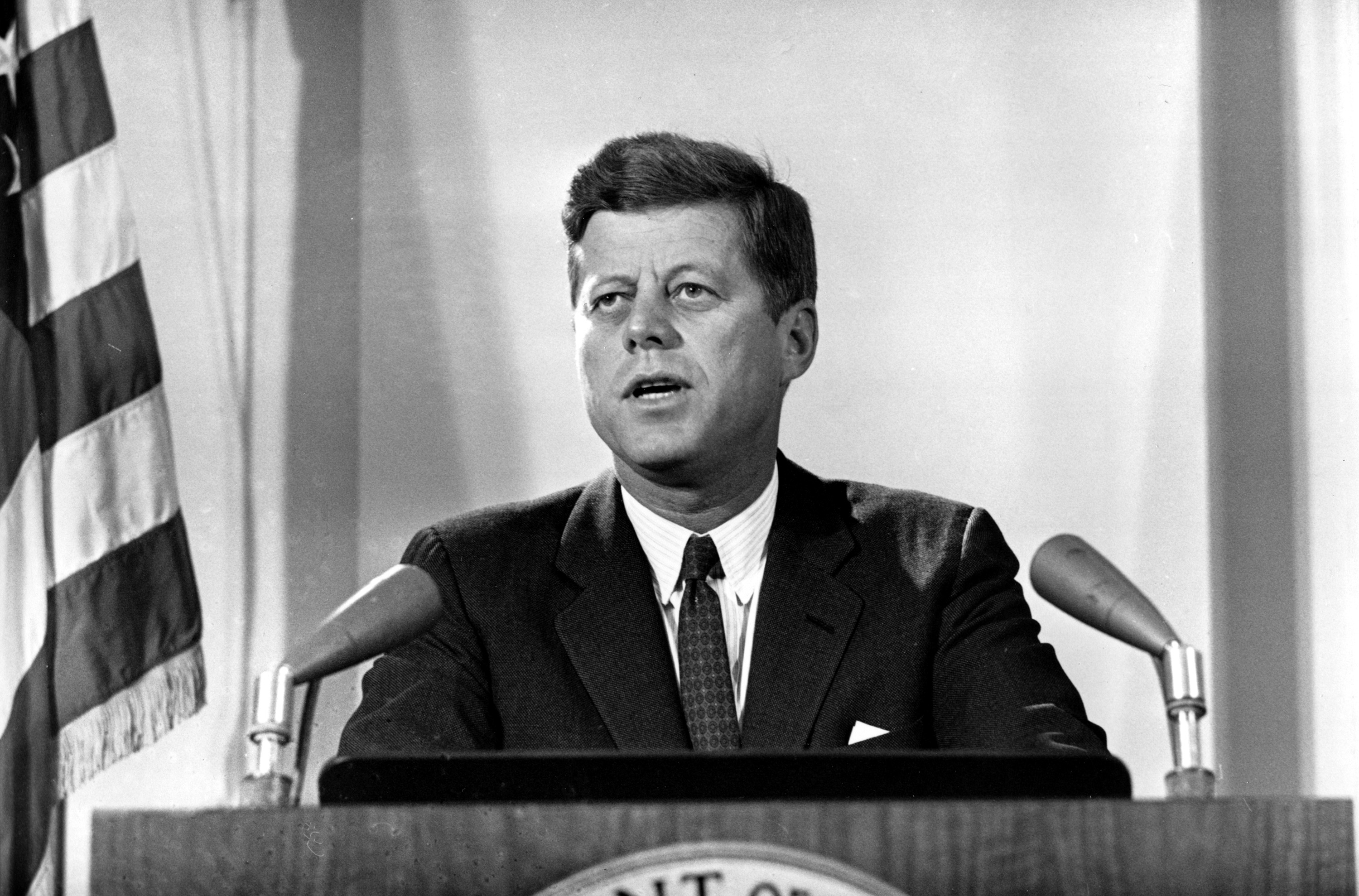
JFK speaking on the problems in Vietnam in late 1963.

In the opening scenes of the recent movie, The Post, we see Daniel Ellsberg copying  the Pentagon Papers in a hidden room  – and hear his voice over as he scans one document to do with JFK:  “May 11, 1961, President Kennedy orders a Pentagon review with a possible commitment of U.S troops to Vietnam.”

This incident and the Papers themselves have led many to conclude Kennedy actually had every intention of full American commitment – which is emphatically not so.  What Kennedy did is to authorize the barest minimum of non-military advisers for cooperation with the South Vietnamese. So, in fact, Kennedy’s “contribution” to the War was nowhere in the same league as Truman’s (citing a May 3, 1950 Paper), Eisenhower’s or LBJ’s.  Indeed, it was Johnson who launched the full scale war which led to 58,000 deaths by use of the Tonkin Gulf ruse.

Let us also be clear that the Tom Hanks’ film, The Post, is based on the NY Times version of the Papers, which is not the complete version. As a result of the way the Pentagon Papers surfaced there have always been difficulties in using them. The Times version, widely available, only scratched the surface. Both the Gravel and HASC editions appeared in only a few, or one printing, and were therefore not very accessible to the public. Restricted availability—in many cases limited to good college libraries—kept the full set of materials away from most of the public.

T
he Gravel edition had the virtue of a straightforward presentation and including Johnson administration documents.  (Former U.S. Senator Mike Gravel entered more than 4,000 pages of the 7,000-page Pentagon Papers into the Senate record in 1971, insisting the public had a right to know the truth behind the Vietnam War.)  The HASC edition’s advantage lay in its much more ample documentation on the presidencies of FDR, Harry Truman, and Dwight D. Eisenhower. On the other hand this version used the pagination of the original Department of Defense compilation, which was confusing and changed almost as often as the studies themselves.

Since the original publication by The Washington Post – using the same source, Ellsberg, as the Times, the clamor for access to the Pentagon Papers has resulted in the appearance of several editions of the documents. The most widely available and best-known of these versions is The Pentagon Papers as Published by the New York Times, which compiled in one place the series of articles and set of documents that newspaper had published. (Note 1) This edition attracted huge public attention and went through many printings but was flawed in that it represented a very narrow selection among the abundance of materials contained in the original. (The Times reporters had distilled the 43 studies of the original to which they had access into a single volume) . That version was far surpassed by the Gravel document, read into the Congressional Record.


Now, for the first time ever, all three major editions of the Pentagon Papers have been made available simultaneously online. The posting is to  the National Security Archive at George Washington University (www.nsarchive.org), and allows for a unique side-by-side comparison, showing readers exactly what the U.S. government tried to hide for 40 years by means of deletions from the original text.

The national archives posting includes the full texts of the "Gravel" edition entered into Congressional proceedings in 1971 by Sen. Mike Gravel (D-Alaska) and later published by the Beacon Press, the authorized 1971 declassified version issued by the House Armed Services Committee (HASC)  with deletions insisted on by the Nixon administration, and the new 2011 "complete" edition released in June by the National Archives and Records Administration (NARA).

See e.g.


It still behooves us to correct the record on JFK’s Vietnam history including his alleged complicity in the assassination of the Diem brothers.  For this,  L. Fletcher Prouty’s citation (cf.  pp. 272-73  JFK The CIA, Vietnam, and the Plot to Assassinate John F. Kennedy)  of a key section in the autobiography (In the Midst of Wars ) of former Gen, Edward Lansdale is invaluable  As Col. Prouty put it:   “One of the most important narratives of this event was written by Edward G. Lansdale in his autobiography In the Midst of Wars. Few Americans, if any, knew Ngo Dinh Diem and the situation in Vietnam from 1954-68 better than Ed Lansdale.”

That Lansdale section reads as follows:

   “As the prisons filled up with political opponents, as the older nationalist parties went underground, with the body politics fractured, Communist political cadre became active throughout South Vietnam, recruiting followers for action against a government held together mainly by the Can Lao elite rather than by popular support. The reaped whirlwind finally arrived in November 1963, when the nationalist opposition erupted violently, imprisoning many of the Can Loa and killing Diem, Nhu, and others. It was heartbreaking to be an onlooker to this tragic bit of history.

 
   Col. Prouty then goes on to elaborate (ibid.):

"It was some time before the news became known that Diem had fled to Cholon and been captured and killed there. This news was flashed around the world; this was the story that everyone heard. The public never heard of the planned flight to Europe that the Kennedy administration had arranged for him.

   Thus it was that the file of routine cable traffic between Washington and Saigon eventually became known with the release and publication of the Pentagon Papers. This is how it happened that Howard Hunt was able to locate certain top-level messages to and from the White House and Ambassador Lodge in Saigon that contained information referring to "highest authority"--the cable traffic code for President Kennedy.

    None of these messages contained any reference to a plot to kill President Diem and his brother or came even close to it. Concealed within these messages were carefully worded phrases that gave Ambassador Lodge the information he needed in order to direct all participants into action and to begin the careful removal of the two brothers to Europe by commercial aircraft.


   According to information that came out during the Watergate hearings, those files that had been forged to smear President Kennedy were put in Hunt's White House safe, where they remained until discovered by investigators later.

   There is much about this episode that has become important upon review. There are those who have been so violently opposed to Jack Kennedy and all that he stood for that they have stooped to all kinds of sordid activities to smear him while he was alive, to attack his brother Bobby while he was still alive, and to hound Sen. Edward Kennedy to this day. Nixon's gratuitous reference to Kennedy's "complicity in the murder of Diem" after a decade of silence on that subject speaks for itself. The efforts of Howard Hunt and Chuck Colson (both employees of the White House at the time) to dig up old files in order to besmirch the memory of President Kennedy provide another example.

    In an ominous way, the Pentagon Papers and Watergate episodes were cut from the same fabric, and most important, their exposure was a direct outgrowth of the nationwide dissatisfaction with the Vietnam War. Because the development of the war in Indochina had been spread out so long, since 1945, and because most of the events that brought about this terrible form of modern genocide in the name of "anti- communism" or "containment" were buried in deep secrecy or not even available in written records, Robert S. McNamara, then secretary of defense, directed, on June 17, 1967 that a task force be formed to collate and study the history of U. S. involvement in Vietnam from World War II to the present. "

And the most salient point (ibid.):

"This neglect of key documents served to reduce the value of those that remained to tell the story of the Vietnam War. From the beginning, the Pentagon Papers were a compilation of documents designed to paint President John F. Kennedy as the villain of the story, and to shield the role of the CIA.

    This vast stack of papers has been labeled the Pentagon Papers, but that is a misnomer. It is quite true that most of them were found in certain highly classified files in the Pentagon, but they were functionally limited files. For example, despite their volume--nearly four thousand documents--there are remarkably few that actually bear the signature of military officers. ..When such papers are removed from the "military" or "Pentagon" categorization, what remains is a nonmilitary and non-Pentagon collection. For the serious and honest historian, this becomes an important distinction. To be truly "Pentagon" Papers, the majority of them, at least, ought to have been written there."


These observations are critical and also germane to the issue of whether Kennedy intended to pull all then U.S. advisors out of Vietnam. This was by his signing and release of National Security Action Memorandum 263, which too many still refuse to accept as factual.   Again, in this regard JFK researchers owe a debt of gratitude to Col. Prouty - who  in his above -cited book- supplied a lot of the document details and backstory, including reference to the cover letter by McGeorge Bundy, e.g.

http://www.jfklibrary.org/Asset-Viewer/w6LJoSnW4UehkaH9Ip5IAA.aspx

Which is carelessly cited as NSAM 263 by amateur researchers or "buffs". These superficial researchers are ignorant of the fact that the actual heart of the NSAM  (sections IB(1-3) of the report cited in the letter) appearing in  Document 142 of The Pentagon Papers: ‘Report of McNamara - Taylor Mission to South Vietnam'


Turning to said document (142) one reads, for example:

IB(2) A program be established to train Vietnamese so that essential functions now performed by U.S. military personnel can be carried out by the Vietnamese by the end of 1965. It should be possible to withdraw the bulk of U.S. military personnel by that time.

IB(3): In accordance with the program to train progressively Vietnamese to take over military functions, the Defense Department should announce in the very near future presently prepared plans to withdraw 1,000 U.S. military personnel by the end of 1963.


Note the wording and that a partial drawdown of 1,000 was due for the end of 1963 and the bulk by 1965. Most lazy wannabes never get this far while some others that do mistake the "1,000" total for the entire intended lot. 


 Not only did Johnson not preserve Kennedy's plans for drawdown as revealed in the NSAM,  he willingly  signed off on the decisions that dispatched the troops and ordered the bombing campaigns.  Much of this was by way of his own NSAM 273. A gain, for more on the origin backstory of LBJ's NSAM -273 check out the information in the link below:


Why slip JFK's NSAM 263 to pull out of 'Nam into a set of supposed military ("Pentagon")  documents designed to portray him as the "villain"? Clearly, one beholds a disinformation hit that coincided with other disturbing aspects of the Diem situation, for example. In fact, it was rogue elements in  the CIA that instigated the coup and murder of the Diem brothers and this also has been made known in sundry released files.  (John A. McCone was Director of the Agency when all this was going on, but it was more likely William Harvey in charge of the Diem assassinations, as well as JFK's via the Staff D mission.)

Some of the aspects of the JFK- CIA rift can be found  in the book, JFK and the Unspeakable by James Douglass.
 
As Douglass notes (op. cit. p. 192): Kennedy got his  final wake up call on who was controlling his government when, in an early September, 1963 meeting he was informed by a David Bell of AID (a CIA cover organization) that the funds from the Commodity Import Aid Program had “already been cut off”,  essentially assuring a coup would ensue with the Diem government in South Vietnam. The Diems were killed on Nov. 2, 1963 and the CIA had planned for Kennedy to be taken out the same day in Chicago, except that trip was cancelled. The lone assassin set up for that hit was Thomas Arthur Vallee.


Kennedy was evidently livid and directly asked Bell who had told him to do that, to which Bell replied, “No one” (ibid.). The will to power disclosed here indicates the CIA felt it more powerful than Kennedy himself or his decision-making authority.  If they felt that way, there is nothing that they wouldn’t do to prevent the President from getting in their way.  In Douglass’ own words – which I can’t surpass:


“In plainer language, the president was acting too much like a president, rather than just another office holder beholden to the powers that be.”

The altercation  was confirmed by New York Times journalist Arthur Krock  in his piece  ‘The Inter-Administration War in Vietnam’, The New York Times, Oct. 3, 1963). wherein he wrote:

"If the United States ever experiences an attempt at a coup to overthrow the government, it will come from the CIA”  


Ironically, the threat of a coup by the Agency is now as great or greater than it was then but for radically different reasons. The CIA essentially "went to war" with Kennedy because he had formally  created the Defense Intelligence Agency, responsible only to him. This after the Bay of Pigs fiasco in which he was grossly misled by DCI Allen Dulles - who he subsequently fired, along with his deputy, Charles Cabell. (In the wake, Kennedy also defined a list of directives on what the CIA could and could not do. By the end of 1961, JFK's 'Special Group' had no less than 17 recommendations for the "reorganization and redirection of the CIA".  This followed on from Kennedy's vow to "smash the CIA into a thousand pieces and scatter it to the winds.")

What strikes many researchers now is the asymmetry between the two situations separated by more than 55 years. I.e. in 1963, JFK adhered to his Constitutional oath of office and respect for law in attempting to rein in an  out-of-control intelligence agency that had plotted (and executed) numerous coups as well as framing a patsy (Lee Harvey) Oswald) for JFK's later assassination in November, 1963.  To read more see e.g.

And:


The Agency - which has now rectified most of its past excesses-  ironically faces a "president"  defined by out of the box excesses.   This is a manic mutt they regard  clearly as a psychotic  loose cannon, and a threat to democracy on account of his unchecked, narcissist tendencies and blatant disregard of intelligence community inputs. (As with the Jamal Khashoggi slaughter by the Saudis.)  That would be none other than Donald John Trump, aka Drumpf.

See, e.g. this piece by former JFK assassination researcher, Jefferson Morley, e.g.

What Happens When The Intelligence Community Decides That Trump Is Too Dangerous To Be President?

Excerpt:


"Trump’s contempt for the intelligence profession, weaponized in his “deep state” conspiracy theories, has agency personnel feeling professionally vulnerable, perhaps for the first time. An irrational chief executive has shattered their apolitical pretensions and forced them to re-examine what their core beliefs require....

If there’s one thing to be learned from talking to former CIA personnel, it’s the sense that the CIA system—powerful, stealthy, and dangerous—is blinking red about the latest news of an authoritarian leader in an unstable nation."

So we now behold a juxtaposition where a once rogue agency that got off on "coloring outside the lines"  and thwarting a lawful president now confronts a renegade "resident" of the White House who fancies doing the same as he smashes every norm and Constitutional principle, e.g.

The Rule of Law
 Stay tuned because this sorry story is still playing out, and there's no telling where or how it will end. 

See also:

http://brane-space.blogspot.com/2013/09/jfk-and-national-security-state-1.html

And:

http://brane-space.blogspot.com/2015/11/convergence-of-two-important-books.html