Showing posts with label Challenger disaster. Show all posts

Saturday, July 20, 2019

Looking Back At The Apollo 11 Achievement 50 Years Ago- A Different Nation (& World) In Many Ways

                                                                  
                       Astronaut Buzz Aldrin walks on the Sea of Tranquility 50 years ago today.

First,  a bit of perspective: the world of 1969 was radically different from the one today, which few born after 1985 may appreciate.  There were fewer than half as many humans inhabiting the Earth for one thing.  Most animal species - not yet faced with incursions by humans (of their habitat)  - were not on the edge of extinction.  There were no computers available to  ordinary mortals. So you relied on either a slide rule, e.g.


 Or Wang  (electronic) calculator - say if you were doing a college physics or math project.    Of course, no  scientific calculators existed back then either  so high school kids taking math had to also do their computations using slide rules. (Or they could use tables of logarithms.).

Google did not exist, so if you sought to learn or research something-  say for a term paper -  you went to the nearest library.  You used what was called the 'Dewey Decimal System' to find what you were looking for.

There were no smart phones or cell phones to text or take photos.  You relied on your trusty Kodak camera with color film - and you talked on a land line.   "Texting"  entailed putting a sheet of 8 1/2  by 11 " paper in your Smith -Corona typewriter, typing out a letter and then mailing it to the intended recipient.  You might get a similar response in a week to 10 days.

The pace of life was much slower then, and the competition for attention  dramatically less. You had three major TV networks and when Americans watched the news, they all came to the same conclusions on what was portrayed. There was no "fake news".    There was no cable TV, no hundreds of stations vying for attention.

Oh yeah, and money was worth vastly more, went further.  The whole Apollo project took $25 billion, which in today's dollars would be over $270 billion.   The talk today is of "going back to the Moon" and the laughable basis is supposedly commercial space enterprises, run by billionaires such as Jeff Bezos, and a guy named Elon Musk.. Here's a newsflash for the private space aficionados: The first attempts at such flights bearing humans are now likely to be delayed past the end of this year and perhaps beyond 2020. This according to a small WSJ piece from 4 days ago ('Capsule Launches With Astronauts Unlikely for 2019', p. A3)

Back in the 1960s the federal government spent twice as much as private business on the space program. Today, as Greg Ip has pointed out  (WSJ, July 15, p. R9) business spends three times as much as the federal government. But are we any better off? Hardly.  As Mr. Ip observes:  "We now equate risk-taking and innovation not with moonshots but with venture capitalists, pharma labs and internet entrepreneurs pursuing wealth, not discovery or prestige."

Which is why we'll be lucky to make it back to the Moon by 2024,  far less build bases there for more distant travel, say to Mars.  But 50 years ago, before Johnson's Vietnam War had sucked up $269 b in federal revenue,  all things space were still possible. We hadn't yet squandered it all away by misplaced priorities.

Fifty  years ago, at roughly 4:17  eastern daylight time in the afternoon,  I arrived at the University of South Florida's  Beta Hall Commons. There,  nearly 40 students had already gathered to watch the Apollo 11 Moon landing and the first time humans set foot on our natural satellite.

Within eight minutes of my arrival - watching the black and white images on a 22" TV set - Neil Armstrong slowly stepped off the landing ladder and uttered some of the most famous words ever spoken: "That's one small step for a man, one giant leap for mankind.".   Most of us at the time envisaged a great space future, with this event only the warm up. I mean, after the fantastic film '2001 - A Space Odyssey' - which had just opened a year or so earlier - we had visions of space stations and Moon colonies dancing in our heads - not to mention trips to Mars by the turn of the century.

What spawned the Apollo project? Space historians go back to May 25, 1961, barely 3 weeks after Alan Shepherd's successful first sub-orbital trip in the Mercury capsule. At that time President John F. Kennedy addressed a joint session of Congress and asked for a joint commitment to 'landing a man on the Moon and returning him safely to Earth', within the decade. Thus began America's biggest, costliest and most ambitious effort ever, rivaled only by the building of the Panama Canal and the Manhattan Project's building of an atomic bomb.

It would take just over 8 years to fulfill the vision, which included disastrous mishaps such as Apollo 1, in which Gus Grissom was killed along with fellow astronauts Ed White and Roger Chaffee during a pre-launch test at Cape Canaveral on January 27, 1967. Despite the setback and other problems that came up, the vision remained in place.

On July 16, the Apollo 11 crew was launched aboard a Saturn V rocket topped by the 'Eagle'  lunar module, arriving on the dusty surface of Tranquility Base 4 days later.. As commander, Neil Armstrong was first out of the module and walking on the Moon, followed by Buzz Aldrin. Alas, somebody had to remain behind and that was command module pilot Michael Collins who was responsible for being the 'gatekeeper' - in lunar orbit.

The success of the mission met with resounding public approval and the U.S. emerged as leader in space faring after a string of losses to the Soviet Union. This was despite the final cost tally of $25b, which -  let us note - we have pissed away in today's equivalent dollars in just 12 years in Afghanistan (we've now been there 18 yrs.)   There followed six Apollo Moon landings in all through 1972 with 12 men  having explored the Moon. We  spaceniks wanted more - including the establishment of lunar colonies-   to show the whole Apollo deal wasn't a flash in the pan for PR. But it wasn't to be.

What happened? Short story: the country painfully learned it couldn't support "guns and butter" and manned space exploration all at once. There wasn't enough money to do so. Recall a short time earlier Johnson's 'Great Society' programs were launched and before that - the Vietnam War - after a concocted incident in the Tonkin Gulf in August, 1964.

Indeed, as the red ink bled, both from the war and LBJ’s “Great Society” programs, it was evident by 1971 that: a) the Apollo missions would have to be truncated, and b) the manned space program – if kept – would devolve and diminish to a low Earth orbit substitute of earlier aspirations. When then President Richard Nixon (just before his Watergate crisis) confronted NASA’s administrators in 1972, they were basically informed of the writing on the wall: Either come up with a much tailored down program for manned space exploration, or have nothing at all.

Given the choice between something and nothing, NASA chose the first – which meant pursuing the less costly Space Shuttle program, already on the drawing boards. Alas, since the Shuttle was really designed for re-supply of existing space stations and none existed yet, this meant it would be constrained mainly to ‘show and tell’ missions in low Earth orbit. There were no other choices, it was either this, leading on to the eventual substantive Shuttle missions 20 years later, or no manned flights.

And so the nation's manned space vision had begun to dim and recede.
Once Reagan assumed office in January, 1981, the constrictions on spending for space grew much more formidable, thanks to his massive tax cuts (going from a maximal marginal rate near 70% to 28%) and the $2.7 trillion defense spending spree (which combination was in fact responsible for converting us into a global debtor). Naturally, in this anemic and hostile (to space spending) fiscal environment the screws tightened even more on NASA and they were forced to lowball cost estimates and cut corners for future flights. 

The latter included ramping up an already overly ambitious launch schedule. If they didn’t do this, they’d be totally left out of the manned space budget. In these circumstances, the Challenger disaster must be understood and referenced, e.g.


brane-space.blogspot.com/2016/01/the-challenger-disaster-what-you-dont.html

As the ultimate result of excessive cutting corners, and rushing launch schedules (the Challenger never should have been launched under those frigid conditions – and the O-ring risk had been noted by engineers at Morton Thiokol)

By 2011, and the final launch of the Space Shuttle Atlantis, the U.S. had basically reached its nadir in space exploration. Now, three years later, the U.S. is still dependent on the Russians to get crew to the Space Station. Without the Russians allowing our illustrious guys to "hitch hike" on the Soyuz, there wouldn't be any Americans in space.  (Indeed, at roughly the same time yesterday as Armstrong walked on the lunar surface 50 years go, an American astronaut was being launched from Kazakhstan -  in a Russia rocket-   to the Space Station.)

To me, this 'beggar thy neighbor' motif,  along with the capitulation of  national manned space programs to the private sector, shows how far we've regressed in vision and acumen along with the symbols embodied by our collapsing bridges, sewer lines, water mains ......and the fouling of our air and water by natural gas fracking. Not to mention squandering nearly 80% of current budget expenditures since 1969 on military BS and other wars of choice (Iraq, Afghanistan.)  We have thus become a nation in monumental decline, though pie-eyed,  false hope pols and others brainwashed by PR refuse to see it.

U.S. space junkies, some of them, assert the U.S. will soon have its own program back, thanks to private outfits like Space-X. But from my vantage point, that is years away, if ever. I'd even be amazed if they have a manned craft ready to go to the IST in 3 years. (Robot craft are one thing, but you need lots of redundancy with manned craft and private companies are more likely to cut corners for profit.)  I will bet it's more like five years, again, if ever. Space-X  truth be told, is a pale imitation of the NASA -government funded space program we once had until too many wars of choice made it unaffordable.


Most serious space junkies that I've talked to are appalled at how far we have receded in our space vision and the commitment to manned space exploration - which is emphatically not a 'gimmick' or ploy to hook the hoi polloi. It is the only means by which we can eventually leave this planet and colonize another world, because - as Isaac Asimov put it in his 1976 Barbados lecture: "Only a foolish species would leave all its eggs in one planetary basket."

As for the deluded ones placing their future space hopes in the commercial, venture capitalists like Richard Branson,  Elon Musk and Jeff Bezos, don't hold your collective breath.  These characters will no more get us to the Moon or Mars than Mickey Mouse.  This is given they can't afford - or refuse to pay - the ancillary (added) billions in costs for redundancy of systems that affords protection to humans in space vehicles.

Let's hope our species gets some smarts before the next 'planet killer' asteroid arrives.  Let's hope enough smart people see the answer again is federal government support and money - once it ceases spending hundreds of billions a year on the military-industrial complex and unnecessary wars!

As for the Moon landing hoax dingbats, I have always had but one question: Why would a 363' tall rocket (the Saturn V) be: a) constructed, and b) launched at Cape Canaveral (seen by one million people estimated there) - with the energy of a small atomic weapon equivalent-  all to perpetrate a "hoax"?   It is among the most hare -brained pseudo- conspiracy memes yet and one was therefore  elated to see Apollo 11's  Buzz Aldrin punch out one simpleton who confronted him and called him a "liar" for not coming clean on the supposed "hoax".  

See also:

And:


Jeff Vogel's picture
Article Tools E-mail | Print Comments (0)


Excerpt:

"Let us set aside July 20, the day a human being first walked on the moon, as a day to remember this profound accomplishment and all its implications, a day to contemplate whether we will embrace our wondrous existence or take it for granted and continue to trash our Mother Earth. "


Thursday, January 28, 2016

The Challenger Disaster: What You Don't Know

Jan. 28, 1986: The space shuttle Challenger explodes after liftoff from Kennedy Space Center, Fla. Seven astronauts lost their lives.
The Challenger blows up thirty years ago over Cape Canaveral

It is safe to say that every sentient person alive 30 years ago recalls exactly where he or she was when informed of the news that the Challenger Space Shuttle had blown up. I was holding office hours for physics and space physics in the Physics Bldg. of the University Alaska-Fairbanks. A student had rushed through the door, barely coherent, and yelped:  "The Space Shuttle just blew up!"  Few could make sense of events from the assorted blurting so it was natural for people to find the neaarest television and turn to CNN as soon as time allowed.

As in the  events of the Kennedy assassination, the horror and shock of the moment engulfed everything at the time. No sense could be made of the causes - only seeing the endless loop of disastrous imagery - that insane, peculiar Y-smoke plume engraved on an otherwise pristine sky over Florida.

The final answers wouldn't emerge until after the formation of an actual government commission (unlike the PR Warren Commission set up by LBJ to investigate the Kennedy assassination) and the stellar work of one bold physicist: Richard P. Feynman. It was, in fact, Feynman who conducted a simple ice water experiment before the Challenger commission to show it was none other than the  failure of an obscure mechanical component (O-rings) in freezing temperatures that triggered the cataclysmic event.

Most of this is written up in over 135 pages of his book, 'What Do You Care What Other People Think: Further Adventures Of A Curious Character', 1989.  What we learn is how Feynman painstakingly extracted the information to conduct his "little experiment" - as he called it - by pursuing points with the Thiokol engineers and other personnel.  He learned, for example (pp. 134-35):

- There were images of hot gas leaks from previous flights - or what the engineers called "blowby"

This inevitably left a "blackening behind an O-ring where hot gas leaked through."

-In some instances, it left an "erosion" where the O ring had actually been burned by the gases a little bit.

-There were charts of all the flights showing how seriously the blowby and erosion manifested on each one.

Basically all these aspects were relevant as Feynman learned something else: During any given Shuttle launch there occur vibrations which cause the rocket joints to move a little.  (Bear in mind the O-rings are directly attached to the solid rocket booster) The O-rings are placed inside the rocket joints and are intended to make a seal and - as Feynman learned - without the O-rings the solid booster's hot gases would expand through the joint and cause a catastrophic event.

On further discussions with the Morton Thiokol engineers, Feynman learned these O-rings had zero resilience at low temperatures. Having lost resilience, they'd be next to useless and then would not keep the crucial seal and so allow hot solid fuel booster gases to expand precipitously,  He learned that on the morning of January 28th, 1986,  temperatures had actually reached as low as 22F at the Cape, or 10 degrees below freezing.

It was time for his experiment!

Seated at one table he had asked an assistant staff member to bring him a glass of ice cold water (with ice actually in it to ensure it was at 32F).  As Feynman describes his testimony, after switching on his microphone (p. 151):

"I took this rubber from the model and put it in a clamp in ice water for a while. I discovered that when you undo the clamp the rubber doesn't spring back. In other words, for more than a few seconds, there is no resilience in this particular material when it is at a temperature of 32 degrees. I believe that this has some significance for our problem."

And in typical, understated Feynman fashion, he blew the minds of the commissioners and others to smithereens. Showing with a simple physics experiment the central cause of the Challenger explosion: the Shuttle was rushed out for a launch in freezing temperatures,  causing O-ring failure and the hot booster rocket gases to explode outward  - claiming the lives of all eight astronauts on board, including teacher Christa MacCauliffe:
Image result for christa mcauliffe
One narrative uncovered by Feynman, in the wake of his experiment, was that NASA wanted the Challenger launch made that icy morning, because it coincided with the date of Reagan's State of the Union speech. Then Reagan could tout the triumph, e.g. of space made even safe for school teachers,  during his appearance on national TV. Instead he had to deliver a somber eulogy.

But Feynman's experimental exposure of  NASA's callous neglect was so devastating and incriminating that the account would only find its way into an Appendix of the Proceedings.

Showing once again that too many humans can't handle the truth!


Monday, June 29, 2015

Space -X Resupply Rocket Blows Up - But Don't Say "Space is Hard'!

Image for the news result

Elon Musk's Space- X resupply cargo rocket, carrying supplies for the International Space Station (ISS) as well as 30 student experiments, blew up two minutes after launch yesterday. Musk tweeted in the aftermath:

"There was an overpressure event in the upper stage liquid oxygen tank. Data suggests counterintuitive cause."

Which is counterintuitive bafflegab and bollocks. Why can't this guy just admit he's not investing enough money and resources into the damned thing, and trying to cut too many corners?

Astronaut Scott Kelly - in space for a year long duration experiment- watched the launch from the ISS and also offered a more or less dimwit comment:

"Sadly failed. Space is hard".

Uh no, it's only "hard" when you don't devote the resources, time and energy needed for success- lessons we've learned over and over since the Challenger disaster in 1986.

Another NASA honcho echoed the same refrain that "It's not easy taking care of a space station, I think sometimes folks think its easy or routine. That's when we get into trouble."

No, we just think you get into trouble doing it on the cheap - using private entrepreneurs, as opposed to an experienced cast and resources NASA had for decades -is a formula for disaster. (Yet some in that previous NASA cast are now helping the military get Shuttle-type launch vehicles put into space with no problems at all!)

So let's cut the crap.

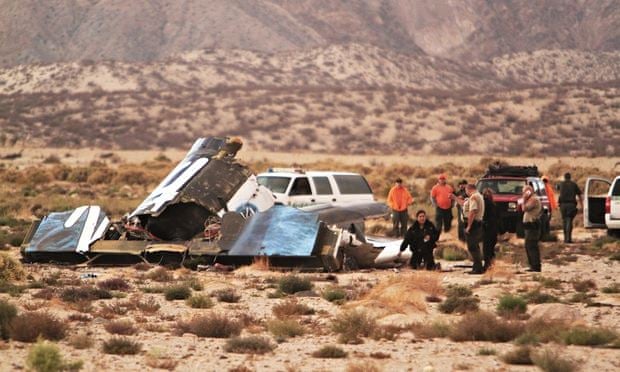
We've seen a similar act play out last year when Richard Branson's Virgin Galactic "Spaceship Two" came crashing back to Earth, e.g.
SpaceShipTwo crash
This was to be the craft to give wealthy hotshots a chance to say they'd at least been to the edge of space (to experience weightlessness) at a quarter million bucks a pop. The total duration of each flight? Five minutes.

Loren Thompson, an analyst at Virginia's  Lexington Institute, who's consulted for Boeing and Lockheed Martin, offered the most blunt perspective on commercial space junkets in a Financial Times piece (Oct. 31, 2014):

"What we're learning is that consistent success in launching space vehicles requires a much bigger investment of time and money than most entrepreneurs are willing to make".

Duh! This has been exactly my point for the past five years, since the retirement of the Shuttle - at least for cargo shuttling purposes to the ISS.  But the entrenched optimists who run these small time commercial outfits simply refuse to accept it. Refuse to accept you ain't going to the Moon, far less Mars, or even to the space station by using relative chump change operations (maximal outlays on the order of $10m or so when the Shuttle program exceeded $300 b) and minimal resources. You need instead the resources of a whole nation and that's why the key successful space missions now are compliments of national efforts (e.g. China and India),  not private company efforts.

That so many people of even above average intelligence can't process this or accept this is simply amazing, but perhaps speaks to the overwhelming power of PR and manufactured malarkey dominating today's 24/7 news cycle.  And so, one must not be too surprised that too often PR can gut and overcome rational and analytical critical thinking faculties.

Scott Kelley and others can spin this latest disaster as "space is hard" if they want, but most of us with a historical perspective know better. A pity most others would rather buy codswallop that these magnates running private, commercial operations  can compete with what a government entity using interconnected talent and resources could do.

Sunday, July 20, 2014

Remembering the Apollo Moon Landing - And How Far Our Manned Space Vision Has Regressed

                                                                     
                         Astronaut Buzz Aldrin on lunar surface, July 1969

Forty-five years ago, at roughly 4:10  eastern time this afternoon,  I'd just returned from an Introductory Astrophysics class with Prof. Sabatino Sofia at the University of South Florida, and trekked to the Beta Hall Commons. There,  nearly 40 students had already gathered to watch the Apollo 11 Moon landing and the first time humans set foot on our natural satellite..

Within eight minutes of my arrival - watching the black and white images on a 22" TV set - Neil Armstrong slowly stepped off the landing ladder and uttered some of the most famous words ever spoken: "That's one small step for a man, one giant leap for mankind.".   Most of us then envisaged a great space future, with this event only the warm up. I mean, after the fantastic film '2001 - A Space Odyssey' - which had just opened a year or so earlier - we had visions of space stations and Moon colonies dancing in our heads - not to mention trips to Mars by the turn of the century.

What spawned the Apollo project? Space historians go back to May 25, 1961, barely 3 weeks after Alan Shepherd's successful first sub-orbital trip in the Mercury capsule. At that time President John F. Kennedy addressed a joint session of Congress and asked for a joint commitment to 'landing a man on the Moon and returning him to Earth', within the decade. Thus began America's biggest, costliest and most ambitious effort ever, rivaled only by the building of the Panama Canal and the Manhattan Project's building of an atomic bomb.

It would take just over 8 years to fulfill the vision, which included disastrous mishaps such as Apollo 1, in which Gus Grissom was killed along with fellow astronauts Ed White and Roger Chaffee during a pre-launch test at Cape Canaveral on January 27, 1967. Despite the setback and other problems that came up, the vision remained in place.

On July 16, the Apollo 11 crew was launched aboard a Saturn V rocket topped by the 'Eagle'  lunar module, arriving on the dusty surface of Tranquility Base 4 days later.. As commander, Neil Armstrong was first out of the module and walking on the Moon, followed by Buzz Aldrin. Alas, somebody had to remain behind and that was command module pilot Michael Collins who was responsible for being the 'gatekeeper' - in lunar orbit.

The success of the mission met with resounding public approval and the U.S. emerged as leader in space faring after a string of losses to the Soviet Union. This was despite the final cost tally of $20b or about $80b in today's dollars. There followed six landings in all through 1972 with 12 men  having explored the Moon. We  spaceniks wanted more - including the establishment of lunar colonies, to show the whole Apollo deal wasn't a flash in the pan for PR. But it wasn't to be.

What happened? Short story: the country painfully learned it couldn't support "guns, butter" and manned space exploration all at once. There wasn't enough money to do so. Recall a short time earlier Johnson's 'Great Society' programs were launched and before that - the Vietnam War - after a concocted incident in the Tonkin Gulf in August, 1964.

Indeed, as the red ink bled, both from the war and LBJ’s “Great Society” programs, it was evident by 1971 that: a) the Apollo missions would have to be truncated, and b) the manned space program – if kept – would devolve and diminish to a low Earth orbit substitute of earlier aspirations. When then President Richard Nixon (just before his Watergate crisis) confronted NASA’s administrators in 1972, they were basically informed of the writing on the wall: Either come up with a much tailored down program for manned space exploration, or have nothing at all.

Given the choice between something and nothing, NASA chose the first – which meant pursuing the less costly Space Shuttle program, already on the drawing boards. Alas, since the Shuttle was really designed for re-supply of existing space stations and none existed yet, this meant it would be constrained mainly to ‘show and tell’ events in low Earth orbit. There were no other choices, it was either this, leading on to the eventual substantive Shuttle missions 20 years later, or no manned flights.

And so the nation's manned space vision had begun to dim and recede.

Once Reagan assumed office in January, 1981, the constrictions on spending for space grew much more formidable, thanks to his massive tax cuts (going from a maximal marginal rate near 70% to 28%) and the $2.7 trillion defense spending spree (which combination was in fact responsible for converting us into a global debtor). Naturally, in this anemic and hostile (to space spending) fiscal environment the screws tightened even more on NASA and they were forced to lowball cost estimates and cut corners for future flights. The latter included ramping up an already overly ambitious launch schedule. If they didn’t do this, they’d be totally left out of the manned space budget. In these circumstances, the Challenger disaster must be understood and referenced- as the ultimate result of excessive cutting corners, and rushing launch schedules (the Challenger never should have been launched under those frigid conditions – and the O-ring risk had been noted by engineers at Morton Thiokol)

By 2011, and the final launch of the Space Shuttle Atlantis, the U.S. had basically reached its nadir in space exploration. Now, three years later, the U.S. is still dependent on the Russians to get crew to the Space Station. Without the Russians allowing our illustrious guys to "hitch hike" on the Soyuz, there wouldn't be any Americans in space.

To me, this 'beggar thy neighbor' motif,  along with the capitulation of  national manned space programs to the private sector, shows how far we have regressed in vision and acumen along with the symbols embodied by our collapsing bridges, sewer lines, water mains ......and the fouling of our air and water by natural gas fracking. Not to mention squandering nearly 80% of current budget expenditures since 1969 on military BS and other wars of choice (Iraq, Afghanistan.)  We have thus become a nation in monumental decline, though pie-eyed,  false hope pols and others brainwashed by PR refuse to see it.

U.S. space junkies, some of them, assert the U.S. will soon have its own program back, thanks to private outfits like Space-X. But from my vantage point, that is years away, if ever. I'd even be amazed if they have a manned craft ready to go to the IST in 3 years. (Robot craft are one thing, but you need lots of redundancy with manned craft and private companies are more likely to cut corners for profit.)  I will bet it's more like five years, again, if ever. Space-X  truth be told, is a pale imitation of the NASA -government funded space program we once had until too many wars of choice made it unaffordable.

To underscore my justifiable skepticism, I can refer to an April 7 article  from The Denver Post to the effect Space X is filing suit against Colorado- based UAL which has an AIR FORCE contract worth $70b to use Russian-made rocket engines.   Hmmmmm......wonder why that is? Because they're MORE RELIABLE! As a UAL spokesperson put it: "We've been using them (in Atlas rockets) for twenty years now".

So why - without meeting QA test criteria, would the AF give a contract to Space X? Well, because they don't believe that outfit is ready yet to handle its ELVP (Expendable Launch Vehicle Program) demands.   Instead of squallering like brats and babies whose nappies are soiled, Elon Musk and Space X need to show- by meeting the Air Force's standards,  how and when they can deliver better quality engines than the Russian ones used by UAL.

Most serious space junkies that I've talked to are appalled at how far we have receded in our space vision and the commitment to manned space exploration - which is emphatically not a 'gimmick' or ploy to hook the hoi polloi. It is the only means by which we can eventually leave this planet and colonize another world, because - as Isaac Asimov put it in his 1976 Barbados lecture: "Only a foolish species would leave all its eggs in one planetary basket."

Right on! Let's hope our species gets some smarts before the next 'planet killer' asteroid arrives.