Showing posts with label Black Forest fire. Show all posts

Monday, January 6, 2014

YES – Global Warming IS Still Real and Ongoing! (Never Mind the Cold!)

NASA imagery
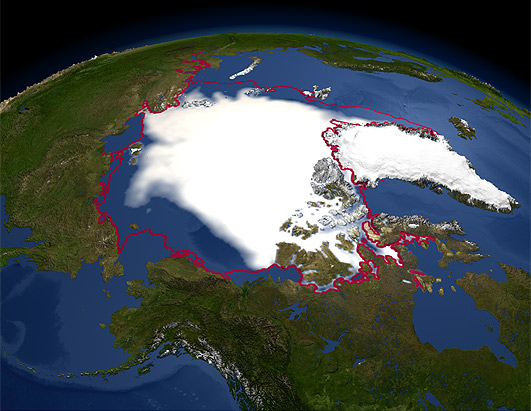
Satellite image of Arctic at point of maximal Arctic melting. Increasing warmth in the Arctic is influencing the polar vortex causing icy cold to spill southward to North America.

The disconnect between much of the media (and public) and ongoing global warming has never been more evident than the past week or so as we witnessed a Russian ship trapped by ice in the Antarctic and bone -chilling frigid air in the Midwest today.  But as I will show, none of these events - strange as they may seem  (i.e. Chicago being colder than Siberia this morning)  controvert global warming.

SF Chronicle conservo writer Debra Saunders thought she was being facetious when she wrote the following:


"To recap, when the Aussie expedition on the Russian ship got stuck, the Chinese Xue Long tried to icebreak its way to the stranded ship. But there was too much thick ice and the Xue Long could not reach the Shokalskiy. Then the Australian Aurora Australis tried to come to the rescue, but couldn’t get to the Russian ship either. Ditto a French icebreaker. There was too much thick ice to reach the global-warming research team.

More irony: The AAE was supposed to follow in the footsteps of the 1912 Mawson expedition – which is the last trek I would want to recreate.  The idea was to allow modern scientists to collect data to compare with the Mawson data in order to do improve climate models for global warming. But then there was too much ice, and now the party’s over."


Mayhap for the Aussie team, but that doesn't mean global warming is over. Indeed, what happened to the Shokalskiy can actually be said to have reinforced the theory of global warming. That is, it's been found (Nature Geoscience, March 31) that melting ice shelves actually spur the growth of sea ice - the form that trapped the Russian ship. While Arctic sea ice has dwindled, Antarctic sea ice has expanded nearly two percent per decade since 1985.
 

As oceans have warmed over the same period, their currents have carried heat to the deep waters surrounding Antarctica. This deflected warmth melts the base of ice shelves, i.e. sections of the Antarctic ice sheet that float over the ocean.  The melting then floods the ocean with cold fresh water that remains on the surface and easily freezes.  Hence, the trapping of the Shokalskiy.
 
 
Regarding the record breaking bone –chilling cold in the Midwest today, this can also be traced to global warming – as originally proposed in a theory by Gunther Weller, more than 25 years ago. That is,  something called “the polar vortex” is normally stable and circulating around the Arctic, like a massive cyclone. (Weller called it  a stable polar cyclone)   However, with increased warming in the Arctic (especially more than anyplace else on Earth) the circulation in the vortex is weakened and the vortex’s cold spills southward – discharging energy and creating the record breaking cold we’re now seeing in places like Minnesota.
 
As a weather specialist noted this morning (CBS), it is unwise to just cherry pick the frigid cold experienced in some parts today and laugh at global warming – since every place else is seeing a warming trend.  Also, warming begins much earlier than it had incepting natural changes in flora and fauna to respond to it. (For example, the dandelions in my yard now begin flowering in early to mid March as opposed to late April. Meanwhile, the maple syrup in Vermont is being adversely affected by too early warmth which is also now too enduring – into the fall).
 
Worse, the unabated general warming trend, such as here in the Rocky Mountain West, has meant the spread of the Mountain Pine Beetle - now destroying forests  by the hundreds of thousands of acres each year. The beetle basically turns trees into tinder for which the slightest spark  - say from a randomly tossed cigarette- can cause a densely forested area to explode into a wildfire. This is what happened with the Black Forest fire last year, and the Waldo Canyon fire the year before that.

 
Only a dunderhead  or nitwit would in any way use the bone chilling cold, snow or even ice storms to try to deny global warming. But don't worry, many idiots will still try!


Sunday, October 6, 2013

Homeowners in Fire Zones May Well Be Dinged Next Year- And They Should BE!

A house is fully engulfed by the Black Forest Fire.
A home is engulfed by flames in Black Forest back in June this year. Higher fees, taxes and insurance premiums on these home owners ought to limit future disasters here in Colorado.

"Wildfires have been part of living in the West ever since people first settled here. For several decades, there has been a continuous buildup of hazardous fuels and this growing risk requires a response."  - Governor John Hickloooper, last Monday at State Capitol after referencing the creation of his Wildlife Insurance and Forest Health Task Force in 2012 and the need to impose higher fees, taxes, insurance premiums on those living in fire danger zones.

Imagine a person choosing to live near a fuel dump where partly- filled cans and containers of gasoline are regularly tossed. Imagine also that each year fierce, dry heat is incepted by climate conditions which trigger one or more explosive fires  after the containers explode.  Yet each year the fuel dump dwellers expect government resources to bail their homes out, while also expecting insurance companies to cough up the bread for rebuilding and not raise their premiums.

What's wrong with this picture? Everything.

In the case of the Colorado fires, specifically the Waldo Canyon fire last year which destroyed over 350 homes, and the Black Forest fire this year which destroyed thousands, we know the fuel includes hollowed out pine and other trees,  turned into tinder by the Mountain Pine Beetle.  In effect, all those folks living in the forested areas of the state are inhabiting de facto "fuel dumps" which was the point of the governor's remark last Monday.  And if they are living in those fuel dump zones, then they ought to be expected to pay more for the privilege  - given precious fire fighting resources will most likely have to be expended there.

As the Colorado Springs Gazette pointed out Tuesday(page B-1) , according to Hickenlooper's proposal, home owners in high risk fire areas would "have their properties rated for wildfire risk and face special fees and taxes to help fund fire mitigation efforts - under recommendations released Monday by the governor's wildfire task force."

Of course, this is eminently reasonable! If you choose to live in a sequestered, private area laden with tinder for wildfires, you ought to be expected to pay for likely consequences and resources needed to help you - given the experiences of the last two years. To expect those of us who live in "normal" areas to swallow higher insurance premiums for your choices is nothing short of nuts. Why should we, given we derive no benefit? (I.e. being able to book your home for a weekend stay - getaway.)

Therefore, exceptionally assessing higher fees, taxes and even higher insurance premiums for properties in high risk fire areas is both rational and fair - and certainly not "spoils taking" ass suggested by Robert Samuelson (last blog).

Still, local GOP-ers, like Springs Mayor Steve Bach, are complaining and arguing that they "would not support a state wide fee for mitigation".  Oh, and he also rejects any talk of a "mitigation audit" - based on state assessors rating homes on a 1-10 scale for fire danger, as recommended by Barbara Kelley - executive  Director of the Dept. of Regulatory Agencies. (op. cit., p. B-5)

Such audits, if yielding scores as high as 9 or 10 would "render some properties uninsurable and thus unsellable". The task force has also recommended disclosures of the risk ratings when homes are sold.

Reepos like Bach hate such proposals because, of course, they don't wish to antagonize their higher income voters, most of whom are those with the properties in the higher risk areas.

But, if our legislators are sane they will ram this task force mitigation mandate through - like they earlier did Colorado's gun control legislation, including limiting magazines to 10 clips.

Stay tuned!

Sunday, September 22, 2013

Good RIDDANCE to Summer!

A house is fully engulfed by the Black Forest Fire.
Massive fires, and now floods, seem to be more and more in the future of Colorado with each passing summer.

Two weeks ago, a neighbor inquired into my use of a chain saw to cut down a weed.  I pointed out to him that this (now)  4 ft. high invader had already broken my large shears - trying to take it down- and this emerged as the only solution. He then laughed, as he continued walking his dog, and exclaimed:

"I believe the weeds are taking over! They already have my place!"

The good thing is an end to the war may be in sight - along with a merciful end to the summer. Today, at precisely 4.44 p.m. EDT, (2: 44 MDT)  the Sun (in its path along the ecliptic), crosses the celestial equator moving southward and heralds the autumnal equinox. (Equinox meaning equal day and night all over the world). Thus, autumn enters, and a miserable summer departs.

What made the summer miserable?

First, the advent of  summer over here each year is marked by an invasion of tens of millions of moths. The Miller Moth has attained notoriety by being able to somehow miss its ultimate destination - the mountains - heading instead toward Front Range city lights. The critters, thereby disoriented, enter homes by the hundreds, crawling through tiny cracks you'd never believe a flat worm could negotiate - and ending up on carpets, drapes, in dishes, in food, in heat vents and .....'dive bombing' humans forced to use "the throne" late at night. Oh, they also try to squirm into the ears  of sleeping humans....or pets...They aren't choosy!


The invasion usually lasts a full month, sometimes longer. The usual way we deal with it is to fill bowls with water then place them directly under bright lights to allow the little beasties to dive bomb into the water.  After collecting maybe fifty or sixty at a time, the bowl is emptied on the lawn - the moths essentially dead, or near dead. Another way, more my choice - not Janice's  - is to snatch any little bugger I can (say off a wall) then crunch it between my fingers and chuck it into a disposal.  Look, the little bastards are cute, make no mistake, and we hate to butcher their sorry little asses, but they are pests! Ask Krimhilde - my sister-in law-  who visits with us every other year and on one occasion ran screaming from her room as one determined Miller moth tried to wiggle into her ear canal.

By the time the moth invasion ends the summer solstice has usually already begun and then it's time for: weeds, skunks and fires!  The weeds, depending on the temperatures (more if warmer) usually start erupting in late April, and by mid summer have taken over nearly the whole yard. How tough are they/ Tough! Forget standard lawn mowers or even large shears, you often need a chain saw to take down the biggest ones - which I was shocked to see had reached heights of up to 4 feet in my backyard this year.  Neglect to take care of them, and you get "weed trees" - as incredible as it may sound.

Somehow, some way, the weeds in the Rocky Mountain West have been getting "jet fuel". What is it? Well, its higher concentrations of carbon dioxide, thanks to global warming!  This is no joke! The warning was probably first sounded three years ago in 2 articles in The Wall Street Journal (June 4, 2010,  p A16, 'Superweeds Trigger New Arms Race'; and June 21, p. D1, 'Least Welcome Sign of Summer')

According to the first account, by the middle of this decade at least 40% of U.S. corn and soybean crops will "harbor Roundup resistant super weeds". Roundup, and especially Monsanto's Roundup -ready seeds, have been amongst the biggest "success stories" in the domain of weed control, primarily because of its primary constituent:  glyphosate- which is one of the least toxic around. As one farmer cited in the first article put it: If glyphosate isn't the safest herbicide, it's damned close".

The article described nine species of weed that  have developed total immunity to it and spread to millions of acres in more than twenty states. One farmer, quoted,  from Osceola, AR  claimed he spent hundreds of thousands of dollars on herbicide, but couldn't control the pigweed which now runs rampant over his 8,600 acre field.

The variant of pigweed on his property grows to six feet in height on a stalk the width of a baseball bat's wide end. The weed is so tough, it damages mechanical parts of his cotton picking equipment and must be rooted out by hand. The farmer had to hire 20 labor hands to attack the weeds using hoes, even then breaking a number of them. Hmmmm.....sounds familiar!  The second article references a study published in the journal Weed Science, in 2007, which indicates poison ivy is getting bigger and spreading faster, plus producing more urushiol as a result of increasing levels of carbon dioxide in the atmosphere.


The emergence of these super weeds, especially as threats to farm productivity (not to mention yards) has convinced many farmers they must resort to much more toxic weedicides to get the job done. That includes using such infamous carcinogenic agents as: 2, 4- D, dicamba and paraquat. But critics have warned given the uncontrolled factors afoot, such as ever increasing CO2 concentrations (now tipping at nearly 400 ppm) all that will happen is that even more super weeds will emerge, resistant to even those arch-herbicides.

My neighbors - to battle their yard weeds, have resorted to atrazine but they are fighting a losing battle. Each year the dandelions and other weeds grow larger and take up more area. In the end, even when their yard looks luscious green, they can't enjoy it - and are compelled to erect 'Danger - POISON!' signs to keep kids and pets off.


Then there are the skunks. They've invaded only over the past two years, arriving with the major fires in Waldo Canyon (last year) and Black Forest (this year). Perhaps they were chased out of their natural enclaves, who knows? What we do know, in our neighborhood, is people have to keep dogs in the house at night .....or risk them being skunk sprayed as happened to one forlorn dog two houses down two months ago. Skunks make their presence known by spraying.....maybe just for the hell of it. At least three times this year we've had to shut all windows in the house as the "aromatic" odor from skunk spray wended its way in.   Far worse than the malodorous fumes is the fact that skunks here have now emerged as the primary carriers of rabies.

With the Waldo Canyon fire, meanwhile, we've received a wake up call here in Colorado, that monster blazes may well be recurring part of our summers every year. But this was predicted by NOAA and other sources, i.e. hotter, drier and longer 'tinder box' summers, coupled with trees turned into tinder by pests like the Mountain Pine Beetle.  We had a second demonstration of the dynamic this year with the Black Forest Fire. Understandably, major efforts are now being made across the Front Range for fire mitigation - which includes insurance companies demanding home owners in fire hazard areas to clear cut shrubs and trees from their property up to a certain distance. It's great that so many people love to live essentially in a forested area, but not great the rest of us (who don't) have to subsidize their insurance premiums each time fires hit. This will be another bone of contention that needs to be addressed among different sets of homeowners in the region.

Then there are the floods....what can I say? Who would have thought or believed that such a "Katrina-like" deluge would strike an arid state - located in what is known as the high desert region of the country. But there it is!  What it discloses is that the perturbations induced by climate change can wreak havoc even in areas where one would normally not expect such disasters. All it took was days of high heat, with temperatures 15-17 degrees above normal, followed by a cold front coming in and the delayed start of the yearly "monsoons". Then...WHAMMO! Massive floods sending rivers and creeks in the northern part of the state up to five and six feet over flood stage. Whole towns, like Lyons and Jamestown swept away, as well as forty or more miles of roads, highways and people still cut off.

Let me say, with the arrival of fall, I am happy again...to be done with the pests, the weeds, the fires and hopefully the floods. Sure, there'll be raking of leaves, but that's a minor nuisance compared to the other crap.

Next summer? I will deal with that when it arrives!


Tuesday, June 25, 2013

George Will: “No Warming for Last 16 Years” – Let Him Come to Colorado!

George Will is the geeky looking guy with spectacles and bow tie whose visage appears in his WaPo and syndicated columns. Ironically, though geeks are supposed to have higher IQs, Will often comes out with balderdash that more suggests a cretin. In the most recent instance, Will denies there’s been any warming the past 16 years while lashing out at Obama’s remarks on climate change recently delivered in Berlin. According to Will (‘Hitting a Wall in Berlin’, June 22, p. 5D, Denver Post):


“Then came Wednesday’s pratfall in Berlin. There Obama vowed energetic measures against global warming. The 16-year pause of the warming was not predicted by, and is not explained by, the climate models for which – in his strange understanding of respect for science- he has forsworn skepticism”


How so? Indeed, Will is caterwauling about a non sequitur since no serious climate scientist buys into any “16 year pause in warming”. Where did Will dredge up this codswallop? Well, from a misinterpretation of the data published in a Nature paper back in 2008 by Noel Keenlyside et al. Therein was made a tentative claim for monotonic global cooling since ca. 1998. This 'jumped the shark' and become embedded into the warming skeptics' arsenal of disinfo and set real global warming science education back at least a decade in my estimation.


At the root of this misapprehension by the faux skeptics is misinterpretation of the data appearing in the paper - not at all helped by the media (like the WSJ) which have also misconstrued it. Even Editors who fully know the actual original source still can't be bothered to consult it, they'd rather get their info 2nd hand (like from the 'Investor's Business Daily') then bloviate how global warming is wrong, or "hyped" in sundry editorials.


People prone to the denial weltanschauung then read these superficial reports, miss the key core clues, and bruit it all about that they (deniers, skeptics) were right all along. Instead of taking shortcuts, skeptics could have retrieved the ACTUAL paper from Nature! They could have studied the paper's key figure, the one that looks at past and (forecast) future global temperatures, "Hindcast/forecast decadal variations in global mean temperature, as compared with observations and standard climate model projections".


If really intelligent, the first thing Will ought to have noted about the figure -indeed, one major source of confusion - is that each data point represents a ten-year centered mean. That is, each point represents the average temperature of the decade starting 5 years before that point and ending 5 years after that point. Thus, the statistics for potential “cooling” could not possibly have been justifiably extrapolated beyond 1998 + 5 = 2003, or in Will's case, "16 years of no warming"  from 1998.


Second, would-be intelligent skeptics should have spotted the red line in the graphic of the Nature publication and – if bright enough – beheld that it was the actual global temperature data from the U.K.'s Hadley Center for Climate Prediction and Research. They then ought to have asked: "Why does the red line stop in 1998 and not 2007?"  Again, it’s a running 10-year mean, and the authors use data from a Hadley paper that ends around 2003, In effect, they can't do a ten-year centered mean after 1998.


Lazy deniers, however, have parlayed their own perceptual deficiency and this simple statistical peculiarity of the data into believing that global warming factually STOPPED in 1998! But the stunning fact is the evidence all around belies this canard!   For example, there was the black swan storm 'Sandy' that struck New York, NJ in late fall - and most climatologists trace its origins as climate-change born. I elaborated on the reasons in the first answer I provided to a reader's question in this previous Mail Brane: http://www.brane-space.blogspot.com/2012/11/maile-brane-seeking-answers.html    

Fast forward to January 2013, which  had barely begun when fiery images from Tasmania and Australia showed what we likely faced in the Northern hemisphere come June, July. For the record (no pun intended) July 2012 was the hottest ever recorded in U.S. annals with a mean tempeature of 77.6F. The average annual U.S. temperature for 2012 was 55.32F or one full degree higher than the old record set in 1998. (So much for the codswallop that all temperature increases ceased in 1998. )

Meanwhile, here in Colorado we’ve had over eighteen monster wildfires in the last 2 years, which can be tied inextricably to global warming-climate change. Whereas at one time a five day spate of 90-plus temperatures was rare, so much so that few Coloradans used a/c we now are in the midst of a 13 day string of such temperatures combined with extremely dry conditions and prolonged drought – ideal for fires.

In June the Black Forest fire erupted in northern Colo. Springs, burning 24 square miles. Barely a week after it was 95% contained the West Fork fire was ignited by two lightning strikes and has now burned up a total of 125 square miles. There is zero containment and fire fighters expect it will burn for months! Experts pinpoint the immediate cause as lightning striking dead trees, turned into tinder by the mountain pine beetle. The spread of the latter has been fueled directly by longer, warmer and drier springs and summers. If Georgie really does believe there was a 16 year pause in warming he ought to have been here in Colorado the past 12 ½ years with my wife and me, seeing year by year how the climate has turned hotter and drier and the beetle population in the forests increased as a result of the shorter cooling seasons. Obviously, the guy needs a practical education!

Actually, he might need ANY kind of further education, especially in basic research. He might start with The Economist (June 16, 2012) report that notes that Greenland's ice cap is "losing an estimated 200 gigatonnes of ice a year, enough to supply a billion people with water. " If this should continue, and lead to a predicted 59 cm (24 in.) rise in sea level by the end of the century, it will prove catastrophic for many population centers abutting the oceans.


  Before he next scribbles bollocks on Obama's lack of climate change insight or skepticism and the ineffectiveness of current models and how many "scientists' disagree with them, I suggest he consult Eos Transactions of the AGU, Vol. 90, No. 3, p. 22 , and the analysis therein of the extent of scientific consensus on global warming published by P. T. Doran and M. Kendall-Zimmerman . They found that (p. 24):

 "the debate on the authenticity of global warming and the role played by human activity is largely non-existent among those who understand the nuances and scientific basis of long-term climate processes". 

 In their analytic survey for which 3146 climate and Earth scientists responded, a full 96.2% of specialists concurred temperatures have steadily risen and there is no evidence for cooling. Meanwhile, 97.4% concur there is a definite role of humans in global climate change.   


Methinks Georgie really needs to stick to his avocation of baseball, or maybe the hack politics in which he's so proficient. He really has no future dabbling in climate science since he's already shown he can't even discern basic statistical results presented in research journals like Nature. But then again, maybe he's an agnotologist - one of those who deliberately sows doubt based on faulty economic, scientific reasoning. We also have another name for them: propagandists!


Thursday, June 20, 2013

AAARGHH! Smoke Fills the Air Again! More Wild Fires!

New Colorado wildfire prompts new round of evacuationsWifey convulsed in a constant hacking, coughing attack around 2 a.m. It was so bad I had to rush her some extra inhaler as well as cough medicine (a new, more effective brand than the stuff I've been taking). Obviously, her bronchitis had been triggered into calamitous heights and I could smell the culprit in the house and outside: smoke. Smoke permeated the air like being at the bottom of a damned chimney!

On waking this morning, I turned on the tube to learn there were now two more fires burning in our state, even as the Black Forest Fire is "95 percent contained". There is one in Walsenburg - about 40 miles south of us- which has now burned over 350 acres, and another to the north, in Jefferson County, just south of Denver.

So, we will get smoke one way or the other, and fortunately that will likely be the only problem (it's enough when you're battling bronchitis) as both fires are far enough away not to force any mass evacuations.

Meanwhile, the knowledge that the U.S. has let its inventory of  large slurry planes (the main ones- like the P3 Orion air tanker-  to fight these fires) slip to ten is depressing. TEN planes to fight mammoth fires across the west? That is insane! If these fire seasons are to be the new normal, as one CSU professor has opined, then we need at least four times that many slurry planes.

Anyway, stay tuned. I hope I can soon report these new fires are under control. So far the one south of us is zero percent contained. And the rest of the week looks dismal: high fire danger with temps in the 90s, winds, low humidity. Where's the rain when you need it?

Tuesday, June 18, 2013

Should Black Forest Homes Be Rebuilt? Probably Not

A house is fully engulfed by the Black Forest Fire. The Black Forest fire, after burning up 24 square miles, leaving two dead and destroying over 500 homes, is now nearly out for good. It is easily the most disastrous fire in the state's history, having consumed nearly $800m in property (estimated) and exacted fire fighting resource costs of nearly $36 million, according to the Denver Post (June 16).  Of course, watchful waiting is still needed, as fire fighters still can't relax but must move through and across the scorched forest grounds digging up to six inches deep to excavate still burning embers and pine cones beneath. Even a single spark then can start a new conflagration, if precautions aren't taken, especially as "fire weather" resumes tomorrow with temperatures in the 90s and low humidity, winds.

Meanwhile, the families affected hanker to get back and re-build their homes, yes, in the same Black Forest. Is this a good idea? No, I don't believe so for reasons I will get into.  But recall, this is one year after the Waldo Canyon fire which also blew out of a forested area last year and took 346 homes with it, at a cost of rebuiliding at nearly $450 million. That's nearly a half billion dollars.

Are we now to see these damned fires every year? Yes, according to Prof. Frederick 'Skip' Smith, of Colorado State University and head of the Warner College of Natural Resources Department of Forest and Rangeland Stewardship. According to Prof. Smith, these annual fires are now the "new normal:". Persistent drought conditions, combined with the ravages of the mountain pine beetle (turning forests into tinder) have made the likelihood of destruction by wild fires a near certainty and yes, every year! Worse, people are contributing to the mayhem by deliberately moving into forested areas that themselves are becoming increasingly overgrown.

To highlight this, Colorado state district forester Larry Long - quoted in the Post article (p. 21A) and noting a fire in the densely wooded Black Forest had long been feared:

"They need to take about half of the trees out and then come back and take another third out. It would be a stark contrast to what it is now. But that is a healthy forest. It looks very nice, it gets park like."

The implication clearly is that no one ought to be rebuilding until such time the forest is thinned out.

Beyond that, no home - not one - ought to be built until every last bit of burnt, dried tinder left behind is removed, every last charcoaled tree stump. Moreover,  each new home needs to be re-designed with fire-mitigation structures, techniques in mind.  Same ol', same ol' cannot work ....not any more, and it is supreme stupidity to allow people to just rebuild according to original specs.

As Smith said:

"It's going to mean we are going to have to do a better job of designing these communities and making them defensible in the face of the certainty that these fires are going to happen."

That includes building homes that don't ignite as easily, having infrastructure in place for fire fighters and having escape routes for homeowners as well as fire mitigation plans integrated into all future building codes.

This is extemeley important given over 540,000 Coloradans currently inhabit forested danger areas and that growth in the wildland-urban interface is expected to increase 300 percent in the next two decades, according to Joe Duda - the state's interim forester.

Prof. Smith himself isn't enamored of any more building-construction of homes in these fire prone areas. As he put it (Ibid.):

"We're not going to be able to live with it. The costs are too great. The amount of money we spend for fire suppression is huge and not sustainable. And continuing to put young people at risk to fight fires is not something we want to do."

Bingo!  Additionally, as noted in today's Post (p. 1A), insurance specialists have observed that the premiums paid by home owners living in forested areas don't reflect the risks - so they will undoubtedly have to go up. This should be no different from what happened to those living in the Hurricane Charlie storm zone on Florida's SW coast in 2004. In particular, after Charlie damaged my folks' place in Port Charlotte their insurance premiums shot up 75%. The new premiums were so high that they had to move into a senior apartment complex.  They hated to leave their home of 22 years, but at the same time were relieved to be away from having full responsibility for a hurricane-prone domecile.

In addition to higher premiums, a task force appointed by Gov. John Hickenlooper is looking into the implementation of yearly 'risk' fees such as apply currently in California. There, home owners in wooded risk areas pay $150 each per year for fire protection services that may be used. The total collected last year came in at $90 million which provided enough to fight CA wildfires this year. People are simply going to have to get used to paying for the privilege of living in these isolated, wooded areas. To quote one letter writer in today's Post:

"A tragedy befell those folks who moved out in the woods — perhaps to get away from it all — under the illusion that they are independent of the rest of the world. In fact, they moved all their material stuff to a naturally fragile environment, now under severe stress due to a number of factors, the most prominent being massive climate change. Anyone who lives in such an area needs to understand that they are placing themselves literally in the line of fire while their own presence further damages a suffering ecosystem of plants and animals. " - Linda J. Drake

Meanwhile, the origin of the fire is now suspected as arson, and investigators are going through the scene where it putatively started to ferret out clues. Whoever did this, well...they merit the ultimate penalty.

Thursday, June 13, 2013

Mass Evacuations Ordered In Northern Colo. Springs - Will We Be Next?

Photo - Flames continue to burn off Burgess Road through the night Wednesday, June 12, 2013 as crews work to contain the Black Forest fire. Michael Ciaglo/The Gazette
The failure to contain the Black Forest Fire along with horrific dry conditions, high winds and high temperatures, has expanded the fire southward forcing mass evacuations from the Springs. Will we be next (despite the fact wifey is now ill with severe bronchitis)? We don't know - but we are starting to assemble an emergency departure kit, including: all insurance policies, all papers to do with Social Security and Medicare, all recent bank-asset  statements, tax files for past 10 years - for B'dos and U.S., all IDs including important personal proof papers not already in the bank safety deposit box, enough clothes, meds, shoes etc. to get by in a shelter - if it comes to that, and of course, a box containing our most precious memories including photos, DVDs of holidays, and written diaries dating back to 1969-70. Another box is to be filled with a limited set of "best books", best movie DVDS, and favorite music CDs - oh, along with Janice's Ipad, our Ipods, and at least one laptop.

Added to the existing havoc are weather conditions producing dry thunderstorms and accompanying lightning strikes the last thing this community needs right now.

Some brief updates up to now (4. 15 p.m. MDT)

3.30 p.m.: Gov. John Hickenlooper appoints Air National Guard Brig. Gen. Peter J. Byrne to head the wildfire reponse and relief support efforts in Colorado. He will work with existing fire incident commanders to seek containment of the beast - which has now destroyed 360 homes and is at 8, 700 acres.

3.37 p.m. Heavy smoke and ash blowing on the northwestern edge of the blaze.

3.45 p.m. Penrose -St. Francis Hospital in northern Springs reports treating people for smoke inhalation in the emergency room.

3.55 p.m. Firefighters report fierce winds driving the Black Forest Fire. Reporter Garrison Wells at Pikes Peak Community College reports wind gusts hitting hard.

4 p.m.  Some citizens report rain drops near Palmer Lake.

Above all, what we need is a heavy rain along with the winds to die down to make progress. As one official put it this a.m. even before the day's battles began:

"Even all the firefighters in the world with all the equipment can't stop a fire driven by winds, high temperatures and low humidity. We will need help from Mother Nature."

Update: 6:15 p.m. We may be getting that assist from Mother Nature. According to latest reports, the winds are dying down and dew points increasing as we approach the 'golden hours' for fire fighting. On the negative side, wifey and I did smell smoke on a return junket from the store with some supplies: gatorade, chips, oranges, soup etc.

Also: The Black Forest Fire is 5% contained.
We will see what happens overnight, and hopefully we get some rain to help out!

Wednesday, June 12, 2013

Raging Fires Return to Colorado!

A house is fully engulfed by the Black Forest Fire.

A home is engulfed in Black Forest, roughly 8 miles north of my place.


The choking smoke smothered everything in sight this morning, even as I struggled to get the hoses ready for front and backyards to water down the tinder dry lawn.  This experience was even worse than last year's (Waldo Canyon Fire) since I have been fighting an acute case of bronchitis for the past week. Despite that, I tied on a make-do face mask, dampened first, and went about soaking the lawn given the fire this year is even closer.

We suspected the worst might happen yesterday around 2 p.m. when 15 acres was first reported burning in the Black Forerst neighborhood, a tony uppercrust, "independent" subdivision about eight miles north of us. TV images taken from the corner of Powers and Woodmen in Colorado Springs showed billowing smoke and the TV meteorologist didn't make light of the fact that conditions were ideal for it to spread: 97 deg F, barely 7% humidity and winds out of the southeast at 30-34 mph.  He then showed a disarming photo of Black Forest lush with its green, well manicured lawns - but noted looks can be deceiving. Particularly as the trees that surrounded the area itself had literally become tinder for fire.

I noted the reasons why last year, when writing about the Waldo Canyon Fire that erupted south of us.That is, that the trees in Colorado have been victimized by sundry insects -particularly the mountain pine beetle -  mainly on account of the drought which has unleashed them in greater numbers.  They've essentially  converted the once living material into tinder that literally explodes when conditions are right- as they were yesterday afternoon.

So true, since from 2 p.m. to 4 p.m. the Black Forest Fire expanded to 400 acres, then reached 800 acres by 5.30 p.m. and 3, 800 acres by 9 p.m. When I awoke this a.m. it was at 8,000 acres with zero containment and people from Falcon were being required to evacuate. Already anywhere from 60-80 homes may have been destroyed.

One of the problems has been lack of adequate water and manpower resources, this as another fire is raging south of us and another erupted near the Royal Gorge, rapidly expanding to 3, 800 acres. The latter fire saw state bureau of prisons agents evacuating prisoners  from the Colorado Territorial Prison at Canyon City. At one point, water storage tanks had to be raided, and since no large slurry planes were available. Instead,  four odd Chinook helicopters (from Ft. Carson) had to be loaded, each with a few hundred gallons, to dump them on thousands of burning acres. A water "shortage" was referred to at one point, and I couldn't help thinking of the 14- 18 million gallons of water wasted so far in our area by fracking for natural gas wells (all of which have emerged 'dry') that might have been used now to put out the fires.

Will the frackers (and the state) learn from this? Somehow, I doubt it. This despite, as I also noted last year, the trend is for these hot, dry raging fire summers to continue in Colorado and the Mountain west. Recall my reference last June to a Washington Post article entitled: Pace of Climate Change Exceeds Estimates, wherein one read:

"Warmer weather, earlier snowmelt, drought and beetle infestations facilitated by warmer climates are all contributing to the rising number of fires linked to climate change. Across large swaths of the United States and Canada, bark beetles have killed many mature trees, making forests more flammable. And tropical rain forests that were not susceptible to forest fires in the past are likely to become drier as temperatures rise, growing more vulnerable."


The beetle referenced above is the mountain pine beetle, a variant of the bark beetle species. It's modus operandi is basically to convert living plant tissue - say in trees -  into highly flammable dead bark for which the slightest spark can set off a conflagration. The beetle then, is a major catalyst for all the presently raging and uncontained Colorado wildfires.

What will we do in the meantime? All we can do is hope the wind direction soon changes so that the acrid odor of smoke which now permeates the house can be abated. Most of it is drawn in with the operation of the evaporative cooler. But with temperatures set to hit 90 today there's no way to turn it off and close all the windows- we'd suffocate. So, we have to tough it out.