In a TIME magazine issue from some months ago, an article ('A Star Is Born'. Nov. 2, 2015, p. 31) appeared which offered the hope that nuclear fusion will soon be available as a viable energy source. One which "would mean the end of fossil fuels and the greatest antidote to climate change the world could ever ask for". Adding "saving the world, that is the endgame". These are heady words and we're also informed that in the past ten years a new front has "opened up" to make fusion a more plausible reality than once believed.
Already, the author notes, there exists a "prototype fusion reactor" which is the product of a secretive company called TriAlphaEnergy. (The name is derived from the triple alpha fusion process in stellar interiors by which three helium nuclei combine to form one carbon nucleus, e.g. He4 + He 4 + He4 -> C12.
The article also points out that communicating these discoveries is still troublesome because too many confuse nuclear fission with nuclear fusion. In the former, massive atoms like uranium 235 (U 235) are split apart into smaller, less massive atoms. This process releases a good deal of energy and hence is used in our current nuclear power plants but there are drawbacks. For one thing, uranium is a scarce and finite course, and secondly fission plants are expensive to maintain and regulate. They also generate enormous quantities of toxic waste that remain hazardous for centuries.
By contrast, in nuclear fusion, rather than splitting atoms they are fused together into larger, more massive ones. Thereby, a fraction of the mass of the particle involved gets converted into energy via the famous Einstein mass-energy equation: E = M c2 . This enables the typical fusion reaction to produce 3 to 4 times as much energy as nuclear fission.
There are also huge advantages including that fusion reactors use an abundant element, hydrogen (the most plentiful in the universe), and fusion reactors don't melt down, they just stop. Little or no radioactive waste is produced and no hazardous pollution is generated as with fission. For example, the main byproduct used in hydrogen fusion is helium - the element used in balloons.
Most modern fusion research and work is based on the Russian-designed tokamak, a toroidal system by which the super heated plasma is magnetically contained and compressed (by magnetic fields) inside a toroidal-shaped device, e.g.

.
The design makes use of the fact that plasma is extremely sensitive to electromagnetic fields. Interestingly, the analogous behavior is observed in coronal loop structures on the Sun, e.g.
 The TIME article noted that the "colossus of all tokamaks" is currently being constructed in a small town in France, outside Marseilles. The so-called ITER (International Thermonuclear Experimental Reactor) will be 30 m high and weigh in at 23,000 tons. Its staff will "number in the thousands" and it will hold 840 liters of plasma. The containing magnets alone will require some 100,000 km of niobium tin wire. The stupendous cost - in the tens of billions estimated now - is being paid by a global consortium that includes the U.S., Russia, the EU, China, Japan, South Korea and India.
It is currently expected to come to full power operation by the year 2027. (Originally it was projected to be in operation this year.)
The goal is the same for all similar machines that preceded it: to pass the breakeven point where the reactor generates more energy than it takes to run it. Some big tokamaks cam close in the 1990s but were always hamstrung by the fact the magnetic containment broke down, and in most cases it barely lasted for a second.
Enter now TriAlpha's fusion reactor which is quite different from the ITER and other tokamaks. As the TIME author put it, "you can think of it as a massive cannon for firing smoke rings except the smoke rings are actually hot plasma and the gunpowder is a sequence of 400 electric circuits timed down to 10 billionths of a second that accelerate the plasma ring to just under a million kilometers per hour".
We're then informed that in fact "there are actually two cannons, arranged nose to nose, firing plasmas at each other which merge in a central chamber and the combined plasma heats up to 10 million degrees Celsius.".
The mammoth machine that orchestrates all this "sits outside a gigantic warehouse section of TriAlpha's Orange County Office Building surrounded by racks of computers that control it and more racks of computers that process the information that pours out of it". In other words, another huge project. (Every five millionths of a second operation generates a gigabyte of data)
All of this sounds and reads in the realm of the "imminent" which is how many sources interviewed in the TIME piece portray it. But is it really? Some speak of reaching commercial fusion in "ten years" but this is probably bollocks. There are simply too many formidable barriers a few of which I will touch on below. More likely as the head of the Princeton fusion lab put it: "I think we'll have commercial fusion on the grid in the 2040s."
But there are significant hurdles to overcome and I will focus on those for tokamaks because: a) these devices have been around much longer and afforded the most opportunity for in depth research, and b) most of the money on the planet is tied up with the ITER not its newfangled commercial fusion cousins. (Which I tend to view in the same manner as the commercial space ventures. Lots of pizzazz but little real value to deliver over time)
The most important consideration in respect of wave-particle energy loss has to do with the wave-particle resonance in plasmas. Recall before we looked at inverse Landau damping in the context of collisionless coronal shocks and specifically the two -stream instability, e.g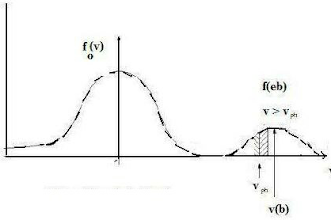
In the region where the slope is positive (¶f(v) / ¶ v > 0) there is a greater number of faster than slower particles so a greater amount of energy is transferred from particles to associated (e.g. Alfven) waves. Since f eb contains more fast than slow particles a wave is excited, and there is inverse Landau damping such that plasma oscillations with vph in the positive gradient region are unstable
In the original case of Landau damping, with the slope negative (¶f(v) / ¶ v < 0) the number of particles slower than the waves phase velocity exceeds the number of those that are faster. Thus, more particles gain energy from the wave than lose energy to it.
In the case of tokamak fusion reactors the loss of particle (ion) energy is critical. Why? Well, if fusion products, say deuterium (D2) reach the plasma-facing tokamak wall at full energy there will be two adverse consequences: 1) they will have lost energy via the interaction so can no longer contribute to heating the background plasma, and 2) they may damage the wall itself. A lot of difficulty here will be obviated with ITER, for which the orbits of generated ions will be small relative to the device size. Given ions will have much farther to travel to escape the plasma we don't expect major losses through single wave -particle interactions.
Chaotic ion orbits associated with multiple resonances from a single Alfven mode is another story. Simulations of this behavior (see Physics Today, October, 2015, p. 34) shows a rapid dispersal of energy for individual ions. As the authors note: "Even if the ions are not ejected from the plasma, their loss from the central core region leads to reduced temperatures and fusion yield."
Without any doubt, given the results of simulations thus far, it may be well into the middle of the century before there is even a faint hint of workable fusion, i.e. that exceeds the 'breakeven' point. As for actual fusion energy meeting even 50 percent of our needs, in terms of exajoules delivered - which would have to rival our current coal power and nuclear (fission) output, I don't expect that until the end of the century, if then.
Looking realistically at the exajoule delivery capabilities of different energy sources, it is evident that fossil fuels will play a major part barring: a) a sudden decrease in population, or b) a sudden decrease in energy demand, i.e. to run our energy insatiable civilization. Global energy consumption rose from barely 21 EJ (exajoules) in 1900, to 318 EJ in 1988, and is at about 400 EJ today. Solar, geothermal + wind by the end of this year will total 10 EJ at most, and will therefore have contributed only:
(10/ 400) x 100% = 2.5% of the total global demand by the end of next year.
The key question is where will the energy come from to support an energy intense and consumptive civilization? You can’t just say “new alternative sources” and leave it at that. What new, alternative sources? Where? As Jay Hanson (www.dieoff.org) pointedly notes:
“The fact that our society can‘t survive on alternative energy should come as no surprise, because only an idiot would believe that windmills and solar panels can run bulldozers, elevators, steel mills, glass factories, electric heat, air conditioning, aircraft, automobiles, etc., AND still have enough energy left over to support a corrupt political system, armies, etc."
According to The Physicist's Desk Reference oil, gas and coal remain the primary energy components (at roughly 83% total) of the current energy mix in terms of EJ delivered. That won't change unless fusion power comes in much earlier and delivers up to 30 EJ a year in a practical form. I simply can't see that happening anytime soon!


