Showing posts with label solar corona. Show all posts

Thursday, November 30, 2017

Selected Questions-Answers From All Experts Astronomy Forum (Cold Space and Cold Fusion?)

Question -
Dear Sir, A young person told me that the Sun was cold, hence cold fusion.
Reason: the higher up the mountain you go the colder it is. Space is cold,
it is the microwaves from the Sun that excite the atmosphere and hence
make us warm. I am a Civil and Mechanical engineer but this stumped me.
Please help.


Answer -

Your young person has misinformed you re: the Sun. It is assuredly not "cold" with

a surface temperature of 6,000 C (11,000 F) and a core temperature of 15
million Celsius.  Given the latter, you can see that fusion in the Sun's core
is not "cold" but extremely hot.

Indeed the temperature of  15 million C is needed in order to achieve the fusion of
hydrogen nuclei into helium., the net effective reaction being:

H1 + H1 + H1 + H1  ->  He4


Regarding colder temperatures with altitude, this has everything to do with
the density of oxygen, nitrogen (e.g. air) molecules decreasing.  Hence,
the higher one goes up a mountain the fewer molecules (matter) there are
to absorb heat- or retain it.

What we call 'heat'  (internal energy) is really energy associated with the motion
of molecules in a medium.  The graphic shown below illustrates the relation of

heat energy to kinetic or motion energy in a gas contained within a cylinder. The
cylinder has a solid bottom at one end and a moveable piston at the other..


In this case the heat imparted by the Bunsen burner causes the molecules in the gas to move more rapidly - colliding with each other and causing the piston to move upward -expanding the gas volume. This changes the volume of the gas from V1 to V2 where V2 > V1.

Space is "cold" because there are so very few molecules of matter in it, being nearly a perfect vacuum.  The presence of so few molecules means very few collisions and little available internal energy.  Hence,  even if you try to heat a volume of space there will be little detectable difference.

Regarding the Sun, it radiates at all wavelengths of the electromagnetic spectrum - not just microwaves.

If you study the diagram of the EM spectrum below you will see that microwaves form only a relatively small region:
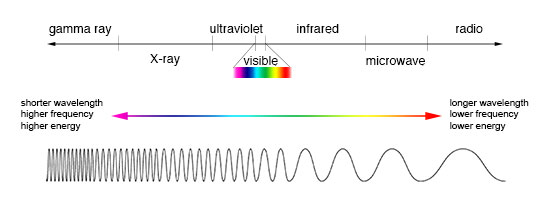
Illustration showing comparison between wavelength, frequency and energy

These are associated with longer wavelength EM radiation, as are radio waves. The
shorter wavelengths (to the left) include what we call the "visible" band - as well as
ultraviolet, x-ray and gamma ray.

The Sun actually shines with its maximum radiation emitted at about
5500 Angstroms (550 nm)   - or in yellow light. It radiates at all wavelengths
but has the maximum at that band. This is depicted below:
Image result for solar radiation spectrum


The conversion of radiant energy - say from the Sun- is really a conversion of large
scale energy, e.g. in electro-magnetic waves- to internal or microscopic energy.

In effect, if air is thin, as it is at the top of a mountain, there isn't enough mass

present to enable or facilitate energy transfer to the medium. Hence, it feels 'cold'
to the human observer. But this has nothing to do with the Sun being 'cold'. (As I noted
earlier.)

The fact is the Sun's radiant energy is being transferred to the Earth through space
by the process known as radiation - which can occur even in a vacuum (or in a
medium of very low particle density).  But the fact the Sun's radiation (including as

heat) can be transferred through space doesn't mean space itself will be hot - as 
I've explained.

The point here is that no heat energy transfer occurs from a cooler body to a
hotter- ONLY from a hotter to cooler. Hence, it follows the Earth must be
the cooler body compared to the Sun

Space is 'cold' not because it absolutely lacks heat  but because its
density (of particles) is too low to have much quantity of heat, or
'thermal capacity'.

The thermal capacity is defined by the amount:

W = mc

where m is the mass and c, the heat capacity. It is a measure of how difficult

it is to increase the temperature of a medium by one degree (e.g. Kelvin).

Obviously, since space is a near-vacuum, m is near 0, and c is near 0, so little

or no thermal capacity exists. What this means is that energy from the Sun (via
radiation) can be transferred through space, without appreciably heating
space.


What about in the vicinity of Earth? Similar arguments apply. The higher
one is above the Earth, the lower the thermal capacity of the medium (e.g. air) -

hence the lower the amount of heat that can be retained, or measured.

Conversely, the more one descends in altitude, the greater the number of particles,

and the greater their retention of heat.


Your young person does have one part of the concept roughly correct: in
linking solar radiant energy to activity of  molecules in the atmosphere. What is

happening is that the radiant energy (mainly from the infrared region, transfers
kinetic energy to the molecules of the atmosphere, thereby raising its internal energy.

The internal energy is defined:  U = 3kT/2

where T is the temperature, and k is Boltzmann's constant (1.38 x 10^-23
J/K)

The equation above is actually a statement for what we call the
equipartition of energy amongst the air molecules - with kT/2 being
transferred to each "degree of freedom" (defined in x, y and z directions)
that a molecule of atmosphere can move.

This internal energy, defined along with the thermal capacity of the air
(W = mc as noted earlier) is what enables us to feel warmth.

Two further points:

i) There is as yet no confirmed evidence for any 'cold fusion' that
extends beyond the magnitude of experimental uncertainties or errors.
(E.g. all results disclosed thus far fall well within the limits of
experimental error).

ii) One can have an enormous temperature - say for the Sun's corona- which
is still not enough to burn anybody!

In the case of the solar corona, we estimate a kinetic temprature of 2
million degrees K, yet if one could insert a finger into it, there'd be NO
burn. Why is this?

Because the corona is essentially a vacuum containing very few particles (low
thermal capacity). However, those few particles have very high velocities, so
possess extremely high 'kinetic temperature'  - which is most of what the '2
million Kelvin' magnitude is about.

Hopefully, this answer will  also prove enlightening to the young person who
claimed the Sun was 'cold'.

Friday, August 18, 2017

What Aspects Of The Coming Total Solar Eclipse Are Most Critical For Astrophysics?


Image showing totality in a previous  solar eclipse. The Sun is totally blocked out by the Moon - in the line of sight- and the solar corona is seen expanding from the solar limb


Graphic showing the path for Aug. 21 total eclipse - and the partial zones to either side, with the percentages of the Sun to be covered.

As we approach August 21 and the first total eclipse to appear in in the U.S. in38 years, many are trying to stay ahead of the fervid hype. Here are the only two things you need to know: 1) In most of the U.S. the eclipse will be seen as partial only and you need special glasses in order to observe the transition to maximum coverup, and 2) If you want to observe the total eclipse (see top image) you will have to travel to some place within the band of totality (see graphic).  For example, in our location (Colorado Springs) the Sun will be roughly 85 percent covered.

Here's the skinny on stats for this eclipse: Approximately 12 million Americans will be directly in the totality band shown in the graphic. Another 88 million will be within 200 miles of some place inside the totality band. Naturally then, those living in communities right in the band (e.g. Jackson Hole, WY, St. Joseph, MO) are expecting eclipse watchers to pour in and pump up their economies - buying t-shirts, special glasses and other paraphernalia.

While the basic image of totality will be the appeal for casual observers,  and even partial eclipse will occur for (and excite)  many others, this doesn't hold quite the same spell for solar physicists or astrophysicists. They look to good observations made during totality, namely to be able to record and analyze the solar corona.   This is the outermost region of the solar atmosphere, at millions of kelvins temperature and extending sometimes millions of kilometers into space.

The corona up to now has presented a mystery, especially in terms of its "inverse" increasing temperature profile considered in the context the general temperature profile is steadily decreasing from the Sun's interior to outside.   For example, the Sun's "surface" or photosphere has an effective temperature of 5,777 K .   The corona's temperature by contrast is at least 2 million degrees K.

How did we find this out?  The key breakthrough probably arrived in 1939 when astronomer Walter Grotrian found that a previously discovered spectral line (attributed to "coronium") was actually 13 times ionized iron. Since it takes enormous energy to ionize even one iron atom (meaning stripping one of its outer electrons away) this meant the iron had to be subject to enormously high temperatures.  Indeed, such ions can only exist in plasmas with temperatures between 1 million and 5 million K.

The first clue as the cause of the extraordinary hearing came with high altitude rocket flights in the 1970s, bearing x-ray telescopes. These showed  features down to a resolution of 1 arcsec or 730 km.  Careful observations showed a positive correlation between the x-ray brightness of active regions (i.e. containing complex sunspots) and plasma-filled magnetic loops, e.g.


The above image was taken by the much more recent Atmospheric Imaging Assembly, built for the Solar Dynamics Observatory . But you easily get the idea noting the brightness (representative image taken at  211Å) and the magnetic loop structures.

Another milestone occurred when Eugene Parker predicted the hot corona must expand into space as a solar "wind". It could not remain stationary or in place with no expansion. The proof of this is left at the end for those interested.

The next question, of course, is where the energy comes from not only to heat the corona but accelerate the solar wind which is an extension of it.  We believe now that MHD or "magnetohydrodynamic" waves of some type provide an answer.   Field lines such as shown in the previous image are rooted at both ends in the Sun's convection zone where they are jostled by the churning of convective cells.  If sufficiently rapid these field line motions could generate magnetic waves capable of carrying energy upward into the loop.   It seems that Alfven waves e.g.

http://brane-space.blogspot.com/2011/04/getting-handle-on-alfven-waves-2.html

are the most effective in reaching coronal heights. (Alas, Alfven waves do not compress the ambient plasma so we still need to identify some other mechanism that can effectively transfer the wave energy to the plasma. A clue may lie with Landau damping, say associated with a beam (or 2-stream)  instability in the plasma. We have a dual Maxwellian profile.


In the region where the slope is positive (f(v)  / v > 0) there is a greater number of faster than slower particles so a greater amount of energy is transferred from particles to associated (e.g. Alfven) waves.  Since f eb contains more fast than slow particles a wave is excited.

But in Landau damping, with the slope negative (f(v)  / v < 0) the number of particles slower than the waves phase velocity exceeds the number of those that are faster. Thus, more particles gain energy from the wave than lose energy to it.

Whatever new data the eclipse generates, and there will be lots of it, we can be confident that the mysteries of the solar corona won't be solved even after it's all analyzed and multiple papers published. But I will keep readers abreast of any new findings say that appear in the next 8-12 months.

Those interested in actual scientific participation are invited to go to the Globe Observer site, where you can collect the app and then be prepared to make temperature measurements.

https://observer.globe.gov/

See also:


----------
Proof that the corona can't be stationary:


A static corona  superficially appears  to be quite reasonable but that’s why we need to test this is so. The first one to do this was Sydney Chapman. He began by first assuming the condition for hydrostatic equilibrium applied:

dp/ dr = -
r {GMs/ r2}

where G is the usual Newtonian gravitational constant, and
r defines the plasma density for the corona, while Ms is the mass of the Sun, and r the distance from the solar center:

r = n(mp)

with n the number density for protons

The coronal pressure (P) is given by:

P = 2 n T

Provided both protons and electrons are assumed to have the same temperature.

The thermal conductivity of the corona is dominated by electron thermal conductivity and takes the form:

k = ko T 5/2

for typical coronal conditions the value of
k is about 20 times the value of copper at room temperature.

The coronal heat flux density is:

q = -
k Ñ T

A static corona means heat inputs cancel heat outputs so that the divergence:

Ñ× q = 0

Assuming a spherical symmetry for the corona one can write:

1/r2 [d/dr (r2
ko T 5/2  dT/dr)] = 0

    Obviously the preceding assumptions mean there must be some distance where the coronal temperature becomes zero.

From the above equation one should be able to show:

d(T 7/2) = 7/2 (F To 5/2)/ 4
p ko d(1/r) = C d(1/r)

where C is a constant.

The integral is:

To 7/2 - T 7/2 = C[ 1/Ro - 1/r]

Now, set the temperature at infinity (T) to zero and obtain:

C = Ro To 7/2 

which fixes the total flux at:

F = 2/7   [4
p Ro ko To ]

After another step, one finds:

T(r) = To (Ro / r) 2/7

    This gives the temperature T at a distance from the Sun= r. This is based on using a defined value (say To = 2 x 10⁶ K) at a defined distance, say Ro = 7 x 10⁸ m.

    For example, at the Earth’s distance (r = 1.5 x 10¹¹ m) one would find: T = 4.3 x 10⁵ K

    This seems fine, until one examines the pressure.

    Analogous to the temperature formalism, we have, the pressure p(r) at some distance r defined by:

p(r) =


p(Ro) exp [7/5 GMs mp/ 2 T(Ro) Ro {( Ro / r)5/7 – 1}]

    Now, if one allows r to approach infinity, e.g. r
®¥ an interesting thing occurs in the equation, as we can see. That is, the denominator of the first term in the end brackets becomes so large (Ro / ¥) that the first term vanishes.

Then we are left with the expression for the pressure:

p(
¥) = p(Ro) [exp – 7k/5 * 1/ T(Ro) Ro]

where ‘k’ denotes a constant composed of all the constant quantities in the previous eqn. (G, M, mp etc)

    Substituting the given values into the above, one finds p(Ro) multiplied by a factor

exp[0] = 1

    The reason is that the exponential of a very small and negative valued magnitude
® 0

Then:

p(
¥)  »  p(Ro)

But this can’t be since the pressure of the coronal base would then be the same as the value at infinity!

    This led astrophysicists to conclude an unphysical result, and that the static coronal model couldn’t be accurate.

    If the static model were accurate, the pressure at infinity should be zero, p(
¥)   = 0, not a small finite pressure that’s effectively equal to the coronal base pressure. This finding led to the further investigations that disclosed a solar “wind” had to flow outwards from the corona.


Wednesday, December 4, 2013

Could Comet ISON's Demise Lead to Solar Physics Insights?

Space Thanksgiving
ISON  (left) taken on Nov. 25 by NASA's Stereo-A spacecraft as it approaches the Sun.

In the aftermath of the disruption of Comet ISON, the question now becomes whether we can salvage scientific information, especially on the Sun's corona.   Undoubtedly, any break up detected and 'unpacked' over its sling shot bypass will also divulge information on the comet composition itself - but my interest is in the value in terms of solar revelations.

The fact is that the anatomy of coronal solar loops is a key subject of interest, including to solar flare forecasting.   To fix ideas some of the physical-structural details in a typical solar loop are shown below:


We can observe the dynamics of such loops using a variety of space-based instruments, but they are still not fully understood. For example, the central issue of which magnetic field lines loop back on the Sun (as depicted) and can contain the million plus degree plasma, and which are forced open in the heliosphere (the region above the solar surface through which the solar wind extends) is still not resolved. While we can analyze the magnetic topology and field line behavior to an extent we can't explicitly tie them to particular solar active regions. One major reason is because they occur in a domain (the lower corona) from which light is hardly emitted and spacecraft can't venture (they'd be incinerated).

As shown in Fig. 2,  the typical solar loop is anchored in a more dense medium in which convection occurs. To see convection in action, get a transparent (glass) saucepan and fill it halfway with water, then heat it to boiling. Observe laterally through the glass when boiling point is attained. Elements (bubbles)  of water are heated near the flame, then rise on expansion to the top, are cooled, then descend back to the source of heat. This occurs in analogous fashion in the Sun except we are talking about elements of solar plasma.  The overturning plasma and small-scale field bundles (entrained within it) supply non-radiative or 'convective' energy to the solar atmosphere. The dissipation of that energy then heats the outer atmosphere (corona) to 1-3 million degrees Kelvin or some 300 times hotter than the temperature of the solar surface (photosphere) itself.  This outer atmosphere then radiates in the high frequency band of the electro-magnetic spectrum, namely in x-rays and EUV (extreme ultra-violet).

Fortunately, we aren't completely hamstrung because nature has provided us with natural probes: sun-grazing comets.  For example, in July, 2011, the comet designated C /2011 N3 or 'N3' for short, transited the solar corona and its tail lit up in the extreme ultraviolet. N3 passed to within 110,000 km of the solar surface, losing up to 100 tons per second of its mass as it did so. A half year later, comet C/2011 W3 ('Lovejoy') passed to within 135,000 km of the surface.  Most noteworthy, the comet's tail was observed moving in response to forces exerted by both the Sun's magnetic field and its atmosphere.

What is the critical key to a useful sun-grazing comet? Primarily it's the mass. While the deep corona is way too harsh an environment for spacecraft, the large initial masses  of sun-grazer comets often enable them to survive long enough to deduce something about the coronal environment.  In this context, we look at the so-called Lorentz force: F = q(E + v X B)  which acts on ionized cometary material (i.e. with gases that have lost one or more electrons).  Then, the resulting ion motions reveal the local orientation of the coronal magnetic field (which shapes the loops).  This is possible even as the comet's ions decelerate and settle into the coronal plasma.

What physical factors can we use to predict the comet tail's evolution, say as a useful indicator of coronal field lines? One is the ratio of the energy density of the coronal magnetic field,( B2 / 2uo ) to the kinetic energy density of the plasma in the comet's tail (i.e.  0.5 r v2).   For example, in the case of Comet N3, the comet's inertia dominated, so as the cometary plasma decelerated during collisions with the corona, the latter's magnetic field became strongly deformed.  By contrast, in Lovejoy's case, the solar magnetic field - reflected in its energy density - appeared to hold its own. Hence, each comet delivered key information on the behavior of the corona in relation to ambient solar factors.

In addition, information was gleaned from the varying deflections of Lovejoy's tail- showing a highly inhomogeneous medium. Subsequent state of the art computer modeling of the solar corona confirmed the interpretation and revealed a striking consistency between observed tail and the orientation of the magnetic field in the solar corona. In other words, Lovejoy really came through as an excellent solar probe -  and provided critical knowledge for projecting future behavior of solar loops.

But let's not get ahead of ourselves. The ultimate goal is to create or construct a global model of the corona. But for this we need a full, 3D spherical map of the Sun. At the present time (or at least until we can get a solar orbiting space craft) only the field in front of the Sun can be reliably measured and then only to latitudes between 70 degrees north and south heliographic. The Sun's rate of rotation is roughly 27 days meaning that for up to two weeks our observational access is blocked until the given active region comes back into view.

Given, this only about one fourth of the solar surface can be accurately mapped from observations of its magnetic field. In effect, no matter how many 'ideal' comet probes we can make use of, we can't get a genuine handle on the corona until we get a full sphere map of it. Maybe when the "war" in Afghanistan is finally ended, and we bring those troops back home, we can use some of the money saved to launch a solar orbiter.

Despite Lovejoy's short (2 -3 day) survival after passing through the solar corona, it did behave enough as a probe to permit a computer model to confirm certain properties of the corona.  What about Comet ISON?  Unfortunately, in terms of learning more about the corona itself, ISON is of limited value. ISON's perihelion distance of 1.2 million km put it much farther out in the corona than Lovejoy's (135,000 km) passage.  Since plasma density drops rapidly with altitude in the corona  ISON's solar interaction will be more dominated by waves and turbulence. 

In this case, it might be possible for ISON's demise to provide us with some useful information about ion acoustic and Alfven wave behavior (see e.g. http://brane-space.blogspot.com/2011/04/getting-handle-on-alfven-waves-1.html

 at the level of the high corona. To check this, we could make use of modeled solar parameters at that altitude, say the coronal pressure, P = 2 n T (where n is the number density and T the temperature), as well as the thermal conductivity: k  = k o  T 5/2   and  thence obtain the coronal heat flux density           q = -k grad T and work these into appropriate wave equations, to check for consistency with computer models.

To what extent this can be done from ISON data remains to be seen, but I am confident we can at least extract something of value to further our understanding of the Sun's corona - at least at the level that ISON transited.

Thursday, November 28, 2013

SO What Happened to Comet ISON? ANS. It's Still Too Close to the Sun

The Hubble Space Telescope captured this view of Comet ISON, C/2012 S1 (ISON), on May 8, 2013.


 In my Nov 1st blog post I noted that Comet ISON (an acronym for the International Scientific Optical Network in Russia, which discovered it in September 2012) was not yet visible. Earlier, I invoked temporary forecasts to say it ought to be brilliant by the dawn of Nov. 28, today. Well that didn't happen either. Why? The reason is that the comet is actually grazing the Sun's corona today - at a distance of about 730,000 miles (1.2 million kilometers). 


Nor is there any guarantee it will survive this close passage because at such proximity it will be subject to the Sun's heat and gravitational forces, the combination of which could see it disintegrate.  This is the fate forecast by Carey M. Lisse, a senior research scientist at the Johns Hopkins Applied Physics Laboratory during a press conference on Tuesday.

 Readers may recall in my October 19 blog post I cited an ASTRONOMY magazine article ('Comet Ison Blazes Into Glory', November, p. 54):


"Optimists tout numbers that have  many amateur astronomers giddy with excitement. If they're right the comet could rival the full Moon when it passes closest to the Sun at perihelion November 28 and remain as bright as the planet Jupiter for several days around then."

In retrospect and as I will show below, "bright as the full Moon" at perihelion-  was not likely to be a reality after later observations. However, the comet did undergo some brightening as noted at the space.com website: 


"From Nov. 13 to 21, Comet ISON brightened by 3.5 magnitudes on the scale used to determine the brightness of objects in space. That's a 25-fold increase in brightness to the observer! Between Nov. 19 and 21 alone, ISON more than doubled in brightness"


For those who want to observe the comet, the new advice from many websites is to be watching just before sunrise or just after sunset for the 12-14 days after its solar perihelion passage today. I likely won't bother to dig out my binoculars until at least Tuesday or Wednesday. I suspect earlier than that will not likely allow a decent sighting since ISON is still too close to the Sun.


Why the scientific interest in ISON? Mainly because it's an Oort Cloud comet, formed a few million years ago, probably by the gravitational nudge of a passing star. That 'nudge' sent it hurtling toward the inner solar system for the first time and quite possibly the last.   Scientists have never before been able to watch an Oort Cloud comet dive past the Sun.


In all probability - from the data we now have- the early ASTRONOMY estimates of a 'full Moon' brightness at perihelion was overblown. 
As one report noted yesterday, scientists at first thought ISON was several miles in diameter and would become the “Comet of the Century,” "rivaling the brightness of a full moon."   But as the comet passed Mars, the NASA orbiter took pictures showing that it was three-quarters of a mile wide at most, smaller than most comets.   In this case, the comet wouldn't reach the brightness forecast, i.e. in ASTRONOMY.


Michelle Thaller, a NASA astrophysicist appearing this morning on MSNBC, gave an exuberant depiction of the comet from an "optimist's perspective". So she is hopeful it will survive it's close passage.  She compared it to Comet Lovejoy, which also made a close solar pass, and noted that it survived its passage. She said ISON is "quite a bit larger than Lovejoy" was - thereby implying a much better chance at survival. However, with a puckish look on her face he wryly noted "that if it breaks up it's in some ways better for NASA because we'll get to see what's inside".  She added we will have clues to what happened in our early solar system from 4 1/2 billion years ago.  Heady stuff indeed, but I suspect most ordinary folk will be hoping that break up doesn't happen!


As to the observing basics, and assuming it survives, Thaller noted it will be visible just before dawn and very near the Sun. As December progresses, she noted, it will be displaced farther and farther away from the Sun- until by Dec. 17 it will be in the East-southeast sky and also be visible at night. She said that "by the time you get to late December it should be roughly where the Big Dipper is in the sky. So assuming it survives you might be in for a very nice show in the sky".


One other remark of Thaller's is somewhat suspect, when she claimed a comet like ISON could be a "very nice probe of the Sun" adding that when such a comet gets very close it "interacts with the Sun's magnetic field, with the solar wind...so in some ways we're doing an experiment".

However, as a recent article in Physics Today ('Comets as Solar Probes', October, p. 27) has pointed out, ISON's perihelion distance of 1.2 million km puts it much farther out in the Sun's corona than Lovejoy's (135,000 km) passage. Since plasma density drops rapidly with altitude in the corona  ISON's solar interaction will be more dominated by waves and turbulence than by collisions and Lorentz forces, i.e. F = q(E + v X B). It is the latter which is truly useful in assessing key parameters for solar MHD or magneto-hydrodynamics.  However, as the the article notes, ISON will allow us to probe a region in the "nascent solar wind". Not as terrific as the denser corona, but not to be sneezed at.

We will wait to see what happens after today!