Showing posts with label Solar Flares. Show all posts

Monday, November 20, 2017

Selected Questions -Answers From All Experts Astronomy Forum (Earth flares?)

Question: For the past several yeas I have observed brilliant, colorful flashes in the sky and I have formed a hypothesis that these are Earth flares. Flares similar to the Sun's but occurring on Earth. What do you think of this hypothesis?

Answer:

It is quite possible, though you haven't clarified the atmospheric conditions, that what you've been observing are electrical discharges called "sprites", e.g.

Image result for sprites atmosphere

According to a Wikipedia entry: "Sprites are large-scale electrical discharges that occur high above thunderstorm clouds, or cumulonimbus, giving rise to a quite varied range of visual shapes flickering in the night sky. They are triggered by the discharges of positive lightning between an underlying thundercloud and the ground."

In contrast, what we call flares are detected as explosive eruptions on the Sun (solar flares)  in which a vast amount of magnetic potential energy ("free energy") is stored  until released by a process called magnetic reconnection. Technically speaking one need not have magnetic reconnection to qualify for a flare. However, one would need to have at least a magnetic mirror system in place, and this should include structures called double layers, which basically act like capacitors to store electrical energy across large potential drops.

If the voltage drop is large enough, one can observe flare conditions. According to Alfven ('Cosmic Plasma', 1981), any double layers within regional "separators" will explode before a saturation level of current is reached such that:


I_s = [V(b) – V(D)] / R


where V(b) = L(dI/dt) + RI

with L the inductance, and I the current, R the resistance and the flare power can be estimated using:

(P) = I V(D)


where V(D) is the voltage across the double layer. The problem with the Earth flare hypothesis is that it is impossible to see how a magnetic mirror system would operate for it, given the low altitudes at which the phenomenon appeared to be seen by the observer(s) you cite. No magnetic mirrors, no likely Earth flares!

Also, you stated having formed a hypothesis but merely making observations and then a conjecture based on them does not constitute such. What are the key elements of it? How will you test it? What indicators for the test will show the phenomenon is an Earth flare? What observations will you require to support that? What observations will falsify it? What are the necessary and sufficient conditions for an "Earth flare" to occur or exist?

Right now, all you really have is a constellation of peculiar observations or anomalies to which you have attached some significance or physical meaning via intuition (for lack of a better word) but devoid of any formal measurements you yourself have performed. When you perform those measurements, or at least publish the photographs of the assorted phenomena (YOU have taken), I will be more inclined to take "Earth flares" as something substantive and distinct and not merely another UFO manifestation.

Again, 'UFO' is not intended as a putdown, but a simple statement of fact of what you actually have here, minus any compelling data of your own or photos, measurements. These latter might enable a more quantitative basis for analysis and even working out a model for your "Earth flare".

Even if you can't provide a model, you should still be able to at least hypothesize based on observations-data that you yourself obtain. It is all very well to go back to historic sightings, magnetic records, but these still don't make the case that an entity such as an "Earth flare" really exists.

Note also when one uses the term "flare" one means something specific in a context of rapid emission of energy. This applies to every case for a genuine solar flare or what we understand by such.  I see no comparable basis to make a similar claim for Earth  flares.

I encourage you to keep on with your observations of assorted optical phenomena.  In one of my original papers I referred to "transient optical phenomena of the atmosphere" - which paper you might find useful to read, e.g.

http://adsabs.harvard.edu/full/1980JRASC..74..168S

Tuesday, August 9, 2016

Solar Flares May Have Helped Originate Organic Basis For Life On Earth


One of the major reasons that I became interested in solar flares was on account of their pervasive terrestrial effects, including: capacity to adversely affect navigation controls on aircraft, ability to erode much of the then ozone layer, release of high energy particles and x-rays to knock out satellites and ability to disrupt telecommunications.

Those research efforts paid off in exposing novel ways to score flare frequency as well as to forecast geo-effective events such as sudden ionospheric disturbances (SIDs).  My work also exposed new aspects of solar physics, specifically the conditions for solar flares to develop near magnetically complex solar active regions if the right morphology was present, e.g.


http://brane-space.blogspot.com/2014/06/quantifying-solar-loop-oscillations.html


Now, new research has revealed that solar flares may not always have been the deleterious phenomena we behold, but actually sparked the first ingredients for Earth life. Researchers at NASA, according to a report in EOS: Earth & Space Science News (July 1), have discovered that when the Sun was about a half billion years old (it is 4.5 billion yrs now) large solar flares could have changed the chemistry of Earth's atmosphere.  These flares, btw, would have dwarfed even the largest flares on record today - including the one that knocked out the Ottawa power grid in 1989.

Specifically, the work --led  by Vladirmir  Airapetian- proposed that bombardment of Earth by high energy particles at the time might have triggered existing inorganic molecules to form organic ones (considered the precursors to life). One of the other molecules that could have formed at the time is a potent Greenhouse gas, methane (CH4).

The authors, based at NASA's Greenbelt, MD  Goddard Space Flight center, published their work in Nature Geoscience:   http://bit.ly/super-flares-life


also noting how the Earth could have been a warm and hospitable place given the Sun was significantly less luminous than today, in spite of the large solar flares 

If their findings are confirmed, it would help illuminate the long-  standing mystery of how the original spark set off the chain leading to organic molecules, as illustrated in the Miller-Urey experiment.

The Miller -Urey experiment basically applied an electrical discharge to a chemical brew resembling the Earth’s primitive reducing atmosphere. This brew included ammonia and methane, as well as hydrogen and water vapor. The effect of the discharge transformed the mix into a diverse yield of organic compounds. These included amino acids, as well as substances such as formic acid and urea that normally occur in living organisms.

The very fact so many organic compounds could arise is remarkable in itself, given the vast number of possible compounds that might have emerged. And while it is true that the discharge didn’t produce actual living cells, there is no reason – given enough time,- that a primitive pre-biotic cell in the distant past could not have emerged given the building blocks left behind.

Thus, if validated, the Airapetian et al solar flare ("super flare")  finding also affects how researchers assess the prospects for life on assorted exoplanets - especially those orbiting young, active stars.

Wednesday, March 7, 2012

About That Giant Flare......


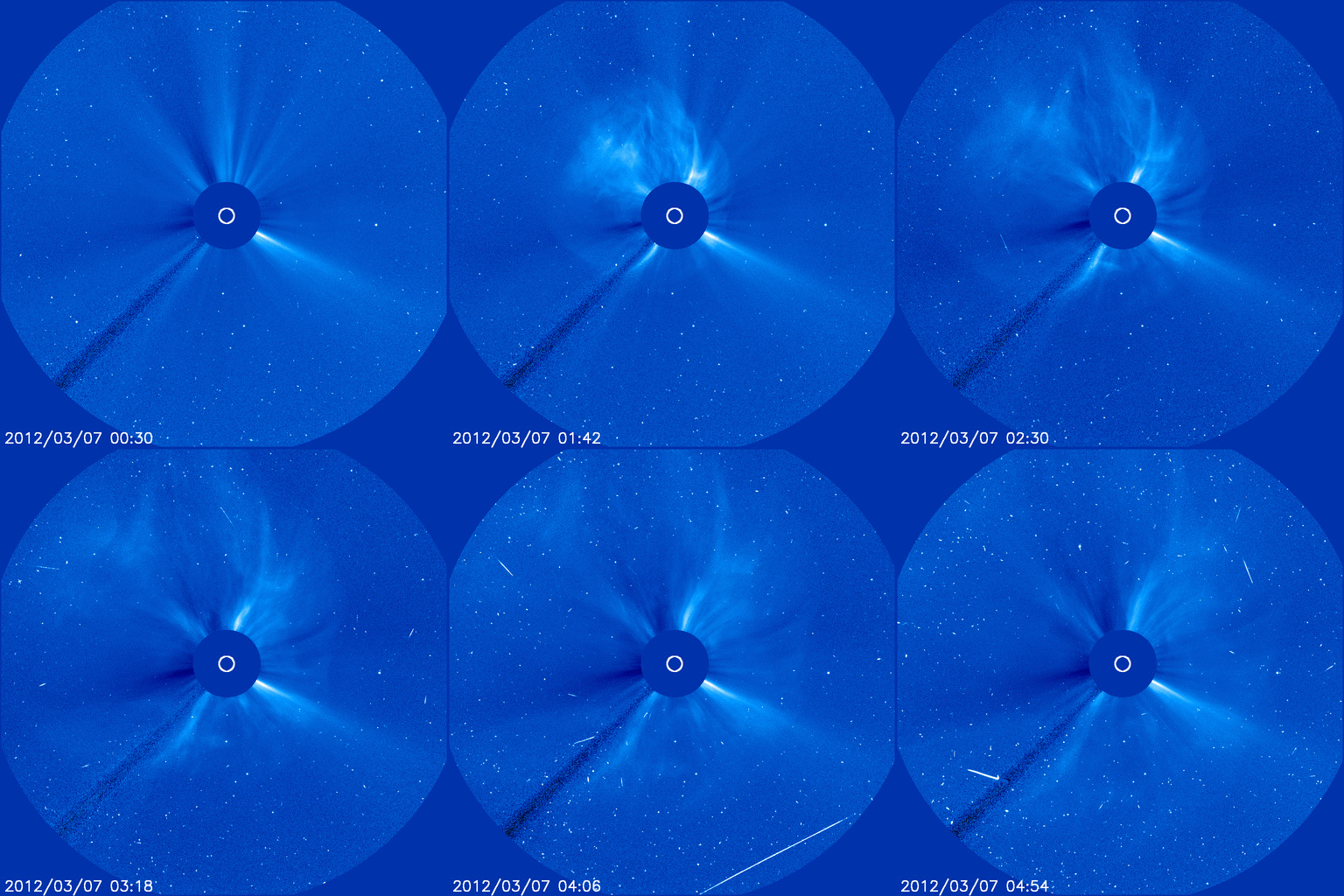
The news was released this morning that an "S-3 class" solar radiation event has been triggered by a monster flare that occurred yesterday. The giant flare (see top graphic from spaceweather.com) is associated with a giant delta class sunpot (see middle graphic) that is expected to generate a number of X-class flares.

Flares generally are headed under three categories by their energies: C, M and X. The X class is the major flare category since those events (delivering x-radiation) can trigger long-lasting storms affecting the ionosphere (among which sudden ionospheric disturbances and short wave fadeouts and blackouts are numbered) as well as interference with commercial aircraft radar. Thus, we always pay special attention to these events in flare forecasts.

Interestingly, the actual flare eruption also incepted a coronal mass ejection, shown here in a movie from the Solar and Heliospheric Observatory. Analysts examining the film and other directional data believe this will only strike us a "glancing blow" - possibly generating enormous auroral displays over the impact dates (Mar. 8-9).

How is it that such giant spot as 1429 get so cranked up energetically that they are able to release so much energy? One very plausible model is depicted in the lowest graphic in which I show two coronal loops - with their bases or "footpoints" putatively anchored in a complex large sunspot such as 1429 would represent. As the photospheric motions increase the loops wrap around each other exchanging magnetic helicity (H(r)) and setting the stage for a fantastic eruption.

“Magnetic helicity” was probably first introduced by K. Moffat in the late 1950s as a topological invariant that describes the complexity of a magnetic field. Generally, magnetic helicity also has “twist” and “writhe” components. It is written as a function of the vector potential (A) and the magnetic field (B), and measures the topological linkage of magnetic fluxes (φ).

The magnetic helicity H of a field with characteristic magnetic induction B within a volume V is defined:

H = INT_ V A*B dV

where INT denotes integral over the volume V .

In actual working solar conditions, one prefers what's called a "gauge-invariant form of H" and this is provided by the “relative helicity” – wherein one subtracts the helicity of some reference field (B (o), e.g. associated with the force-free parameter alpha = 0) and having the same distribution of the normal component of B on the surface (S). Thus:

H_r = [INT _V A*B dV - INT V_o A_ o B_o dV_o]

It is hypothesized that shearing and twisting of the field “injects” helicity and that this may be useful in quantifying: a) how much magnetic free energy becomes available, and b) whether instability can be predicted based on observed indicators of helicity at the level of the photosphere-chromosphere.H(R) can then be resolved into two components such that:

d H(R)/ dt = d H(R) [T] / dt + d H(R) [W] / dt

where term 1 on the RHS refers to the “twist” and term 2 to the “writhe”. We see evidence of the Sun’s magnetic helicity in the solar corona as well as the solar wind that streams past Earth. In eruptive prominences, for example, we actually have images that show the twist and writhe (or helical structure) associated with topological helicity – and which is magnetic helicity in the Sun’s magnetic environment.

For example, if you carefully inspect and study the prominence in the upper right of the image below, you can discern both twist and writhe in the plasma filaments.:
http://antwrp.gsfc.nasa.gov/apod/ap060416.html

Evidently then, prominences are capable of transporting magnetic helicity in the solar corona.

Warning! Specialized stuff!

We now get to the lowest graphic and how that energy is quantified by mutual twisting. Thus, the two different loops shown (a1-a2 and b1-b2) will conform to motions and transfer of relative helicities such that:

d H(a1-a2)/ dt = d H(r’ ) [Ta1a2] / dt = d/dt [ (L1 B_Θ(a))/ (a B z (a))]

d H(b1-b2)/ dt = d H(r ) [Tb1b2] / dt = d/dt [ (L2 B_Θ(b))/ (b B z (b))]

and: L1 > L2

with the radius for L1 = a and the radius for L2 = b, each of which is assumed to remained constant. Thus, the respective aspect ratios (ratio of length of loop to radius) are: L1/a and L2/b.

When a collision occurs between the loops, we expect:

d H(a1-a2)/ dt + d H(b1-b2)/ dt =

d/dt [ (L1 B_Θ(a))/ (a B z (a))] + d/dt [ (L2 B_Θ(b))/ (b B z (b))]


and the increase in relative velocity in terms of the linear velocities (projected on the axes: +x, -x) is:

d/dt [L1 cos w t] = - w L1 sin w t and d/dt [-L2 cos w t] = w L2 sin w t’

where we use w for the angular velocity (the Greek common omega symbol in the graphic)

therefore:

delta H(r’) [Ta1a2] + delat H(r) [Tb1b2] = - w L1 sin w t + w L2 sin w t’

Of interest for generating large flares (hence significant CMEs) is that the relative twists be asynchronous - which may occur if one of the loops or a segment thereof alters its length during the mutual winding. If on the other hand, the relative rotary motions of each loop L1 and L2 are synchronous, w t = w t’ = 2π, one obtains: 2 rho sin (2 w t - w t’ )/[ π (a + b)/2)^2] ~ 0.

In other words there is essentially no net change in helicity. This is more likely to be true for a line-tied case, and the zero net change means an instability is unlikely.

Whether one understands the preceding math or not, we might be in for a nice display in the skies over March 8-9.