Showing posts with label Overpopulation. Show all posts

Monday, July 2, 2018

The Migrant Crisis Is Ultimately A Global Population Crisis

Image result for Keleti station crowds
Part of scene at Keleti Rail Station in Budapest, Hungary - a few days after we left.

It was on the evening of Sept. 2nd, 2015,  that we learned that thousands of migrants - mainly Syrian  refugees -   were flooding into Keleti train station in Budapest. The grim scenes  televised over the BBC into our hotel room were not encouraging, with thousands occupying the station - and mats, people spread all over. The word "bedlam" perhaps best described what we beheld.

After grabbing an early breakfast on Sept, 3rd, we went to the front desk to checkout, hoping to arrive at Keleti by no later than 9.55 a.m. to avoid any delays or confusion.  But Lili, the amiable hotel front desk  manager,  informed us that the station has been totally shut down - no trains running at all. Period. The existing chaos featured tens of  thousands of migrants attempting to board trains to Western Europe on their own, forced the authorities' decision.

By now we know the end result of that mass panic migration, which saw Angela Merkel's Germany taking in nearly 1 million immigrants, triggering enormous impacts - not only in Germany but across Europe.  (cf. WSJ, ' Europe Raises Barriers To Immigration',  June 30- July 1, p. A6).  To sum up: Merkel's right centrist party (CDU) which formed a governing coalition with the Bavarian CSU,  is on the ropes  (cf.  'Merkel Faces Showdown With Coalition Partners', Financial Times today)  splitting with the CSU's Horst Seehofer, over migrant issues. According to the FT account, "if the two fail to bury the hatchet, Horst Seehofer said he will resign, a move that would mark a historic rupture in the center right of German politics."

This is happening  even while Right wing, anti-immigrant governments have come to power in Austria, Italy and been powerfully re-elected in Hungary - with Viktor Orban..

In addition, the EU has been forced by popular pressure to consider diverting the incoming migrant masses,  shifting the processing of asylum claims to African countries.  African nations themselves have been reluctant to host what the EU calls "disembarkation platforms"  fearing they could become magnets for migrants and targets of jihadists.

The disembarkation platform concept itself  is inspired by a model long adopted by Australia, i.e. in which thousands of migrant boats have been turned back and sent to 3rd country centers run by local authorities. In other words, the Aussies have no more stomach to deal with processing migrant asylum requests themselves. Like Pontius Pilate, they are washing their hands of the problem.  Naturally, the Aussie solution has prompted international outrage (ibid.)

European leaders, mindful of the Australian experience, have assured one and all that  the disembarkation platforms will be operated in UN- approved centers within African and other 3rd party nations.  The "bloc has also pledged 500 million euro (about $580 m) to support African countries in managing migrations and to create a new fund to support border security".

The long and short of it is that migrants from whatever nation are getting hostile receptions on both sides of the Atlantic - as well as in the Pacific (with the Australians).  Put bluntly, the world doesn't want migrants. Not now, not ever. The "prosperous" world nations, at least, believe they can keep their quality of life if they prevent their borders from being traversed by millions of "others".  This is magical thinking, to be sure.

In the U.S. we learned ('Shifts In The Search For Asylum', WSJ,  op. cit., p. C4):

"The policy makers who crafted the 1980 Refugee Act never imagined that within a generation the U.S. would have a vast asylum bureaucracy ."

But they should have,  given the exploding global population which must be linked to exploding mass migrations.  It is common sense that if overall human numbers grow out of resource bounds in too many overpopulated, economically stressed nations, those numbers will overflow into other nations less besieged by problems.

The author of the piece, Maria Cristina Garcia,  also noted:

"From 1973 to 1980, only 23, 722 requested asylum....A decade later petitions for asylum increased dramatically due to political turmoil in Haiti and civil wars in Central America."

Noting that in the years from 1980-1991,  400,000 requested asylum.

Apart from the political instability let's note how the human numbers have changed in those cited years. For example, 3.9 billion populated the planet in 1973, compared to 4.4 billion in 1980. But then by 1990  it was 5.2 billion.  All other things being relatively equal one would expect an increase in migrants as well as asylum seekers given the added population. Flash forward now to 2015, the year of the great influx of Syrian and other refugees into Europe and we find the world at 7.4 billion - or 2.2 billion more people than in 1990.  Why wouldn't there be vastly more migrants, asylum seekers?

The false assumption of global planners is that nations ought to remain in population equilibrium and hence not see a third or more of their populations fleeing to 'greener pastures.'  But we know this isn't the case, and any nation can devolve into civil war or other instability if the right confluence of factors emerges, such as they did in Syria.  Let us also process the U.S. has had a major role in a lot of the incipient political instability over the years, especially in Central America. For example, in 1954, the U.S. overthrew the democratically elected Jacobo Arbenz in Guatemala, leading to 200,000 civilian deaths and  endless strife.  Arbenz sought to nationalize the vast banana plantations of United Fruit – but  was ousted in a U.S. engineered coup (“Operation PBSUCCESS”) in 1954. See :
http://www.gwu.edu/~nsarchiv/NSAEBB/NSAEBB4/

The U.S. also, in 1977, backed the bloodthirsty military regime in El Salvador, leading to 70,000 civilians massacred and paving the way for the internal strife and drug linked gangs operating with impunity now. Then starting in 1981, the Reagan administration trained and funded the 'Contras" in Nicaragua, leading to 30,000 civilian deaths and much civil upheaval.  In many ways, therefore, the U.S. could be said to have a direct responsibility to care for those fleeing the violence in Salvador, Nicaragua and Guatemala.

Will things get worse, and mass migrations vastly increase? Of course, because the most vulnerable nations are seeing the largest population increases, combined with severe resource depletion, including food crops (much of this from climate change).  Overpopulation in the African continent is especially worrisome,  as it ought to be to Europeans who fret over the numbers of asylum seekers liable to drown in risky crossings.

In the WSJ piece, 'Humans Lions Struggle to Co-Exist', Aug. 8-9,  2015, p. A7, it was noted:

"Africa's human population is the fastest growing in the world. In roughly the same period as the lion decline (42 percent over 21 years), the number of Africans has doubled to nearly 1.2 billion people. The population will double again to 2.5 billion by 2050 according to the United Nations."

In fact, short of a global catastrophe - say like an Avian flu pandemic or airborne Ebola -  it is projected to reach 5.8 billion by 2100. That means nearly 1 of every 2 people on Earth will be African. Where will the resources be to support them? The jobs? The water? The life quality?   Even if those billions are fortunate to have wise leaders with the best intentions, resource scarcity - including from enhanced climate change - is likely to defeat them, certainly without vast economic support.

Fact is, that the current  global population growth is unsustainable and means either vast numbers will perish, likely of disease, war or famine - or they will do everything they can to go to places with greater opportunity and resources- like Europe and the U.S.  By 2030, with the global population at nearly 8.8 billion, there will emerge total overshoot by one whole planet - that is, we will require an entire extra Earth's worth of resources, e.g.

This means we will need the equivalent of two Earths to support us by 2030, a physical impossibility.  Given the stress on African (and Central American, SE Asian) nations will be even greater, there will likely be migrant flows on the order of 200-400 million per year compared to the 68.5 million this year, according to the United Nations Refugee Agency which released its annual report 2 weeks ago.  The UN report noted refugees pouring out of diverse places, nations including: Syria, Myanmar, Congo and Venezuela.

Ms. Garcia, author of the last cited WSJ piece, correctly points out there are now "few opportunities for lawful entry" for Central American refugees, and the U.S. now -  under Trump - takes a dim view of whatever excuses most have to offer for coming. Basically, traversing Mexico to escape economic hardship simply doesn't cut it and U.S. immigration law "gives priority to those with financial means, education and skills necessary to the U.S. economy"

This is pretty well what Australia also demands, and what the EU is liable to require soon.  In other words, it's a tall order for refugees from any stressed nation to gain entrance to a more developed, economically secure or prosperous one.

What is the solution given the immense increase in numbers leading to overshoot day by 2030? It  is emphatically NOT to increase human numbers purely for economic purposes as some knot headed economists have proposed.  People need to grasp that by reproducing to appease a warped economic system they are merely perpetuating gross economic inequality by helping to sustain a vast pool of surplus labor.  If this numbers game is encouraged worldwide we are asking for a mass migration problem that will make the current one look like a walk in the park. (If labor is needed in the more prosperous nations, the OECD reports there are nearly 230m under or unemployed workers in its constituent nations. Also, there are millions of Central American, African and other immigrants willing to do the jobs Americans and Europeans won't, such as construction, landscaping, and farm labor.)

What to do?  If the U.S, EU, Australia and other centers of greater relative prosperity are serious in their unwillingness to take in millions more refugees they need to dispense more effective artificial contraception and on a scale that dwarfs what is presently available,  This will be most focused on the poorest regions - with fewest resources-  which can least afford more population stress.

This move is dictated by several propositions:

1) Human resources cannot sustain numbers at the overshoot level or even half the overshoot level

2) If those numbers increase, then concomitant mass migrations will as well

3) Since few newly reproduced people will be admitted to existing "prosperous" nations - without negatively impacting them - a solution to limit future population growth must be implemented.

4) If any nations or its leaders claim to oppose mass-dispensed artificial contraception then they are effectively saying they will accept the overflow migrant numbers, so the stressed nations "need not worry".

5) Nations cannot at the same time be against mass birth control programs AND mass migration!

If you are unwilling to limit the numbers on our planet, for whatever "moral" or other reason, you have no choice but to accept responsibility for the vastly added numbers of migrants - whatever their cause-  because of your opposition!

It's time the moralizers who spout off about "protecting life"   and even argue against birth control,  take moral ownership for their decisions and policies.

See also:

http://www.smirkingchimp.com/thread/jim-hightower/79930/a-wall-wont-fix-immigration

And:

http://www.smirkingchimp.com/thread/jeff-biggers/79932/trump-is-following-arizona-s-playbook-on-immigration-we-know-how-to-fight-back

Friday, May 11, 2018

Why Is The Corporate Media Concealing The Over Population Threat?


Isaac Asimov lectures in Barbados, on Feb. 6, 1976. He focused on the Moon, but also touched on the dangers of overpopulation with respect to Earth and its finite resources.

As I read an article in the local paper (COS Gazette) from 15 years ago, by Mitzi Perdue, it again occurred to me how the danger of excessive population growth is being soft-soaped, suppressed as if our consciousness of it is being hollowed out.  Ms. Perdue's article ('Population Quietly Keeps On Exploding') began:

"If you're over 50 you may remember in the early 1960s, one of the hottest topics for discussion was the population explosion. You could read about it on the cover of TIME magazine", e.g.
Image result for TIME population explosion cover

"Or in a book by Paul Ehrlich that topped the best seller list", e.g.

Image result for TIME population explosion cover
as well as constant editorials and articles.   Fast forward to the present and you'll see a startling reversal has taken place:The subject is rarely mentioned in the popular corporate media or by political figures. And this is in spite of the fact that many scientists will tell you that the population explosion is the number one problem facing mankind."

Indeed, one of those scientists - Albert E. Bartlett- within one year of Perdue's piece, wrote a stirring article ('Thoughts On Long Term Energy Supplies - Scientists And The Silent Lie') in Physics Today July, 2004, p. 53):

https://www.colorado.edu/physics/phys4810/phys4810_fa08/4810_readings/bartlett.pdf

Writing that, in respect to why so many scientists remain silent on the issue:

 "Scientists’ general reticence stems from the fact that it is politically incorrect or unpopular to argue for stabilization of population – at least in the U.S. Or perhaps scientists are uncomfortable stepping outside their specialized areas of expertise”.

Adding that whatever the reason, it is equivalent to perpetuating a “silent lie”, a term derived from a Mark Twain quote:

“Almost all lies are acts, and speech has no part in them…I am speaking of the lie of silent assertion: we can tell it without saying a word.”
But while too many scientists have remained silent, the loopy bastion of neoliberal economists continue to chirp that more people are needed!  For example, The Wall Street Journal  article, Nov. 23, 2015, p. A1, 'Population's Flagging Growth Undermines Global Economy', wherein we learn:

Previous generations fretted about the world having too many people. Today's problem is too few. This reflects two long-established trends: lengthening lifespans and declining fertility.

Simply put, companies are running out of workers, customers or both. In either case economic growth suffers

Which is total balderdash given the World Bank and IMF at the time noted the OECD nations had well over 230 m citizens unemployed thanks to a combination of reasons including:   corporate restructuring, increased automation and offloading jobs to cheaper nations.  In other words, the adequate population to carry out whatever labor certainly exists, but just not in the same places!  The solution then isn't to produce more people but to move existing workers to places where jobs need to be filled.

And yet the propaganda that the world and most populous countries need more people continues to be piled on. Such as with the April 30 WSJ piece (p. A1) 'Limit  To China's Economic Rise: Not Enough Babies'.  - accompanied by the subsidiary header: 'The workforce is aging but Beijing's policies still discourage childbirth'.  And why shouldn't they? It was precisely those policies that have allowed China to compete with the industrialized West in terms of financial assets, including a large middle class.   As I've written before, castigating high birth rate morons like Bret Stephens (e.g. Nov. 5, 2015 post), after insisting China certainly has the "space" to pack another billion:

"The point is this numskull has no clue that supporting a massive population isn't simply based on finding the space in which to squeeze them. You also need to consider the support systems, for growing enough food to feed them all each day, as well as the water (clean water) to meet basic needs - not to mention an energy and transport infrastructure. And we aren't even going to get into the number of hospitals (or even urgent care centers) that'd be required to serve all their medical needs."

Then, taking on Stephen's criticism of China's "one child" policy:


"Nowhere in his little rant is Stephens honest enough to cite what China's fertility rate was in 1950. As per an earlier article in the WSJ (Nov. 2) it was 6.11 per woman.  (Compared to 1.55 now).

Does this bozo have any remote idea what such a birth rate would have translated into had China not acted? It would have meant a population exceeding 2.2 billion by 1990 and the Chinese never would have been able to support it, nor would the country have reached the near superpower status it has  - even being a creditor to U.S. bond debt. (Owning nearly $1.3 trillion of our bond debt). Further, China's trade capacity would never have evolved to what it become, nor would it have been able to support the military it has - now rivaling the U.S. in the Pacific.  For all intents, China would have remained little better than one of those poor, overpopulated African nations - from which hundreds of thousands are now trying to flee to get to Europe. "

Or, would have remained as generally impoverished as India in relative terms. (Difference of 10- 15 percent in economic growth, and ability to support a significantly bigger middle class.)   While it's true Indira Gandhi and others tried more coercive sterilization measures to halt India's exploding population, it never worked as well as China's one child policy. See e.g.
The dirty little secret? As India's numbers continued to explode beyond 2000, the Indian government was hard pressed to keep up in terms of providing support, resources.  This is why, when the WSJ pressed China's Deputy Director of its Family Planning Commission (Wang Peian)  - on whether the nation had enough fresh blood to provide able workers, and didn't need more babies, Mr. Wang tersely replied:

"China doesn't have a population shortage. Not now, not in 100 years."

Which is true. Its issue is not in the numbers per se, but the distribution of workers. The worker deficit problem can be solved by allocating more workers, more people then,  where they are needed.  It isn't solved by reproducing more mouths to feed who then must be tended to in their old age! That is the classic definition of a pyramid scheme.

As I've noted already,

"Here is the essential axiom: a nation cannot at once have a vast  rapidly growing population and material wealth. If the population outstrips its available resources it is condemned to destitution. The Chinese themselves, if the earlier WSJ story ('Chinese Face Hurdles To Baby Boom After Policy Shift')  is to be believed, are in no hurry to make more babies via the revised policy either. (And if Stephens took the time to read "ambitiously" the articles in his own paper he'd see that - before writing a column full of codswallop)."

Adding:

"Maybe in Bret Stephens little pie-eyed capitalist clown fantasy world population can grow unabated with material wealth per person, and a family with seven or eight kids can afford "the best'. Alas, it doesn't work like that in most of the real world, by which I mean outside the gated enclaves of the rich.

The Cornucopians like Stephens get it wrong because they don't see population growth for the toxin it is, and can't put 2 plus 2 together to see how it leads to the Malthusian nightmare."

Which brings us to the issue of why the corporate media are so assiduously concealing or minimizing the problem of excess population. Well, first because they don't want you to know there is a problem!  How often, indeed, in the past ten years have you read anything concerning overshoot, i.e. that our numbers and their derivative consumption of existing resources is overtaking what is available? Even moderate UN scenarios suggest that if current population and consumption trends continue, then by the 2030s we will need the equivalent of two Earths to support us.  This is shown in the following graph:

Which I doubt any major newspaper has published since it became available. Why not? Because it would cut through all the propaganda, PR and 'feel good' economic bunkum (e.g. about needing more people to increase global GDP) to show we are unambiguously in a crisis with regard to resource sustainability.

Second, there is no mention that every energy use and conversion pollutes and degrades the environment we depend upon. Hence, the more people, the more energy conversions and the more rapidly we descend into a high entropic, high waste world. (Already nations are refusing waste from the U.S,, e.g. piled onto ships and dispatched from NYC because it has insufficient landfill space). 

Too many of our citizens then fail to appreciate that every energy conversion process has as an accompaniment entropy, or disorder. In most cases this appears as waste heat, as well as pollutants. For example, a car engine produces carbon monoxide as well as carbon dioxide and waste heat generated via the internal combustion engine.  The 2nd law of thermodynamics or entropy law  states that the expelled gas constituents cannot ever be combined again to produce the original fuel. In other words, resource consumption here is a one way process. Resource extraction, such as oil shale fracking also has many adverse effects on the terrestrial environment, apart from the CO2 released when the stuff is burned (e.g. as kerogen)

Turning resources into waste faster than waste can be converted into resources puts us in global ecological overshoot, depleting the very resources on which human life and biodiversity depend.


Lastly, the hedge funds and corporations that own the newspapers and run the boards of directors are in thrall to consumption and ever more debt.  If they spilled the beans about too many people already, they'd have to admit to their agenda of not only exploding population and exploding consumption but exploding debt. Already, consumer debt of all types (including student loan debt) in the U.S. has hit $15 trillion.   The increasing debt itself is a pronounced signal that things cannot go on as they are, e.g.
http://brane-space.blogspot.com/2013/09/44-trillion-in-deficits-by-2024-minus.html

The astute and aware citizen must be sentient enough to know more people is not in humanity's best interest. Isaac Asimov, as part of his Barbados lecture (see top image), warned that humans had two choices: decrease their population to the carrying capacity limit to live in an equilibrium with the Earth and its resources, or let nature “increase the human death rate” (e.g. by starvation, pestilence, wars over resources etc.)

He also remarked:

"It is now the willingly childless woman who is the heroine of our planet. She is the one who now deserves all the kudos and praise, for helping to do what is necessary to spare humanity from the ravages of over-population"


Thursday, March 9, 2017

Another Bloomberg 'Genius" Falls For The Myth That The U.S. Needs More People

The U.S. population clock shows 300 million on Oct. 17, 2006 at the U.S. Census Bureau in Washington, DC. The US population hit the historic milestone of 300 million at 7:46 am EDT.
Let's put it right out there in the open, that this country is bloody crowded with people. Here in Colorado if you decide to go to the mountains or Rocky Mountain National Park any given weekend, you are doomed to wait hours in long lines on the I-25. If you're in Miami or LA the highways are backed up 16 lanes with traffic almost all the time at peak hours. Here in Colorado Springs. unless you make reservations for most places - even 'Mom n Pop' cafes- you're likely to be out of luck. And woe betide you if you have to use an ER, you may wait for hours.

SO on basic observation the claim this country needs more people is bollocks. But here again, the economic eggheads who think they know better than anyone else, are convinced Americans need to make more babies given our decline in birthrate.  The latest one to make this argument is Bloomberg resident columnist Stephen Mihm whose piece 'Baby Bust!'  appeared in The Denver Post (front page Sunday 'Perspective', Jan. 8 )  He writes:

"Shortly before Christmas, the U.S. Census Bureau put some coal in the nation’s holiday stocking. It released data highlighting a worrisome trend: The population grew a subdued 0.7 percent, the lowest rate of growth since the Great Depression years of 1936 and 1937. Declines in the birthrate and the slowing pace of immigration are to blame.

Ask an economist why this matters, and you’ll get a welter of contradictory answers, as the relationship between population growth and economic expansion is a vexed and controversial subject. But if you sift through the historical data on the subject, it’s hard to deny that the demographic slowdown, should it continue, likely puts a damper on future economic growth."

Okay, two quick points to make at the outset. If the central argument is that the economy "needs more people" - which appears to be the case- then Mihm has already admitted (1st paragraph) that the cause need not be low birthrate, but  rather slowing immigration. This elides into another point I've made consistently in these economic arguments: that the world as a whole is overpopulated but any given nation per se may not be overpopulated. Thus, the world has more than ample people, but with different densities in different nations, regions. Hence, less densely populated places can make up for any perceived economic consequences by simply allowing more immigrants into their nations, while not increasing global population. I know this isn't popular with all the Reich wing populist nuts like Le Pen and Trump, but there it is. THAT is what you're going to have to do in an already overpopulated world.

In the OECD nations right now there are well over 230 m unemployed thanks to a combination of reasons including corporate restructuring, automation - and offloading jobs to cheaper nations.  So rather than add to the world's population burden (and the attendant environmental problems)  why not put these current unemployed back to work wherever needed? Make them 'citizen workers of the world' - since the whole market impetus is to globalization anyway.

Second, Mihm - like most of his economist brethren - misses the mark believing population is the major factor impacting economic growth. No, it is not. As I've noted before (Sept. 20, 2013), it is the decreasing energy return on energy invested (EROEI) of fuel sources. In other words, our energy-dependent civilization is becoming ever more impoverished as the efficiency of the energy to run it diminishes over time. Essentially, a nation which had become addicted to energy delivering 20 to 30 or even 40 times as much energy as it cost to extract, now faces a future with energy return 5 to 8  times less. This spells monetary-economic disaster because at the end of the day it is energy which  determines wealth of nations- money is only a medium to represent it.
A report issued by the London investment firm Tullet Prebon as recently as five years ago, and circulated via 'Strategy Insight' newsletter warned:

"For 2020, our projected EROEI of 11.5 to 1 is not as catastrophic as 5: 1 but would nevertheless mean that the share of GDP absorbed by energy costs would have escalated to 9.6% from about 6.7% today. Our projections further suggest energy costs would absorb as much as 15% of GDP (at an EROEI of 7.7 to 1)  by 2030."


This shows the trend in a nutshell and it has nothing to do with population, only that increasing it globally would make matters worse because all those added people would require much more energy to live, including for fuel, food cultivation, transport etc.. And 2b more are expected by 2030.

Again, this shows the problem is not too few people but too many and the core sane solution is to redistribute them for economic maximization. This as opposed to insisting all the more developed nations have more babies.  Not to sound too hyperbolic, but that's kind of like tossing cans of gasoline on a slow burning fire.

We don't need it. But don't try to tell that to these economists! Mihm goes on to admit, however:

"these declines in the birthrate — and the larger rate of population growth — weren’t bad news in and of themselves; if anything, they seem to have been quite positive, going hand in hand with dramatic economic growth."

Well, this is not really surprising given that it costs a hell of a lot to raise a kid from birth  As per a Denver Post Business story ('Discovering What It Costs To Raise A Child') from Jan. 3rd, 2013 (p. 5K) we learn an "average middle class family will need $245, 340 over 18 years, for a child born in 2013"(From a U.S. Dept. of Agriculture 'Cost of Raising A Child' report).   And this is bound to be more expensive in the future as medical expenses will rise, and health care is much more difficult to afford (thanks to the GOP).

That chunk of moola, nearly a quarter million or what each retiree needs to cover medical expenses Medicare doesn't,  includes: "diapers, formula, child care, baby furnishings, new clothes every year, electronic computers, smart phones...and other gear and seemingly don't end when the young one finds a job".

So it's no wonder economic growth would rise if that albatross was removed from many couples' necks.  Additionally,  recall this pullback is being done in an energy environment which is regressing in terms of efficiency.  Northwestern University's Robert Gordon has posited that the Industrial  Revolution (at the turn of the 19th century) had a vastly bigger effect on productivity, economic growth than the so-called "PC revolution" in the 20th. Think about it! The former meant a transition from the impossibly laughable energy of whale oil to kerosene, coal etc., a mammoth jump in the EROEI of available energy sources. The latter transpired over a period of roughly 20 years, over which the EROEI of oil actually decreased from 16:1 to roughly 12:1. So no wonder that even millions of computers were not able to match the sheer change in productive output that accompanied the Industrial Revolution- and within the scope of the latter's purview we include the internal combustion engine, electricity, and indoor plumbing.

Gordon argues, and he's correct, that by the time the digital revolution got under way- say in the 80s- the big payoff in productivity began shrinking. Meanwhile, the PC-computing payoff basically has "come and gone" dissipating by 2004, when EROEI reached below 10:1 and fracking began as a last desperate effort to snare the vestigial ""riches" of oil - along with deep sea drilling.

We come back again to Mihm's reliance on Canadian economist Clarence Barber's study tying economic growth to a nation's population:

"In theory, immigration might have picked up the slack. While Barber didn’t address this in his study, it’s worth noting that Congress put drastic curbs on inflows of people in 1924. That year, approximately 706,000 immigrants legally entered the country. The number dropped precipitously the following year, and by 1933, the number had fallen to 23,000, a decline of almost 97 percent.
How these demographic declines set the stage for the Great Depression is hard to know with certainty, but Barber believed that the decline in birthrates among native-born Americans was sufficient to set the stage for declines in aggregate demand."

But again, I can make the symmetric argument that Barber was remiss in not factoring immigration into his work. And if this is so, then the claimed drop-offs in aggregate demand are a function of labor inputs, numbers not native birth rates.  I can vouch for my own maternal grandfather who came to the U.S. from Croatia in 1914 and had his own corner grocery operating in Depression-era Milwaukee by the mid 1920s. His business did so well he could help many native born Americans adversely affected. Hence, one cannot and must not dismiss the role of immigration, particularly in an already overpopulated world.

The solution for nations perceived to be underpopulated, then,  is to allow a larger influx of foreign workers.  To be sure, I am not elated about adding any more people to this country, because I think 300-plus million is more than enough. We already risk a large surplus labor force which can drag down pay or at least keep it stagnant. But ...if the choice is between Americans having many more babies, and allowing in more immigrants to try to enhance economic growth - I am definitely in favor of the latter!

The truth?  Increased populations only assist Neoliberal  (or conservative - like the Koch bros.) elites who can afford to live apart - in their gated enclaves- but who can profit handsomely by the vast surplus labor pools created. As investors, or even owners,  they can basically bid down wages and benefits to whatever lowball number they want, and if the peons.....errr  workers.....don't like it....they can tell them they will send the jobs to China.  Or, automate them.

In terms of providing health care to the people already residing in the U.S. this is a big deal. There is already a projected physician shortage across all specialties and at least the immigrant physicians - say from India, Jamaica, Iran etc., had been making the shortage manageable. Now, with idiot Trump's new "EO" this may be truncated, even as he's altered his "bad guys" list from 7 nations to 6 - already showing it was contrived to begin with. (Apart from which a Dept. Of Homeland Security Report from a week or so ago stated clearly no attacks of any kind came from any of those 7 nations.)

In addition, the fact that the new GOP health care plan wants to pull the rug out from underneath families shows this is not the time to have more kids. What support - health wise- will you get,  especially if your child has autism, muscular dystrophy or some other condition that demands extraordinary  medical expense?  The answer is none. So the decision not to have children  is rational in this hostile environment. One in which the majority R -party is more exercised and outraged about the unborn than protecting the health of the already born.

Oh, and protecting their financial health too while also not emulating  Jacob Chaffetz- who actually suggested if people want to afford their new Reepo health care they should not buy that new I-phone. Evidently, this monkey isn't aware that a typical premium for health care now costs $18,000 a year, compared to a few hundred bucks for an I-phone. (With blabber like this, Chaffetz is ripe for a takedown by Katherine Allen, a physician from Salt Lake City now planning to run against him.)

By the end of his piece, Mihm seems to catch a glimmer of realism but then that recedes as he writes::

"data released by the real estate firm Trulia last week indicates that the number of young people living with their parents (or siblings) recently hit levels not seen since 1940. That statistic suggests that a baby boom isn’t likely, never mind a boom in consumption fueled by the formation of new households.

But at least the U.S. still has immigration, right? Perhaps not: President-elect Donald Trump has been vocal about his opposition to illegal immigration, but since the election, he has started to send signals that he intends to crack down on legal immigration, too. If that happens, only a homemade baby boom will save us from further decline in the Trump years."


But alas, as I showed, no such "baby boom" will save us because it merely means more biologic energy "sinks" to draw on ever diminishing EROEI energy sources. In addition,  it will massively add to the debt of any families that do have more kids - given their atrocious expense- and in an environment where Repukes will be slicing all possible benefits (including healthcare) to the working and middle classes.

All it will do is speed our nation's accelerating decline, especially given the upside down economics of the Trumpites.

Friday, November 4, 2016

Risk Analysts Agree: Climate Change Is Biggest Threat - But Not On Candidates' Radar


It really wasn't surprising to me to read in the most recent TIME (Nov. 7, p. 48)that one of the elements of angst keeping teens up at night is climate change-greenhouse warming. Logically, it should be given they will be the ones to inherit a planet with polluted cities, oceans suitable only for jellyfish and heat waves that will make current ones look balmy by comparison. And we're not even getting into the major extinction of animal life going on even as I write.

Also, no surprise that according to a recent AP  report, 17 of 21 risk assessment specialists ranked climate change as the top threat to humanity, selected from a broad spectrum. Again, it should be ranked so for any sentient beings paying attention, which often means reading much more than provided by the corporate media. Those who need to understand why the corporate media would not give full attention to climate change, or portray it in terms of "equal and opposing viewpoints" (i.e. to denial or skepticism) should read Robert McChesney's 'The Problem of the Media'.

Anyway, the risk experts were particularly chagrined to observe that neither presidential candidate has the five major threats properly on their radar, or cited in their various speeches. Why not? Is it a fear of "negativity"?  That would hardly be applicable in the case of Trump who revels in negativity, i.e. that the nation is spiraling down the proverbial toilet. But perhaps he avoids threats like climate change  because it entails science, which he  doesn't understand.

So while Trump waxes long on immigration (giant walls needed to build) and terrorism, we hear nary a word about a threat that vastly exceeds either. According to University of California engineering professor and expert on human -caused disasters, Bob Bea,  quoted in yesterday's Denver Post (p. 11A):

"I have not heard or read about any significant deliberations of the major risks that face our country today and tomorrow."

Even Clinton appears to be more concerned with financial  insecurity and gun violence than climate change or the real risk of nuclear confrontation with Russia.  This, in fact, was a front and center worry of The Bulletin of the Atomic Scientists in a recent report - especially as regards Syria and the adoption o possibly "no fly zones".

Both candidates, in terms of ignoring the primary threat of climate change, would have done well to look up last year's 'Defense, National Security And Climate Change Symposium' , held in Washington, D.C.  At the Symposium,  Brigadier General Stephen Cheney stepped up to the podium to discuss 'Conflict and Climate Change'. Cheney, like some other speakers- zeroed in on climate-driven migration, asserting:

"We know for a fact that climate change is already driving internal and cross border migration"

Referencing here, for example, that in Bangladesh - the 'ground zero' of global warming- rising sea levels could displace 15 million by 2050. Oxford University's Norman Myers has projected there could be as many as 200 million climate refugees by mid-century.  Cheney's presentation tagged a number of conflicts that climate change triggers, including the desertification in the borderlands between Chad and Nigeria which "has caused a lot of migration". He also indicated that the terror organization Boko Haram "is simply taking advantage of that".

Other aspects of Cheney's talk cited beefing up military infrastructure at home and abroad to be resistant to harsher climate. The army, in fact, has adopted a 'Net Zero' initiative to make its U.S. bases water and energy independent.  Supporting the national defense position, nearly all the reinsurance companies (like Munich Re) have climate change factored into their tables, costs, plans.

All of the above could have been cited by either candidate - in any of their  forums, debates - but wasn't.  Economic and psychology expert George Loewenstein, was typical of the risk assessment experts consulted in the AP study. He called climate change "a problem that threatens the very existence of the human race and is already having devastating consequences around the world".

Indeed, extreme weather events derived from climate change have killed more than twice as many people in the U.S. as terror attacks in the past 15 years - including the carnage on September 11, 2001.   In fact, the slow rolling disaster of ever intensifying climate change can be thought of as a mode of natural terror which we dismiss or diminish at our peril.

Yet it didn't remotely make the radar in any major political forum. One can understand this omission in the case of a scientifically illiterate or unread person who dismisses global warming as a "blurtation",  but it is incomprehensible for any leader who must confront it.  When asked to rate Clinton and Trump to their attention to major threats facing the nation and the world, 14 of the 21 risk experts gave Trump an average of 'F', and Clinton a C+.  Not much to brag about!

Seth Baum, executive director of the Global Catastrophic Risk Institute offered (ibid.) that Clinton "appeared to be assessing risks based on more careful analysis"  whereas Trump "appears to rely more on intuition". Which is a polite way of saying Trump doesn't read science articles, books or papers but goes by his gut.

The results of the AP survey were similar to a larger survey of 750 experts conducted earlier this year by the World Economic Forum. Their Global Risks Report 2016 found that the five biggest global risks in terms of impact were: 1) climate change, 2) weapons of mass destruction, 3) water crises, 4) large scale migration, and 5) severe energy price shocks.

At least three of the four (and possible (5)) can be directly tied to overpopulation, see e.g.

http://brane-space.blogspot.com/2015/04/earth-day-alert-biggest-problem-remains.html

And:

http://brane-space.blogspot.com/2015/08/of-dead-lions-and-swarming-migrants-why.html

Part of the mandate of our leaders is to bring these threats and problems to the attention of the people. It isn't to allow them to remain ignorant and comfortably ensconced in a fool's paradise.  The risk assessment surveys cited here impart a clear warning shot that it will have to be up to citizens to inform themselves, not wait for their leaders to do it. That then implies action on these issues may have to percolate from the ground up.

Thursday, October 27, 2016

Did You Know The Poor Have Gained The Most Wealth In The Past 200 Years?

Image result for brane space, political elite

"You might think the rich have become richer and the poor even poorer. But by the standard of basic comfort in essentials the poorest people on the planet have gained the most....Inequality of financial wealth goes up and down but over the long term it has been reduced...by the more important standard of basic comfort in consumption, inequality within and between countries has fallen nearly continuously."

- Deirdre N. McCloskey, 'Equality, Liberty, Justice and Wealth', The NY Times,, BU-6, Sept. 4

McCloskey puts forward an interesting premise, but once one reads two thirds through her piece it becomes clear it is yet more Neoliberal propaganda based on precious little evidence.  Start with the nonsense of a "basic comfort" gauge - i.e. comparing the downtrodden masses today with those in the early 1800s living in "tents and mud huts". Are you kidding me? Is THAT really the standard for economic elevation we're going to adopt? For a professor of economics it is incredible McCloskey wouldn't appreciate fully that one must use the living standards of the time - not how the lowest were 200 years ago. Else, one ends up comparing apples and oranges, chalk with cheese.

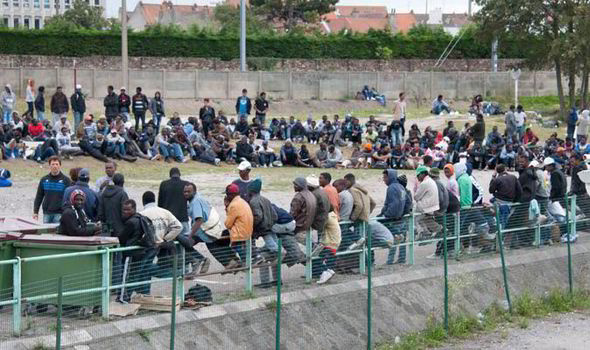
Indeed, if the poor masses have it so great today why are they flooding Europe en masse trying every which way to escape from their lousy economic environs - whether in South Sudan, Bangladesh, Mexico, Cuba, Honduras or wherever, e.g.
calais, migrant, britain, welfare, economic, immigration, population ...
African migrants congregate near Calais to try to make a break through the "Chunnel" to get to Great Britain

Make no mistake that most of these people are economic migrants, which they will admit  to if pressed. They want to get to nations where they perceive increased opportunity, never mind that may well turn out to be a mirage.  Though most attention has focused on fleeing Syrians, in fact the biggest wave is from Africa and this is no surprise because it is experiencing the biggest population explosion.

As noted in the 2015 WSJ piece, 'Humans, Lions Struggle to Co-Exist', Aug. 8-9, p. A7:

"Africa's human population is the fastest growing in the world. In roughly the same period as the lion decline (42 percent over 21 years), the number of Africans has doubled to nearly 1.2 billion people. The population will double again to 2.5 billion by 2050 according to the United Nations."

In fact, short of a global catastrophe (Avian flu, new Ebola outbreak?) , it is projected to reach 5.8 billion by 2100. That means nearly 1 of every 2 people on Earth will be African. Where will the resources be to support them? The jobs? The water? The life quality? Fact is, that population growth is unsustainable and means either vast numbers will perish, likely of disease, war or famine - or they will do everything they can to go to places with greater opportunity and resources- like Europe and the U.S.

Thomas Malthus grasped that an increasing population was unsupportable unless it had access to resources: food, minerals, materials for building, etc., beyond subsistence. He also observed this must be the case given that population grows geometrically (2, 4, 8, 16 etc.) and food production only arithmetically (2, 4, 6, 8). In effect, at some point the population growth becomes so great that the available foodstuffs can no longer support it and one has a crash or dieout.  This is a primary reason for the mass migration movement today, which is also a symptom of endemic poverty.. People understand that they have only one of two choices: starve over the long run or try to get to a place where they might have work, economic security...enough food to eat.

Already, as the preceding image shows, European locations are being swarmed by desperate Africans, from Eritrea, Uganda, Somalia, Nigeria and other countries - as well as by Syrians seeking to escape their civil war. And this doesn't include the tens of thousands also headed for the southern U.S. border, often crossing the Atlantic to Brazil then  going through to Central America. (See the recent TIME on the new migrant influx).

At the core of these human floods is one condition: overpopulation. The population of African nations, for example, is vastly outpacing the ability of those nations to provide jobs or even basic resources. And because these populations consume the scarce resources there are, it means that for their subsistence they are creating ecologic havoc.

That Niger person may not have a Chevy Grand Cherokee belching out 6 tons of CO2 a year but he or she is raiding forests (e.g. for wood to render charcoal for fuel) and thereby decimating the primary carbon "sink". All totaled, between 1990 and 2005 Niger lost 34.9% of its forest cover or around 679,000 hectares. Meanwhile, the total rate of animal habitat conversion for the same interval amounted to 25. 7 percent.

I bring population up because McCloskey as part of her Neolib PR tract  writes:

"Look at the astonishing improvements in China since 1978 and in India since 1991"

But does she seriously believe these economic improvements would have materialized without severe policies to cut back on population?  Take the case of China, for example. It rejected  the world's opprobrium  to implement  a "one child only"  policy.  It opted to do this to contain its numbers so as to strive for higher life quality for all its people. The proof 'is in the pudding' as they say, and if anyone doubts it they merely have to look at the size of China's middle class which now is vastly greater than the U.S. And when you travel to Europe, If you do, you will see Chinese tourists all over- from Jungfraujoch in Switzerland, to Bratislava, Slovakia, to Vienna, Austria and Prague.  There is NO way that many well off Chinese would be turned into globe trotters had the population policy not been changed to provide a more favorable resources to population ratio.

And let's get it straight that lower fertility rates in correlation with greater material abundance and financial status is not peculiar to China.  India by virtue of its mass sterilization policy (attributed to reducing its population by at least a half billion over 30 years)  is also such a success story. It made possible  at least a significant Indian middle class roughly on a par with China's.

McCloskey asks: "What then caused the Great Enrichment?"

And like a true believer, a true Neoliberal acolyte, she writes:

"Not exploitation of the poor but investment, not existing institutions but a mere idea, which the philosopher and economist Adam Smith called 'the liberal plan of equality, liberty and justice.' In a word, it was liberalism, in the free market European sense."

Just give them "equality before the law and equality in social justice and leave them alone", and magical things will happen. 

Which, of course, is codswallop. Because what she is referring to isn't anything other than Neoliberalism and even Adam Smith recognized the need to keep it under control lest resources get out of balance. Smith wrote in his superb book, 'An Inquiry Into The Wealth Of Nations':,

"There are needs in a civilized society that a barbaric one refuses to address" and "What improves the circumstances of the greater part can never be regarded as an inconvenience to the whole". If one reads his 2-volume work carefully, it is clear Smith is not at all exalting or proposing the distorted Neoliberal system at work in the world today. That system disavows economic security provided by the state-  and extols "free" markets ex machina, which are really coercive markets. What Smith advocated was but something more in line with Rhine capitalism.  As the authors of Capitalism vs. Capitalism have noted, the Rhine economies in the 1970s-80s (with large doses of socialist behavior) actually exceeded American cowboy capitalism in productivity for most of the 70s, 80s. Evidently, some ethic of redistributive sharing works, as even Adam Smith acknowledged in his quote above.

Thus the Rhine model of capitalism built in redistribution to benefit those left behind (say the victims of today's trade pacts)  via higher taxation, which U.S. Neoliberals disavowed. Meanwhile, Matt Miller in his book,  The Tyranny of Bad Ideas, has pointed out that all the so-called European "welfare state" economies (e.g. Denmark, Norway, Sweden etc.) fared much better than the neo-liberal, market dominated U.S. during the great recession. They provided the resources for their citizens to be more resilient, and also their higher formal tax structures prevented the sort of macro-scale deficiencies we still see in the U.S. where infrastructure is crumbling, public pensions are under-funded.

In the U.S. capitalist system, it is more rank commercialized competition that prevails - and that engenders a perpetual destruction that ravages precious resources.  These resources include higher quality (i.e. higher EROEI, or energy returned on energy invested) energy sources. Because of population beyond the bio-capacity limit, and especially higher consumption in the Neoliberal economic West, we are headed to a state of degraded energy assets, massive debt and poverty. See e.g.

http://brane-space.blogspot.com/2013/09/44-trillion-in-deficits-by-2024-minus.html

In  a small nation like Barbados, with few natural resources, each must be maximized. There isn't the quantity to allow duplication or other squandering in wasteful competition. In the U.S., the exact opposite holds. Huge amounts of resources are yearly squandered in competitive games- that have only one or a few 'winners'. In effect, the 400-odd  billionaires counted in this country have emerged at the expense of vast finite resources being destroyed forever.

McCloskey also insists we can "improve the conditions of the working class" by "raising low productivity". She claims "enabling human creativity" is what has mainly worked.  In a sense, this is true, but that enabling hasn't been consistent or equally distributed for a number of reasons. One of them is the variability of productivity owing to the variability in the energy sources to drive it.

Thus, McCloskey ignores the history of productivity advances, and what's really  been behind them. Northwestern University's Robert Gordon has posited that the Industrial  Revolution (at the turn of the 19th century) had a vastly bigger effect on productivity, economic growth than the so-called "PC revolution" in the 20th. Think about it! The former meant transition from the impossibly laughable energy of whale oil to kerosene, coal etc., a mammoth jump in the EROEI of available energy sources. The latter transpired over a period of roughly 20 years over which the EROEI of oil actually decreased from 16:1 to roughly 10:1.

So no wonder even millions of computers were not able to match the sheer change in productive output that accompanied the Industrial Revolution- and within the scope of the latter's purview we include the internal combustion engine, electricity, and indoor plumbing.  How can we attain the corresponding drivers of productivity today? We can't without new sources of energy.

Gordon  argued, and he's correct, that by the time the digital revolution got under way- say in the 80s- the big payoff in productivity began shrinking.  In this context no amount of "creativity" would matter because ultimately creativity also is contingent on energy capacity to make the new creative concepts work. Meanwhile, the PC-computing payoff basically has "come and gone" dissipating by 2004, when EROEI reached below 10:1 and fracking began as a last desperate effort to snare the vestigial ""riches" of oil - along with deep sea drilling.

What might change the equation? Well, nuclear fusion power, but don't look for it anytime soon. See, e.g.

http://brane-space.blogspot.com/2016/04/fusion-power-within-ten-years-basically.html

 The mistake the Neoliberal species called "homo economicus"  continues to make, then, is confusing advancing technology with adequate, high quality energy supply needed to actually leverage creative processes into widespread use for the benefit of all.
The Neoliberal cornucopians like McCloskey get it wrong because they don't take such factors into account nor do they see population growth for the toxin it is, and can't put 2 plus 2 together to see how it leads to the Malthusian nightmare (not necessarily on Paul Ehrlich's timetable).  All of this comes back to net energy which is that energy humans need to survive. If the oil taken from the ground, say by fracking, only has a ratio of 1:1 (for energy produced to energy consumed) then it is useless to extract it. The same amount of oil-energy you are using up to get it, is basically what it carries. There is no net gain.

It is the periodic net gains made possible by higher grade energy sources  that have allowed humans to reproduce and thrive in many places around the globe.  But there has always been a critical balance between the given energy capital and the rate of human consumption. Too little, productivity languishes, too much and existing energy sources become scarce or degraded and productivity still languishes.

It is currently the erosion of net gain (reflected in ever lower GDP)  that will eliminate a majority of  humans. Right now, with humans consuming nearly the equivalent of 1.6 Earths per year there is no way even a population of 7.3 billion can be sustained - far less squeezed into an area the size of Texas as the dimwit Bret Stephens once claimed. (WSJ, 'The Tyranny of a Big Idea', Nov. 3, 2015).
The Neoliberalism McCloskey worships only succeeds because it basically rigs itself against the citizens with fewer assets. This increases inequality, and worse, consolidates the power of the richest on the political system, especially in the U.S. This is why one can have laws which protect profiteers, such as corporations in Denver who refuse to build affordable housing because it doesn't redound to their profit demands or benefit. This leads to deplorable conditions like that shown below:
Michael Lee, 38, looks at a water bottle his daughter Kayah Lee, 6, brought back as her mom, Cristal Olko, 32, and sister, Kemani Lee, 3, look on at the A homeless family crowds into a corner of an Aurora, CO shelter. A food shortage at the shelter meant it had to seek outside assistance. How is Neoliberalism benefiting them?

The affordable  housing situation is so dire in the Denver area (as it is in others, e. g. Miami, San Francisco), that the city must hold a lottery every fall to award 700 to 1000. Section 8 vouchers.  Without such vouchers, a Denver resident would need an income five times the median existing one just to own a home at the median price. He or she would need three times the income to rent - given a median rent in the area of $1700/ month. Do the math for a Walmart clerk or Starbucks barista and see how that works out. And what of the 1.5 million Americans who live on only $2 per day, as reported in Project Censored's No. 5 most concealed story?  (Colorado Springs Independent, Oct. 26- Nov. 1, p. 24)

Here in Colorado Springs the  affordable housing situation isn't much better. The median home price at $262,500 - while less than Denver's ($345,000)  - is still beyond the reach of service sector workers. The mean apartment rent has spiked to $991/ month,  leaving many others in the cold.

What is Neoliberalism doing to rectify this situation? Well, nothing, because as McCloskey writes it's premise is "to leave people alone once laws for social dignity" are in place, oh as well as "equality under the law" (as I've shown, a total farce, given it doesn't exist in practice).  If the laws themselves are predicated on coercive markets instead of genuine free markets, this is a myth. To quote Charles Reich, Opposing the System, Crown Books, 1995, p. 22:

"A free market produces results that favor the health of society as a whole, because an essential balance is maintained. But in a coercive market, the balance is destroyed, the earning power of work and the standard of living of workers declines, and society as a whole is devastated while those with economic power gain an ever more unbalanced share of the nation's economic wealth."


Adam Smith, if he saw McCloskey's paean to the Neoliberal idiom would be turning over in his freaking grave.

Thursday, April 28, 2016

Capitalism IS A Zero Sum Game - It's Time Its Apologists Understand That


Despite Bernie Sanders' campaign bringing some degree of enlightenment to the 2016 presidential race (by making it okay to criticize capitalism), much more needs to be done. That includes holding its sundry apologists to account for the loose thinking, and false logic they consistently display.. One such case emerged in the August 15th issue of The Economist in a review of John Plender's book: Capitalism: Money, Morals and Markets.

The anonymous reviewer observed how "capitalism lacks defenders while protests against it have fresh vigor" forgetting that most of those protests have not occurred in the mainstream media but in the marginal media or blogs, as well as on the streets. Hence, it's debatable how much of an impression has been made.

What we can say is that when an illustrious person like Pope Francis speaks out on capitalism's ills, or a Thomas Piketty (in his books) then it's more likely the mainstream news takes note - but more often than not criticizes the critics for their short sightedness. Thus, in the review of Plender's book do we see a faint damning of ancient critics like Socrates who "declared that the more men think of making money, the less they think of virtue."

Which is probably true for most humans, just look at the tallies of those who win giant Powerball jackpots then blow them on booze, drugs, unwise gambling or unwise investments (often in the same category as the previous one).  Money -sighted people then, as I've often found, are basically two dimensional operating on the existential axes of time vs. money and seldom express an original thought outside this reference frame,

Gordon Gekko, of 'Wall Street'  movie fame,  may be something of a caricature but his basic persona is often replicated in many of the Street's money men (bond traders, investment bankers - once referred to as "big swinging dicks" by one of them in a FORTUNE piece, or plain old stock brokers.)   Their failure in morals then, if it transpires, usually occurs by virtue of a failed larger vision or perspective. One that transcends their yearly bonus and where they will spend their grand vacation or how - killing protected lions in Zimbabwe, or going on a week -long million dollar golf binge at a St. Kitts resort, while their wives enjoy $250k each rose and wine wraps - with or without cucumbers.

Usually, the defenders of these guys just plain fail to see the vast harm of which they are capable. Consider just the credit meltdown and freeze of 2007-08. How many attribute the cause to the correct source? Very few! Usually the lazy media (often right wing) blames it on poor dopes who had maybe $100 in an account but were offered sub-prime mortgages by unscrupulous scheisters (such as depicted in the film, 'The Big Short'. Based on the excellent book by Michael Lewis).

Seldom (either) do they look at the pseudo-intellectuals or “quants” that helped develop the Gaussian Copula formula (see embedded graphic at top) who were quite confident that when they applied it to the development of credit default swaps (a bastardized form of credit derivative)  they’d be virtually home free. On account of the lingo used and the complex nature of the underlying formula – few ordinary mortals would figure them out before it was too late.

To refresh memories, these nasty devices were geared to enable commercial banks (the ones that hold your passbook savings) to leverage their assets to preposterous ratios, sometimes as high as 33:1.  In other words, their generation of profits would largely be based on phantom money – since they lacked the reserves to make good if the bets (which is what the credit defaults swaps were) failed. In the meantime, the Gaussian formula itself allowed the credit derivatives to be sliced and diced numerous ways to package them throughout ordinary securities such as collateralized mortgage obligations.  The failure of the credit agencies themselves to be onto the junk bond nature of CMOs and allowing the presence of one fraction of ‘AAA’ bonds in each – then designating the whole AAA - led directly to the collapse of the credit markets in 2008.

 Since then  it’s become ever more evident why elite economics is a failure and can’t even be regarded as a science like Physics, or even in a “pre-scientific phase” . If it had then the main practitioners of the dismal science ought to have been able to predict the effect of their CDS on a vulnerable home debt market. They didn't.

 In the case of the Gaussian copula, invented by David X. Li  -  while working at JP Morgan Chase and articulated in his (2000) paper: ‘On Default Correlation: A Copula Function Approach”  -  it wasn't even a true mathematically sound equation analogous to those used in physics or celestial mechanics.. It was more an intellectual Frankenstein monster that never should have seen the light of day any more than a four-headed baby with a pointed tail. For example, Li's misuse of the distribution functions (FA(1)) and (FB(1)) would appall any genuine mathematician or physicist. Each is actually based upon significant uncertainties via survival law distributions which can vary enormously. There is no way to normalize any probability based on (TA, TB so there is no way to equate Pr[TA, TB] to anything on the left side. The equal sign is dangerous recklessness masquerading as math. Did the illustrious economists or "quants" know any of this when they cranked out credit default swaps? Or assigned the bonds in which they were buried AAA ratings? The evidence of failure to predict the 2008 credit crash shows they didn't.

 
All of which supports Chris Hedges’ condemnation of these mental zombots, i.e. p. 98, The Empire of Illusion:

“They cannot grasp that truth is often relative. They base their decisions on established beliefs such as the primacy of an unregulated market or globalization, which are accepted as absolutes.”

 
In other words, these money men and derivative inventors inhabit a self-confected, solipsist world of illusion devoid of critical empirical testing or critical thought. I mean, Jeez, if any one of these so-called geniuses would have just taken the time to understand WHAT he was doing in applying the Gaussian Copula to credit derivatives he’d likely have seen it was the equivalent of a physicist taking a tiny piece of special relativity and trying to inject it into areas that had no relevance because the primary criterion (speeds near c, the speed of light) were not being  met.

But see, at least physics has and uses empirical testing before advancing – so the odds are less that physicists will make asses of themselves. Not so with these economic, political elites.   Unlike astronomers,  who can accurately predict the position of Jupiter or Mars in 2050 or the next lunar eclipse or occultation of a star, the economists can't even predict simple stuff in their immediate domain - say like forecasting the growth would be 3.2 % in 2011 when it was only 1.7%
 
Remarkably, Plender is aware of the cost of high finance on capitalism's rep and this is pointed ou by the reviewer (p. 75):
 
"It's not just that few people can see the benefits of complex financial products like credit default swaps. He adds that 'bankers have undoubtedly done their best to give capitalism a bad name. The extraordinary scale on which big banks have been rigging interest rates and foreign exchange markets and ripping off their customers is almost beyond comprehension."
 
Fair enough, but it still doesn't let the system itself off the hook, which breeds these tactics and the money men who use them.  This leads to a blindness about perceptions of capitalism.
 
For example, the reviewer's claim - echoing Plender- that the financial crisis was the latest example of "the inherent stability of capitalism", i.e. "allowing it to benefit from creative destruction". In fact, the financial crisis was just the opposite, a glaring example of capitalism's instability.  We actually came within a hair's breadth of another Depression and only barely escaped because the political system and party in control at the time was enabled by votes to use taxpayer money (nearly $897b) to bail the system out and interject liquidity.
 
In the same manner, if a series of nuclear reactors were to "nearly melt down" - governed by the same computerized control algorithms - one would not argue or assert the "system is stable" or "shows stability".  But no one - after all the taxpayer money was spent - came after the clowns that nearly wrecked the financial system, leaving it open to future predations.

Why do we keep paying attention to these clowns? Just because they have Harvard, or Cambridge or Stanford or whatever degrees after their names? Mainly, yes – and also because the politicos who achieve high office tend to install them in their cabinets so instead of being relegated to some corner office behind the walls of ivy, they have the ear of Presidents and Prime Ministers. These clowns can then help determine national policy which is usually to the detriment of the rest of us.

At root of it all, which none of them or the bought out media will tell you, is that the trillions of bucks circulating in the capitalist markets represents  FORCE. A force that can crush opponents underfoot, including presidential campaign opponents who dare to bring its nefarious consequences (to our electoral system) to light.

They also don't want too much exposed because they know deep down as capitalism ramps up it generates millions of losers a year, not to mention destroys what's left of our natural environment. As Naomi Klein has pointed out, it's no coincidence that a capitalism has spread and consumerism reached exponential levels, the planet's atmosphere has been laid waste to via the Greenhouse effect.

The Economist reviewer's claim then that (ibid.):

"For all its faults capitalism has raised the living standards of billions of people since the 18th century and improved their life expectancy"

Is only a half truth, since it ignores the other side: that this enhancement of living standards and life expectancy has come at the cost of the planet as a habitable future abode. These long lived consumers (no longer seen as citizens) now plunder the planet to the tune of the equivalent of 1.5 Earths' worth of finite resources per year. They are driven by capitalist-based advertising to do so, as it generates ever more 'wants' as opposed to fulfilling actual needs. Thus, every manjack has to have his own car to drive and pollute  with CO2. Every unused computer or 'Barbie' tossed into the landfill - along with soiled diapers and plastic bags - creates ever more waste and hazards.

It is no surprise that pollution and cancers have reached a peak now as ever newer weedicides and pesticides have to be created - not to mention GMO crops - to feed a growing population in which food sources must keep up with numbers.

But the other perverse aspect is that capitalists love overpopulation because it means - n their minds- vast "markets" of global consumers to buy their ever larger quotas of crap, that ever lowers Earth's store of non-renewable resources.

Perhaps no one has better explained the connection of global warming, especially, to capitalism, than Naomi Klein. Readers who are interested should get hold of her book, This Changes Everything: Capitalism Vs. Climate Change.  Basically, as Klein argues, capitalism is unable to affect or alter  the course of climate change due to its dependence on fossil fuels and need for continuous growth. Also,  the time for marginal fixes has expired, thus forcing us to now make radical changes in how we live.

 We simply don't have the luxury of using all the carbon that lies in the Earth. Yet capitalism's never ending growth engine would demand we do so to support the expansion of new markets for exploitation and wanton consumption.  Failing to note that the more we take from the Earth the less real wealth we have left: a zero sum game.