Showing posts with label Austrailan heat wave. Show all posts

Thursday, April 4, 2013

Australia's Heat Calamity Summer - A Preview of Our Own?

Tim Holmes
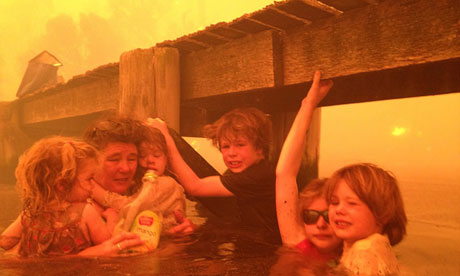
Family taking refuge under a bridge  from a firestorm that erupted in Tasmania in January.

The recent extreme heat waves, flooding and brush fires ravaging Australia may well be a wake up call for the rest of us, especially in the northern hemisphere. The sad part? All those events which have naturally occurred – such as droughts and heat waves – have intensified under the onslaught of climate change.


Meanwhile, the Australian Climate Commission has stated that only fast and deep cuts to carbon emissions can begin to reverse the trend. According to Prof. Will Steffen of the Climate Commission:

“We are very concerned that the risk of more extreme and more severe weather events is increasing as we continue to emit more and more greenhouse gases.”


Chief Commissioner Tim Flannery (author of ‘The Weather Makers’) noted in addition:


“Records are broken from time to time but record breaking weather is becoming more common as the climate shifts. Only strong preventative action, with deep and swift cuts in emissions this decade, can stabilize the climate and halt the trend toward more intense and extreme weather.”

The Commission report states that the number of record hot days in Australia has doubled since the 1980s with the summer of 2012/13 featuring the hottest summer, hottest month and hottest day on record. By comparison, in 2009, Melbourne experienced three days with temperatures of 43 C (109 F)  or higher. Now, this recent summer, that level has occurred much  more often leading to 980 heat- related deaths.

The Australian Commission Report went on to note:

"There is little doubt that over the next several decades, changes in extreme events will increase the risks of adverse consequences to human health, agriculture, infrastructure, and the environment in Australia. "

Drought in Australia, meanwhile, has impacted key growing regions reducing crop output and leading to increased food prices.

Beyond the risks to human life the Report also noted the economic costs that extreme weather can cause. In many ways, for the economic scale of Australia, the costs of radical climate change events rival the costs in the U.S., for example from Superstorm Sandy and other intense storms. And the future projection is that these will be worsened.

The Report also noted that global warming has caused global sea levels to increase by an average of 20 cm, or more than half a foot, though our own media in the U.S. haven't made this known. But it explains many of the problems being experienced in terms of flooding from storm surges around the world.

The U.S. projections aren't any better, according to a U.S. Forest Service Report on Climate just released, e.g.  http://www.treesearch.fs.fed.us/pubs/42610

As it notes,

"By the end of the 21st century, forest ecosystems in the United States will differ from those of today as a result of changing climate. Although increases in temperature, changes in precipitation, higher atmospheric concentrations of carbon dioxide (CO2), and higher nitrogen (N) deposition may change ecosystem structure and function, the most rapidly visible and most significant short-term effects on forest ecosystems will be caused by altered disturbance regimes. For example, wildfires, insect infestations, pulses of erosion and flooding, and drought-induced tree mortality are all expected to increase during the 21st century."


Insect depradation and invasion will be particularly ramped up and in an updated report in today's Denver Post it was noted that raging wildfires will occupy twice as much area by 2050 as they do now.

Even before the Forest Service Report appeared, most of us in the Rocky Mountain west expected a hellacious summer that rivals the last, including just as many wildfires (recall the Waldo Canyon last year) and heat waves that may last weeks. The worst part of it is that having moved to these parts for their scenic beauty we're now faced with seeing forests ravaged by pests, more and longer droughts, and fire seasons that may last for months.  The rest of the nation will, of course, have its own climate burdens to contend with, including: floods, tornadoes, and powerful hurricanes.

In spite of this, why is it so difficult to get people to pay attention, far less change? The obvious diconnect between information and action isn't that mystifying when two other trends are considered that have ratcheted up over the past 20-30 years. One is related to research in behavioral science, highlighting the human tendency to sift facts using emotion based filters (i.e. 'How much will this affect ME, personally?") and to favor short term payoffs over longer term adjustments or solution. The second is the sustained disinvestment in alternative energy which has been ongoing since the Reagan administration.

I would also add an additional factor has been the agnotology agenda of the Right wing corporate media, which has continually downplayed the risks, basically allowing governments to fiddle while the Earth burns. Recall here that agnotology has been defined by Stanford historian of science Robert Proctor as the trend of skeptic science sown for political or economic ends - e.g. in imparting ignorance and faux skepticism.

Sadly, even as we've learned the pace of global warming is accelerating, this agnotology meme has probably delayed us too long to prevent the worst climatic changes.

Saturday, January 12, 2013

A Vision of Humanity's Near Future?

Tim Holmes As the debate on climate change and global warming continues - annoyingly, since it ought to be settled by now - one harrowing image that has made the rounds of global media stands as a devastating portent of what we may all soon face. That image - taken by dad, Tim Holmes- captures wife Tammy Holmes and their children huddling under a bridge from a firestorm that erupted in Tasmania. This image needs to be fully absorbed and processed by all the remaining deniers. The incident occurred as Australia and Tasmania have expererienced the hottest summer ever (it's now summer in the Southern hemisphere) with Australian officials having to actually invent a new temperature color coding for their maps, showing temperatures up to 130 F.

Of course, 2013 has barely started but the photo image shows what we may likely face in the Northern hemisphere come June, July. For the record (no pun intended) July 2012 was the hottest ever recorded in U.S. annals with a mean tempeature of 77.6F.  The average annual U.S. temperature for 2012 was 55.32F or one full degree higher than the old record set in 1998. (So much for the codswallop that all temperature increases ceased in 1998. But as I showed in earlier blogs, 2011-12 and onward would bring even higher temperatures if all the graphs presented in a 1998 Nature paper were properly interpreted.)

Even more eye-popping, the year 2012 displayed an average temperature a full 3.2 degrees hotter than the average for the entire 20th century! Meanwhile, nineteen states set yearly heat records - though Alaska was a bit cooler than average.

According to the National Climate Data  Center (whose completed data comes out this coming week) through the first 11 months of 2012 the world was on pace to have its eighth warmest year ever. More distrurbing still, 16 consecutive months have seen the U.S. with higher than average temperatures.

Of course, people being what they are, their brains begin to numb after dealing with only relatively small subsets of climate stats. Turnoffs can come even sooner if the stats bear out an unfolding calamity. However, a single graphic photo can focus human attention in much the same way the proverbial hangman's noose to the soon-to be executed.

Are humans soon to be executed? Very possibly! It's already pretty clear that the 2 degree Celsius "firewall" to avert runaway climate change-global warming will be crossed, e.g. http://www.brane-space.blogspot.com/2012/12/the-doha-verdict-2-degree-threshold.html  this means an unsettling yearly increase of solar insolation arising from Greenhouse warming every year, averaging about 2 W/m^2.  This also signifies that 2 parts per million of CO2 has been added to our atmophere each year. What is the runaway tipping point? Some say it's at 450ppm, others say 500 ppm. If it's 400 ppm right now, that means that a rate of addition of 2 ppm/yr we may hit the runaway greenhouse in 25 years. But that assumes the same rate of fossil fuel consumption as now.

Some say - on glancing at the Tasmania image: "Oh well, that's different! It's Tasmania!"

However, if they'd had the sense to check a global map they'd see that the Tasmanian town near which the Holmes family took refuge under the bridge is at about 41 degrees South latitude. Now, "mirror" that latitude to the northern hemisphere, say applicable to a northern hemisphere summer, and what do you find? Well, very close to New York City's nothern latitude, or that of Boulder, Colo. or Redding, CA. So don't get too damned comfortable, northern hemisphere dwellers! Our time is likely this summer!

Indeed, here in Colorado we already got a taste of monster wildfires last June and July. It's one we don't want to repeat. We saw literally mile high flames shooting up and people running for their lives near Waldo Canyon, having to leave their homes with barely their jeans and shoes. The sky was befouled for weeks, with even more CO2 from the burning trees injected into the atmosphere.

What awaits us now? Who knows, but it seems the fossil fuel addicts are as busy as ever trying to dredge up the last vestiges of petroleum, never mind the cost to the planet.

It is time people everywhere closely absorb the image of the Holmes family, because - perhaps even more than the wildfire photos coming out of Colorado last summer- it ought to remind us of what sort of life awaits us if we continue to refuse to clean up our sorry act.