Showing posts with label Alvin Toffler. Show all posts

Monday, December 2, 2019

A Four-Day Work Week? Be Careful What You Wish For

No photo description available.

All of a sudden we're learning that Microsoft is "testing" a 4 day work week. Indeed, the company had already commenced with an experiment earlier this year in Japan.   We also learn from a recent Denver Post Business article ('In Test Run, Four -Day Work Week Boosts Output', Nov, 10, p. 5K):

"Even in a country known for its extreme overwork, the shorter week had a big boost in prdoctivity".

Adding:

"The test run, which took place in august and gave employees five consecutive Fridays off, boosted sales per employee by 40 % compared to the same month a year earlier....The test was billed as being part of a 'work life choice;  strategy helping employees work more flexibly."

A great boon to workers, especially with families?  Hold strain!  The shorter work week comes with a cost: less free time each day because you will now be working TEN hour days, not 8-hour.  And because corporate employers will still want to squeeze out that extra face time - just as 8 hour days becoming 9 or 10, look for 10 hour days becoming 11 or 12.  Don't think that's possible? Then you are fooling yourself. As one UK website points out:

"In reality, most employees on a four day week will most likely be expected to work the same 40-hour weeks, but in four days instead of five. In this case, shifts might be extended to 10 hours. Longer days could have a significant effect on your employees' stress levels and therefore their overall wellbeing and productivity. "

  As the Post piece also warns:

"Some smaller companies that have tried the idea cheer its benefits ...but they have also said it can lead to workers pushing the limits on long weekend scheduling and result in more pressure- filled days when people are on the job,"

Adding:

"Some have warned the push could cut workers' pay, hurt competitiveness, and that a move toward reducing hours rather than legislating  cap is more desirable"

Indeed, futurist writers like Alvin Toffler, e.g.  in his two books,  'Future Shock' and 'The Third Wave', had predicted vastly increased leisure time for future U.S. citizens. For example, in the latter book, he wrote (p. 276):

"Thus we are moving toward a future economy to which very large numbers never hold full time paid jobs, or in which 'full time' is redefined .. .to mean a shorter or shorter work week or work year."

He then cited the case of Sweden in which a "full time" work year continued to mean "1840 hours" or in more practical terms, 1600 hours.   Using that example, then under the currently offered "4 day work week" one ought to expect 4 days with eight hours a day put in, no more.  This would be the work week redefined downward as Toffler indicated.

 We know that never came to pass given that more computers, added gizmos etc. simply compounded the volume of work and thereby increased the demand for more productivity.  All this tied to the GDP or GNP (gross national product)

Let's also please note that comparing the workaholic Japanese  and their productivity gains to those of American workers is  like comparing chalk and cheese.  This is perhaps why, according to the Post article:

"None of the 2020 Democratic presidential candidates had embraced the idea (of the four day week) even though they have backed other ambitious ideas, such as universal basic income or a federal jobs guarantee."

But there really is no mystery in their avoidance here, as opposed to their embrace of the two other proposals. The reason is that they would know - as the UK website pointed out - there's vast room for corporate exploitation of this 4 day week, especially without legal caps on work hours.  So as the site noted, repeating it again:

"Longer days could have a significant effect on your employees' stress levels and therefore their overall wellbeing and productivity. 

SO why would any Dem candidate worth a grain of salt back such a daft proposal?  UBI or universal basic income on the other hand is a :"plus one" for workers in that they receive that money (most estimates are $1,000 a month) in addition to their wages.  Hence, can more easily pay off debts and keep up with medical bills etc.  As for the federal jobs guarantee, that is an unconditional plus for any unemployed but qualified person, again not open to exploitation like a four day work week would be.

What the Dem candidates WOULD back, but which we are unlikely to see from the Neoliberal corporatists,  is a TRUE 4 day week, meaning four,  eight -hour work days but with the pay scaled to a 5 day, 40 hour week.  In other words, less total hours worked but still receiving the same pay as for the longer, original  5-day  work week.

But as I wrote in previous blog posts, don't look for this alternative to happen anytime soon.  That better option isn't what's on offer  because economists keep to a rigid definition of GDP and what constitutes paid work.  As Toffler explained at the time (pp. 282-83):

"Should not a man or woman who stays home and rears a child, thereby contributing to the productivity of Sector B (the formal exchange sector market)  through his or her efforts in Sector A (the informal self-directed, unpaid labor market) receive some income even if he or she does not hold down a job in Sector B?"

This echoes what I wrote in a Feb. 5, 2018 post on the need to redefine the GDP:

"GDP is supposed to measure the total production and consumption of goods and services in the United States. But the numbers that make up the Gross Domestic Product by and large only capture the monetary transactions we can put a dollar value on  ....Almost everything else is left out.  ....In addition, there are hundreds of other contributions not registered that arguably have  major economic impacts. For example, a 2015 Forbes article highlighted how 40 million family caregivers in the U.S. are putting their own careers on hold to provide unpaid care — sometimes for decades.   The estimated  total value of the care has been put at nearly $1 trillion. This isn't reckoned into the GDP but IF it were,  the labor productivity would surely be much higher in the years since 2007."


As Toffler further observed (p. 280):

"There is no recognition as yet that actual production also takes place in Sector A  - that the goods and services produced for oneself are quite real, and that they may displace or substitute for goods and services turned out in Sector B.  Conventional production figures, especially GNP figures, will make less and less sense until we expand them to include what happens in Sector A."

To simplify all this further, if American workers are already doing much "Sector A" work, say care giving for a child or spouse, it should be a no brainer that a 32 hour (4 day) work week makes eminent sense. It allows the worker to commit 32 hours to "Sector B" paid work but also allows him or her time to take care of family needs on the 8 other hours (for which he will now be paid, but are not worked in the formal job).  The issue here is that a 4 day, 10 hour a day job does not make that cut and I am sure Toffler would agree with me - if he was still alive.

The problem we face is that the wealthy owners and capitalists (especially hedge fund owners of hospitals, banks etc) who largely  fund economists' research,  still are committed to reducing pay as much as possible while squeezing every last additional hour of toil from hapless, already overworked (Sector B working) citizens. No one, therefore, ought to be fooled that this 4-day work week now on offer is any kind of boon.

Unless one is a confirmed workaholic, of course.  Or has no family that requires outside of (paid) work attention.

See also:


http://brane-space.blogspot.com/2011/06/modern-economics-its-evil-basis-pareto.html

and

http://brane-space.blogspot.com/2011/06/modern-economics-its-evil-basis-pareto_13.html


Saturday, September 28, 2019

Future Shock and Decision Fatigue - Are They Really One And The Same? How To Deal With Them

Image result for brane space, besieged brains
Never mind the incessant, infernal chaos and toxic memetic emissions  emanating from Trump world, we can't allow that detritus to dominate our waking lives.  As functional and conscious humans we all have other things apart from Trump and his denizens to task us mentally, emotionally.   Namely, that from the first minute any of us awakens each morning, our brains are already overwhelmed with too much stimulation.   We're basically saddled (by evolution) with brains still more attuned to identifying predators on the savannah as opposed to adjusting to the cacophony of a modern city with its congested traffic, lack of green space, and noise.

In addition,  each day we face an overwhelming number of choices: Whether to exercise or not, how long if we do, what clothes to wear, what breakfast to eat, which tasks to prioritize and so on.  To make matters worse, we’re constantly bombarded with notifications from our  digital devices—emails, text messages and phone calls—as well as disparate information on the web.
It’s no wonder we’re exhausted at the end of each day. Our brains are constantly multitasking and working 24/7 without a break.  That was not how evolution designed them, and it will take another 100,000 yrs. at least to get to that phase.
This condition of maladaptation  is what author  Alvin Toffler in his 1970 book, Future Shock" referred to  as "over choice ".   Too many choices, especially in media, diluting any collective attention to one thing, one show, one event.  A Wikipedia item references:

"The phenomenon of overchoice occurs when many equivalent choices are available.Making a decision becomes overwhelming due to the many potential outcomes and risks that may result from making the wrong choice"

The basic assumption is that humans are rational agents and, when offered a set of choices - say for a product- will end up making the optimum one. But in an excellent book entitled The Paradox of Choice, the author showed this isn't the case and when humans are offered a surfeit of choice they punt! They either don't make any purchase, or they opt for the first one that comes to mind or the item most prominent in their field of vision.
Alvin Toffler himself wrote, in terms of "decisional overstimulation" (pp. 326-27):

"When we combine the effects of decisional stress with sensory and cognitive overload, we produce several common forms of individual maladaptation. For example, one widespread response to high speed change is outright denial.The Denier's strategy is to block out unwelcome reality. When the demand for decisions reaches crescendo, he flatly refuses to take in new information. Like the disaster victim whose face registers disbelief, the Denier too, cannot accept the evidence of his senses. ..

A second strategy  of the future shock victim is specialism. The Specialist doesn't block out all novel ideas or information. Instead, he energetically attempts to keep pace with change - but only in a specific narrow sector of life. Thus we witness the spectacle of the physician or financier who makes use of all the latest innovations in his profession, but remains rigidly closed to any suggestions for political, social or economic innovation.

A third common response to future shock is obsessive reversion to previously adapative routines that are now irrelevant and inappropriate.  The Reversionist sticks to his previously programmed decisions and habits with dogmatic desperation... The more change threatens from without the more meticulously he repeats past modes of action.  Shocked by the arrival of the future, he offers hysterical support for the not so status quo, or he demands, the glories of yesteryear.

The Barry  Goldwaters and George Wallaces of the world appeal to his quivering gut through the politics of nostalgia....The middle-aged, right wing reversionist yearns for the simple, ordered society of the small town, the slow paced social environment in which the old routines were established."

In the last two paragraphs, I'd say Toffler nearly 50 years ago nailed the identity of the white nationalists of today, or one of the Trumpies, declared acolytes of the Dotard.    They disdain and hate the arrival of migrants,  of immigrants because in them they are seeing the arrival of a brown and black future. And they can't handle it.    Hence, as Toffler follows on "instead of adapting to the new he becomes more and more divorced from reality as he does so."
Extrapolating from Toffler's work we are actually looking at a more complex form of decision fatigue.  The future is here in the sense it arrived with too many choice offerings which now overwhelm our brains almost to the point of paralysis.  The future -shocked citizen tries to take it all in: driverless cars, AI systems taking jobs (even of CFOs and newspaper columnists),  robots recruited for work in nursing homes (in Japan now),  cashless stores and the prospect of totally digital money within 10 years (WSJ, Thursday).  But the effect is to cause the saturated brain to recoil in consternation and confusion.   
In a nutshell, the more decisions we make in any given day, and the more novel information we attempt to absorb, the more mental energy we use up. Worse,  the lower the quality of our resultant decision-making. In a manner of speaking, we end up like one of Toffler's stock future shock caricatures: The Denier, the Specialist, or the Reversionist.
So is there a mode of escape from incessant overload, from overchoice? Is there a strategy to avoid decision fatigue? If that is the word.
The answer is simple: If we find we make too many decisions on a daily basis, then the rational strategy must be to pare them down.  First, by prioritizing the critical ones over the also -rans, and second, by avoiding overstimulation and over engagement.  As an example of the second, when scanning through emails I delete 95% of them in the first pass. NO reading, no parsing, no need to see if anything is really a phishing email. I just delete, delete, and delete.  Since most are begging for political donations or other requests for money, or adverts, then they automatically assume lowest priority and are dispatched to the cyber dustbin.    

As for prioritizing critical tasks over less critical or less urgent ones, that's easy.  My first priority each day is my mathematical physics book, now 99 percent completed and only needing a few tweaks. After that is reading the newspapers: NY Times, WaPo,  Wall Street Journal, Financial Times etc. to catch up on the defining events of the day. Next is writing a Brane Space blog post,  but that importance will always vary day to day, i.e. depending on how much attention the previous post (or posts) received. If the interest (gauged in reads)  was relatively low, the next post will go on the back burner.  So perhaps not be written until the afternoon, or even the next day - or later. If at all.

The best way then to protect our brains from decision fatigue and keep energy levels high throughout the day is to drastically reduce the number of choices we’re faced with on a daily basis. By getting in the habit of prioritizing tasks this is simplified. In the simplification process it is always important to remain aware of decisions of low import, say which cereal you're going to buy today - if any - and how mulling too much over these merely dissipates mental energy. Don't do it.
The fewer decisions we make, the better our decision-making and the more energy we’ll have to focus on what truly matters to us. I have found- without overthinking all of Toffler's  future shock nuances  (i.e. reversionism, specialism etc.)  that this works for me. I also suspect it will work for anyone else if they genuinely make the effort to reduce choice (decision)  overload - which then leads naturally to reducing information overload. 

See also:


by P.M. Carpenter | September 28, 2019 - 7:07am | permalink

Wednesday, March 7, 2018

No, Young Padawan, The 90th Oscars Was No "Turd Show"

Image result for 90th Oscars images

I was disheartened and somewhat disappointed to open my Facebook page Monday to see a post from a nephew headed "Oscars - What A Turd Show!"   What prompted such a harsh judgment? There was little elaboration other than it "sucked" and "was too long" - but reading assorted critiques around the net one quickly concludes one of three reasons: 1) The show is long - this time running 4 hours and "trying even the patience of hard core movie lovers"  according to one WSJ piece, 2) too much politics and activism on display, or 3) the films receiving awards weren't the big box superhero or other flicks the hoi polloi wanted to win.

Fair enough, but I'd argue none of these warrants calling the Oscars "a turd show".. What is a real turd show is any Trump presser or photo op in the White House  like with the DACA gathering or the recent one on guns- when we know the guy is just going to lie and play everyone in his typical con game.

According to a WSJ piece yesterday ('Oscars Hit Sour Note With Viewers', p. B1,  Business & Finance) the viewing audience fell by 19 percent from last year's which drew 32.4 million. The previous low was 32 million in 2008. We also learned (ibid.):

"There was no shortage of social commentary during the broadcast, as the issues of sexual harassment and equal opportunities for women took center stage. ...Many on social media pointed to performers using their platform to espouse political and social views as  factor in viewers tuning out."

Another lame excuse given for the drop in viewers was from Brandwidth which "attributed the decline to the pandemonium on social media last year when the wrong movie  La La Land  was accidentally announced as Best Picture winner instead of the rightful winner, Moonlight."

Of course, the very reason that snafu occurred was because a genius from Price Waterhouse Cooper  -which controlled the award envelopes  - was too enmeshed in social media texting to attend to delivering the correct envelope to the presenters (Faye Dunaway and  Warren Beatty).  For people now -  mainly social media addicts - to tune out because it might occur again is total bollocks. It also doesn't say much about their average IQ.

But I submit that the preceding reasons may only account for perhaps 5 percent of the dropouts at most. After all, as any intelligent person  -viewer knows, such politicizing has always been part of the Academy Awards, certainly in the past two decades. We also know the movies don't exist themselves in a bubble - detached from the greater society. Especially now in the age of Trump where every thing the bastard does or says grabs air space and headlines. So why the hell wouldn't a reaction to it?

For example, the latest blockbuster superhero movie, 'The Black Panther', was described in a recent TIME article as "an act of resistance by its very existence."  Indeed, the latest issue asserts that as recently as five years ago it likely couldn't have been made  - a spectacle film with nearly all black cast and black super hero to boot. We saw it with our friend Muriel two weeks ago and loved it.  And for sure the power projected by the  black citizens of the fictional African nation of Wakanda would make any white nationalist or Trumpie racist tremble in his boots.  As would the "Black Panther" himself:


In a similar vein the Best Picture winner,  The Shape of Water, was about diversity and breaking down the barriers that divide us. Personally, after watching it twice at the cinema, it ought to be required viewing for every Trumpie. That, and The Black Panther.

This brings us to what is more likely the main reason for a drop in  Oscar viewers (ibid.):

"The sheer number of entertainment choices is causing an industry wide decline in rating across all TV programming. Live performance had, at least for a while, been the exception to the broader declines, as audiences recorded shows or turned to on-demand streaming services."

This condition is what author  Alvin Toffler in his 1970 book, Future Shock" referred to  as "over choice ".   Too many choices, especially in media, diluting any collective attention to one thing, one show, one event.  From Wikipedia we have:

"The phenomenon of overchoice occurs when many equivalent choices are available.[Making a decision becomes overwhelming due to the many potential outcomes and risks that may result from making the wrong choice"

In terms of entertainment media in the current era, there is inevitably no "equivalence" in  viewing choices because of  consumer driven preference  creeping in. Thus, there is now the preference for "cord cutting" and streaming movies and such instead of watching the latter in actual theaters. This is particularly so among the younger set.  Hence, we now see a kind of "regression to the mean" which often translates to the most comfortable choice  for many viewers.   Take my nephew, for instance. If he is a frequent Netflix user, or even more inclined to play video games  - and is then confronted by a choice between these and watching the  entire 90th Oscars on network TV,  he will almost certainly go for one or other of the former.  He will skip over the Oscars - or ditch it quickly  - because it doesn't deliver the mode of entertainment he wants.  (But to call the Oscars a "turd show" because they're not his cup of tea, is going a bit too far imho.)

This phenomenon of consumer preference is not so critical in terms of entertainment but becomes a real danger to our democracy when we have balkanized news media    - including one  (FOX News) which lies and distorts as a kind of  agenda to pander to its viewers.

 In October of 1962 all 100 million of us watched the same Walter Cronkite on CBS as he spelled out the latest news on the Cuban Missile Crisis. There wasn't some "channel X" that half the citizens tuned to which told them  "we repeat again-  this whole Cuban Missile crisis is a hoax, this is a big nothing burger."

We watched and enjoyed the Academy Awards as we do every year because we are hard core movie lovers  seeing on average 16-20 movies a year, by which I mean actually showing up to buy tickets, get cokes etc. and recline in the new D-Box seats.  By contrast, the typical American sees only four films a year at the cinema  - according to another WSJ piece. (Mar. 5).  Given this difference, I would conjecture people like us are much more likely to tune into the Academy Awards and pay attention to the awards for 'sound mixing', 'best animated feature'  and 'best musical score' as well as 'Best picture'.

It is true, as the WSJ piece notes,  that "most of the nominees and winners  came from films that weren't box office hits",   and this could also explain part of the lack of  U.S. viewer interest.  But on the other hand, the Oscars ceremony and fanfare on a global stage, enables the opportunity to highlight little known,  quality movies that  -  while not "block busters"  -  are well worth seeing.  Not every great film has to be about super heroes, or be  a super hero sequel.  Finally, bear in mind while the U.S. audience may have dwindled, there's still a global audience that dwarfs it.  While it's not "a billion" - as frequently cited, e.g. by Oscar hosts-   it is in the high nine figures and from 30 to 40 times the U.S. viewership in any given year. So if 26.5 m U.S. viewers watched this year, do the math and you find at least 795 million would have watched this year, globally. Not too shabby!

Maybe one day my young Padawan nephew will appreciate that and also be more inclined to move out of his entertainment -viewing comfort zone.

Saturday, July 8, 2017

Spread of Flat Earther Nonsense Shows We Are In A Period Of Intellectual Regression

Members of Flat Earth Fort Collins ...
Flat Earth buffs meet for a 'seminar' in Fort Collins. They believe they've aced reality and know more than the 'academic elites'. They are totally bonkers wrong.

Let's concede that the pace of modern scientific advance has been breathtaking. Some have noted that more new knowledge has been generated since 1997 than in the previous 400 years- up to and including 1997-  which is probably an understatement. Scientific journals and papers have proliferated at such a rate that most specialists barely have the time (or energy) to keep up with their own niche area, far less the entire discipline.

One estimate is that  1.8 million articles  are published each year, in about 28,000 journals. This elicits the question: who actually reads those papers?  According to one 2007 study, half of academic papers are read only by their authors and journal editors. This is nothing short of astounding but makes sense if one gets inside what research scientists actually do, which is to narrow their focus almost exclusively to their specific specialty areas  In addition, specialty areas themselves can be reduced to sub specialties, for example solar physics has a sub-discipline of solar flare magneto-hydrodynamics, another of solar flare predictions. Perhaps the former comprises 5 percent of solar physics and the latter 2 percent. Take the overlap between them and you may only find 50 solar physicists.

If the situation is practically untenable for regular scientists to keep pace with scientific knowledge, imagine what it must be like for most laymen, who may not even have been exposed to a high school biology or physics course.  At some point the burden of trying to keep pace with new knowledge - even produced in popular literature- may be too much for them, so they just give up. They either opt to blank out, or - as often the case- deny a given tenet or scientific principle or even an entire theory (e.g. general relativity).

This notion isn't new or remarkable. As far back as 1970, author Alvin Toffler - in his book, 'Future Shock' - observed (p. 326) that "one response to high speed change is outright denial".  Adding: "The Denier's strategy is to block out unwelcome reality".    Like the "disaster victim whose face registers total disbelief , the Denier too cannot accept the evidence of his senses. Thus he concludes things really are the same and all evidences of change are merely superficial."

This memetic basis, I believe, applies as much to the climate change or evolution denier as it now does to the new breed: the regressive flat Earther who denies the Earth's sphericity.  While the climate change denier rejects the cumulative evidence of the past several decades showing CO2 buildup connected to a rapidly warming Earth, the flat Earther rejects the evidence of the past two thousand years.  The first astronomical credit for deducing a spherical Earth is generally awarded to Eratosthenes (276 - 194 B.C.) who used basic trigonometry (based on the shadow length at Alexandria) to estimate the Earth's circumference within 5 to 15 % of its actual value.

According to a Denver Post front page story yesterday, the flat Earth bunch is making a return here in Colorado with regular meetings in Fort Collins. According to the Post:

"Every Tuesday at 6 p.m., three dozen Coloradans from every corner of the state assemble in the windowless back room of a small Fort Collins coffee shop. They have met 16 times since March, most nights talking through the ins and outs of their shared faith until the owners kick them out at closing.

They have no leaders, no formal hierarchy and no enforced ideology, save a common quest for answers to questions about the stars. Their membership has slowly swelled in the past three years, though persecution and widespread public derision keep them mostly underground. Many use pseudonyms, or only give first names.

“They just do not want to talk about it for fear of reprisals or ridicule from co-workers,” says John Vnuk, the group’s founder who lives in Fort Collins."


Well, of course, they shouldn't fear "reprisals" - because there is no place in a civilized society for any physical attacks on such people who hold archaic beliefs.  However, they can't expect to be immune from harsh criticism, provided it is scientifically based and not so much in the ad hominem regime.

What is more difficult to believe is this codswallop (ibid.):

"He is at the epicenter of a budding movement, one that’s coming for your books, movies, God and mind. They’re thousands strong — perhaps one in every 500 — and have proponents at the highest levels of science, sports, journalism and arts.

They call themselves Flat Earthers. Because they believe Earth — the blue, majestic, spinning orb of life — is as flat as a table."

If true, this would represent a monumental intellectual reversal on a par perhaps, with returning medicine to the age of using leeches to "bleed bad humors" out of sick people.  Say, as opposed to delivering antibiotics or using other interventions.    But it would play into Toffler's observation of a significant population no longer able to keep up with modern science.

Indeed, it is doubtful any of these flat Earthers have even heard of the specialized science of geodesy - i.e. as defined from Wikipedia:

"Geodesy, also called geodetics, is the scientific discipline that deals with the measurement and representation of the Earth, its gravitational field and geodynamic phenomena (polar motion, Earth tides, and crustal motion) in three-dimensional time-varying space."

In other words, this highly technical science is devoted to the precise measurement of the Earth's shape using specialized satellites and advanced techniques. Most of these have been published in a superb monograph featuring a chapter on geodesy by the late Heinrich K. Eichhorn who used to be the chairman of the Dept. Of Astronomy at the University of South Florida.

review image

Eichhorn's chapter is a masterpiece and shows in detail what must be done to arrive at the "geoid". Will the flat Earthers read it? I doubt it because they likely lack the math background to grasp its most basic principles, such as satellite orbits. Do they even believe that satellites exist? One wonders.

Vnuk goes on to chirp:

"Some will accept it, some won’t. But love it or hate it, you can’t ignore Flat Earth.”

Uh, yes we can! Other than as a historical curiosity that eventually humans got savvy enough - in their methods and knowledge- to out grow. It is tragic that this now represents a regression to more primitive times, but again it fits in with Alvin Toffler's take on those who can't accept rapid scientific change. They are "future shocked".

Vnuk claims the Fort Collins group "touts itself as the first community of Flat Earthers in the United States. Sister groups have since spawned in Boston, New York, Houston, Philadelphia, Phoenix and Chicago."

Which leads me to think many of those joining just want to be controversial and contrarian. They probably couldn't explain any "scientific" basis for rejecting sphericity if they had to.

One thing these folks must admit is the Moon is plainly visible in the sky and it IS spherical, e.g.
Related image
And no, they can't argue the image is still "flat like a pancake" because the phenomenon of astronomical nutation allows us to see over the top of the Moon's pole in a spherical context.

In addition, they probably can't even grasp that if indeed the Earth was flat as they claim, and in a mutual orbit with a spherical Moon, the orbit would soon become unstable. Indeed, we would not observe the regularity of Earth tides which in large measure arise on account of the differential gravitation effect of the Moon on the spherical Earth - with greater attraction at the near point than the far one, e.g.

No photo description available.
Here, the Moon exerts a pull of force F1 on the near point (call it A on the Earth). By the same token, point B on the opposite side from A would be pulled nearer to the Moon than the water above it, thereby inducing a high tide at point B as well. In other words, two separate pulls resulting in two high tides at locations A  and B. This model also allows the prediction (average) for the time between two tides at 12 hrs. 25 mins.    Close inspection of (b)  would show tide raising forces were greatest at the intermediate points.  That is, between the Moon’s nadir and zenith positions.

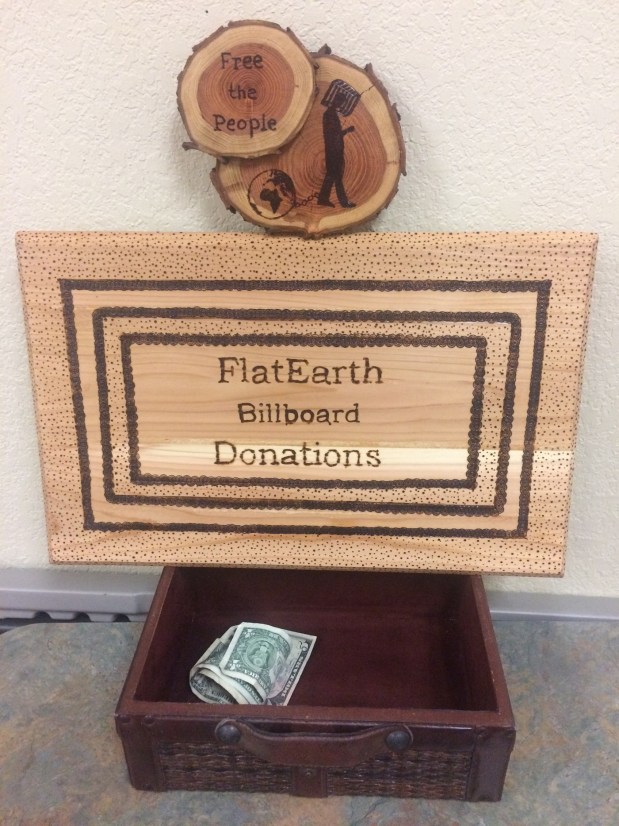
Incredibly, the flat Earthers even have "donation boxes" staked out to try to collect money for bill boards, e.g.
A collection box for billboard donations at a Tuesday meet-up.

Talk about a total waste!    But to further try to give ballast to this nonsense the Post quotes a guy named Bob Knodel, who supposedly was an "engineer" for 35 years. What kind they don't say. Maybe a sanitary engineer? According to Knodel:

"There’s so much evidence once you set aside your preprogrammed learning and begin to look at things objectively with a critical eye says you learn soon that what we’re taught is mainly propaganda.”

Seriously? A satellite geodetic survey is propaganda? How about flying great circle routes,   say to get  from New York City to Hong Kong. e. g.
or has Knodel never done that?


Why take that particular route? Well, because for a spherical geometry it is the shortest route between two points - so it saves fuel and time!  If he had the time (and math background) I'd even show him how to calculate the distance between two locations on Earth - say Barbados to Bristol, England, using spherical trigonometry, e.g.

cos(dist.)= sin (lat1) sin (lat2) + cos (lat1) cos (lat2) cos (long1 - long2)

In this case, Barbados latitude is 13 deg N., Bristol's is 51 deg 26' N. Bristol's longitude is   2 deg 35' W. Barbados' longitude is 59 deg 30'  W.

This is all one needs to use the spherical triangle formula to arrive at the distance (taking into account the circumference value of 24,901 mi.).

Knodel "runs the popular YouTube channel Globebusters," which has nearly 2 million views across more than 135 videos.   So it appears he is at least knowledgeable about spreading mind viruses- especially among those whose brains have already been colonized by fake news.

Knodel goes on:

“I’ve researched conspiracies for a long time. I’ve looked very critically at NASA. Why is it that the astronauts have conflicting stories about the sky? Is it bright with stars, or a deep velvet black?”


Well, maestro, because different astronauts (and even the same)  making orbits at different times will experience variable illumination and also (timed to the period of satellite orbits) "daylight" and "night" - e.g. once they pass the day-night terminator. Hence, in the latter condition they will see the sky as "velvet black" and indeed populated with stars, and at other times with brighter background, e.g. in 'daylight' conditions of the orbit. There are no 'conflicting stories' unless one reads conflicting stories into the accounts and is unable to parse correctly what is being said.

The most amusing part of the Post account:

“How are we Flat Earthers supposed to explain to our friends the solar eclipse in August?” asked one attendee. The room fell silent. “We’ll have to do more research and get back to you on that.”

Ah yes, "do more research and get back on that".   Meanwhile, the solar eclipse is easily explained by appeal to shadow geometry applied to the assorted spherical bodies involved: Sun, Earth and Moon, e.g.
Image result for solar eclipse diagram

Indeed, the path of the shadow cone (umbra-penumbra) itself depends directly on the Earth being a spherical - not flat- body.

Anyway, after the flat Earthers return to the drawing table I can hardly wait to see what their 'research' coughs up.   It's bound to be awesome. Heck, maybe they can even put it on a billboard. (If it will fit!)


Wednesday, February 1, 2017

Yes, There ARE More Political Posts - Because The Times Demand It

donald trump immigration ban protest3Related image

Yes, it is true that there are many more political posts on this blog than usual, for anyone keeping a tally. But I make no apologies for that because while science and math are running themes, the tumultuous times we're in demand attention to what's going on in the political world. Nearly all of this centers on the ascension of Trump and his extremist administration to power- including now making a Supreme Court  pick that could have ramifications for decades.  (See next post).

There is also the ongoing danger too many Americans may not perceive how our nation is seen from outside, and they may not read foreign news to process that - if they read at all. Thus, many may have missed the thousands protesting in the streets of London (even as many thousands protests here) to demand Trump not be allowed to visit the UK. 

Nor may they have seen that the European Council President has now - since Trump-Bannon's Muslim Ban - compared the U.S. to the likes of China, Russia and even radical Islam. According to one headline from the WSJ:  "EU Council Chief Says Trump A Threat To Europe's Future"

The EU leader Mr. Tusk said the Trumpian actions "call into questions the past 70 years of American foreign policy".  The Europeans, even more than Americans, are appalled at what has transpired and what it bodes for not only their future, but civilizations. Especially if Trump's Muslim ban triggers the "clash of civilizations" that Benjamin Barber wrote about in his book by the same name.

From day one, everything about the Trump Imperium has been in terms of 'spit in your face' arrogance as they released pseudo order after order upending the political equilibrium around the world - and now (in the words of one commentator) risking not only economic recession, but political (constitutional) crises as well and even potential war with China and North Korea. Too many still aren't processing these events, perhaps because as Alvin Toffler once put it ("Future Shock") when the pace of events exceeds a certain threshold many minds blot them out and become less aware, even responding in a kind of PTSD mode. Meanwhile, for many millions of others, interpretations of events are needed - because the vanilla, allegedly "objective" mainstream media is too often in the "see both sides" mode.

So make no mistake we are living amidst momentous events and these merit being recorded, including in a blog.  Those who might yearn for more of the math or science content can easily Google: "brane space, mathematics" or "brane space, physics" - or any permutations of these, e.g. "brane space, astronomy" and bring up previous posts devoted to those subjects. That is especially if you are tired of the focus on politics. But for others, this is where it's at right now, literally.

And as long as impacting political events are occurring I will be posting about them. When the tumult dies down a bit, well, then we will get back to the more eclectic mix of topics.