Showing posts with label explicit atheism. Show all posts

Saturday, September 10, 2016

John Kasich Takes His Wrath Out On Atheists - After Campaign Pummeling By Trump

Image result for brane space, Atheism
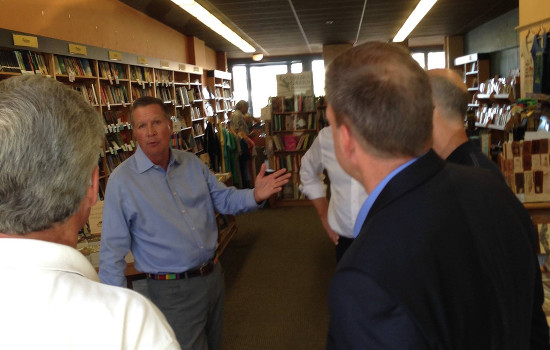
KasichBookstoreNH
Ohio Guv John Kasich - above left - shoots his mouth off in a NH bookstore about Daniel Radcliffe being an atheist. Kasich obviously needs to pull his head out of his ass.

It looks to me like Ohio Gubernator John Kasich is suffering from a bit of Stockholm syndrome. Seems that all those punches along with the Reepo debate hostage taking by Trump have  taken their toll on him mentally.  In a recent bookstore appearance in downtown Exeter, NH - according to a report in The Washington Post-  he appears to have finally lost all his marbles.

Kasich was evidently on a tour of beautiful downtown Exeter with Chris Sununu in tow (the son of former Sen. John Sununu)  and he spotted a copy of one of the Harry Potter books. Immediately, Kasich's febrile and senile brain experienced a rare neuronal association and connected it to the "Harry Potter" movie actor Daniel Radcliffe.  In the next instant a minor brain quake erupted and Kasich,  after wiping some dribble from his chin, sputtered:

You know that Daniel has declared himself an atheist? I’m serious. What a weird thing. Why would a guy who has had all that success just, I mean, what the hell is wrong with him?”


Well, it appears not only is he a grade A asshole for that vapid blurtation, but also is unaware that atheists and "nones" (no religious affiliation) are the fastest growing group in the U.S.  on the religious-non-religious spectrum.  He also appears to have emanated a major brain fart with his failure to process that being an atheist has nada to do with success. Nothing. And on a per capita basis there are actually more successful atheists than Christians, like Kasich. This may well be because atheists operate according to reason and adhere to the rules of logic instead of shooting balderdash from the hip.

To reinforce the point further, the Post noted the growing list of "A-list" atheists including: Keira Knightley, Julianne Moore, Javier Bardem and Billy Joel, to name a few. Then there are the 7 out of 10 (estimated) physical scientists who have successfully published their research in peer-reviewed journals and even won Nobel Prizes (like  physicist Steven Weinberg).  As the Post author put it:

"Kasich might be doing a lot more head scratching or fist shaking at the TV"

In other words, this idiot is in denial at just how successful atheists are in multiple spheres, so there's certainly no reason for Daniel Radcliffe to hang his head. Rather, buttbrains like Kasich - who I once actually thought of as the only serious Reep candidate, fit the loser bill. I mean look how he got beaten by Trump, to a bloody pulp!

The Post also pointed out that Radcliffe has made no secret of his atheism, telling Esquire in a 2009 interview "I'm an atheist but I'm very relaxed about it. I don't preach my atheism:

In other words, it's very likely he's an implicit as opposed to explicit atheist. To refresh memories, the implicit atheist simply withholds belief in any kind of deity already on offer by the theist. (The explicit atheist, by contrast, rejects it outright.)  The explicit atheist is also more likely to be aggressive based on his or her attitude.

As a result of Kasich's juvenile outburst American Atheists President David Silverman is calling on Kasich to apologize and meet with atheists in his home state so he doesn’t say something offensive like that again.  The problem with that appeal is that it only works with reasonable, rational people. For a knuckle dragging ignoramus like Kasich it would be like getting an ape in a zoo to apologize for shooting his wad on passersby.  Frankly, he wouldn't know what the hell you were talking about.

In a letter sent to Kasich’s office and posted online, Silverman declared:
To state what should be obvious: There is nothing “wrong” with Mr. Radcliffe nor with the tens of millions of atheists in this country.
Atheists are members of your community. We are your firefighters, your police officers, your teachers, your doctors, and your coworkers. I have no doubt that atheists serve on your staff and volunteered for your presidential campaign. If you think you’ve never met an atheist, you’re wrong. 
I challenge you to sit down with a group of your atheist constituents. Talk to us about what we want from our government. Ask us why we’re atheists and what it means to us. You name the time and place and I’ll make it happen.

Again, very eloquent and it would be compelling if one was dealing with a rational or even semi-rational person, but Kasich is neither. (See the analogy given earlier). If anything, Kasich is such a class A asshole he'd just double down on his antagonism if the American Atheist prez pleads too much.

The bottom line is that dingbats like John Kasich don't give a rat's patootey whether atheists are part of their community, are successful or not.  In their tiny, misshapen world the exercise of our rights can never receive an imprimatur because atheists are not considered as equals.  Silverman could as well ask a pig or drunken ape to whistle "Dixie" and have more success.

Wednesday, January 29, 2014

Surprise! A Fundie Is Incapable of Understanding the English Language!

Photo: Another dummie fundie!

It seems there is a persistent and irascible (also under-educated)  little fundie who still is unable to parse or grasp the distinction of the agnostic atheist – in terms of withholding belief in a deity. He evidently read my previous blog on fundies unable to process these subtle distinctions- leading his febrile brain to go haywire once more, and end up with the wrong conclusion.  But this is to be expected when one's educational standards have always been low, and the person in question is more at home in a bar fight than a classroom.

So, it seems we must explain it to him again, not that it’ll do any good – especially if one lacks the capacity for abstract ACH thinking. (As an aside, it’s clear this character couldn’t pass a PSAT Verbal test, far less a GRE Verbal test!)

 
Recall I had written:

What is happening here is not active disbelief, i.e. in making a statement “There is no god,” but rather simply passively withholding belief in a statement already made. Hence, the deity believer has made the positive claim. The ontological   (implicit) atheist’s  response is simply an absence of belief in it. No more and no less. It does not and never has implied  active disbelief, aggressive rancor or a vehement and militant opposition to the beliefs.

Let me quickly add here that this withholding of belief is the more natural position, as opposed to advocating belief, which is unnatural
.”

 
Now, believe it or not – probably not – this dumb fundie demands:  “make up your mind” i.e. “Is it withholding belief or absence of belief’?.’ This guy, who’s probably had too many knocks on the head either from bats in bar room fights or from DI pugil sticks, thereby interjects a false dichotomy (thought he likely doesn't know what that means either).  Clearly he doesn’t grasp that they amount to one and the same thing.

 
If I withhold belief what am I doing? Am I actively DO-ing anything? No! Despite the word, it is a passive act.  However, the consequence of the withholding is yes, the absence of belief in the claim.

 You tell me you have an alien in your attic but you can’t prove it or give me a snap shot, so I withhold belief. I do not “deny” you have such an entity, only tell you that minus the evidence I can’t bestow any investment of mental capital to concur with it.  Hence, you walk away minus that belief, and so for you - there is an ABSENCE of my belief. How simple can it be? But evidently it's like general relativity or advanced rocket science for this moron fundie.

Again, via any withholding, what is the EFFECT? The effect is an ABSENCE of that which is withheld!  (See for example the cartoon graphic pertaining to the doofus withholding Jacks from his playing card deck but claiming there's no absence of them in his deck.)  Ipso facto, by any withholding one has engendered an ABSENCE of that withheld.  This absence could not have existed if one didn’t withhold.  Why the inability to process the logical connection? I suggest a lack of ACH thinking ability, which as James Cheyne has observed, is also a critical feature of many standard IQ tests.

The error made by this fundie lamo is to equate “withholding” belief to an active response, as opposed to an absence of belief.  In his incapacitated, regressive and forlorn brain, withholding is like denying! He doesn’t grasp that there is a logical and fundamental connection between withholding and absence -of whatever it is withheld.

 
The Webster’s Encyclopedic Dictionary defines withholding as:

to refrain from granting or giving something

 
It defines absence as:    a lack or deficiency of

 
And continues by way of explicating: i.e. to withhold granting something will create a deficiency or lack in it, for example withholding food- say to a starving populace-   creates a deficiency or absence of food.

 
In other words, a logical connection obtains between the words. Now, it is true that by use of the term “withhold” the causal consequence, i.e. directly leading to absence may not be immediately apparent, but it ought to be implicit.  At least it ought to be to a person of  even average intelligence. But then this guy was never even minor sub-Mensan level (e.g. top 20% as opposed to 2%) to begin with. (He may be Densan, or lower 40%).

On that note we shall have to leave it because though this deluded idiot believes he’s “checkmated” me he’s really only shown the extent to which he’s checkmated himself by stupidly entering a semantics war he isn’t outfitted  (educationally or intellectually) to win.  Maybe if he sits down and plays computer chess or GO he may improve his intellectual prowess, but given his only activity is blogging misinformation about his backward religious beliefs....I wouldn't make any bet that would work

 
The point remains that withholding belief in a deity is the warp and woof of the agnostic atheist, and it is correlated to an absence of belief - no matter how much hard heads want to contrive a ridiculous false dichotomy where none exists.


Sunday, January 26, 2014

Can We Hope to Educate Fundies on the Different Types of Atheist?

Cartoon of a dumb fundie.
In approaching the fundamentalist brain, one thing one must perpetually keep in mind is its inherent simplicity and the incessant demand for simplicity. Thus, rather than acknowledging the Big Bang as the source for inception of the cosmos the fundie will invent 'young Earth' and 'young Sun' nonsense because it's simpler. After all, you needn't learn about the physics of the Big Bang including the significance of the 2.7 K isotropic microwave radiation  -- you need only invoke the fairy tale of 'Adam & Eve'.

In a similar vein, in approaching evolution the dumb, semi-educated fundie will usually cherry pick one aspect to try to make hay out of (like the 98% chimp-human sharing of DNA) but entirely ignore the more difficult aspects such as that: 1) chimps and humans share the exact same cytochrome-c protein sequence despite 10^93 different possibilities for variation, and 2) the fact that the ape 2p and 2q chromosomes underwent telomeric fusion to become the '2' chromosome in humans. 

But this is what we've come to expect from  a lot that still believes ancient fables such as that a man could survive 3 days in a whale's belly (or 'great fish') despite it being full of hydrochloric acid, or that an 'Ark' could have been constructed to carry pairs of all the critters then on Earth including dinosaurs.

So it's not a surprise to learn that most also lack the intellectual capital or ability to appreciate the distinctions between atheists.  After all, it's simpler just to assume ALL atheists are of one type, e.g. "militant" if they even write something negatively about Xtianity.  Their pea brains fail to understand that writing something negative, say in a blog, is NOT the same thing as demanding the extirpation of religion - even fundy-ism.

Nor do these clowns grasp the distinction between agnostics and atheists. So we are obliged to help them out, and try to express some sympathy too.

Author George Smith[1] notes that the most vernacular usage confuses the meaning of agnostic, usually asserting it is “somewhere between belief and outright unbelief.” The way it is usually framed is that the agnostic “isn’t sure whether or not God exists.”  In fact this is an erroneous interpretation of the term.


What it actually, technically means is someone who asserts there is not yet adequate evidence to make a decision if one were possible. In other words, the issue must remain open-ended and unresolved until such time evidence appears. Thus, true agnosticism is not some dithering or fence-sitting between belief and unbelief, but rather acknowledgement of the impossibility of knowledge as it pertains to any ability to address the question in the first place.


But mayhap this is far too complex for the simplistic gray matter of fundies.


Smith himself (op. cit., p. 9) splits and parses the agnostic position even further, according to whether one is an agnostic atheist or an agnostic theist. The first avers that all supernaturalist propositions or claims are inherently unknowable (because they are untestable) by the human mind, and so not worth discussing any more than pink elves, unicorns or fairies. In this sense, unbelief isn’t really even necessary, since who would actually believe in a pink elf or unicorn? Well, then there’d be even less merit to arguing over an invisible Being! Thus, without any capacity for knowledge about it, it’s redundant.


The theist agnostic meanwhile, maintains a firm belief in the existence of God, but asserts the precise nature of this God is unknowable. On this basis, no attributes are assigned to try to define God’s nature.  We cannot say that any divine nature is “eternal”, or “omnipotent” or “omnipresent” because one simply doesn’t know. Thus, it makes no sense to use words to try to describe a deity. Belief is as far as one can go.

Related to definitions of atheists is the ability to distinguish between implicit and explicit atheists. In many ways, the implicit atheist is similar to the agnostic atheist except for the fact the kmowability or otherwise of supernaturalist propositions is not gone into. Thus, the implicit atheist simply avers to be withholding belief in any kind of deity already on offer by the theist. (The explicit atheist, by contrast, rejects it outright.)


As I noted in an article published in the Mensa Bulletin, March 1994:


"Let's be clear about what constitutes Atheism and what doesn't. The Atheist - to put it succinctly, absolutely withholds investing intellectual/emotional resources in any supernatural claim. Indeed the word Atheism itself embodies this definition: a-theos, or without god.”


What is happening here is not active disbelief, i.e. in making a statement “There is no god,” but rather simply passively withholding belief in a statement already made. Hence, the deity believer has made the positive claim. The ontological   (implicit) atheist’s  response is simply an absence of belief in it. No more and no less. It does not and never has implied  active disbelief, aggressive rancor or a vehement and militant opposition to the beliefs.


Let me quickly add here that this withholding of belief is the more natural position, as opposed to advocating belief, which is unnatural. Consider a different context: a neighbor runs over and informs me that aliens have landed in his yard in a spacecraft. Until I actually go over and try to verify his claim I am under no obligation to accept it as a statement of fact. Thus, the default intellectual position is always skepticism, irrespective of the claim made. This again is because the onus is always on the claimant to make good, not the skeptic to “disprove” it.

It isn’t difficult to see from the above context that the more conservative (and reasonable!) position is withholding belief until a claim is validated. One does not, after all, accept a claim then do further research. One ab initio doubts the claim and then sets out to devise tests to ascertain the validity!  And in the case of extraordinary claims (which certainly include “God” and visiting aliens in spaceships), “extraordinary claims demand extraordinary evidence” as the late Carl Sagan used to emphasize.

 
It also isn’t difficult to see that this is exactly analogous to the atheist withholding belief in a deity. After all, If God genuinely exists, why is he/she/it not uniformly perceptible,  at least in basic features, to all peoples? As we saw in previous blog posts (from 2011, mainly), there are nearly as many different versions of deity as there are people. (Or at least, religions!)

Another error made by the wayward fundie is assuming that a negative belief, i.e. that there is no God, is the same as being a positive belief, 'there is a God'.  An example of this would be what Lisa Kennedy spouted on a Bill Maher Real Time show in January, 2012, i.e.  if an atheist simply doesn’t believe in the supernatural or God he is expressing a belief, albeit a negative one. If expressing a negative belief, then it's the same as a positive belief such as invoked in religions, ergo he is professing a religion. This is utter nonsense.


It would be akin to asserting that if I decline belief in ghosts I still have “negative ghost belief” and therefore am a Ghostologist ! The error inheres in asserting that an absence of belief is the same as a belief. This error repeats the canard that the onus is on the non-believer to disprove the believer’s claim, instead of acknowledging it is impossible to prove a negative. Some sophists attempt to get around this by claiming it  "isn’t impossible to prove a negative". They argue that they can prove “there are no black balls” in a box by simply emptying the box out and finding all white balls. But this misrepresents the example, since the possibility of “all white” balls was never in question! The analogy is specious because the existence of God IS in question, and isn’t objectively verifiable, unlike counting real balls. The analogy trivializes the deity existence question while not validating the sophist.

In the end, it may be that because the brains of fundies are unable to perform ACH thinking - or what James Cheyne  has called abstract, categorical and hypothetical thinking (such as integrated into standard I. Q. tests, e.g.  the Raven's and Wechsler Similarities tests) then they cannot also be expected to discriminate between subtle differences in definitions, say for 'atheist'.

Why are believers, fundies especially,  missing this crucial component of thought which also, by the way, is essential for critical thinking? There are a number of reasons. For example, one may be that the honing of such skills was never possible, for example if they came from a home schooling environment. Another, more controversial, is that the very neural pathways that predispose them to belief or faith, are also the ones that inhibit predictive ACH conceptualizing. Lastly, it's feasible they may have suffered head injuries, maybe from a DI - using a pugil stick-- in the Marine Corps at Parris Island, and they never got their senses back together.

Sadly, if any of these is true we can be sure they will always take the simpleton path in their thinking as regards atheists and atheism.


[1]  George Smith, Atheism - The Case Against God, 1989, Prometheus Books, p. 9.

Thursday, January 9, 2014

Congrats to Pastor Ryan Bell - For Trying Out Atheism!

Ryan J. Bell
Pastor Ryan Bell is now learning what it's like to be an atheist in America. He's learning that, contrary to the bollocks of a "free country", there may be penalties to be paid for expressing one's first amendment rights, for example. As people may or may not know, Bell announced on the Huffington Post on New Year's Eve his experiment to see what it was like to live as an atheist - at least for a year.

I am not sure one can "try" atheism, because one either is or isn't. He or she either has the mindset for it or not. It's not something you can "try on" anymore than one can "try on" Catholicism. (Although, true, many of us born into that religion are forced by accident of birth to 'try it' - though when we reach maturity we can make up our minds that it's not for us. As I related to my Mom - a firm Catholic- 25 years ago when she asked why I left Catholicism: "I felt I was wearing a suit that had shrunk and could no longer fit into it. I needed to get a suit that fit!" She liked the analogy and accepted it.)

Once having become an atheist, I experienced further change - in this case from being a "anti-religion" atheist in the mold of Madalyn Murray O'Hair and her American Atheists, to  becoming a more moderate agnostic atheist.  The moderate atheist in this sense is one who adheres to the original meaning of the term a-theist, absence of belief, as opposed to denouncing belief. This change was documented in the last chapter of my new book, Beyond Atheism, Beyond God.   Basically, it meant no longer screaming for the elimination of all religions, but rather adopting a more nuanced stance: that in an era in which knuckle draggers on the Right are attempting to halt every social justice advance - or attempted advance - we need all the allies we can get. It serves no purpose to alienate millions.

In any case, I do admire Bell's pluck and courage in at least trying to alter perspectives for a year, to understand how the unbelief part of the populace lives- and what we face. His intent, related on cnn.com, means:

He will not pray, go to church, read the Bible for inspiration, trust in divine providence or hope in things unseen. He’s taking the opposite of a leap of faith: a free fall into the depths of religious doubt.


Now, this is a heady mix even for a temporary atheist. Especially ditching the bible addiction, which I've always maintained is the first criterion for any person to move beyond reflex belief. If you are as truly confident in the existence of the "divine" as you claim,  you ought not require a special book as a spiritual crutch - especially the Bible - which as my sister-in -law has noted, "was written at about the level of eighth graders."

Not trusting in divine providence is, of course, implicit for the atheist - moderate or extreme. Thus, we operate according to the more evidentiary perspective that fortuitous events - say, such as surviving an airline crash, or a mass shooting, is a matter of dumb luck and chance. You happened to be in a safe seat, or were out of the line of sight of the shooter. It wasn't that "God" specially protected you - while allowing the others around you to be demolished or mowed down. That sort of magical thinking is the sure sign of an infant .

As for "religious doubt" that ought to be expected of any person pursuing a spiritual path. Not to doubt, not to accept the world as gray - instead of black and white-  is again to remain spiritually childish. Not doubting, as philosopher Alan Watts once put it, is to forclose your perspective and inhibit your own self-growth. It leads to a mental, spiritual dead end and stunts your vision. The world then becomes filled with enemies and caricatures of demons who must be fought to the death. Hence, the emergence of the religious extremist who would blow up an airliner or an abortion clinic.

Some Christian critics of Bell, however, believe he's doing the wrong thing.  According to one author on Christianity Today:

The issues Bell has with the church, and even his interest in atheist thought, doesn't require a turn to atheism.

This is true, and one can indeed just read atheist books, say like my own Atheist's Handbook to Modern Materialism, to get a handle on the basis for atheist thought.  One needn't "try atheism" as a mental position and live that way to grasp atheist thought. (Though it does help!) One can also work out any problems with his church, if there is mutual willingness to do so. The problem, however, is that one cannot experience what it's like to BE an atheist unless one lives as an atheist. Reading about atheist thought only gets you into a passive, armchair understanding - not a deep experience of being one.

Thus, had Pastor Bell not chosen to actually live as an atheist he'd not have known how easily he could have been released from his pastor position or fired from his adjunct professorship.  He might have suspected that the widespread meme: 'atheists are the most distrusted group in America' - was only hyperbole or nonsense. He may never have actually experienced it.

Of course, his former Christian cohort has rabidly denied all this and insisted none of those events bore any relation to Bell's choice to live as an atheist. Yeah, right, and Chris Christie was just totally surprised that thousands of commuters could have been inconvenienced by one of his staff who - somehow - believed that payback had to be delivered (by closing 3 of 4 lanes over a primary bridge)  for a Dem Mayor not supporting Mr. "Pillsbury Doughboy"  Guv's NJ re-election. Well, gullibility takes all kinds of forms.

This is displayed by one Xtian named Os, who writes:

"This is not true as many who are very close to this story know. I also think it is unfortunate that Ryan is being used here, with or without his encouragement I do not know, as a poster child for America's culture wars in a way that many would immediately recognize as deeply inauthentic if roles were reversed,"

Whatever. The fact is Os and his Xtian compatriots left Bell hanging out there in the wind with no financial  support. It was left to atheist Hemant Mehta (aka 'Friendly Atheist') to summon help from fellow atheists for Bell's support. So far well over $7,000 has been collected with more coming in all the time.

Bell, in his blog on Tuesday, wrote:


I am shocked and overwhelmed a the outpouring of support that I have received after Hemant Mehta (aka Friendly Atheist) asked people to support me financially. I am grateful. But just as I am leaving behind the fear and sometimes hate-inspired religion of my past, I am deeply uncomfortable about raising support by casting my friends in the Christian community in a negative light–especially one which is not true."


Again, I congratulate Bell for his courage, whether or not his experiment succeeds or whether indeed, he leaves Christianity fully behind and becomes a full -fledged atheist.

For Christians, the treatment of Bell ought to incite their own soul-searching concerning whether they can really believe they have finally found "the light" or, more likely, are still being kept in the dark about the true nature of their professed religion. To quote the words of my sister-in-law  Krimhilde again (from her May interview):

"If it were true that the God they worship is one of love THEY themselves would show such love in their lives, not with words but actions! They would feed the homeless and clothe them, they would donate their time selflessly to those with less than they have, instead of wallowing in their own self pity and hate.  You can always tell what type of thing a person worships by how he behaves, how he acts. He can say all he wants his God is real, real love or whatnot, but if he himself doesn't show that love then it is a fraud. "


I couldn't have put it better!


Monday, October 21, 2013

Six Types of Atheist? I Don't Think So!

 S.E. Cupp claims to be an atheist, but in reality is what I call a pseudo-atheist. She uses the atheist label only as an 'in' for media gigs most real atheists can't get.

The meaning of the word 'atheist' has often been parsed and explained so badly that most people simply give up and run to a dictionary - which is about the worst thing they can do. All most dictionaries offer is that 'atheism' is a form of belief, but now manifested as "un-belief". This isn't helpful and doesn't get us very far. It also leads to consistent misrepresentations of atheists in the mainstream media. As I noted in an article published in the Mensa Bulletin, March 1994:

"Let's be clear about what constitutes Atheism and what doesn't. The Atheist - to put it succinctly, absolutely withholds investing intellectual/emotional resources in any supernatural claim. Indeed the word Atheism itself embodies this definition: a-theos, or without god.”

What is happening here is not active disbelief, i.e. in making a statement “There is no god,” but rather simply passively withholding belief in a statement already made. Hence, the deity believer has made the positive claim. The ontological atheist’s is the simple absence of belief in it. No more and no less. It does not and never has implied aggressive rancor or a vehement and militant opposition to the beliefs. (Though yes, some militant atheists – or what we call “strong atheists” – do have such attitudes!)

This is referenced as a new study has come to light trying to show there are "six types of atheist." According to the study's authors from the University of Tennessee, Chattanooga, the main observation was that "nonbelief is an ontologically diverse community,”.  They arrived at this from "59 interviews" (not a whole lot for a study purporting to offer serious academic insights).

They were led to conclude six basic groups including:

1- Intellectual atheist/agnostic

This permutation of the basic atheist fancies internet arguments and "seeks information and intellectual stimulation about from atheism"

2- Activist

This lot aren't content to be generic unbelievers they want to tell others why they don't accept a god, and also are more likely to put up billboards espousing their positions, and write letters to the press.

3- Seeker-agnostic

Made up of those unsure of the existence of a God, but keep an open mind as regards human limitations and experience.

4- Anti-theist

This sub-group regularly speaks out against religion by positioning themselves as diametrically opposed to it. Examples include: Sam Harris, Richard Dawkins. Christopher Hitchens (when he was alive) and Victor Stenger.

5- Non-theist

This sub-group simply divests itself of engaging in any back and forth at all, concerning religion. Religion plays no role or consciousness in their world view so in one sense might be called "absolute atheists" to the extent religion or "God" has no meaning.

6- Ritual atheist

This sub-group "doesn't believe in God or an afterlife or associate with religion, but still finds useful the teachings of some religions." In most cases, their adherence to rituals stems from the habit of family tradition, say going to Christmas Mass - but now going there simply as a mechanical reaction not inspired by any emotional connections of investment into any religious meaning.


But is this level of discrimination valid (the authors ultimately see 32 classes by 2020) ? The long time atheist will easily see that in most cases a pronounced overlapping ensures the categories can probably collapsed to at most three sub-groups and others can even be left out. For example, in my book, Atheism: A Beginner's Handbook, I note that non-theists are separate from atheists, and more or less on the same  definitional basis as Deists. I also took pains to separate anti-theists from atheists. (Although I made some allowance that they can sometimes be included in the already established category of strong atheists - which embodies those much more vehement that weak atheists.) The other terms used consistently for these two are: explicit and implicit atheists. The implicit atheist here conforms more to the original definition I provided in the Mensa Bulletin.

"Activist" atheists are also subsumed under the explicit or strong atheist umbrella. They are most likely to be members of American Atheists, and be more involved in expressing the strong atheist meme, often in public protests.

The "seeker-agnostic' can also be subsumed (with some modifications of explanation) under the weak or implicit atheist banner. The agnostic atheist - as George Smith has defined it - arises not out of "not knowing" whether a God exists, but rather out of the belief in the impossibility of adequate knowledge accessible to the human brain. This leads to the belief in the impossibility of knowing anything about a supernatural realm, and hence anything of possible entities existing within it. It may not seem like there's much of a difference but there is, because accepting the premise of the impossibility of knowledge puts the person on an entirely different footing as the media representation of an agnostic who sits atop the fence between firm belief and unbelief.

Lastly, there is the pseudo-atheist, which is perhaps a category of one, as embodied by media star S.E. Cupp. She has adopted the atheist label out of convenience but often expresses sympathy for religion, especially of the Republican-fundie brands. In this way she's been able to get gig after media gig that hard core real atheists can only imagine.   A review not long ago, of one of her books,  gushes:

"She’s an atheist. A non-believer. Which makes her the perfect impartial reporter from the trenches of a culture war dividing America and eroding the Judeo-Christian values on which this country was founded"

Note the highlighted words: what the corporo-press-media empire has wet dreams over: "the perfect impartial reporter". They don't want to hear from REAL Atheists  because they may not receive the acceptable versions of thought for publication or media circulation. Hence, a fake like S.E. Cupp serves their interests to a tee.

Let's be thankful that Ms. Cupp likely "broke the mold" for this pseudo-version. Meanwhile, the authors of the 'six types of atheist' study need to go back and re-examine their work in a more objective manner.  This should include the issue or aspect of whether those in their brackets embrace any forms of the philosophy of Materialism. To my way of thinking, no actual atheist can renounce or reject Materialism - though yes, there are different forms. (See e.g. http://brane-space.blogspot.com/2011/02/materialism-still-mostly-misunderstood.html )

Tuesday, March 10, 2009

The Futility of Debating Religious Believers (2)

In my previous article I pointed out the extreme problems in confronting and debating religious believers, in terms of both language and logic. In the first case, believers (since they are objectively always at a disadvantage in any rational argument) always aggressively seek to deform the meaning of words used to their own ends.

This is perfectly exemplified in the latest, most recent posts (on Pastor Mike's Blog) attacking me (mainly by a poster named 'Rene') where the definition of "atheist" is challenged.

The definition I gave in at least one comment on the (innominate) site, was based on a definition I had provided in an issue of The Mensa Bulletin (March, 1994):

"Let's be clear about what constitutes Atheism and what doesn't. The Atheist - to put it succinctly, absolutely withholds investing intellectual/emotional resources in any supernatural claim. Indeed the word Atheism itself embodies this definition”

What is happening here is not active disbelief, i.e. making a statement 'There is no god', but rather simply passively withholding belief/acceptance in a statement already made. Hence, the deity believer has made the positive claim. The ontological atheist’s is the absence of belief in it. No more - no less.

What I mean by the "ontological atheist" is one who derives his or her atheism from the basis of ontology. The type of atheist here is also known as an implicit atheist.
However, it appears this form of atheist causes too much mental consternation for the likes of Rene. For he keeps insisting it is a "cop out" or "cowardly" for not actually "denying God".

But, as I have tried to point out to his pedestrian brain, one does not deny that for which the existence hasn't been shown anyway. And I provided Rene the basis to do this, by giving the necessary and sufficient conditions for ths existence of his deity. But, up to now, he has skirted this, opting to come after my use of precision terms (and if words are not precise, how can thought be?) as "exercises in semantic nonsense".
In fact not. These terms are well agreed upon. One of the best articulations is by Austin Cline:

http://atheism.about.com/od/atheismquestions/a/strong_weak.htm


Another definition has been given by George Smith(which Rene invokes to assert my own definition is "poor" - evidently unaware that Smith merely has provided his own interpretation not necessarily agreed upon by all):

"the absence of theistic belief without a conscious rejection of it"

But I have a few quibbles about it. I would change that to read: "the absence of any theistic belief or emotional, intellectual investment in such - based on the absence of any ontology provided by theistic believers. Thus, implicit atheism entails a conscious appreciation that theism has no ontological basis, and is rejected on that basis".

Note: I did not say the underlying entity ('God') is rejected-denied, but rather theistic belief.

There is an easy reason for this: because if no god believer provides a definition for his entity then we cannot know what manner of 'divinity' he is talking about. (This is especially important because otherwise we have to assume all god believers accept the same divinity, which I am sure they would object to).

So, unable to accept or process my very exact language, Rene adopts the only tack available, to attack my language - as opposed to rectifying his native obtuseness. Belligerently clasping on to Smith's (incomplete definition) and his own obdurate tone-deaf stance, he then has the temerity to ask me:

"Phil are you a child with the conceptual capacity to grasp the issues, but you are still unaware of them or are you a man [who attended Christian College for three years] unacquainted with theism? "

And this alas, merely exposes poor Rene as a hopeless, desperate dolt. He has already shown he can't process nuance, in definitions, and now uses my early attendance at a Catholic university to try to impute a kind of infantilism to me, which actually he is projecting as a trait of himself.

Indeed, this is evident in his next remark:

"You again want to redefine your atheistic position from active denial to passive denial".

Again, disclosing the impossibility and futility of debating Xtians. (Okay, at least a certain type of Christian for whom logic and reason are not facile skills) Here he errs by referring to active and passive denial, when there is no such thing. One either denies, or one does not deny. There is no "passive" aspect. There IS a passive withholding of acceptance and recognition of the claim made.

Rene's Neolithic and neonatal (childish) brain appears inured to processing that "denial" is not germane if the entity is regarded as redundant, which it would be if no ontological basis (e.g. necessary and sufficient conditions) has been shown for it. Thus, no serious person in his right mind goes about denying elves, tooth fairies, or flying spaghetti monsters. Denial is unnecessary because it pre-supposes a tacit existence ALREADY there. But if no one has presented me with the n-s conditions for fairies, it is superfluous for me to "deny" them. Denial embodies the subtext that in the back of my mind I suspect they really exist. But I do not. I act and conduct my affairs as if they DO not exist. In other words, the entity is redundant to physical reality. And the claimants have not demonstrated its inclusion is justified.

Now granted this can be a subtle difference, and perhaps too subtle for a coarse, neolithically-fragmented 3 pounds of Rene-based protoplasm, conditioned to think simply in black and white (either-or) terms. But one does not concede to a primitive accusation here merely because his opponent's brain is resoundingly primitive and unable to parse critical differences. Such is the case with Rene.


This error is then compounded by his resort to false analogy, a violation of logic. (And we won't even begin to belabor the incessant and ongoing logical violation known as "affirming the consequent" or making the statement that something exists prior to showing it exists!)

An excellent insight into Christian illogic (of the form peculiar to fundies) is evident in Rene's next remark:

"It is interesting that atheists assert that atheism is not a religion but total absence of belief. This is like saying that black [which is the defined as the total absence of color], not a color."

In fact here he makes a common logical error (driving the false analogy). That is in conflating a belief (or non-belief) in a God with holding or rejecting a religion. This has just come to the fore recently with a detailed survey finding that 15% of Americans are not affiliated with any religion. HOWEVER, many of those interviewed made it abundantly clear that this didn't mean they rejected God belief, only that they rejected being associated with a religion! Thus, it is clearly possible to be religion-LESS and hold a God-belief. In an inverse sense, it is possible to be religion-LESS and God-less! (Which the survey also shows, since the number of atheists doubled and they are also a subset of those WITHOUT religious affiliation)

The sterile (and self-defeating) ploy of comparing a color like 'black' to the condition of (simply) godless atheism is particularly egregious. Here, Rene conflates the use and medium of scientific definitions, with cultural or cosmetic ones. Obviously, for the latter group - black IS a color, since once can manufacture clothes, etc. of that color. One does not have to appeal to scientific journals to access "black"! However, that still does not obviate or remove the fact that in color spectra terms (based on what we can obtain using a laboratory spectrograph, say) 'black' IS an absence of color. (E.g. there is no wavelength or range of such in the electro-magnetic spectrum that allows the identification of 'black')

Rene then goes on:

"It is common practice throughout the world that black is a color regardless of the technical definition. Likewise atheism is a religion."

And here his brain is unable to process the simple and basic fact that a scientific definition is not necessarily the same as a cultural one. (And alas, his whole argument's validation critically depends on them being one and the same!)

But in science, since lab spectra disclose no 'black' it IS an absence of color. But that doesn't mean a cultural value for black (as a fashion) doesn't exist, nor that the latter's use and medium nullfies the scientific definition. Again, we behold the limits of his neolithic brain. The flat conclusion that 'likewise atheism is a religion' is then merely a hollow non sequitur, uttered to confirm his nonsensical brand of logic. Or is it illogic?

But as we saw, even in the recent religious affiliation survey Rene is proven wrong, since its results make clear that those who claim religions do NOT include atheists A(and atheists are ipso facto included in the sub-group without religious affiliation). Rene would actually have done slightly better by insisting atheism was a 'belief' (actually a negative belief) because at least then he wouldn't come off as an abject moron.

Rene, not to allow anyone think he's achieved brilliance at the last moment then writes:


"By the way, the US Federal Court of Appeals ruled atheism as a religion"

Which, of course, is neither here nor there. U.S. courts make tons of rulings each year, but that doesn't mean they are each engraved in stone. And while this court may well have ruled atheism a "religion" to make its legal argument more transparent, it still doesn't alter the fact atheism is NOT a religion.

For one thing it turns the very meaning and basis of religion on its head. We know all religions embody centralized beliefs or dogmas that issue from some sacred scripture or a body of theology based on scriptural interpretations.. Atheism has none of these, since there are no central propositions or beliefs with which all atheists agree.

Second, atheists make no positive claims for any transcendent existent that requires their worship or obeisance. They simply acknowledge no god or entity with which to build a religion in other words. Third, atheists maintain no sacred works, scriptures, or ancient artifacts, from which their “truths” are extracted.

They have no analog to a Bible, Qu’ran, Talmud or anything remotely similar. Instead, atheists pursue objective truth via open inquiry predicated on current science, which may provide fewer certainties or answers than if they merely placed their faith in a book.

Fourth, atheists convene no regular communal rituals, services or ceremonies to honor, or propitiate any entity. By contrast, the centerpiece of 99.99 percent of religions is precisely some social ritual, for the purpose of assembling together like-minded believers toward a common goal. Moreover, their churches, synagogues, temples etc. dot the landscape, taking up room that could be used to house the homeless in each respective area or locale.

Perhaps most importantly, there is no "acceptance" of atheist principles from any “congregation” since there’s no homogeneous congregation to bestow it. Atheists often disagree on as many things as they agree on, precisely because no formal coda exists to fix beliefs within a uniform dogma.

That said, let us look at Rene's last remark - again woefully missing the mark, and showing once again the futility of exchanges with certain dead-heads of the fundie persuasion:

"Accordingly, he does not say, 'I do not believe a deity exists', but rather prefers to say, “I choose to withhold my belief that a deity exists.” He claims there is a big difference between the two."

Here again, Rene's own neolithic and unnuanced language does him in. If I say the first statement, I am committed to a position of negative belief, e.g. disbelief. We need only go back to my Mensa Bulletin definition and the key words, here highlighted for his benefit:

"the atheist absolutely withholds investing intellectual/emotional resources in any supernatural claim "

What is happening here is not active disbelief, i.e. making a statement 'There is no god', but rather simply passively withholding any intellectual acknowledgment of committment or acceptance in a statement already made. Hence, the deity believer has made the positive claim. The ontological atheist’s is the absence of belief in it. No more - no less.

But now fully in the realm of folly, Rene cannot help himself when he blurts:


"To demonstrate this, all one needs to do is just invert the argument; is the assertion 'I believe a deity exists' any different from the assertion 'I choose to confirm my belief that a deity exists'? "

But, of course, readers will clearly see this isn't what my definition stated. Nor is it relevant to what has already been given. So here, once again, we behold Rene making an irrelevant pitch with an egregious example.

And we let him have his last say:

"Surely, the semantic value of such a distinction is zero, and so is the cowardly position of implicit atheism taken by a rational and educated adult."

To which I say: the semantic value of your twisted version of MY definition may be zero to you, but the RATIONAL value of my own definition(see my own words in my definition of implicit atheism from the Mensa Bulletin) is substantial to me. The reason is that it allows an exactitude and latitude for nuanced capacity of thought which your 'black-white' - either-or demands cannot permit. But if I capitulated to your demands, I would become as neolithically-primitively minded as you are.

Surely, the mark of a truly educated adult is to strive for maximal thought expression via exactness and attention to meaning, not descend to the minimum or base quantum allowed. So, it is no surprise that you see my rejection of your lowest common denominator methods and definitions as unacceptable.

As for "cowardly position", hardly! Not after having put myself out there with two books on atheism and Materialism. What you interpret as 'cowardice' here is really the inability of your own truncated intellect to argue at the level required to make cogent points.

But this is understandable, since your fundyism only teaches and drills you on the basis of cant and doctrine, not critical thought.

Thus again, we see why it is futile to debate hard core religious believers. Debate with Rene is clearly futile because he remains ensconced in primitive reasoning skills and resorting to deforming language to his own ends....since all other options for advancement of his claims are foreclosed. One step could easily be achieved if he would only provide the necessary and sufficient conditions for his deity's existence. But he can't. And it ought to be self-evident why he can't.