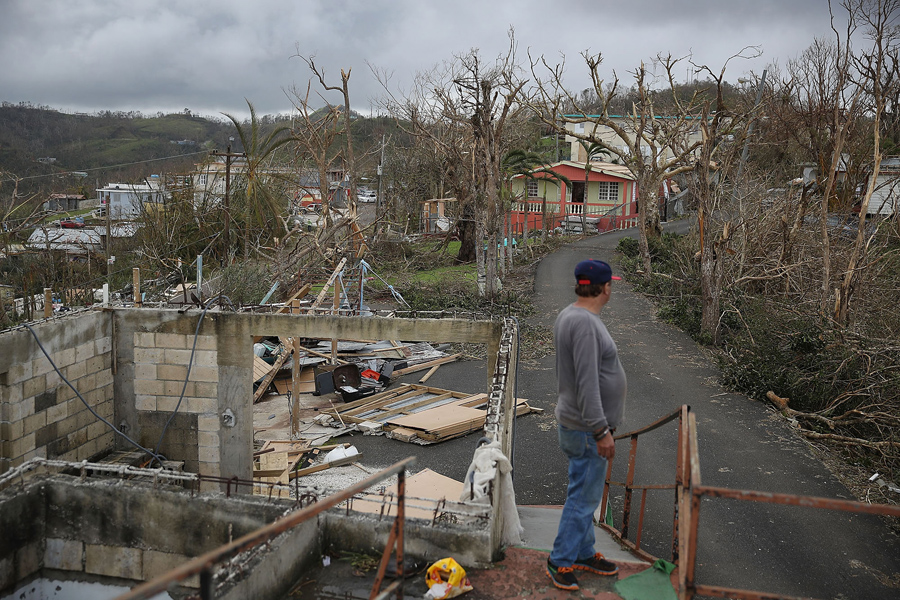
Devastation in Puerto Rico following Hurricane Maria, which climate scientists agree was spawned by warmer ocean temperatures from global warming.
In a WSJ article Tuesday (p. A15) by Steven F. Hayward ('Climate Change Has Run Its Course') it is claimed that climate change is now passé and "climate change as an issue is essentially over". It is quite possible that Hayward, a "senior resident scholar" at the University of California -Berkeley, really is a scholar of some repute at least in "government studies". But the tripe he wrote for the WSJ a few days ago discloses him as merely another climate know nothing who probably has never even taken a college physics course.
Basically this dunderhead trots out all the usual canards which I do not intend to go through in detail - as I've addressed them dozens of times with other uninformed dopes, pretenders and propagandists, e.g. Steve Koonin, David R. Henderson, Roger Pielke Jr. et al. So I will just take up the new arguments that Hayward insists disqualifies the topic as anything of immediate import.
What is ironic here, is just as I was reading Hayward's codswallop, wifey and I were on the phone with an agent from the Hartford, to discuss yet another roof replacement. This was to do with replacing all the tiles on our roof after another mega hailstorm barely three weeks ago - with many stones the size of golf balls or half dollars. This followed an initial hail storm featuring baseball size hail in 2016 which saw us replacing the roof for the first time. This after residing 17 going on 18 years here in Colorado, but which featured two massive hailstorms in the past two years that required new roofing. Of course, even the most menial moron ought to be able to grasp this is linked to climate change. Just as the drought we're in the middle of which has now eroded the snowpack to 50 % of what it was a few months ago.
This triggered water restrictions in Manitou Springs, nearby, but not yet here in Colorado Springs. (Though it should!) Meanwhile, we're now in the midst of a string of 90 degree plus days or some 15 degrees hotter than normal.
And this is just the beginning of what we here in Colorado can expect. Merely two years ago the average temperature in Denver for June, July and August was 72.7 degrees — 1.5 degrees higher than the annual average of 71.2 dating to 1872, according to Kyle Fredin, meteorologist for the National Weather Service in Boulder. If current trends in heat-trapping emissions continue, Denver residents by 2050 will face an average of 35 days a year where temperatures hit 95 degrees or hotter, the study found.
Boulder by 2050 will have an average 38 days a year with temperatures exceeding 95 degrees and, by the end of the century, an average of 75 such days a year. The studies found Fort Collins by 2050 will have an average 24 days with temperatures exceeding 95 degrees and 58 days on average by the end of the century.
These numbers may not significantly impress many people, but they should given they mean vastly more demands on the power grid. Moreover, our power grid demands will be multiplied across the nation and people will take notice as their electricity costs spike upward from 100-200%. Also, as extended periods of each day find people - wherever they live- without power, especially in 100 degree plus temperatures.
Factor in also the "one hundred year storms" with rain downpours the likes of which that can sweep whole towns away - such as for Ellicot City, MD recently. See e.g.
http://brane-space.blogspot.com/2017/11/rivers-from-skies-nature-of-mega.html
Then there is the ongoing risk of flooding in Miami given sea level rise. Even though it may only be measured in inches these rain events are able to flood the streets even on sunny days if there is also a king tide on those days..
Research published in the journal Environmental Research Letters and reported in the WSJ (April 21-22, p. A3) shows that "single family homes in Miami Dade County are rising in value more slowly near sea level than at higher elevations."
Reinforcing Keenan's work, the WSJ (ibid.) cites another new paper from researchers at the University of Colorado-Boulder and Pennsylvania State University. This paper "shows the trend in Miami is playing out across the country, with homes vulnerable to rising sea levels now selling at a 7 percent discount compared to similar but less expensive properties."
But all this is but a prelude to what can be expected by 2035, e.g. as seen in this U.S. Geological survey projected map:

I reference all the above, as well as the monster hurricanes last year, that wreaked havoc in Texas, Florida and Puerto Rico given the following words from Hayward's piece:
"While opinion surveys find that roughly half of Americans regard climate change as a problem, the issue has never achieved the high salience among the public, despite the drumbeat of alarm from the climate campaign. Americans consistently ranked climate the 19th or 20th of 20 leading issues."
Eliciting the question of why this is so when Europeans - who generally aren't threatened by monster hurricanes or tornado outbreaks - rank it consistently higher. Are the Germans, Dutch, British more intelligent than Americans? I wouldn't say so only that their media do not undermine the message by canceling out the alarms by publishing the dreck from rightist and libertarian think tanks in the misplaced interest of "balance". These op-ed pieces are written mainly by propagandists and climate deniers paid by the think tanks so the newspapers save money by filling space without using actual journalists.. Again, we call this agnotology. As Exhibit One I present this garbage published in the WSJ in January, 2012:

In many ways it's cut from the same patch of recycled, already skewered balderdash as Hayward's recent piece. As I have pointed out repeatedly, agnotology, derived from the Greek 'agnosis' - the study of culturally constructed ignorance- is achieved primarily by sowing the teeniest nugget of doubt in whatever claim is made (and as we know NO scientific theory is free of uncertainty).
Stanford historian of science Robert Proctor has correctly tied it to the trend of skeptic science sown deliberately and for political or economic ends . In other words, the supporters of agnotology - whoever they may be- are all committed to one end: destroying the science to enable economic profit and hence planetary ruin. Proctor also notes these special interests are often paid handsomely to sow immense confusion on the issue. Hence, it's no surprise most of the twits who scribble these pieces hail from economics, government studies or political science - and also belong to rightist, corporate think tanks (e.g. American Enterprise Institute, Heritage Foundation, Manhattan Institute, Hoover Institution). In Hayward's case, he is an imp from the American Enterprise Institute.
Despite all this, as well as the fact that typical brains take more time to process slow moving threats, I am still convinced climate change will make its way up the priority ranking of issues for Americans. It is bound to after enough of their homes are destroyed by tornado outbreaks, hail storms, floods, or general severe storms such as intensifying hurricanes. All spinoffs as climate change ramps up.
Knowing Hayward's connection to that think tank I wasn't the least surprised when he wrote the following:
"The descent of climate change into social justice identity politics represents the last gasp of a cause that has lost its vitality."
-
SO in other words, we are to ignore the fact that the poorest, most resource -devastated populations are usually the most ferociously hit, such as in Puerto Rico. (See image at top). In that instance, when reporters like David Muir from ABC travel to Puerto Rico's hinterlands to show us vast scenes of devastation and the people drinking from contaminated pools to get water, we are to see them as detached from us - maybe a different species. But lord help you if you identify with them. As if there is no way such a fate could ever befall the rest of us, especially in the nightmare that is Trump world - where Scott Pruitt's EPA is daily wrecking more and more protections from climate change onslaught.
Anyone can see this is irresponsible nonsense, and in fact if we dispel identity politics in any form we cede the memetic and political battlefield to the Right. Naomi Klein put it thusly in her book NO Is Not Enough - Resisting Trump's Shock Politics' :
"It is short-sighted, not to mention dangerous, for liberals and progressives to abandon their own focus on identity politics",
because:
"To a terrifying degree, skin color and gender conformity are determining who is physically safe in the hands of the state, who is at risk from vigilante violence, who can express themselves without constant harassment and who can cross a border without terror."
Process that the next time you see the images of Trump tossing packages of paper towels to Puerto Ricans after Maria, and marveling at only "16 dead" when we now know the total is over 4,600.
Instead of peddling horse manure like in his WSJ op-ed, Steven Hayward ought to be explaining to his groupies why it is that reinsurance companies like Munich Re all have climate change factored into their tables, costs, plans. But he won't because he's a puppet for those whose only interest is to milk the oil out of the planet, even if it surpasses the 550 gigaton limit we can extract without triggering the runaway Greenhouse.
See also:
http://www.smirkingchimp.com/thread/jeremy-brecher/79526/a-climate-constitution-in-the-courts-and-the-streets

