
Delaney Tarr, a senior at Stoneman Douglas High in Parkland FL, three months ago, warned the NRA backing pols: "We are coming after every single one of you and demanding that you take action, demanding that you make a change!"
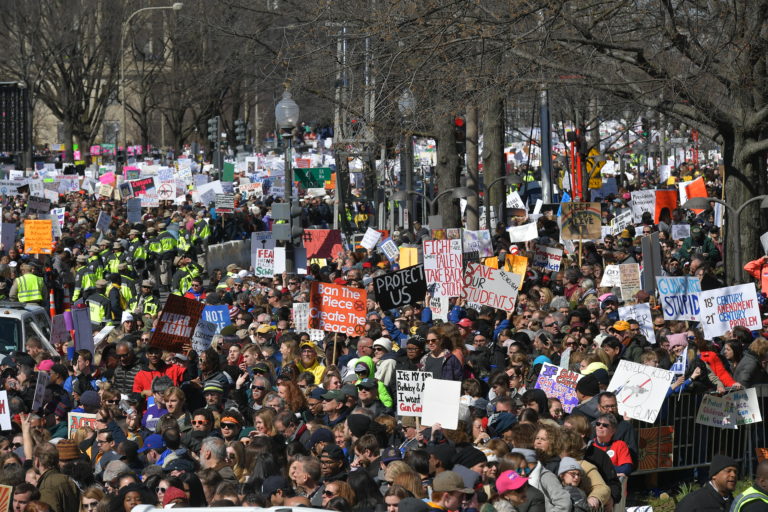
Part of the crowd which showed up for the "March for our lives" in Washington, D.C. two months ago.
No fully conscious citizen can forget how the Parkland #NeverAgain protest movement began with great fanfare three months ago, marking its high point with the "March for our lives" on March 24. The event featured stirring speeches from a number of the students whose Parkland FL school was the scene of the worst ever mass shooting for a high school. In one of the first speeches, Marjory Stoneman Douglas senior Delaney Tarr told the crowd of the students’ demands, including background checks and a ban on assault weapons.
“When you give us an inch, that bump stocks ban, we will take a mile. We are not here for breadcrumbs, we are here to lead.”
Before her D.C. march appearance, Ms. Tarr appeared a number of times earlier, including on CNN, and MSNBC, warning NRA-backed politicos that "we are coming after you". She achieved much prominence, as did the other Parkland students - including Emma Gonzalez, David Hogg, and Cameron Kasky - based on their poise, knowledge and ability to articulate the anxieties of millions of kids nationwide, trapped in an out of control gun culture. (An estimated 300 million guns are possessed by a minority of U.S. citizens.)
Parkland student Jordan Khayyami, 15, warned: “I think that legislatures should be aware that the next generation of voters is right in front of them so if they don’t want to promote change then we will vote for change.”
The scenes of hundreds of thousands of activated students was overwhelming to many of the victims of earlier gun violence, including Mark Barden, whose seven-year-old son Daniel was one of the 20 children murdered at Sandy Hook in 2012, Barden told a reporter from the UK Guardian:
“I did not expect this. I’m still astounded,. To me, it looks like our entire nation is finally on board, on the right side of this issue. It’s so inspiring and encouraging and overwhelming, and beautiful to me.”
The students - including speakers from other gun-victimized high schools, e.g. in D.C., Maryland, Chicago, also took time to set up voter registration booths, to prepare as many 18-year olds and others eligible to vote this year as possible.
But what has transpired since the last marches in April? Not much, and this bespeaks why the #Never Again movement may now be running out of steam. This also highlights the bane of too many incipient mass movements that begin with energetic protests but soon expire - especially in the modern era (including "Occupy Wall Street"). The cautionary note being that even the most sensational mass marches and activism are often interpreted in hindsight as merely temporary shows of enthusiasm.
Indeed, as we discovered in the 1960s, it is extremely difficult to translate march protests into sustained mass movements that can change history. In fact, for most of American history - going back to the "Wobblies" in the 1920s and even before - it was understood that movements required months or even years of planning and effort as well as determined commitment. It couldn't simply be a case of rousing the masses to concerted action, then say going off to college and forgetting about them, or assuming they will organize on their own.
This is why starting in the mid 1960s one was often asked to be part of "the movement", which was understood to mean committing your heart, mind and soul to the work at hand and then showing up whenever and wherever bodies were needed. That included not only in march protests like the kids from Parkland put on, but also appearing in Southern diners alongside African American students - say in Birmingham or Jackson, Mississippi in the fall of 1964, or on buses as "Freedom Riders".
I learned early at Loyola, in September, 1964, at a rapidly- called meeting by the Loyola chapter of the Congress for Racial Equality (CORE) that I was not cut out for such commitment. I came out of curiosity to the meeting, held at nearby Tulane - with about 35 other Loyola freshmen - expecting to learn ways we could contribute. But when we were told we needed to board buses that weekend to go to Montgomery, Alabama as "Freedom Riders", many of us balked. For me it was a matter that I'd just commenced my college first year and was on scholarship - which I didn't want to risk. For others, it was that they simply didn't feel the amount of time needed was feasible. For others, it was a fear of actual physical harm since we'd already read of Freedom Riders being beaten and buses set on fire.
As it turned out, those who joined the CORE campaign were not seen at Loyola from the next year. The word was most had either dropped out to join the movement full time, or had been injured, or flunked out and left. This brings us to the #Never Again movement.
Recall how two beat writers (Arian Campo-Flores and Nicole Hong) on the staff of The Wall Street Journal wrote a stirring article ('From Shooting To Gun Control Movement') of why these Stoneman Douglas students were different, noting:
"The students at Stoneman aren't like those who witnessed previous mass shootings at Columbine High School in 1999, or Virginia Tech in 2007. They are digital natives, at one with the language and power of smartphones and social media. That is one reason why the movement they started, dubbed #NeverAgain, has become a nationwide phenomenon in barely a few days, and shows signs of becoming the kind of campaign success that a company or politician can only dream of."
This and similar media pieces naturally spawned vast expectations. It prompted the expectation - especially after a number of states had enacted new gun laws in response - that this was just the beginning. But one little element appeared to escape the attention of the movement optimists: Most of the Parkland activists were Stoneman Douglas seniors who were now in the midst of Advanced Placement preparations (the AP Calculus test, for example, was last Tuesday a.m.) and are going off to college. How then can the needed motivation and commitment be sustained if one must take on intense, new obligations? As many of us learned in our first year at Loyola, it can't. You can't honor two masters at the same time. If you honor your education with first priority you have to let full commitment to the movement go.
This is what Parkland's ambitious student activists are now learning and the rest of us as well. That is, just dispatching social media texts from an office and organizing to show up on the streets and in schools, does not necessarily presage a movement or earn you enduring credit. While jump starting a movement is easy, making it stick is a helluva lot more difficult - especially to translate into concrete change.
Make no mistake the latter has been achieved by the Parkland kids and victims, in terms of new state gun laws (see previous post), but much more could still be done - especially mustering the numbers to get 18 years registered to vote for the mid terms. Who will see this through? What is possible, of course, it that the younger Stoneman Douglas students, e.g. 15 year old Jordan Khayyami and 16 year old Morgan Williams, can now take up the banner from their older peers.
If they don't, or can't - say because of time constraints or academic priorities - then the #Never Again movement that held so much promise three months ago, may now founder on the rocks of lower energy and inattention.

