Wednesday, August 3, 2022

The Catastrophe Implicit In A World With 5 Billion More People Than It Can Support


"The recent report that informed us that in November of this year the population of the Earth will reach 8 billion is not good news. And those who regard it as such should be treated for Tik Tok brain. The Secretary General of the United Nations of all people, said that welcoming our eight billionth person was an occasion to celebrate our diversity.  Yeah, how wonderful people of all races will be contributing to an already unsustainable carbon footprint and choking and starving equally." - Bill Maher in last segment of New Rules on HBO Real Time Friday Night.

Bill McGuire’s latest book, Hothouse Earth, could not be more timely as we approach the 'official' announcement (by the U.N.)  of 8 billion earthings in November.   This horrific "milestone" of humanity's path to perdition was cleary called out as such by Bill Maher in his New Rules Friday Night, e.g.

New Rule: Let the Population Collapse | Real Time with Bill Maher (HBO) - YouTube

Maher does a superb job encapsulating in five minutes why 8 billion people on this finite world is madness and I recommend every blog reader view it.  I especially enjoyed how he put down a numbskull named Matthew Yglesias  ('One Billion Americans') , writing in New York magazine that the U.S. has more than ample space.

Maher made verbal mincemeat out of his nutso claim by noting - as I have in an previous post, e.g.

Meet Another Overpopulation Crackpot...Errr Advocate (Matthew Yglesias) Who Insists The U.S. Can Hold 1 Billion People 

That having a huge population is about more than about space, but also the resources to support it, especially water (which is now disappearing everywhere in the drought -ravaged West where Lake Mead may reach 'dead pool' level by 2024).  See e.g.

Rapid intensification of the emerging southwestern North American megadrought in 2020–2021 | Nature Climate Change

 But see, idiots and ignoramuses like Yglesias just like to toss out B.S. and bollocks for the sake of click bait for their pieces, they could care less about facts.

Maher also kids the twit about placing millions in North Dakota, 

"What are all those millions in Greater Bismarck going to eat, Soylent Green?"

Plenty of space in ND for sure, but does Yglesias really think people will be beating down the doors to get into that flyover state?  Hell no.  Maher also to his credit points out that it would take five - count 'em FIVE Earths - to support 8 billion people if all want to live like Americans do now.  Which is to say with 330m people gobbling up 1/6 the planet's resources each year.  (A Dept. of Agriculture report in 2018 forecast the average American would consume 222.2 pounds of meat and poultry in the course of the year - more than twice the amount of meat eaten by the average person on the planet.)

Even without that insane aspiration of a global U.S. standard of living we are currently consuming the resources equal to 1.8 Earths a year, catapulting to a point called "overshoot" e.g.

The interpretation of the graph is simple. By June, 2030 TWO full Earths -  the resources therein - will be needed to support the then population. Already we are at 1.8 Earths. Every year Global Footprint Network raises awareness about global ecological overshoot with its Earth Overshoot Day campaign. Earth Overshoot Day is the day on the calendar when humanity has used up the resources that it takes the planet the full year to regenerate. What is so difficult about grasping the concept of "overshoot"?  Actually nothing. Unless, that is, one has zero concept of limits. In this case, the limits of a nation - or a planet- to provide for all its inhabitants.  Hence, the need to limit population because we inhabit a limited planet, not an infinite one.   Therein lies the crux of solving the population problem.  Ans.  There isn't any unless one supports neverending growth.     What is the above graphic  telling us?  Easy!  We do not NEED any more people on this planet! Or...in the US of A.

For all the talk of wind and solar energy fossil fuels supplied 84 % of the world's energy in 2019.  Part of the reason for this has been the emergence of middle classes in China and India - who want every single goodie, amenity, food option, household space his counterpart in the U.S. has.  All of which require intense energy as is only found in oil and gas to supply.

Meanwhile McGuire, who is emeritus professor of geophysical and climate hazards at University College London, makes clear in his uncompromising depiction of the coming climatic catastrophe, we have basically blown it. We should have been massively using artificial birth control worldwide to limit the population to 6 billion, no more. Even that is nearly double the limit science writer Isaac Asimov once advocated. 

In his February, 1976 lecture in Queen's Park Theater, Barbados, e.g.

Asimov defined carrying capacity thusly: 

(usable land-water resource base providing water + food + fuel) / (individual food, fuel + water requirement)
If the numerator is 
 »  11.4 x 10 9  hectares of usable aggregate equivalent land-water resource base and if 4 hectares is the ideal "mean individual requirement" over a lifetime (e.g. to meet all basic needs and have a few private luxuries) , that means:

CC = (11.4 x 10 9   hectares) / 4 hectares/person » 2.85  billion

That is a figure we are now on the verge of surpassing by a factor of four.

 Because we've played the fool for far too long, allowing the human population to explode beyond the capacity of the planet to support it, we are going to pay a heavy price for our complacence. This will not only be  in the form of storms, floods, droughts and heatwaves - that will easily surpass current extremes - but in societal breakdowns in countries worldwide.  Including possibly in the U.S. where we already got a minor 'taste' with the Jan. 6, 2020 insurrection.

As pointed out by Michael Shermer (2015 book, 'The Moral Arc Of Science')  too many people means too much strife and competition for scarce resources, and hence a deformation of humanity's moral arc.  Citing this work in her essay in Free Inquiry magazine (Dec. 2021), Karen Schragg observes:

"Morality - encompassing such values as equal treatment under just laws, equal job opportunity, equal access to healthy food, equal access to potable water is profoundly threatened by the far -reaching implications of overpopulation."  

Adding:

"Simply put, whenever demand exceeds supply there will be immoral scramble to get one's fair share."

We all beheld this at a micro-level in early 2020 when fights broke out in super market aisles over limited toilet paper rolls- when the first supply shocks hit after the pandemic began.  Now try to imagine major food supply shortages  and the mad scramble to "get one's share".  This is why Asimov - as well as Shermer and Ms. Schragg - could see that overpopulation is a roadblock to any kind of moral progress. To put it bluntly, in a scarcity environment incepted by too many mouths to water or feed, ethics and morality are the first to go.  The "moral arc" is destroyed or blunted severely, and it is "survival of the fittest" to use the phrase of the Social Darwinists.

Even as I write this law and order has almost completely collapsed in Haiti where roving gangs are increasing their chokehold on Haiti’s capital, using bulldozers to raze entire neighborhoods, overwhelming poorly armed police and taking their violence to within blocks of the seat of government.

Although Haitians have endured relentless bloodshed and tragedy for years, the escalation of lawlessness in recent weeks and the government’s inability to exert control has terrified the nation. Over nine days in July, more than 470 people were killed, injured or missing as a result of gang warfare in Cité Soleil, the country’s largest slum, according to the United Nations.


 As gangs expand their territory and are now close to the presidential palace, interior ministry, the central bank and the national penitentiary, where hungry prisoners are threatening to riot, officials warn. In Cité Soleil, home to about 300,000 people, gangs fighting for control are gang-raping women and girls, killing at random and using bulldozers to topple homes, according to residents.


Things are no better in Sri Lanka where its president has already fled the country as mobs took over the seat of government, see e.g.


What to know about the protests against the Rajapaksa family in Sri Lanka - The Washington Post


Meanwhile civil upheaval, gang violence, rapes and terror continue to plague many nations in sub-Sahara Africa with the continent already exceeding 1 billion in population.  All signs continue to point to ever more global violence as the crunch of human numbers and pressure on limited resources - not just water, but food and fuel, continues unabated.


One of the primary culprits, of course, in the ceaseless addition to destitution and overpopulation - driven violence is the Roman Catholic Church - on account of it criminal anti-birth control dogma.  This is why the science writer Arthur C. Clarke labeled Pope John Paul II a 'dangerous man' , i.e.


See Also:


And:


 "To Breed Or Not To Breed?" The Answer Ought To Be Obvious By Now!

Solutions To Tensor Algebra Problem

 In a certain rectangular coordinate system, the directions of whose axes are given by the unit vectors i, j and k, the inertia tensor of an object is given by:

I = K x= 

(1….0…..0)

(0….1…..1)

(0….1… ..1)

a) What are the principal moments of inertia of the object (the moments of inertia along the principal axis) relative to the origin of the above coordinate system?

b) What is the direction of the principal axis corresponding to the principal moment of inertia and equal to K?

c)If the origin of the above rectangular coordinate system is at the center of mass of the object and the total mass of the object is M, what is the change in the inertial tensor of the object if the rectangular coordinate system is displaced parallel to itself a distance ro in the direction


 (1/ Ö2)j +  (1/Ö2)k?


Solutions:

a) We have:  I = K x 

(1….0…..0)

(0….1…..1)

(0….1… ..1)

 We write out the determinant with eigenvalue  l:

(1 - l….0…..0)

(0….1 - l   ..1)

(0….1… ..1 - l)

Leading to the characteristic equation:

(1 - l)3 – (1 - l) = 0

Factoring:

(1 - l) [ ((1 - l)2 – 1] = 0 

Or:

(1 - l) (l2 –  2l) = 0

Yielding eigenvalues: l= 0, l = 2

Then:

T = Kl,  so:  T1 = 0, T2 = K, and T3 =2K

Or: (0, K, 2K)  for the principal moments of inertia.

b) We have to take:  (I – T1)C

So that:

=

 (0….0…..0) (x)

  (0….0…..1) (y)

  (0….1… ..0) (z)   =   0

 Finally:  0  =

(0)

(z)

(y)  

 Where ‘0’ for the x  element in column matrix implies the direction is i.

c) By the analog of the parallel axis theorem:

I o = IG -   M(R2 I – RR) 

D I =  I o -  IG   =    M(R2 I – RR)

RR =   

And:

D I =   

Finally:  D I =


Tuesday, August 2, 2022

Religion's Not Really Dying? Who You Gonna Believe Two WSJ Religious Op-Ed Writers - Or Your Common Sense?

 According to WSJ op-ed contributors Byron R. Johnson and Jeff Levin (Religion Is Dying? Don’t Believe It  p. A12, July 30) 

"Reports of religion’s decline in A m e r i c a have been exaggerated. You’ve heard the story: Churchgoers are dwindling in number while “Nones”—those who tell pollsters they have no religious affiliation—are multiplying as people abandon their faith and join the ranks of atheists and agnostics. Headlines declare that the U.S. is secularizing along the lines of Europe. From Britain’s Daily Mail in 2013: “Religion could disappear by 2041 because people will have replaced God with possessions, claims leading psychologist. These conclusions are based on analyses that are so flawed as to be close to worthless. In a new study with our colleagues Matt Bradshaw and Rodney Stark, we seek to set the record straight.

Data from five recent U.S. population surveys point to the vibrancy, ubiquity and growth of religion in the U.S. Americans are becoming more religious, and religious institutions are thriving ”

Of course, data of whatever denomination are only as valid and useful as the interpreters who parse it.  In this case, these two clowns wouldn't know a 'religion' from a rhinoceros.  Hence, Amanda Marcotte in her recent Salon piece is quite correct when she writes:

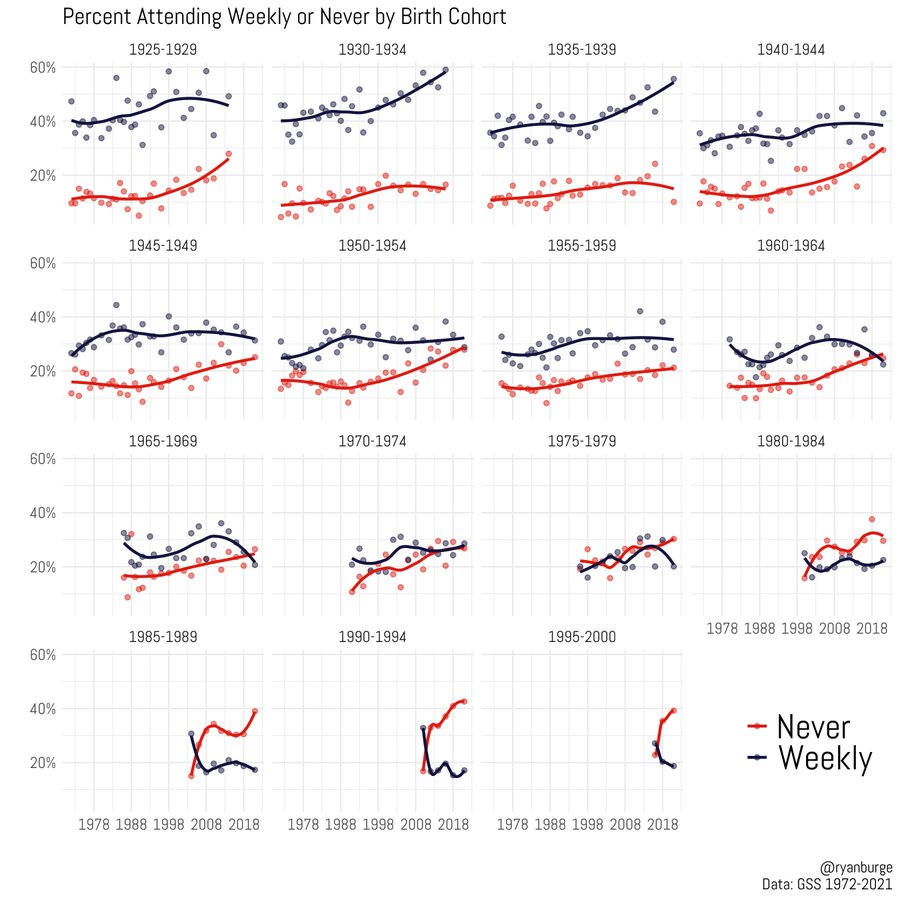
"There can be no doubt about it: Religion, especially Christianity — while still powerful in American culture — is in decline. Fewer than half of Americans even belong to a church or other house of worship. Rates of church attendance are in a freefall, as younger Americans would rather do anything with their precious free time than go to church. As religion researcher Ryan Burge recently tweeted, "Among those born in the early 1930s, 60% attend church weekly. 17% never attend. Among those born in the early 1950s, 32% attend weekly. 29% never attend. Among those born in the early 1990s, 18% attend weekly. 42% never attend."

Don't just take mine or Amanda's word for it, dig into the data yourselves e.g.

So how do Johnson and Levin pull their positive spin out of such miserable data? Well, by the tried and true technique (fallacy of equivocation)  of re-defining what constitutes acceptable definitions or terms applied to religion,  e.g. as when they write:

"Hundreds of new denominations have quietly appeared, as have thousands of church plants (new congregations) and numerous non-Christian religious imports. These more than make up for losses from mainline Protestant denominations, which are indeed in free fall and have been for decades."

Well, no shit, Sherlocks! Of course, when you expand the constellation of "religion" to encompass hundreds of new sects and cults - excuse me, denominations-   as well as "non-Christian religious imports"  ( e.g. Santeria, Wicca etc.) you will inflate your side's numbers.  But it's bogus.  Peeling back their bunkum one finds the argument that any theism will work to support a religion, even if that means multiple gods.  This leads to the core question asked by all thinking people and certainly atheists - as articulated by James T. JHouk in his superb monograph 'The Illusion of Certainty-  How The Flawed Beliefs of Religion Harm Our Culture' p. 52:  "Why do literally thousands of religions and religious groups exist - a number that increases through time" 

If only one divine entity supposedly exists?  In other words, the very idea of thousands of religions destroys the putative basis of religion as an overarching, self- consistent belief system.  The two WSJ author very citation of "thousands of denominations"  confirms this, despite - as Houk asks 'Why do beliefs, dogmas and truths vary so much from one religion to another?"

Indeed, Houk points out there is not one single, solitary dogma or belief that has attained the status of global acceptance. Even Roman Catholicism - not just the laity - disagree over the meaning of the virgin birth, the Trinity, and even the resurrection:

 We're not even including here actual divergences on teachings supposedly universal, such as against artificial contraception.  Take this beyond the RCs and search all the supposed faiths for commonalities of belief and it quickly degenerates into absurdity.  In other words, the vast disparity of beliefs - as well as in entities worshipped- quickly makes a sham of any coherent meaning of religion.  But if one is hidebound to go that route,  to say this or that about religion- say in the U.S. - the only common sense approach would be to stick to what's happening to the mainstream ones - which these two stalwarts fail to do. 

These miscreants - Levin and Johnson -  even attempt in their sideways sophistry to include atheists in their inflated definition of those adhering to religion. As when they write this codswallop:

"According to the 2018 General Social Survey, 6.4% of self-described atheists and 27.2% of agnostics attended religious services monthly or more; 12.8% and 58.1%, respectively, prayed at least weekly; 19.2% and 75% believed in life after death; and 7.3% and 23.3% reported having had a religious experience."

Never mind the basis for the apparent anomaly or contradiction has already been explained here:

Atheists Who Go to Church: Doing It for the Children - ABC News

Wherein we learn:

A new study out of Rice University has found that 17 percent - about one out of five scientists who describe themselves as either atheists or agnostics - actually go to church, although not too often, and not because they feel a spiritual yearning to join the faithful.

More likely, it's because of the kids.

What?  Why would somebody who doesn't believe there's a god want his own offspring wasting their time in an enterprise he believes has no foundation in fact?  Especially a scientist. 

The study, by sociologists Elaine Howard Ecklund of Rice and Kristen Schultz Lee of the University at Buffalo, found that many atheists want their children exposed to religion so that they can make up their own minds on what to believe.  In addition, church may provide a better understanding of morality and ethics, and occasionally attending services may ease the conflict between spouses who disagree over the value of religion to their children, the study contends.

The above study is spot on and I can say that nearly all the atheist colleagues I've known - as in the American Astronomical Society - were reluctant to expose their children to unbelief, even in their own actions, lives. They also sought to avoid conflict with their more religious spouses.   As one researcher from the AAS Dynamical Astronomy division confided to me at a conference back in 2008, "The problem with religion is that its base ideas are  so much easier to understand. Especially for kids."

This was reiterated in an essay about "ensoulment" in the August-Sept. Free Inquiry, p. 27.   

"The problem with every religious idea is that it's simple whereas the real world is complex. Ensoulment is so simple a child can understand it. 'Grampaw's watching over you from heaven, honeybunch'"

Thus, a human gets conceived and presto magico - a "soul" is instantly infused into his proto-cellular form.  At some point, many decades later, the 'ensouled'  physical system breaks down and the "soul" leaves the corpus behind as it wings it way heavenward.   What kid would not want to believe that as opposed to life being based on a million random agents acting in concert?  Or a real world model for consciousness which more fits the facts, e.g.

Wherein I note:

We can simplify what the Self is right away, by dropping the concept of "soul". It is ultimately, a vacuous Macguffin and non-entity existing only in human brain neurons as synaptic excitations. Thus, there is no immaterial soul on which most religions rely. As (Julian Baggini) writes:

"Whatever stuff you are made from is the same kind of stuff that everything else is also made of"

This is a radical concept more in tune with what modern neural science has found, but woe betide you if you try to impart it even to a high IQ kid. But as author Hark Fox puts it (ibid.): 

"The complexity of consciousness, the functioning of those processes that produce it, cannot be imprinted onto an invisible, undetectable 'soul'. any more than it can be imprinted onto a pile of leaves - or a section of concrete wall."

The reason, of course, is because consciousness requires a material substrate. It is preposterous to presume an immaterial, invisible 'controller' sits behind the eyes working some kind of magic. It is childish rubbish, but what most religionists believe.  Especially it is easy to have immature minds - as in children's, consume it - like Santy Claus.  Religionists get away with peddling this rubbish because: a) they never advance claims that are falsifiable, and b) they know most Americans will gravitate to their 'ensoulment' codswallop much more readily than a complicated, multilevel model that's more faithful to neural science, i.e. reality.

 Therein lies precisely the hook of religion and what makes it addictive for too many who have given up critical thinking or even basic inquiry.  It is also what enables feeble sophistry to be presented in papers like the WSJ, making the claim religion isn't dying and atheists and agnostics are really religionists in disguise.  (Based on absurdly expanding the definition of religion, and ignoring salient facts to do with atheists, i.e. wanting their offspring to make their own choices - so allowing some  exposure to bunkum like ensoulment.)

We should always be aware that religionists and religious promoters - like Johnson and Levin - will seldom miss an opportunity to  try to blur distinctions in order to promulgate their discredited brand of supernatural malarkey. We should also understand that religion's pushers never ever hold themselves accountable or subject their wacko beliefs to any standards of objective proof.   Which is why they're able to get away with spreading so much nonsense.


See Also:

And:

You don't have a soul: The real science that debunks superstitious charlatans | Salon.com

And:

Monday, August 1, 2022

"Biden Inflation" To "Biden Recession"? - Never Mind The Reepos' Desperate Semantic Tricks & Gnashing Of Teeth

The Wall Street Journal front page article Saturday  (Inflation, Slowdown Point to Bumpy Economic Transition) was clear on what is happening now in the U.S. economically:


"The U.S. economy is enduring a rocky transition from an exceptionally strong recovery to a steep slowdown, data this past week showed, as rising inflation and interest rates weigh on consumers and businesses. Economic growth surged last year, as consumers unleashed spending and businesses recovered from the short, deep pandemic recession of early 2020. But that robust growth is grinding to an abrupt halt as households, companies and policy makers face deep challenges..."  


This is a  fairly accurate assessment of what's going on now with the U.S. economy and as even WSJ columnist Greg Ip (p. A2, same issue) writes:


 "Whether a recession is eventually declared, the message from the latest economic data is just as sobering: The recovery is, effectively, over. To be sure, the second-quarter decline in inflation-adjusted gross domestic product was a bit misleading. Inventory destocking explains all of the decline, as it did for the first-quarter drop in GDP. Employment is still growing."


In other words, given the last critical marker - and as CBS economist Jill Schlesinger noted last Friday-  this does not meet the definition of a recession. But never mind! The Reepos are in a frenzy to tag on the next meme "Biden Recession" i.e. from the same WSJ front page piece:


"Republicans of course seized on the GDP figures, along with elevated inflation, to argue the administration is trying to redefine what a recession is and playing down signs of an economic slowdown. 'Joe Biden’s recession is here. The American people are saying it even if the White House won’t', said Sen. John Barrasso (R., Wyo.),"


But Barrasso is an 'Asso'.  So eager are these  scumballs to use any disinfo tool to fog Americans' brains and grab power in the midterms.  Do not fall for it. We cannot afford to let these lying, conniving traitors and Trump knob polishers back into power!


As for recession, as Nobel winning economist Paul Krugman pointed out in his recent column (NY Times. July 28,  'How Goes The War On Inflation?') :


"The U.S. economy is not currently in a recession. No, two quarters of negative growth aren’t, whatever you may have heard.  The “official” or “technical” definition of a recession; that determination is made by a committee that has always relied on several indicators, especially job growth. And as Jerome Powell, the chair of the Federal Reserve, noted yesterday, the labor market still looks strong."


But never mind objectivity. Republicans are desperate to distract attention from the J6 hearings, make no mistake, and their yen is especially to claim the House back so they can begin a string of bogus hearings.  Think 3 years of the Benghazi circus was bad?  Wait until you behold blowhard asswipe Jim Jordan presiding over  "hearings"   and "investigations"  to try to discredit the January 6 Committee.  


Am I just writing this to defend the Dems and Biden in the wake of further Reeptard pile on? Well partly, yes.  But let us please get two other points clear:


1)  With millions of Americans in a funk and nearly deranged over soaring inflation something had to be done to put on the brakes.  Hence, the Fed raising interest rates.  The natural consequence of this is an economic slowdown which means slowing the consumer demand that drives inflation.


2) We for sure may be headed for recession, but are not there yet, and likely will not be for at least another year. Don't forget that in the wake of the 2008-09 financial crisis no recession was officially declared until after the Obama administration had secured the $780 b stimulus package in late 2009- which likely saved us from a depression.


Regarding the GDP and how it's falling, other points can be made, especially - as I've written earlier. Namely that GDP is a terrible gauge for productivity.   One which another Nobel winning economist (Joseph Stiglitz) said was "mismeasuring our lives." 


GDP is supposed to measure the total production and consumption of goods and services in the United States. But the numbers that make up the Gross Domestic Product by and large only capture the monetary transactions we can put a dollar value on. Almost everything else is left out: old growth forests that maintain cooling and act as CO2 repositories, watersheds, animal habitats, e.g. the Everglades, and costs of infrastructure maintenance. But ALL of these count toward  the physical security and welfare of a society. If bridges collapse owing to maintenance failure and hundreds or thousands of drivers are inconvenienced, delayed  - then that has an economic impact!


In addition, there are hundreds of other contributions not registered that arguably have  major economic impacts. For example, a 2015 Forbes article highlighted how 40 million family caregivers in the U.S. are putting their own careers on hold to provide unpaid care — sometimes for decades.   The estimated  total value of the care has been put at nearly $1 trillion. This isn't reckoned into the GDP but IF it were,  the labor productivity would be much higher. 

What to use in place of GDP? The Index of Sustainable Economic Welfare which was first proposed by Eco-economist Herman Daly of the University of Maryland. is a prime alternative  Daly's point was that the GDP was too artificial and narrow an indicator of economic health. He argued that if one incorporated all the "externalities" usually dismissed or ignored by standard economic models, people would be more parsimonious in how they consume which would yield a better world. 

Yes, the U.S. economy is definitely slowing.  But this is basically because the Fed - not Joe Biden -   is deliberately engineering a slowdown to bring inflation down. After all, would you rather have $15 a box corn flakes or eggs 50 cents each like in Barbados?  Be grateful for small mercies!   Yeah, it’s possible that this slowdown will eventually be severe and broad-based including the loss of millions of jobs. But if you must blame something blame the pandemic for its disruption of supply chains, necessitating temporary lockdowns and rabid consumption after the vaccines emerged. 

Desperate for "change" and to see what the Reeps have to offer?  Then before jumping into that cesspool in the midterms consider this note of alarm received today from the National Committee to Protect Social Security and Medicare: 

'Senator Rick Scott - who chairs the committee responsible for helping elect Republicans to the Senate -  has released a plan that would require Congress to re-authorize Social Security and Medicare every five years.  So a future Congress could choose not to renew these programs'.

And by the way, before you're tempted to slap this down with a 'Meh!' - recall a past Supreme Court ruled that neither program is a right.

Meanwhile, blame Republicans for churlishly using misrepresentation and semantic gyrations to make political capital out of Americans' financial misery.

See Also:

by Sonali Kolhatkar | August 1, 2022 - 7:37am | permalink

Excerpt:

“Inflation” is the new buzzword of the year. It is the reason for the Federal Reserve’s interest rate hikes designed to increase the costs of some loans. It is the excuse given against renewing the expanded child tax credit program that briefly lifted millions of American families out of poverty. It forms the name of one of the key pieces of legislation that may salvage President Joe Biden’s first term: the Inflation Reduction Act. And, it is the basis of Republican complaints against Democrats heading toward the midterm elections this fall.

With all this concern over inflation, one wonders why so little heed has been paid to another “i” word: inequality.


And:
by Robert Reich | July 31, 2022 - 6:12am | permalink

— from Robert Reich's Substack

Excerpt

So much economic news (with too much of it mis-reported) that I want to keep you apprised.

Following Thursday’s report by the Commerce Department that the U.S. economy had shrunk for the second quarter in a row, economists in and out of the White House have spent much of the last several days deconstructing the word “recession.”

Are we in one or not? The answer, technically, is no (the independent National Bureau of Economic Research in Cambridge, MA makes that call), but most Americans feel we’re in one because their paychecks have been shrinking. Employers have raised wages a bit, but the costs of energy, food, and much else have been rising faster.


And: