Showing posts with label sidereal period. Show all posts

Wednesday, July 31, 2019

Can You See The "Black Moon" Today? Nope - Just Know It's Occurred


Ok, first the good news: there will be a black Moon occurring all across  North America today,  July 31st -- the first one since 2016.  The bad news? You won't be able to actually see it because all it means is there is a second New Moon.  This is not visible given it is in the position shown in the diagram below:
So, while a 'blue Moon' derives from its rarity - the 2nd full Moon in a month, the  black moon is basically the second new moon of the month.  This is also something that rarely occurs but we use the word 'black' because, well, the Moon's non-sunlit side is facing Earth,  so 'black' to us. Get it?.
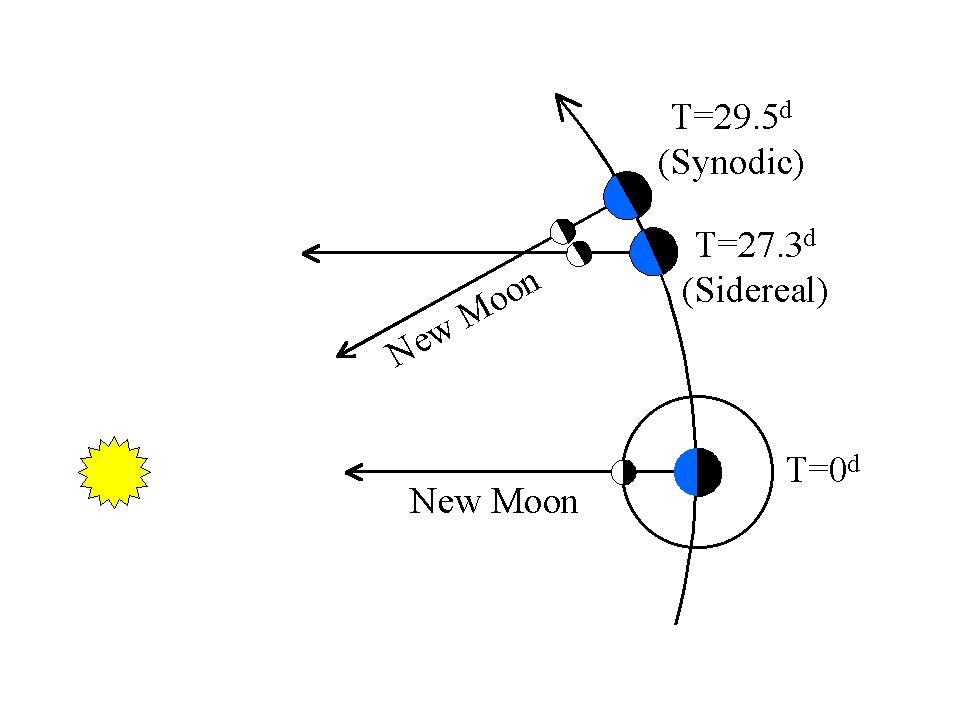
Another aspect to why this is possible lies in the difference between the Moon sidereal period (27.3 days), i.e. referenced to the distant stars, and its longer synodic period (29.5 days) referenced to its position relative to the Sun, or phase.  This difference is captured in the diagram below:
Over the period of the sidereal revolution, then,  Earth and Moon together revolve roughly 1/13 way around the Sun.  This is an angular distance of about 360 deg/ 13 =  27.6 degrees. In effect, the Sun then appears to move 27.6 degrees east on the celestial sphere over the Moon's sidereal revolution.  In other words, the Moon would not have completed a whole revolution about the Sun over the sidereal period.  Consequently it would not have completed a full cycle of phases (e.g. New to New, full to full).  A fractional phase increment is always left over.

 The  slight deviation in position, between synodic and sidereal, means certain observational anomalies can occur over time, and given the lengths of months can vary, i.e. 28 or 29 days for February, and 30 or 31 days for other months. Combine the two effects and you can get two full Moons some months, and also two New Moons, i.e. because the months in the latter cases (31 d) are slightly longer than the Moon's synodic period.
 So about every 32 months we can get two full moons or two new moons. The second full moon in a month is called a blue Moon, and the second new moon is called a black Moon. 

 Oh, by the way, "black Moon" can also refer to no New Moons in a given month!

Tuesday, April 17, 2018

Selected Questions- Answers From All Experts Astronomy Forum (Relative Distances of Superior, Inferior Planets)

Question: Can you explain how one can find the relative distance to an inferior or superior planet, i.e. in the solar system?

Answer:  Let's first define geometrically the inferior and superior planet based on the diagram shown below:


As seen from the diagrams, an inferior planet defines one which is interior to Earth's orbit, relative to the Sun. A superior planet defines one which is exterior to the Earth's orbit.

While  it's easy to apply Kepler's 3rd law to obtain the basic dimensions of an orbit, namely the semi-major axis (a)  of the orbit - or the mean distance from the Sun, things become somewhat more difficult when we seek to find the distance say, of the Earth to the planet.

So, we consider two cases:

(A) Inferior planet (see the diagram A)

(B) Superior planet (Diagram B)

Case (A):

The maximum elongation occurs when the planet's geocentric radius vector (pE in diagram A) is perpendicular to the planet's heliocentric radius vector, pS. Then,  by a careful measurement of the angle SEp, say over a series of nights around maximum elongation, one can obtain a value for the angle of maximum elongation. At such time the angle SEp is right-angled hence:

Sp/ SE = sin(SEp)

The quantity Sp/SE is therefore the distance of the planet from the Sun in terms of Earth units (or AU, astronomical units, where 1 AU = 1.5 x 10¹¹  m). Let Sp = R and SE = a(E) the semi-major axis for Earth's orbit, then:

Sp = R = sin(SEp) [a(E)]

Example:

If the angle SEp = 60 deg, find the planet's distance from the Sun.

Then: sin(SEp)= sin (60) = Ö3 /2 = 0.866

So: R = 0.866[a(E)]= 0.866 AU  

Case (B):

Here, we let the planet p be in opposition at some given time with the Earth and Sun (e.g. showing the alignment S-E-p in diagram (B). As we know, with opposition, the elongation is a straight angle or 180 degrees. Then after t days have elapsed the Earth's radius vector SE has moved ahead of the planet's as shown in comparing SE1 to Sp1. As can be seen, this reduces the angle of elongation from 180 degrees at opposition to angle SE1p1. This is then measured.

Now, over t days, the angle ESp will have increased from 0 (at opposition) to a value Θ given by:

Θ = [n - n(p)] t

where n, n(p) are the mean daily motions of the Earth and the planet, respectively. Using relations for the periods (from the previous answer) we may write:

Θ = 360 (1/P - 1/P') t

where P and P' are the sidereal periods for the Earth and the planet, respectively.  Then, it follows by the synodic/ sidereal relations seen in previous answer. 

Θ = 360 (1/S)

So, since t and S are both known, Θ can be obtained - that is, angle E1Sp1 is calculated. Hence, angle E1p1S can be found from:

angle E1p1S = 180 - angle SE1p1 - angle E1Sp1

From plane trigonometry we then obtain:

sin(p1E1S)/ Sp1 = sin(E1p1S)/SE1

or:

Sp1/ SE1 = sin(p1E1S)/ sin(E1p1S)

Again, giving the distance from the Sun in terms of Earth's distance unit. 


To fix ideas here is a further  example problem:

Estimate the distance of Venus from the Sun at its most recent maximum elongation, if the angle of maximum  elongation was 46 degrees.


Solution:

The diagram is shown below with the angle of maximum elongation.

No automatic alt text available.
We know, from the geometry:

SV/ SE = sin (SEV)

Then Venus' distance is:

SV = (sin(SEV)) SE

where: angle SEV = 46 deg and SE = a(E) = 1 AU

then:

SV = sin (46) 1 AU = (0.719) 1 AU = 0.719 AU


Monday, April 9, 2018

Selected Questions-Answers From All Experts Astronomy Forum (Sidereal and Synodic Periods of a Planet)

Question: Can you please explain the difference between the sidereal and synodic periods for a planet and how they can be computed? Thanks!

Answer:

The sideral period is the time interval for a planet's revolution about the Sun reckoned against the fixed stars. We photograph a planet at point 'x' in its orbit, with the stars determining a specific background format, then again when it reaches the same point x, relative to that background.

Of particular interest also in these computations are what we call the 'mean motions'.  For reference I use the diagram below:
No automatic alt text available.

Let P1 and P2 be the sidereal periods of revolution of two planets  (p1 and p2) around the Sun. Then the mean motions are defined:

n1 = 360 deg/ P1

n2 = 360 deg/P2

where we assume for example, that n1 > n2

in which case the radius vector for the (interior) planet p1 gains on the radius vector for planet p2.

As an example, let us consider the earth (P2 = 365¼ days) vs. Venus (P1 = 224.7 days).

Then:

n2 = 360 deg/ (365¼ days) = 0.985647 deg/day

n1 = 360 deg/(224.7 days) = 1.602130 deg/day

which confirms that a planet nearer the Sun has a smaller period of revolution than one further away so that P1 < P2, and also: n1 > n2.(By virtue of the  SMALLER PERIOD it has a more rapid mean motion.)

And, in effect, in the case above, Venus' radius vector gains on the Earth's by (n2 - n1) degrees per day, or [(1.602130 deg/day) - (0.985647 deg/day)] = 0.61646 deg/day.

By inspection of the diagram let the alignment Sp1p2 denote the positions of the Sun, Venus and Earth at a particular time or "epoch" in the parlance of celestial mechanics. Then, it is clear on the same inspection that one synodic period S will have elapsed by the time the two are in the new alignment Sp1'p2'. So, during the time interval,  Venus'  radius vector (Sp1) will have gained 360 degrees on the Earth's.

Now, since Sp1 gains on Sp2 by 0.61646 deg/day then it gains 360 degrees in a time S =

S x (0.61646 deg/day) = 360 deg

Or: S = 360 deg/ (0.61646 deg/day) = 583.9 days

Which is exactly the synodic period for Venus!

Hence, in general:

S x (n1 - n2) = 360 deg or

S = 360 deg/ (n1 - n2)

Or, by reference to the earlier formulations for the n1, n2 mean motions:

S (360/P1 - 360/ P2) = 360 deg

And:

S = 360 deg/ [360/P1 - 360/ P2]

Or:

1/ S = 1/P1 - 1/P2

In most problem -solving scenarios a planet's period is sought when Earth's is known. The key to the solution lies in determining whether the unknown planet is an inferior one (e.g. interior to Earth's orbit) or a superior one, e.g. exterior to the Earth's orbit. Thus there emerge two cases:

(a) The planet is inferior (like Venus), then P1 refers to the planet's sidereal period and P2 refers to Earth's.

(b) The planet is superior (e.g. Jupiter) then P1 refers to the Earth's sidereal period and P2 to the planet's.


Example Problem:

The synodic period of Venus is found to be 583.9 days. If the length of the Earth's year is 365¼ days, find the sidereal period of Venus:

1/S = 1/P1 - 1/P2

Venus is an inferior planet, so that Earth's period is inserted for P2.

Then:

1/(583.8 d) = 1/P1 - 1/(365¼ d)

Or:

1/P1 = [365¼ + 583.9 d]/ [583.9 x 365¼ ]


yielding P1 = 224.7 days 


Another problem with the roles of P1, P2 reversed:

If the synodic period of Saturn is 1.03513 years, find its sidereal period. 


Solution:

Saturn is a superior planet (orbit exterior to Earth's) so we apply:


1/ S = 1/P1 - 1/P2

but now with P1 = Earth's sidereal period, and P2 = Saturn's. Thus we have:

1/P2 = 1/P1 - 1/S

where S = 1.03513 years

1/P2 = 1/1 - 1/1.03513 = 1 - 0.966 = 0.0339

P2 = 1/ 0.0339 = 29. 4 yrs. 


yielding P1 = 224.7 days

Wednesday, August 17, 2011

Tackling Intermediate Astronomy Problems (2)


Among the more important considerations for serious amateur astronomers concerns the sidereal and synodic periods of the planets, and translating between them. In general, we define the synodic period to mean the time interval for the revolution of a planet as determined from the same phases, which means in turn the same geometrical configurations. (E.g. or between the same configurations, say between the same oppositions, or between "inferior conjunctions" - see Fig.1).

As indicated by a study of Fig. 1(a), a superior planet (say Mars)may appear to to be 90 degrees away from the Sun in the sky. Therefore, a line from Earth to the Sun makes a right angle with the line extending from Earth (E) to the planet. A planet in this configuration is said to be in quadrature. (The planet rises or sets at noon or midnight).

If the superior planet's on the other side of the Sun fomr Earth, it's then in the same direction from Earth as the Sun and is said to be in conjunction. (For the inferior planet, e.g. Venus in Fig. 1(b) the same direction implies inferior conjunction).

Another aspect or configuration is referred to as elongation. This is just the angle formed between the Earth-planet direction and the Earth-Sun direction. In other words, this elongation is the angular distance from the Sun as seen from the Earth. In the case of the inferior planets (such as Venus and Mercury) one will have a maximum western elongation, and maximum eastern elongation, as shown.

Note also that a superior planet at conjunction has an elongation of 0 degrees, and ditto for the inferior planet at inferior conjunction. Meanwhile, the superior planet has an elongation of 180 degrees at oppositon, and 90 degrees at quadrature. An inferior planet, as can be discerned from the geometry in 1(b), can never ever be at opposition. It can, however, be at superior conjunction, when it is on the opposite side of the Sun from Earth.

The sideral period is the time interval for a planet's revolution about the Sun reckoned against the fixed stars. We photograph a planet at point 'x' in its orbit, with the stars determining a specific background format, then again when it reaches the same point x, relative to that background.

Of particular interest also in these computations are what we call the 'mean motions'. Let P1 and P2 be the sidereal periods of revolution of two planets around the Sun, then the mean motions are defined:

n1 = 360 deg/ P1

n2 = 360 deg/P2

where we assume for example, that n1 > n2

in which case the radius vector for the (interior) planet p1 gains on the radius vector for planet p2.

As an example, let us consider the earth (P2 = 365¼ days) vs. Venus (P1 = 224.7 days).

Then:

n2 = 360 deg/ (365¼ days) = 0.985647 deg/day

n1 = 360 deg/(224.7 days) = 1.602130 deg/day

which confirms that a planet nearer the Sun has a smaller period of revolution than one further away so that P1 < P2, and also: n1 > n2.(BY VIRTUE OF THE SMALLER PERIOD IT HAS A MORE RAPID MEAN MOTION!)

And, in effect, in the case above, Venus' radius vector gains on the Earth's by (n2 - n1) degrees per day, or [(1.602130 deg/day) - (0.985647 deg/day)] = 0.61646 deg/day.

By inspection of Fig. 2, let the alignment Sp1p2 denote the positions of the Sun, Venus and Earth at a particular time or "epoch" in the parlance of celestial mechanics. Then, it is clear on the same inspection that one synodic period S will have alapsed by the time the two are in the alignment Sp1'p2'. So, during the time interval S1 (for Venus) its radius vector will have gained 360 degrees on the Earth's.

Now, since Sp1 gains on Sp2 by 0.61646 deg/day then it gains 360 degrees in a time S =

S x (0.61646 deg/day) = 360 deg

Or: S = 360 deg/ (0.61646 deg/day) = 583.9 days

Which is exactly the synodic period for Venus!

Hence, in general:

S x (n1 - n2) = 360 deg or

S = 360 deg/ (n1 - n2)

Or, by reference to the earlier formulations for the n1, n2 mean motions:

S (360/P1 - 360/ P2) = 360 deg

And:

S = 360 deg/ [360/P1 - 360/ P2]

Or:

1/ S = 1/P1 - 1/P2

In most problem -solving scenarios a planet's period is sought when Earth's is known. The key to the solution lies in determining whether the unknown planet is an inferior one (e.g. interior to Earth's orbit) or a superior one, e.g. exterior to the Earth's orbit. Thus there emerge two cases:

(a) The planet is inferior (like Venus), then P1 refers to the planet's sidereal period and P2 refers to Earth's.

(b) The planet is superior (e.g. Jupiter) then P1 refers to the Earth's sidereal period and P2 to the planet's.


Example Problem:

The synodic period of Venus is fond to be 583.9 days. If the legnth of the Earth's year is 365¼ days, find the sidereal period of Venus:

1/S = 1/P1 - 1/P2

Venus is an inferior planet, so that Earth's period is inserted for P2.

Then:

1/(583.8 d) = 1/P1 - 1/(365¼ d)

Or:

1/P1 = [365¼ + 583.9 d]/ [583.9 x 365¼ ]

yielding P1 = 224.7 days

Other problems:

(1) What would be the sidereal period of an inferior planet that appeared at greatest western elongation exactly once a year?

(2) If the synodic period of Saturn is 1.03513 years, find its sidereal period.

(3) A planet's elongation is measured as 125 degrees. Is it an inferior or superior planet?

(4)If the sidereal period of Mercury is 88 days what is its synodic period?

(5) Calculate the ratio of the Earth's mean motion, n, to that of the planet Neptune, given the distance of Neptune is 30.06 AU. (Hint: You will need to apply Kepler's 3rd or harmonic law, see 'Tackling simple Astronomy problems (6)' to first get Neptune's period!)

(6) A newly discovered planet in the Zeta Reticuli system is found to have a semi-major axis of 10 AU. Compare its mean motion n(z) to that of Saturn (hint: reference solution to Problem #2)