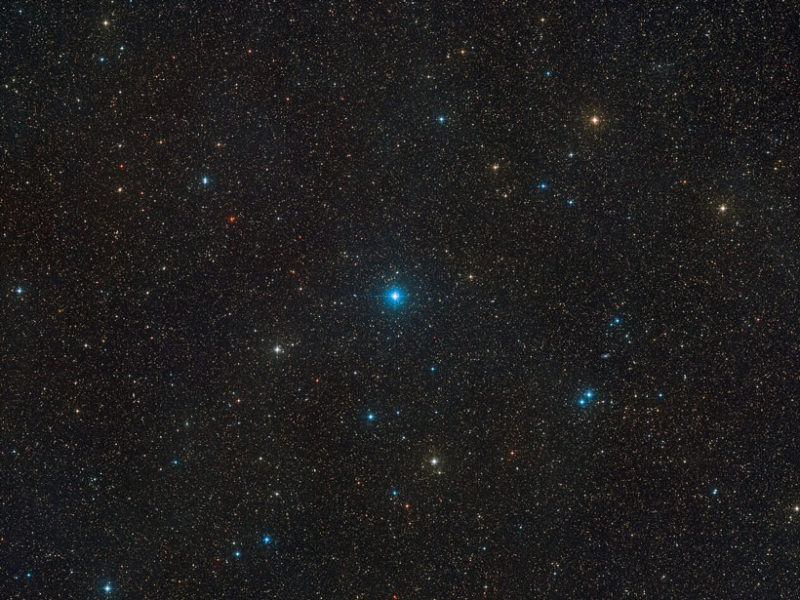
Astronomers deduced the closest black hole to Earth in the constellation Telescopium.
Supermassive black holes—millions or billions of times more massive than the Sun—anchor the centers of most galaxies. We examined how the history of such monsters has been documented in a previous post, based on a presentation at the 236th AAS meeting, i.e.
But we know that smaller (stellar) black holes, i.e. at just a few solar masses, exist and should theoretically be scattered throughout galaxies. A few hundred candidates have been found in the Milky Way, including Cygnus X-1,. Now, as reported in Eos: Space Science Journal, we learn that Thomas Rivinius, an astronomer at the European Southern Observatory in Santiago, Chile, and his team have recently identified another one of these stellar mass black holes. Further, it holds a special importance given it’s the closest black hole to Earth yet discovered. The ESO team's findings also shed light on the dynamics of supernova explosions that create black holes, the team suggested.
Let's be clear it isn't easy to find any of the many black holes that aren’t consuming matter—since they don’t produce X-rays like Cygnus X-1. Sometimes serendipity strikes, however, and the universe aligns itself just right to reveal these "wallflower" black holes. That’s what Rivinius and his collaborators found when they examined HR 6819, a seemingly ordinary pair of stars about 1,000 light-years away in the constellation Telescopium.
In 2004, Rivinius and his colleagues trained a 2.2-meter telescope in La Silla, Chile, on HR 6819. According to Rivinius:
“We thought it was only two stars,”
But to their surprise, they discovered that one of the stars was wobbling in a circle, or "being flung around" in the parlance of Rivinius. That’s the telltale sign of a companion star, a nearby object that’s tugging gravitationally on the observed celestial object. So HR 6819 wasn’t just a pair of stars—it was three objects: one star on a relatively wide orbit and one star paired with something unseen, the team concluded.
The astronomers calculated that the mysterious third object in HR 6819 had to be at least about 4 times the mass of the Sun. Given a star of that mass we know it would generate light to be visible even if it belonged to the dimmest class of stars (spectral class M), Rivinius and his collaborators ruled out fainter objects like white dwarfs and neutron stars because they’re typically of much lower mass. That left only one logical conclusion: The unseen object was a black hole.
That hypothesis based on this deduction languished for several years, however, after tragedy struck unexpectedly: A team member died in a car accident in June 2014. In Rivinius' words: “The study stalled,”. But last year, new results spurred Rivinius and his colleagues to revisit their findings. Another team of researchers had reported finding a black hole using the same method. Rivinius then recalled seeing a press release and thinking, “Wait a second—I have something in the drawer that looks exactly the same.”
Rivinius and his collaborators estimated that the black hole in HR 6819 was about 1,000 light-years from Earth, making it the closest known black hole. Its proximity implied that systems like this one are common. In Rivinius' words (ibid.):
“Our neighborhood is nothing special. If it’s here, it must be everywhere.”
These results were published this month in Astronomy and Astrophysics.
As for the relevance to the dynamics of supernova explosions, the existence of HR 6819 sheds light on how these create black holes. It’s long been believed that such explosions are antisymmetric, meaning they send matter flying preferentially in one direction, with the result that the black hole is launched in the other direction. However, finding a black hole gravitationally bound to a star implies that in some cases, black holes aren’t flung from their birthplaces. That means supernova explosions are sometimes symmetric.
Determining what fraction of supernovas are symmetric versus antisymmetric clearly requires a larger sample size for these less massive black holes. According to Todd Thompson, a theoretical astrophysicist at the Ohio State University in Columbus not involved in the research, that is entirely possible. In his words (ibid.):
“There are probably a million black holes in the galaxy that have binary companions that are stars. That’s a very big sample that we should get busy trying to understand.”
Indeed. And if black hole astrophysics is to progress it means the dynamic problems associated with the initiating supernova explosion are essential to solve. This will requires excellent observations in tandem with improved theoretical astrophysics.
See Also:
https://www.nationalgeographic.com/science/2020/05/closest-black-hole-to-earth-found-hiding-in-plain-sight/
